
Designing Your Bespoke Galvanized Iron Floating Pontoon: A Comprehensive Engineering Blueprint
Achieve a robust 1.2m x 5m pontoon with 0.3m freeboard and 1000kg load capacity through precise design and material selection.
Constructing a galvanized iron floating pontoon to your specifications—1.2 meters wide by 5 meters long, with a 0.3-meter freeboard and a 1000 kg load-carrying capacity—requires careful attention to buoyancy, structural integrity, material selection, and safety. This guide synthesizes key engineering principles to help you realize a durable and effective design.
Key Design Highlights
- Precision Buoyancy Engineering: Accurate calculations are paramount to ensure the pontoon supports the 1000kg designated load plus its own structural weight, all while maintaining the critical 0.3m freeboard for safety and performance.
- Robust Galvanized Steel Framework: Utilizing hot-dip galvanized steel for the primary structure offers exceptional strength and longevity. Adherence to standards like BS EN ISO 1461 for galvanization is key to maximizing corrosion resistance, especially in marine environments.
- Holistic Stability and Safety Design: A well-thought-out design considers even load distribution, optimal pontoon geometry, and potentially includes features like internal compartmentalization to enhance stability and safety on the water.
Fundamental Design Parameters
The foundation of your pontoon design rests on clearly defined parameters:
- Overall Dimensions: 5.0 meters (Length) x 1.2 meters (Width)
- Required Freeboard: 0.3 meters (This is the vertical distance from the waterline to the top edge of the pontoon deck when fully loaded)
- Design Load Capacity: 1000 kg (This is the external load the pontoon must support, in addition to its own weight)
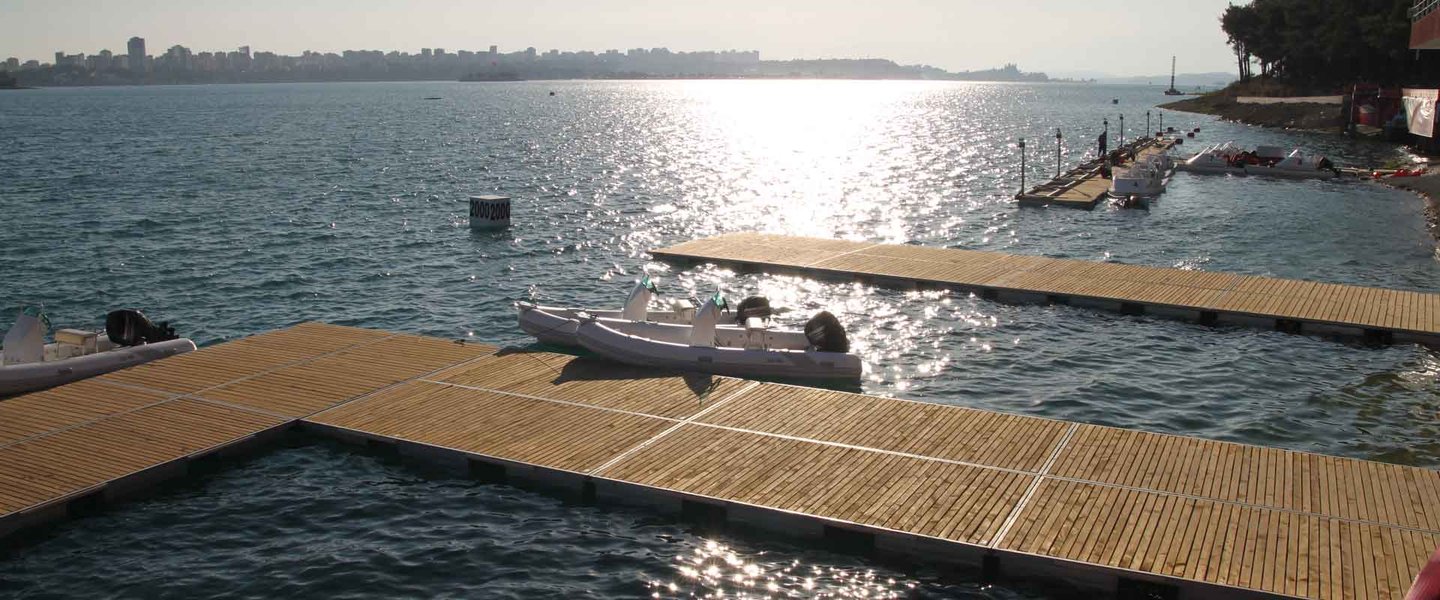
Typical appearance of a floating pontoon dock in use.
Material Selection: The Core of Durability
Primary Structural Material: Galvanized Iron (Steel)
Hot-dip galvanized steel is the material of choice for the pontoon's main structure. This process involves coating the steel with a layer of zinc, providing excellent protection against corrosion. For optimal longevity, especially in freshwater or mildly brackish environments, the galvanization should conform to recognized standards such as BS EN ISO 1461. For saltwater applications, an additional protective coating (e.g., epoxy paint) over the galvanization is advisable.
Flotation Elements
The buoyancy of the pontoon will be provided by dedicated flotation elements. Common and effective options include:
- High-Density Polyethylene (HDPE) encased floats: These are durable and resistant to marine growth.
- Expanded Polystyrene (EPS) foam blocks: Often encased in a protective skin (e.g., GRP - Glass Reinforced Plastic, or concrete) to prevent damage and water absorption. EPS foam offers excellent buoyancy per unit volume.
The choice of flotation material will influence the overall weight and construction of the pontoon.
Buoyancy, Weight, and Dimension Calculations
The core of the pontoon design lies in ensuring it can float the specified load while maintaining the freeboard. This involves Archimedes' principle: the buoyant force on a submerged object is equal to the weight of the fluid displaced by the object. We'll assume the density of freshwater is approximately \(1000 \, \text{kg/m}^3\).
Step 1: Displacement for the External Load
The pontoon must displace enough water to support the 1000 kg external load.
\[ V_{\text{load}} = \frac{\text{Mass}_{\text{load}}}{\text{Density}_{\text{water}}} = \frac{1000 \, \text{kg}}{1000 \, \text{kg/m}^3} = 1.0 \, \text{m}^3 \]Step 2: Estimating Pontoon Self-Weight
The pontoon's own weight (self-weight) must also be supported. This requires an iterative estimation. Let's assume the pontoon is a rectangular box made from 3mm thick galvanized steel (density approx. \(7850 \, \text{kg/m}^3\)).
To make an initial estimate of the pontoon's height, we'll add a preliminary draft to the freeboard. If the initial draft for the 1000kg load and pontoon weight combined is roughly 0.23m (we'll refine this), then an initial pontoon height \(H_{\text{est}}\) might be \(0.23\, \text{m (draft)} + 0.3\, \text{m (freeboard)} = 0.53\, \text{m}\).
Calculating Steel Volume and Weight:
- Pontoon Length (L): 5.0 m
- Pontoon Width (W): 1.2 m
- Estimated Pontoon Height (H): 0.53 m (This is the overall height of the pontoon structure)
The surface area of the steel for a hollow box pontoon (top, bottom, and four sides):
\[ A_{\text{steel}} = 2 \times (LW + LH + WH) \]However, a more common approach for a simple box float is to consider it as a hollow structure. If it's a single large float, the perimeter of the cross-section is \(P = 2 \times (W + H) = 2 \times (1.2 \, \text{m} + 0.53 \, \text{m}) = 2 \times 1.73 \, \text{m} = 3.46 \, \text{m}\). The surface area of the sides along the length is \(A_{\text{sides}} = P \times L = 3.46 \, \text{m} \times 5 \, \text{m} = 17.3 \, \text{m}^2\). The area of the two ends is \(A_{\text{ends}} = 2 \times (W \times H) = 2 \times (1.2 \, \text{m} \times 0.53 \, \text{m}) = 1.272 \, \text{m}^2\). This calculation method is for an open-ended box; for a sealed pontoon, it's simpler to use the surface area of all six faces if it's a single box, or the sum of components if multiple floats. Answer C uses a simplified shell area method. Let's use the total surface area of a sealed box: Area of top and bottom: \(2 \times (L \times W) = 2 \times (5 \, \text{m} \times 1.2 \, \text{m}) = 12 \, \text{m}^2\) Area of sides: \(2 \times (L \times H) = 2 \times (5 \, \text{m} \times 0.53 \, \text{m}) = 5.3 \, \text{m}^2\) Area of ends: \(2 \times (W \times H) = 2 \times (1.2 \, \text{m} \times 0.53 \, \text{m}) = 1.272 \, \text{m}^2\) Total Steel Surface Area \(A_{\text{total_steel}} = 12 + 5.3 + 1.272 = 18.572 \, \text{m}^2\).
Volume of steel (\(V_{\text{steel}}\)) assuming 3mm (0.003m) thickness:
\[ V_{\text{steel}} = A_{\text{total_steel}} \times \text{thickness} = 18.572 \, \text{m}^2 \times 0.003 \, \text{m} = 0.0557 \, \text{m}^3 \]Weight of pontoon steel (\(W_{\text{pontoon}}\)):
\[ W_{\text{pontoon}} = V_{\text{steel}} \times \text{Density}_{\text{steel}} = 0.0557 \, \text{m}^3 \times 7850 \, \text{kg/m}^3 \approx 437 \, \text{kg} \]This weight is an estimate and can be refined with detailed structural design (e.g., internal stiffeners, decking). Let's round it to approximately 440 kg for calculation. Previous answers suggest around 400kg; the exact value depends on the detailed design of the shell and internal bracing.
Step 3: Total Weight to be Supported
The pontoon must support both the external load and its own weight.
\[ M_{\text{total}} = \text{Mass}_{\text{load}} + W_{\text{pontoon}} = 1000 \, \text{kg} + 440 \, \text{kg} = 1440 \, \text{kg} \]Step 4: Total Displaced Volume Required
This is the total volume of water the pontoon must displace to float with the total mass.
\[ V_{\text{total_displaced}} = \frac{M_{\text{total}}}{\text{Density}_{\text{water}}} = \frac{1440 \, \text{kg}}{1000 \, \text{kg/m}^3} = 1.44 \, \text{m}^3 \]Step 5: Calculating the Draft
The draft (d) is the depth to which the pontoon is submerged. The plan area of the pontoon is \(A_{\text{plan}} = L \times W = 5 \, \text{m} \times 1.2 \, \text{m} = 6 \, \text{m}^2\).
\[ d = \frac{V_{\text{total_displaced}}}{A_{\text{plan}}} = \frac{1.44 \, \text{m}^3}{6 \, \text{m}^2} = 0.24 \, \text{m} \]So, the pontoon will be submerged to a depth of 24 cm.
Step 6: Determining the Total Pontoon Height
The total height (H) of the pontoon structure itself is the sum of the draft and the required freeboard.
\[ H = \text{Draft} + \text{Freeboard} = 0.24 \, \text{m} + 0.30 \, \text{m} = 0.54 \, \text{m} \]Thus, the pontoon should be designed with an overall height of approximately 0.54 meters (54 cm). This is consistent with our initial height estimation used for calculating self-weight, suggesting the iteration is reasonably close.
Structural Design and Construction Insights
Frame and Pontoon Shape
A rectangular box-shaped pontoon (or multiple box-shaped floats) is often the most practical to fabricate from galvanized steel sheets. The main frame should be robust, potentially using channel or box sections of galvanized steel. Internal stiffeners (longitudinal and transverse) should be incorporated within the hollow pontoon structure to prevent buckling and add rigidity, especially for a 5m length. These stiffeners also contribute to the overall weight.
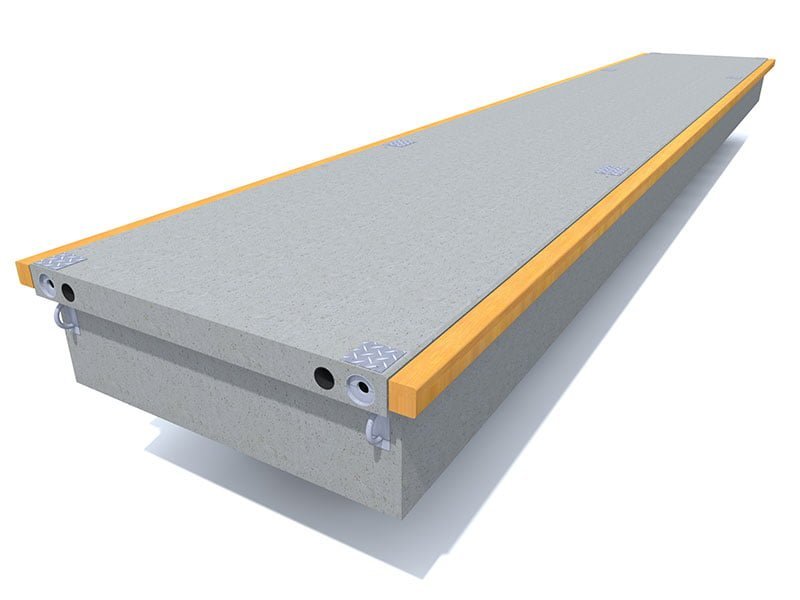
Example of a heavy-duty pontoon structure, often utilizing robust materials like galvanized steel and concrete-encased floats.
Compartmentalization for Safety
It is highly recommended to divide the pontoon's internal volume into multiple watertight compartments. If one compartment is breached and floods, the others can maintain buoyancy, preventing the entire pontoon from sinking. This significantly enhances safety.
Decking
The top surface of the pontoon will serve as the deck. Materials like treated hardwood, composite decking, or galvanized steel checker plate can be used. The choice will depend on budget, desired aesthetics, and slip resistance requirements. The decking and its support frame will add to the pontoon's self-weight.
Welding and Galvanization Integrity
If welding is performed on galvanized steel, the galvanized coating at the weld areas will be damaged. These areas must be repaired using methods like zinc-rich paint application or re-galvanization (if feasible for the component size) to maintain corrosion protection. Ideally, fabrication should be completed before the final hot-dip galvanization process.
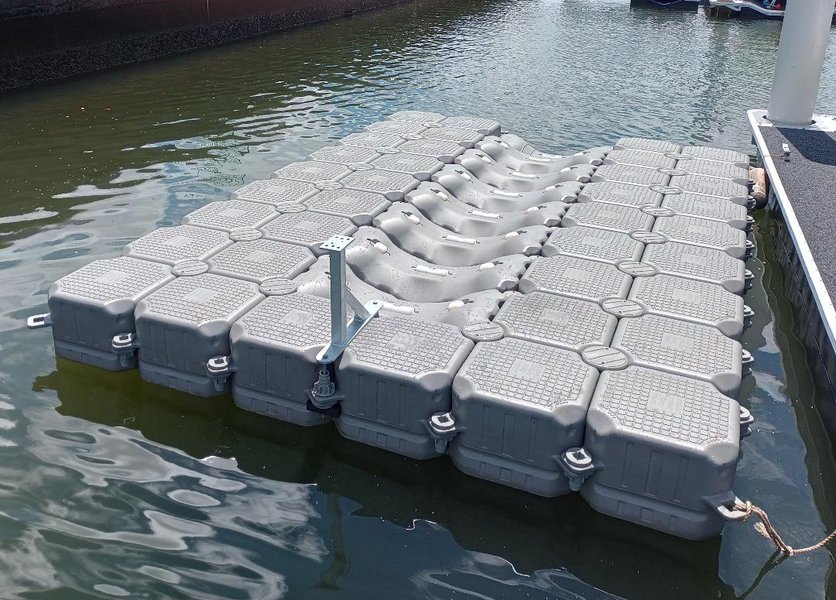
Modular floating dock systems often use individual flotation units, a concept applicable to pontoon design for buoyancy and stability.
Key Performance Attributes of Galvanized Steel Pontoons
The choice of galvanized steel for pontoon construction offers a balance of several important characteristics. The radar chart below provides a visual comparison of these attributes on a relative scale (where higher scores generally indicate a more favorable characteristic).
This chart highlights factors such as Structural Strength, Corrosion Resistance (critical for marine applications and enhanced by galvanization), Cost-Effectiveness (balancing initial outlay with lifespan), overall Durability, Ease of Fabrication for common pontoon shapes, and Low Maintenance Needs when properly designed and constructed. Galvanized steel generally scores well in strength, durability, and, with proper treatment, corrosion resistance and maintenance.
Visualizing Pontoon Design Elements: A Mindmap
To better understand the interconnected components of your galvanized iron pontoon design, the following mindmap outlines the key areas of consideration, from initial requirements to final implementation details. This visual representation helps in organizing the thought process and ensuring all critical aspects are covered.
This mindmap illustrates the holistic approach needed, covering everything from the fundamental physics to the practicalities of construction and use.
Visualizing Pontoon Construction: A Practical Guide
The following video provides a step-by-step tutorial on building a floating pontoon dock. While it may utilize pre-built kits or feature different materials in some aspects (like aluminum frames or specific plastic floats), it offers valuable visual insights into the general assembly process. Key takeaways include the handling of flotation elements, the construction of the frame, and the installation of decking. These concepts are broadly applicable and can help in understanding the practical challenges and solutions involved in bringing a custom pontoon design, such as your galvanized iron project, to life.
Observing such construction processes can spark ideas for efficient assembly and highlight areas requiring particular attention to detail during your build.
Summary of Design Specifications
Based on the calculations and considerations outlined, here is a summary of the key design specifications for your galvanized iron floating pontoon:
| Parameter | Value |
|---|---|
| Overall Length | 5.0 meters |
| Overall Width | 1.2 meters |
| Calculated Pontoon Structure Height | Approximately 0.54 meters (54 cm) |
| Calculated Draft (Submerged Depth, Fully Loaded) | Approximately 0.24 meters (24 cm) |
| Design Freeboard (Fully Loaded) | 0.30 meters (30 cm) |
| Assumed Steel Thickness (for estimation) | 3 mm (can be optimized) |
| Estimated Pontoon Steel Self-Weight | Approximately 440 kg (excluding decking, internal floats if separate, etc.) |
| External Load Carrying Capacity | 1000 kg |
| Total Mass Supported (Load + Estimated Self-Weight) | Approximately 1440 kg |
| Total Displaced Volume of Water | Approximately 1.44 m³ |
| Primary Material | Hot-dip Galvanized Steel |
Note: The estimated self-weight is for the main pontoon structure. Additional weight from decking, extensive internal bracing, or separate flotation units (if not integral to the steel structure) should be factored into a more detailed weight budget.
Frequently Asked Questions (FAQ)
What is 'freeboard' and why is it important for a pontoon?
Freeboard is the vertical distance from the waterline to the lowest point of the deck or top edge of the pontoon hull where water could enter. A sufficient freeboard (0.3m in this design) is crucial for several reasons:
- Safety: It prevents waves from easily washing over the deck, keeping the surface dry and reducing the risk of swamping or instability.
- Load Capacity: It provides a margin of safety, ensuring the pontoon doesn't submerge too deeply under its maximum designed load.
- Comfort and Usability: A higher freeboard generally results in a drier platform, especially in choppy water.
How is the pontoon's load-carrying capacity precisely determined?
The load-carrying capacity is determined by Archimedes' Principle. The pontoon must displace a volume of water whose weight equals the total weight of the pontoon itself plus the external load it's designed to carry, all while maintaining the specified freeboard. The calculation involves:
- Estimating the pontoon's self-weight (structure, decking, fittings).
- Adding the desired external load capacity (1000 kg).
- Calculating the total volume of water that needs to be displaced to support this combined weight.
- Designing the pontoon's submerged dimensions (length x width x draft) to achieve this displacement. The draft, combined with the freeboard, gives the total height of the pontoon structure.
Why is galvanized steel recommended for this pontoon design?
Galvanized steel (specifically hot-dip galvanized steel) is recommended due to its excellent balance of properties for marine structures:
- Strength: Steel provides high structural strength and rigidity, necessary for a durable pontoon.
- Corrosion Resistance: The zinc coating from galvanization creates a protective barrier against rust and corrosion, significantly extending the pontoon's lifespan in freshwater and, with proper care, saltwater environments.
- Durability: It can withstand impacts and environmental stresses well.
- Cost-Effectiveness: While potentially having a higher initial cost than some alternatives, its longevity and low maintenance requirements can make it more cost-effective over time.
What kind of maintenance will a galvanized iron pontoon typically require?
A well-constructed galvanized steel pontoon is relatively low-maintenance. However, periodic checks are advisable:
- Inspect Galvanized Coating: Look for any signs of damage to the zinc coating (scratches, wear). Damaged areas should be cleaned and repaired with zinc-rich paint to prevent underlying steel corrosion.
- Check Welds and Fasteners: Ensure all connections are secure and show no signs of excessive corrosion or fatigue.
- Clean Marine Growth: Periodically clean off any accumulated marine growth from the submerged parts, although galvanization can help reduce this.
- Inspect Decking: If wooden decking is used, check for rot or damage and treat/replace as necessary.
- Check Flotation Integrity: Ensure flotation elements are secure and undamaged. If the pontoon itself forms sealed buoyant chambers, check for any leaks.
Can this pontoon design be used in saltwater environments?
Yes, galvanized steel pontoons can be used in saltwater, but some additional considerations are important:
- Galvanization Quality: A thick, high-quality hot-dip galvanization (e.g., to BS EN ISO 1461) is essential.
- Additional Coatings: For extended life in harsh saltwater, applying an additional protective coating, such as an epoxy or polyurethane paint system over the galvanization, is often recommended. This creates a duplex system offering superior corrosion protection.
- Sacrificial Anodes: In some cases, particularly if there are dissimilar metals nearby or if the pontoon is part of a larger metallic structure, sacrificial anodes (e.g., zinc or aluminum) might be beneficial to protect the steel from galvanic corrosion.
- Regular Inspection: More frequent inspections for signs of corrosion are advisable in saltwater compared to freshwater.
Recommended Further Exploration
To deepen your understanding or explore related topics, consider these queries:
- How to optimize pontoon stability with varying load distributions?
- What are the best practices for anchoring a floating pontoon in different water conditions?
- Comparison of different flotation materials for pontoon construction: EPS foam vs HDPE vs concrete floats?
- What are the regulatory requirements for private pontoon construction in my area?
References
The design principles and material suggestions in this guide are supported by information from various industry sources and manufacturers. For further details, you may find the following resources helpful:


Last updated May 18, 2025