
Mastering German at B2 Level: Your Complete Learning Blueprint
Elevate your German skills with this structured approach to grammar, gender recognition, tense usage, and conversational fluency.
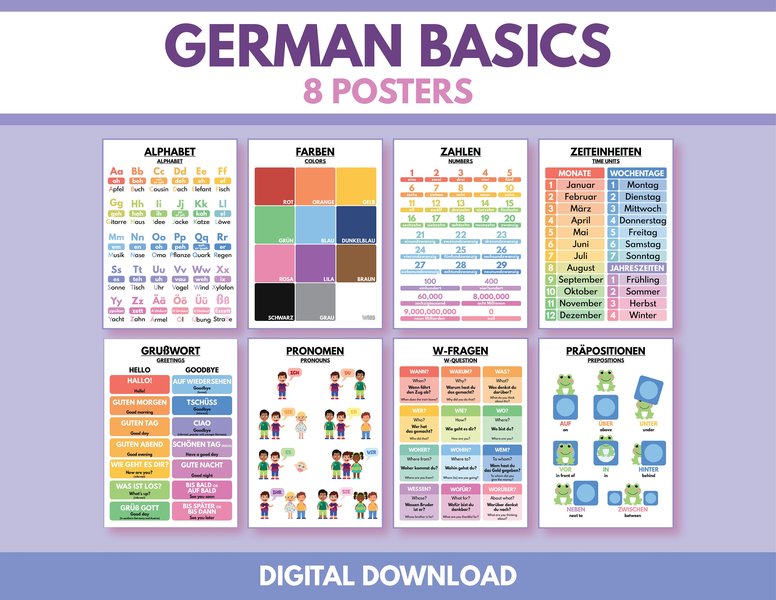
Essential Elements for Your B2 German Learning Journey
- Focus on advanced grammar structures including complex clauses, subjunctive forms, and passive voice constructions
- Master gender recognition patterns using reliable noun endings to confidently use der, die, and das
- Understand precise tense usage for natural-sounding German in both written and spoken contexts
Advanced Grammar Structures for B2 Level
At the B2 level, you need to move beyond basic sentence construction to express complex thoughts fluently. The following grammar structures will help you achieve this:
Complex Sentence Structures
Advanced German requires mastery of both main clauses (Hauptsätze) and various types of subordinate clauses (Nebensätze):
Subordinate Clauses
- Causal clauses with "weil," "da," and "denn" (because)
- Concessive clauses with "obwohl" and "trotzdem" (although, despite)
- Conditional clauses with "wenn," "falls," and "sofern" (if, in case)
- Temporal clauses with "als," "wenn," "nachdem," "bevor," and "während" (when, after, before, during)
The Passive Voice
The passive voice (Passiv) is essential for formal writing and academic contexts:
- Present passive: "Das Buch wird gelesen." (The book is being read.)
- Past passive: "Das Buch wurde gelesen." (The book was read.)
- Perfect passive: "Das Buch ist gelesen worden." (The book has been read.)
Subjunctive Mood
The subjunctive (Konjunktiv) expresses hypothetical situations, indirect speech, and polite requests:
- Konjunktiv I (indirect speech): "Er sagt, er sei krank." (He says he is sick.)
- Konjunktiv II (hypothetical situations): "Wenn ich reich wäre, würde ich reisen." (If I were rich, I would travel.)
This mindmap illustrates the key grammar elements required at the B2 level, showing how they relate to each other in the overall German grammatical system.
Gender Recognition: Mastering Der, Die, Das
German nouns have one of three genders: masculine (der), feminine (die), or neuter (das). Learning to recognize patterns in noun endings will significantly improve your article usage.
Common Noun Endings by Gender
While there are exceptions, these patterns can help you predict the gender of most German nouns:
| Gender | Common Endings | Examples |
|---|---|---|
| Masculine (der) | -er, -el, -en, -ling, -ig, -ent, -ant, -ist, -or, -ismus | der Lehrer (teacher), der Schlüssel (key), der Garten (garden) |
| Feminine (die) | -ung, -heit, -keit, -schaft, -ion, -ik, -tät, -ie, -ei, -in (female forms) | die Zeitung (newspaper), die Freiheit (freedom), die Möglichkeit (possibility) |
| Neuter (das) | -chen, -lein, -ma, -ment, -tum, -um, -o, -ett | das Mädchen (girl), das Büchlein (little book), das Thema (topic) |
Special Rules for Gender Recognition
- Compound nouns: The last word determines the gender (e.g., "der Wein" + "die Flasche" = "die Weinflasche")
- Nominalized verbs: Always neuter (e.g., "das Schwimmen" from "schwimmen")
- Days, months, seasons: Masculine (der Montag, der Januar, der Sommer)
- Most rivers: Feminine (die Donau, die Elbe), with exceptions (der Rhein)
German Tense Usage: When to Use Which Tense
Using the correct tense is crucial for accurate German communication. At B2 level, you should be comfortable with all six main German tenses:
The Six Main German Tenses
This chart shows the approximate frequency of each tense in everyday German usage, highlighting which tenses you should prioritize in your learning.
Present Tense (Präsens)
Used for:
- Current actions: "Ich lese ein Buch." (I am reading a book.)
- Habitual actions: "Ich gehe jeden Tag spazieren." (I go for a walk every day.)
- General truths: "Die Erde dreht sich um die Sonne." (The Earth revolves around the sun.)
- Near future: "Morgen fahre ich nach Berlin." (Tomorrow I'm going to Berlin.)
Perfect Tense (Perfekt)
Used for:
- Completed actions in the past (spoken German): "Ich habe das Buch gelesen." (I have read the book.)
- Actions with relevance to the present: "Ich habe mein Handy verloren." (I have lost my phone.)
Simple Past (Präteritum)
Used for:
- Formal written narratives: "Er ging in den Wald." (He went into the forest.)
- With auxiliary and modal verbs in speech: "Ich war gestern krank." (I was sick yesterday.)
Past Perfect (Plusquamperfekt)
Used for:
- Actions that happened before another past action: "Nachdem ich gegessen hatte, ging ich ins Kino." (After I had eaten, I went to the cinema.)
Future I (Futur I)
Used for:
- Future predictions: "Es wird morgen regnen." (It will rain tomorrow.)
- Assumptions about the present: "Sie wird jetzt zu Hause sein." (She will be at home now.)
Future II (Futur II)
Used for:
- Actions that will be completed by a certain point in the future: "Bis nächstes Jahr werde ich mein Studium beendet haben." (By next year, I will have finished my studies.)
- Assumptions about past events: "Er wird das Buch schon gelesen haben." (He will have already read the book.)
B2 Level Small Talk: Essential Phrases and Expressions
At B2 level, you should be able to engage in natural conversations beyond basic exchanges. Here are some practical phrases to help you navigate different small talk situations:
Conversation Starters
- "Wie läuft's bei dir?" (How's it going with you?)
- "Was hältst du von...?" (What do you think about...?)
- "Hast du von dem aktuellen Ereignis gehört?" (Have you heard about the current event?)
- "Was beschäftigt dich zurzeit?" (What are you busy with these days?)
Expressing Opinions
- "Meiner Meinung nach..." (In my opinion...)
- "Ich sehe das ein bisschen anders, weil..." (I see that a bit differently, because...)
- "Einerseits..., andererseits..." (On one hand..., on the other hand...)
- "Es kommt darauf an..." (It depends...)
Discussing Daily Life
- "Wie war dein Wochenende?" (How was your weekend?)
- "Ich bin gerade dabei, ... zu machen." (I'm currently in the process of doing...)
- "Kennst du schon das neue Restaurant in der Stadt?" (Do you know the new restaurant in town yet?)
- "Hast du Pläne für die Feiertage?" (Do you have plans for the holidays?)
Cultural Small Talk
- "Hast du den neuen Film von... gesehen?" (Have you seen the new film by...?)
- "Ich habe kürzlich ein interessantes Buch gelesen über..." (I recently read an interesting book about...)
- "Was für Musik hörst du gerne?" (What kind of music do you like to listen to?)
- "Ich bin ein großer Fan von..." (I'm a big fan of...)
Transition and Filler Phrases
- "Übrigens..." (By the way...)
- "Das erinnert mich an..." (That reminds me of...)
- "Im Großen und Ganzen..." (All in all...)
- "Wie dem auch sei..." (Be that as it may...)
This video provides practical examples of small talk phrases in German that you can immediately incorporate into your conversations, helping you sound more natural and fluent at the B2 level.
Implementing Your B2 German Learning Plan
Weekly Study Schedule
To effectively progress with your B2 German learning, consider implementing this balanced weekly schedule:
Daily Practice (30 minutes)
- Monday: Focus on complex grammar structures and exercises
- Tuesday: Practice gender recognition with new vocabulary
- Wednesday: Work on using different tenses correctly
- Thursday: Small talk practice and conversation building
- Friday: Review and reinforce weak areas
- Weekend: Immersive activities (German movies, podcasts, or books)
Comprehensive Monthly Goals
- Master one complex grammar structure per week
- Learn 50-100 new vocabulary words with correct genders
- Have at least two 30-minute conversations with German speakers
- Read one German article or short story per week
- Watch German media for at least 2 hours per week
Frequently Asked Questions
References
- German Tenses: Overview & Usage - StudySmarter
- German Tenses: A Comprehensive Guide - FluentU German Blog
- German Noun Gender: Learn Smarter And Stop Memorizing - German with Laura
- German Small Talk Tips - FluentU German Blog
- German B2 Level: Resources and Preparation - Lingoni
- Top German B2 Grammar Topics - Entri
Recommended Further Learning
Last updated March 28, 2025