
Unpacking Life Expectancy: Gleason 9 Prostate Cancer with Bladder Involvement
Understanding the prognosis for aggressive, locally advanced prostate cancer and the factors that shape survival outcomes.
When facing a diagnosis of Gleason 9 prostate cancer that also involves the bladder, understanding the potential life expectancy is a primary concern. This form of prostate cancer is considered high-grade and aggressive. The involvement of the bladder typically signifies that the cancer is locally advanced, which has important implications for prognosis and treatment. This response aims to provide a comprehensive overview based on current understanding.
Key Insights into Gleason 9 Prostate Cancer Prognosis
- Aggressive Nature and Local Advancement: Gleason 9 prostate cancer is inherently aggressive. When it extends into the bladder, it's generally classified as locally advanced (often Stage T4), which is a more serious condition than cancer confined strictly to the prostate gland.
- Survival Varies Significantly: Life expectancy is not a fixed number. It's influenced by the precise extent of bladder invasion, the specific Gleason pattern (e.g., 4+5 vs. 5+4), the chosen treatment regimen, its effectiveness, and the patient's overall health, age, and comorbidities. For Gleason 9 cancer with bladder invasion, 5-year overall survival estimates often range from 50% to 60%, though this can vary.
- Multimodal Treatment is Crucial: Due to its aggressive nature, a combination of treatments (multimodal therapy) is typically recommended. This often includes surgery (if feasible), advanced radiation techniques (like EBRT with a brachytherapy boost), and androgen deprivation therapy (ADT).
Defining Gleason 9 and Bladder Involvement
What is Gleason Score 9?
The Gleason scoring system grades prostate cancer based on how abnormal the cancer cells appear under a microscope, with scores ranging from 6 (less aggressive) to 10 (most aggressive). A Gleason score of 9 indicates a high-grade, very aggressive cancer with a high likelihood of growing and spreading quickly. This score is derived by adding the two most common Gleason patterns seen in the biopsy. For a Gleason 9, this is typically a combination of pattern 4 and pattern 5 cells (i.e., 4+5=9 or 5+4=9). The primary pattern (the first number) being a 5 (as in 5+4) is generally associated with a slightly worse prognosis than if the primary pattern is 4 (as in 4+5).
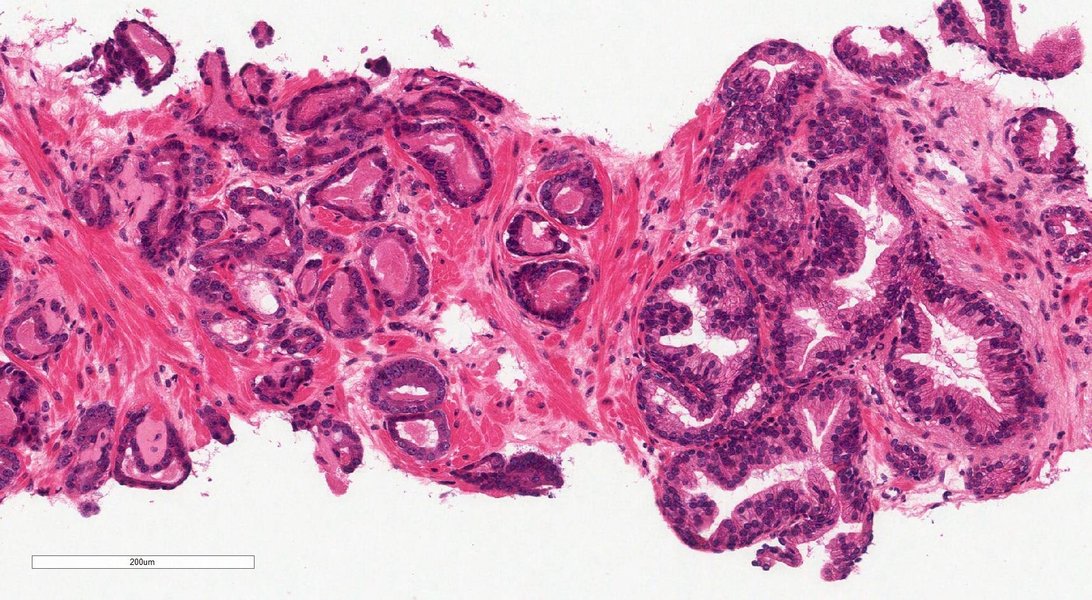
Microscopic appearance of prostate adenocarcinoma, illustrating abnormal cell structures characteristic of cancer.
Interpreting "Localized in the Prostate and Bladder"
The phrase "localized in the prostate and bladder" requires careful interpretation.
True Localization vs. Local Extension
While "localized" often implies the cancer is confined to the organ of origin (the prostate), involvement of the bladder signifies that the cancer has likely spread beyond the prostate's capsule into adjacent tissue. This is more accurately termed locally advanced prostate cancer, often corresponding to stage T4 if the tumor invades structures beyond the seminal vesicles, such as the bladder neck, external sphincter, rectum, or levator muscles.
This distinction is critical because cancer that has extended into the bladder generally has a more guarded prognosis and requires more intensive treatment than cancer strictly confined to the prostate gland. The extent of bladder involvement (e.g., microscopic invasion at the bladder neck versus gross invasion into the bladder wall) also influences the outlook.

Illustration of prostate cancer stages, showing progression from localized to regional and distant spread. Bladder involvement indicates a more advanced local stage.
Life Expectancy and Survival Outcomes
Survival rates for prostate cancer are often reported as 5-year or 10-year relative survival rates, which estimate the percentage of patients who are still alive that many years after diagnosis, compared to people without cancer. It's important to remember these are statistical averages and individual experiences can vary widely.
Context: General Prostate Cancer Survival
For prostate cancer that is truly localized (confined to the prostate gland), the overall 5-year relative survival rate is nearly 100%. However, Gleason 9 cancer behaves more aggressively, and when it involves the bladder, the prognosis shifts.
Survival Estimates for Gleason 9 Prostate Cancer
The table below provides a comparative overview of survival estimates based on the extent of localization. It's crucial to understand that these figures are estimates and can be influenced by many factors.
| Disease Status | Estimated 5-Year Overall Survival | Estimated 10-Year Overall Survival | Key Considerations |
|---|---|---|---|
| Gleason 9 localized strictly within the prostate | Approximately 70-90% | Approximately 50-80% | Dependent on aggressive local treatment; outcomes generally better than with spread. Significant improvements in recent years due to advanced therapies. |
| Gleason 9 with extension to the bladder (Locally Advanced, e.g., T4) | Approximately 50-60% | Lower, data more variable (can be in the 30-50% range, highly dependent on response to therapy) | Considered locally advanced; requires intensive multimodal therapy. Higher risk of recurrence and progression to metastatic disease. Individual factors and treatment response are critical. |
Note: These are general estimates. Individual prognosis can vary based on precise staging, specific Gleason patterns (4+5 vs. 5+4), response to treatment, patient age, and overall health.
Recent studies indicate that 5-year prostate cancer-specific mortality (PCSM) for men with Gleason 9-10 cancer has improved, decreasing from around 46% in 2000–2005 to about 26% in 2016–2020, reflecting advancements in treatment and management.
Micrograph illustrating prostate carcinoma cells involving the bladder neck, an example of local extension.
Key Factors Influencing Prognosis
Several elements play a crucial role in determining the outlook for an individual with Gleason 9 prostate cancer involving the bladder.
Detailed Tumor Characteristics
Gleason Pattern Composition
Within Gleason score 9, the distribution of patterns (4+5 vs. 5+4) matters. A primary Gleason pattern 5 (i.e., Gleason score 5+4=9) is generally associated with a more aggressive course and potentially poorer prognosis than a primary pattern 4 (Gleason score 4+5=9).
Extent of Bladder Invasion
The degree to which the cancer has invaded the bladder is a significant factor. Microscopic involvement at the bladder neck may have a different outlook than extensive tumor growth into the bladder wall.
Lymph Node Status and PSA Levels
The presence of cancer cells in nearby lymph nodes (nodal metastasis) or very high Prostate-Specific Antigen (PSA) levels at diagnosis can also indicate a more advanced disease and impact prognosis.
Treatment Efficacy and Approach
The choice and success of treatment are paramount. Aggressive, multimodal therapy is standard for high-risk localized or locally advanced prostate cancer. This can include:
- Radical Prostatectomy: Surgical removal of the prostate. Its feasibility and effectiveness can be challenging with bladder involvement.
- External Beam Radiation Therapy (EBRT): Often combined with Androgen Deprivation Therapy (ADT).
- Brachytherapy Boost: Internal radiation, sometimes added to EBRT and ADT, has shown to improve outcomes, including better prostate cancer-specific survival and longer time to distant metastasis compared to EBRT alone in some Gleason 9-10 cases.
- Androgen Deprivation Therapy (ADT): Hormone therapy to lower testosterone levels, often used for several years in conjunction with radiation or as a standalone treatment for advanced disease.
Patient-Specific Factors
Age and Comorbidities
A patient's age and overall health, including the presence of other significant medical conditions (comorbidities), can affect treatment tolerance and overall survival.
Visualizing Prognostic Influences
The following chart illustrates the relative impact of various factors on the prognosis of Gleason 9 prostate cancer with bladder involvement. Higher scores on the axes (further from the center) generally indicate a more favorable influence or status, while lower scores suggest a more challenging factor. This is a conceptual representation.
This chart visualizes how a combination of factors contributes to an individual's overall prognostic outlook. For instance, effective treatment and a good response to ADT can significantly improve prospects even with challenging initial features like extensive bladder invasion.
Navigating Treatment and Management
Given the complexity and aggressive nature of Gleason 9 prostate cancer with bladder involvement, a carefully planned and executed treatment strategy is essential, typically managed by a multidisciplinary team of specialists.
The Interconnectedness of Factors in Management
The mindmap below illustrates the interconnected elements involved in managing Gleason 9 prostate cancer that has extended to the bladder. It highlights how diagnosis, prognostic factors, treatment options, and potential outcomes are all related.
(Prostate & Bladder Involvement)"] id1["Diagnosis & Staging"] id1a["Gleason Score 9 (e.g., 4+5 or 5+4)"] id1b["Bladder Involvement Assessed
(Locally Advanced - Likely T4)"] id1c["PSA Levels & Other Biomarkers"] id1d["Advanced Imaging (MRI, PSMA-PET)"] id2["Key Prognostic Factors"] id2a["Depth & Extent of Bladder Invasion"] id2b["Specific Gleason Pattern Details"] id2c["Lymph Node Status (N0 vs N1)"] id2d["Patient Age, Comorbidities, Performance Status"] id2e["Genomic Profiling (emerging)"] id3["Comprehensive Treatment Strategies"] id3a["Multimodal Therapy (Essential)"] id3aa["Radical Prostatectomy (highly selective cases)"] id3ab["External Beam Radiation Therapy (EBRT)"] id3ac["Brachytherapy Boost (often considered)"] id3ad["Long-term Androgen Deprivation Therapy (ADT)"] id3ae["Chemotherapy (e.g., Docetaxel, in specific contexts like node-positive or high-volume disease)"] id3af["Newer Hormonal Agents (e.g., Abiraterone, Enzalutamide in advanced settings)"] id3b["Management by Multidisciplinary Team
(Urologist, Radiation Oncologist, Medical Oncologist)"] id4["Outcomes & Long-Term Management"] id4a["Survival Probabilities (5-year, 10-year)"] id4b["Disease Control vs. Remission vs. Cure"] id4c["Monitoring for Biochemical Recurrence (PSA)"] id4d["Managing Treatment Side Effects"] id4e["Quality of Life Considerations"] id4f["Potential for Clinical Trial Enrollment"]
This mindmap underscores the necessity of a holistic approach, considering all aspects from initial diagnosis through long-term follow-up and quality of life.
Insights from Clinical Research on High-Grade Prostate Cancer
The following video discusses cure rates and treatment considerations for localized, non-metastatic high-grade prostate cancer, including Gleason 9. While the query specifically mentions bladder involvement (making it locally advanced), the principles discussed for managing aggressive, non-metastatic disease are highly relevant.
This video provides expert insights into managing high-grade (including Gleason 9) non-metastatic prostate cancer, covering treatment strategies and potential for cure. Understanding these concepts is valuable context for cases with local extension to the bladder.
Discussions in such expert forums often emphasize the importance of aggressive primary treatment and the potential benefits of combining therapies. For Gleason 9 disease, even if it has extended locally, the goal of treatment is often curative or to achieve long-term disease control.
Frequently Asked Questions (FAQ)
What does a Gleason score of 9 signify for prostate cancer?
A Gleason score of 9 indicates a high-grade, aggressive form of prostate cancer. The cancer cells look very different from normal prostate cells and are likely to grow and spread quickly. It's composed of Gleason patterns 4 and 5 (e.g., 4+5 or 5+4). This score places the cancer in a high-risk category, necessitating comprehensive and often aggressive treatment.
How does the cancer being "localized in the prostate and bladder" affect the prognosis?
When prostate cancer involves the bladder, it typically means the cancer has grown beyond the prostate gland itself. This is classified as locally advanced disease (often Stage T4), not strictly "localized" in the most favorable sense. This extension generally leads to a more guarded prognosis compared to cancer confined solely to the prostate. Survival rates are lower, and the risk of recurrence or further spread is higher, necessitating more intensive treatment strategies.
Are there different prognostic implications within Gleason score 9 (e.g., 4+5 vs. 5+4)?
Yes, there can be. A Gleason score of 9 is made up of primary and secondary patterns. If the primary (most common) pattern is 5 (i.e., 5+4=9), the cancer may behave more aggressively and have a slightly worse prognosis than if the primary pattern is 4 (i.e., 4+5=9). While both are high-risk, this subtle distinction can be relevant in prognostic considerations and sometimes in treatment planning.
What are the primary treatment approaches for Gleason 9 cancer involving the bladder?
Treatment is typically multimodal and aggressive. It often involves a combination of:
- External Beam Radiation Therapy (EBRT): Often with advanced techniques to target the prostate and involved areas.
- Brachytherapy Boost: Internal radiation may be added to EBRT to deliver a higher dose to the tumor.
- Androgen Deprivation Therapy (ADT): Hormone therapy used for an extended period (e.g., 2-3 years) to suppress testosterone, which fuels prostate cancer growth.
- Surgery (Radical Prostatectomy): May be considered in highly selected cases, but is more challenging and less common when there's significant bladder involvement.
- Chemotherapy: May be considered in certain situations, particularly if there's evidence of spread to lymph nodes or a very high tumor burden.
Is it possible to achieve a cure or long-term remission with Gleason 9 prostate cancer involving the bladder?
While Gleason 9 prostate cancer with bladder involvement is a serious and aggressive condition, achieving long-term disease control or even a cure is possible for some patients, especially with modern aggressive multimodal therapies. Cure rates for non-metastatic Gleason 9 disease, even if locally advanced, can be significant (some sources suggest around 80% with optimal treatment and negative PSMA PET scans prior to local therapy, although bladder invasion complicates this). However, the risk of recurrence is higher than for less aggressive or strictly localized cancers. The goal of treatment is to eradicate the cancer or control it for as long as possible while maintaining quality of life.
Recommended Further Exploration
- What are the latest treatment options for locally advanced Gleason 9 prostate cancer?
- How does Androgen Deprivation Therapy work in conjunction with radiation for high-risk prostate cancer?
- What quality of life considerations are important after treatment for aggressive prostate cancer?
- Are there prognostic differences between Gleason 4+5 and 5+4 prostate cancer in terms of treatment response?
References
Last updated May 7, 2025