
Unveiling the Future: Key Innovations from Google I/O 2025
A Deep Dive into Google's AI-First Vision and Product Advancements
Google I/O 2025, the company's premier annual developer conference, was unequivocally centered around Artificial Intelligence, showcasing a sweeping integration of AI across nearly every facet of Google's product ecosystem. From enhancing search capabilities to revolutionizing video communication and developer tools, the event underscored Google's commitment to an "AI-first" future. The announcements revealed a strategic push to make AI more helpful, personalized, and accessible to users and developers worldwide.
Essential Insights from Google I/O 2025
- AI Takes Center Stage: The most prominent theme was the pervasive integration of AI, particularly Google's Gemini models, into core products like Search, Android, and Workspace, transforming user interactions and developer workflows.
- New AI Capabilities and Subscriptions: Google introduced advanced Gemini model capabilities, including "Deep Think" for complex reasoning, and unveiled new AI subscription tiers (AI Pro and AI Ultra) to provide enhanced access and experimental tools.
- Hardware and Platform Evolution: Significant updates were made to Android XR, demonstrating Google's ambition in mixed reality with new smart glasses partnerships, alongside advancements in Android 16 for better user experience and developer tools.
The AI Revolution: Gemini at the Core
At the heart of Google I/O 2025's announcements was Gemini, Google's flagship large language model. The conference highlighted substantial advancements to Gemini, solidifying its role as a universal AI assistant capable of handling increasingly complex tasks and integrating seamlessly across Google's services.
Enhanced Gemini Models and Capabilities
Google unveiled significant improvements to its Gemini models, particularly Gemini 2.5 Pro and Gemini 2.5 Flash. These updates focus on making the models more powerful, efficient, and versatile. A notable introduction is Gemini 2.5 Deep Think, an "enhanced reasoning" mode designed to tackle highly complicated tasks in areas like mathematics, code, and multimodality. This advanced capability aims to provide more accurate and insightful responses by performing more complex reasoning processes. While undergoing additional safety evaluations, Deep Think will be available to Google AI Ultra subscribers, offering a glimpse into the cutting edge of AI-powered problem-solving.
Furthermore, Gemini's ability to integrate with personal context from Google apps like Gmail and Google Drive was highlighted. This allows for features such as "Personalized Smart Replies" in Gmail, where Gemini can generate replies based on a user's notes, past reservations, and even replicate their tone, making digital communication more efficient and personalized. Gemini Live, a feature for real-time interaction, now supports camera and screen sharing for all users, including iOS, further expanding its utility as a dynamic AI assistant.
AI in Search: A Transformative Experience
Perhaps one of the most impactful announcements was the broad rollout of "AI Mode" in Google Search for all U.S. users. This feature, previously an experiment, fundamentally shifts the search experience from a list of blue links to a more chatbot-oriented interface that provides computer-generated answers to complex queries. AI Mode leverages the latest Gemini models to deliver high-quality, accurate, and fast AI responses. It is designed to handle multi-part questions, generate custom charts and graphics based on queries, and manage follow-up questions, aiming to provide comprehensive answers without extensive scrolling.
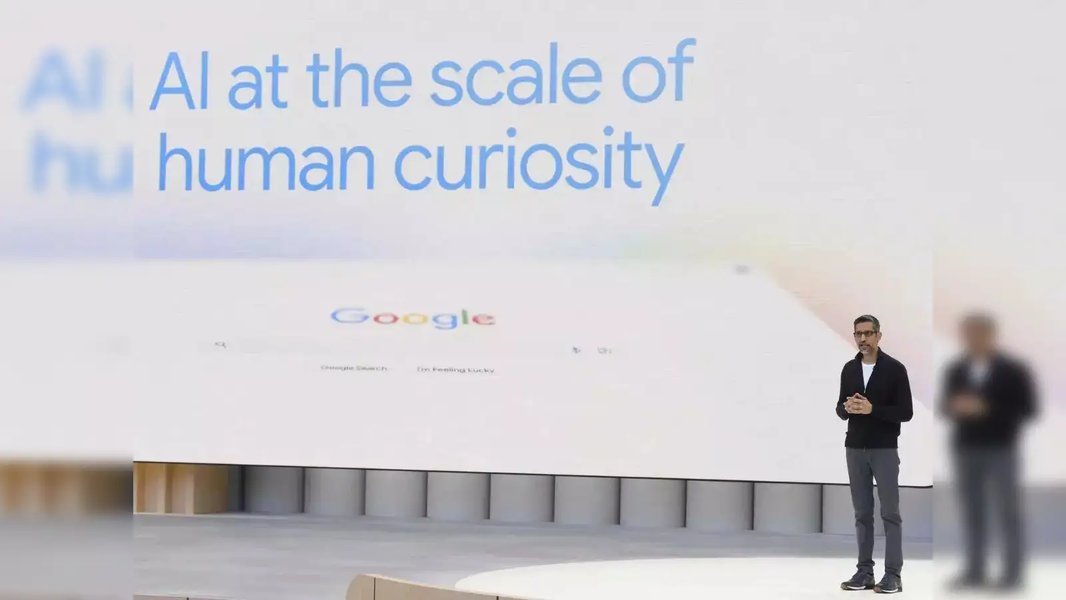
Sundar Pichai on stage at Google I/O 2025, emphasizing the pervasive role of AI.
Google also announced the expansion of "AI Overviews" to over 200 countries and 40 languages, indicating a global push to integrate AI-powered summaries directly into search results. This signifies a major step towards making search more proactive and informative, anticipating user needs and providing distilled answers directly.
New AI Subscription Tiers and Tools
To cater to power users and developers, Google introduced new AI subscription plans: the AI Pro Plan, available globally at $19.99 per month, and the more premium AI Ultra Plan, priced at $249.99 per month, initially rolling out in the U.S. The AI Ultra Plan offers higher limits on AI usage, early access to experimental tools like Project Mariner (an internet browser extension for automating tasks) and Deep Think, and premium benefits such as YouTube Premium and 30TB of storage across Google Drive, Google Photos, and Gmail. This tiered approach aims to monetize Google's AI advancements while providing exclusive access to its most cutting-edge capabilities.
For developers, Google AI Studio has been updated with Gemini 2.5 Pro integration into its native code editor, allowing for faster prototyping and seamless generation of web apps from various prompts. The Gemini API and SDK now support the Model Context Protocol (MCP), enabling developers to integrate a wider range of open-source tools with Gemini models, fostering a more open and collaborative AI development ecosystem.
The Evolution of Android and Beyond
While AI dominated the keynote, Google I/O 2025 also delivered substantial updates across its other flagship platforms, including Android, Android XR, and new communication technologies, reinforcing Google's holistic approach to innovation.
Android 16 and Developer Enhancements
Android 16 introduces several key features focused on personalization, productivity, and security. New wallpaper and lock screen options for Pixel phones include live-updating weather animations and creative photo framing. A significant addition is "Live Updates," a new class of notification templates designed to track user-initiated journeys like rideshares, deliveries, and navigation in real-time, providing more dynamic and helpful information directly on the lock screen or in the notification shade.
For Android developers, Google announced 16 key updates, emphasizing AI integration and improvements to development tools. Android Studio Narwhal Feature Drop (2025.2) includes AI-powered tools with Gemini, enhancing UI development with Compose. Firebase Studio will now suggest backend services like Firebase Auth and Cloud Firestore, streamlining app prototyping. These tools aim to put AI at developers' fingertips throughout the development lifecycle, enabling them to build more intelligent and adaptive experiences faster.
Android XR and Smart Glasses
Building on its mixed reality ambitions, Google provided more details on its Android XR platform and announced new partnerships for smart glasses. An XR headset, developed in partnership with Samsung, is slated for launch later this year. Additionally, Google is collaborating with glasses designers Warby Parker and Gentle Monster to create smart glasses based on Android XR. These glasses will leverage Gemini AI for features like real-time language translation, with live demos showcasing Farsi and Hindi translation into English appearing directly on the lenses. This demonstrates Google's vision for a future where digital information and AI assistance are seamlessly integrated into our visual perception of the world.
This radar chart illustrates the perceived impact of the announcements from Google I/O 2025 across several key areas. "AI Integration" received the highest impact score, reflecting the overwhelming focus on infusing AI into Google's core products and services. "Developer Tools" also scored highly, indicating significant enhancements for developers building AI applications. "User Experience" reflects the direct benefits to end-users through features like AI Mode in Search and personalized smart replies. "New Hardware" covers the advancements in Android XR and smart glasses, while "Monetization" reflects Google's new AI subscription plans. The "Expected Future Growth Potential" dataset, represented by the green line, suggests an even higher future impact, particularly in AI integration, as Google continues to refine and expand these technologies.
Transforming Communication and Creativity with AI
Google I/O 2025 also showcased groundbreaking advancements in AI-powered communication and creative tools. Project Starline, Google's breakthrough 3D video technology, evolved into Google Beam, a new AI-first video communications platform. Beam uses an array of six cameras and AI to transform 2D video streams into a realistic 3D experience on a lightfield display, providing a more natural and immersive conversational experience with near-perfect head tracking. The first Google Beam devices, developed in collaboration with HP, are expected to be available to early customers later this year.
For content creation, Google introduced Flow, a new AI filmmaking tool built with and for creatives. Flow is powered by advanced video and image generation models, including the latest Veo 3 (which now features native audio generation) and Imagen 4, Google's image generation model offering "stunning quality" and "superior typography" with capabilities for up to 2K resolution images across various aspect ratios. These tools aim to democratize filmmaking and creative expression through AI.
Below is a video highlighting some of the key announcements from Google I/O 2025, offering a concise overview of the event's most impactful reveals, especially concerning Gemini AI upgrades and Android 16 innovations.
Highlights from the Google I/O 2025 Keynote, showcasing major AI and platform advancements.
Developer-Focused Innovations and New Initiatives
Google I/O remains fundamentally a developer conference, and this year's event provided a wealth of new tools, APIs, and initiatives designed to empower developers to build the next generation of AI-powered applications.
AI in Developer Tools and Platforms
Beyond the Gemini API and SDK enhancements, Google announced several specific tools and platforms designed to streamline AI development:
- Firebase AI Logic: This new feature allows developers to integrate Google’s generative AI models directly into their client apps or through Genkit for server-side implementations, simplifying the process of adding AI capabilities to applications.
- Computer Use API: A significant new feature enabling developers to build applications that can browse the web or use other software tools under user direction, paving the way for more sophisticated agentic AI applications.
- Agent2Agent Protocol: Google is pushing for open protocols like Agent2Agent to allow AI agents to communicate with each other, fostering a more interconnected ecosystem of intelligent agents.
- Jules: Described as a "true coding agent," Jules is an asynchronous AI coding agent that can read code, understand intent, and perform tasks like writing tests, building new features, fixing bugs, and updating dependency versions. This aims to significantly boost developer productivity.
Specialized AI Models and Research
Google also showcased specialized AI models and ongoing research:
- Gemma 3n Preview: A powerful, efficient, and mobile-first open AI model capable of handling audio, text, images, and videos, designed to run on devices with as little as 2GB of RAM.
- MedGemma & SignGemma: Specialized models demonstrating Google's commitment to AI for social good. MedGemma analyzes health-related text and images, while SignGemma translates sign language to spoken-language text, with a focus on American Sign Language and English.
- DolphinGemma: A world-first large language model fine-tuned on decades of field research data to help scientists understand dolphin communication patterns, showcasing the diverse applications of AI.
- Gemini Diffusion: A new experimental research model in text diffusion, indicating ongoing advancements in generative AI research.
Broader Product Updates and User-Facing Features
Beyond the core AI and developer announcements, Google I/O 2025 brought updates to various other Google products and services, aiming to enhance everyday user experiences.
Workspace Enhancements with AI
Google is infusing more AI into Workspace applications. Subscribers to Google Workspace will receive new "Personalized Smart Replies" in Gmail, capable of digging through Gmail and Google Drive to generate context-aware responses. Gmail is also getting a new inbox-cleaning feature powered by AI. Google Vids is seeing new ways to create and edit content, further leveraging AI for video production within Workspace.
The ability to connect Gemini models to Google Drive and Gmail for generating custom research reports and integrating with Canvas for dynamic infographics, quizzes, and podcasts was also highlighted. This empowers users to build functional apps and creative content simply by interacting with Gemini.
Shopping and Visual AI Innovations
New shopping features were introduced in AI Mode, including a "virtual try-on tool" that works with personal photos. This allows users to upload a picture of themselves and see how clothes (pants, shirts, dresses, skirts) would look, taking into account how materials fold and stretch on different body types. This feature leverages AI to create realistic digital try-on experiences, aiming to revolutionize online shopping.
Google's AI Mode in Search demonstrating the new virtual try-on feature.
The SynthID Detector, a "verification portal," was also announced to help identify AI-generated content by detecting Google's SynthID watermark, reinforcing efforts towards responsible AI development and content transparency.
Other Notable Announcements
Google also announced updates for Android-based devices beyond phones, including integration of Gemini into TVs, watches, and cars. Volvo drivers, for instance, will be able to converse with Gemini for tasks like sending messages, translating them, or asking questions about their car's manual. Updates to Google Play include enhanced personalization, new ways to showcase apps, and powerful subscription features to streamline checkout and reduce churn. Additionally, NotebookLM, Google's popular AI offering, was launched as an app for both Android and iOS, with the ability to download AI-generated podcasts for offline listening.
Frequently Asked Questions (FAQ)
What was the main focus of Google I/O 2025?
What are the new AI subscription plans announced at Google I/O 2025?
How is Google Search changing with AI?
What new hardware or mixed reality announcements were made?
Were there any updates for Android developers?
What is Google Beam?
Conclusion
Google I/O 2025 unequivocally solidified Google's future as an "AI-first" company. The sheer volume and depth of AI integrations across its product portfolio, from the foundational Gemini models to consumer-facing features like AI Mode in Search and the innovative Google Beam, paint a clear picture of Google's strategic direction. The conference not only showcased advancements in AI capabilities but also emphasized making these powerful tools accessible and practical for both everyday users and developers. The announcements suggest a future where AI acts as a collaborative partner, enhancing productivity, personalizing experiences, and enabling new forms of creativity and communication. Google's continued investment in AI research and development, coupled with its commitment to responsible deployment, positions it at the forefront of the evolving AI landscape.
Recommended Further Exploration
- Deep dive into Google Gemini 2.5 Pro and Flash model enhancements
- The future of search with Google AI Mode and AI Overviews
- Innovations in Android XR and Google's smart glasses roadmap
- How Google's new AI developer tools are shaping application development
References
Last updated May 22, 2025