
Google I/O 2025: A Deep Dive into AI's Future and Beyond
Unveiling Groundbreaking Innovations Across AI, Android, and Immersive Experiences
Key Highlights from Google I/O 2025
- AI Takes Center Stage: Google I/O 2025 was overwhelmingly focused on Artificial Intelligence, with significant advancements in Gemini models, AI-powered Search, and new generative AI tools like Veo 3 and Flow.
- Gemini's Evolution into a Universal Assistant: Gemini is rapidly evolving, becoming a more intelligent, agentic, and personalized "world model," integrating into various Google products, from search to productivity apps, with features like Deep Think and Gemini Live.
- Transformative User Experiences: Beyond AI, Google introduced innovations like Google Beam for AI-enabled 3D video calls, significant updates to Android XR, and enhanced developer tools, all aimed at creating more powerful and intuitive digital experiences.
Google I/O 2025, held from May 20-21 at the Shoreline Amphitheatre in Mountain View, California, marked a pivotal moment for the tech giant, unequivocally positioning Artificial Intelligence at the core of its future. The annual developer conference, led by CEO Sundar Pichai, showcased a relentless push to infuse AI into every facet of Google's ecosystem, from enhancing existing products to launching entirely new, innovative solutions. The emphasis was on building a more helpful AI that is not only intelligent and personalized but also capable of taking action on behalf of users, effectively extending Gemini to become a "world model."
The Pervasive Influence of Gemini: Google's AI Brain
The star of Google I/O 2025 was undoubtedly Gemini, Google's advanced AI model. The conference detailed major upgrades to the Gemini app and its underlying models, demonstrating Google's commitment to making AI more accessible, powerful, and integrated into daily life. Gemini's capabilities are expanding, with new features rolling out across various platforms and applications.
Advancements in Gemini Models and Capabilities
Google announced significant improvements to its Gemini 2.5 Pro and Flash models. Notably, Gemini 2.5 Pro now includes an experimental "Deep Think" mode. This enhanced reasoning capability allows the AI to perform high-level research techniques, considering multiple hypotheses before generating a response. This advancement is crucial for tackling more complex queries and offering more nuanced, intelligent outputs. The expansion of Gemini 2.5 Flash and Pro capabilities on Vertex AI, including thinking summaries, further empowers enterprises with advanced AI tools.
Gemini Live: Real-Time Interaction and Assistance
One of the most impressive and immediately impactful announcements was the widespread availability of Gemini Live. This feature, which combines input from a phone's camera, voice commands, and agent-like abilities to search the web and collate information, is now freely accessible to all Android and iOS users via the Gemini app. Building on the experiments from Project Astra, Gemini Live allows users to interact with the world around them by simply pointing their camera, enabling the AI to describe what it sees, remember key facts, and perform hands-free tasks through natural conversation. Examples include interview preparation and marathon training, showcasing its practical utility.
Gemini's Integration into Google Products
Gemini is being deeply embedded into Google's suite of productivity apps, making them more intelligent and personalized. A prime example is the new Personalized Smart Replies in Gmail, which leverages Gemini to provide more relevant and context-aware response suggestions. Furthermore, LearnLM, Google's learning news initiative, is being infused directly into Gemini 2.5, indicating a future where AI plays a central role in personalized education and information synthesis.
Revolutionizing Search with AI Mode
Google Search received its biggest AI upgrade yet at I/O 2025, transforming the traditional search experience into something far more interactive and capable. The introduction of "AI Mode" marks a significant shift towards a chatbot-oriented search paradigm.
AI Mode: A Chatbot for Complex Queries
AI Mode, previously an experiment, is now available to all users in the US. This new tab within Google Search runs on Gemini 2.5 and is designed to handle more complex queries than people have historically used Search for. It allows users to ask multi-faceted questions, compare different products (like fitness trackers), or find the most affordable tickets for events. AI Mode will also gain the ability to whip up custom charts and graphics related to specific queries, further enhancing its utility for finance and sports-related searches. The integration of Project Astra's capabilities means Search Live will incorporate real-time AI assistance, making search more dynamic and responsive.
AI Overviews and Enhanced Search Features
Building on the AI Overviews feature introduced last year, which summarizes search results at the top of the screen, Google plans to inject more of AI Mode's features into the core Search experience. This evolution aims to make search results not only tailored to past activity but also capable of deeper, more nuanced responses, moving beyond the traditional "10 blue links" model.
Generative AI: Unleashing Creativity and Immersive Experiences
Google I/O 2025 showcased groundbreaking advancements in generative AI, particularly in the realm of visual and interactive media. These tools promise to democratize content creation and redefine digital communication.
New Tools for Video and Image Generation
Google introduced new generative AI video tools like Veo 3 and Flow. Veo 3 is particularly noteworthy for its ability to generate AI-powered video output with accompanying dialogue and sound effects from a descriptive scene, marking a significant leap past the "silent era" of AI video. Flow is a tool made specifically for AI movie creation, hinting at a future where filmmaking is more accessible through AI assistance. The event also highlighted updates to Google's image generation models, although some ethical considerations around watermark removal from copyrighted images were noted.
Google Beam: Reinventing Video Calls
A surprising and highly anticipated announcement was Google Beam, an AI-enabled 3D video calling technology. While details are still emerging, Beam has the potential to reinvent video communication, offering a more immersive and lifelike interaction experience. This is an evolution of Project Starline, Google's ongoing research into realistic telepresence.
Android XR and Smart Glasses
The future of immersive computing was also a key theme, with significant updates to Android XR. Google demonstrated Android XR glasses with live language translation, showcasing two Googlers speaking different languages while English translations appeared beneath their images on their smart glasses. Google is collaborating with Samsung to create reference hardware and software designs for Android XR glasses, and new smart glass manufacturers like Gentle Monsters, Warby Parker, and Xreal are coming onboard. This signals a concerted effort to push mixed reality into the mainstream.
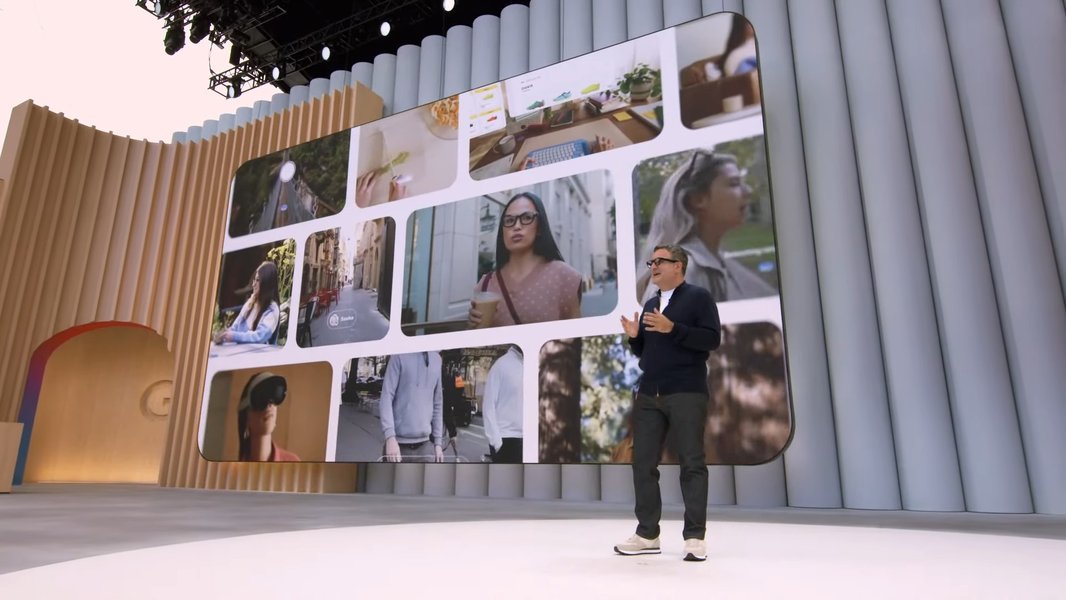
Android XR smart glasses demonstrating an on-stage language translation during Google I/O 2025.
Developer Ecosystem and New Monetization Models
Google I/O, at its core, is a developer conference, and this year was no exception, with new tools and platforms aimed at empowering developers to build the next generation of AI-powered applications. The event also touched upon new monetization strategies, including a premium AI subscription.
Building with AI: Tools for Developers
New tools were unveiled to help developers integrate AI into their applications, enhancing workflows and boosting productivity. Gemini Nano, for instance, now offers built-in AI APIs with multimodal capabilities, providing enhanced privacy, reduced latency, and lower costs. Chrome 138 will include new APIs like Summarizer, Language Detector, Translator, and Prompt API for Chrome Extensions. Firebase Studio now allows direct import of Figma designs, enabling developers to add features and functionality using Gemini without writing extensive code. Google also announced a new Google Cloud & NVIDIA community to connect experts and provide exclusive learning content and credits.
Google AI Ultra Plan
Google introduced an expensive AI Ultra plan, priced at $250 per month, offering access to its highest AI rate limits and early access to experimental AI products like Project Mariner, Veo 3, and Gemini 2.5 Pro with Deep Think mode. This premium offering signifies Google's strategy to monetize its advanced AI capabilities, potentially catering to professional users and businesses requiring cutting-edge features.
Google I/O 2025 Impact Areas: A Radar Chart Analysis
To better understand the multifaceted impact of Google I/O 2025, let's visualize the relative emphasis and potential influence of key announcements across several dimensions. This radar chart represents an opinionated analysis of how each area was highlighted and its expected future significance.
The radar chart illustrates the strong emphasis placed on AI integration across all product categories. "Gemini Evolution" and "AI in Search" show high scores, reflecting their central role in the keynote. "Generative AI Creativity" is also very prominent, given the introduction of tools like Veo 3 and Flow. "Immersive Experiences" (Android XR, Google Beam) indicates significant investment in future interactions. "Developer Tools" remain a core focus, empowering the ecosystem to build with these new AI capabilities. Finally, "User Accessibility" highlights Google's efforts to make these advanced features available to a wider audience, including the free rollout of Gemini Live for Android and iOS users.
Other Notable Announcements and Initiatives
Beyond the core AI and developer news, Google I/O 2025 also featured updates across various other products and initiatives, reinforcing Google's broad technological footprint.
Updates to Android and Google Apps
While Android 16 was showcased the week prior to I/O, the keynote still included important updates relevant to the Android ecosystem. Google announced a desktop mode for Android, working with Samsung to enable Windows-like stretching and movement of apps across screens. NotebookLM, Google's AI tool for organizing documents into study guides, received an iOS and Android app, alongside a new "Video Overviews" feature that can turn data dumps into video summaries. Google also unveiled new AI-powered shopping features in AI Mode, including a virtual try-on tool that works with personal photos, making online shopping more interactive and personalized.
The Future of Google's AI Strategy
Google's overall strategy, as articulated by Sundar Pichai, is to build a "universal AI assistant" by extending Gemini to become a world model. This involves not only making AI more intelligent and agentic but also enabling AI agents to communicate with each other through protocols like the Agent2Agent Protocol. The Model Context Protocol (MCP), introduced by Anthropic, is also now compatible with Gemini API and SDK, allowing agents to access other services seamlessly. These foundational developments underpin Google's vision for a future where AI is deeply integrated and capable of autonomous action across various digital and real-world contexts.
The full Google I/O '25 Keynote showcases all the major announcements, particularly focusing on the advancements in AI and Gemini.
This keynote video provides a comprehensive overview of all the major announcements, including the latest news, updates on AI, and the direction Google is heading with Gemini. Watching the full keynote offers valuable context and demonstrations of the new technologies in action, highlighting the scale and ambition of Google's AI-first approach.
Key Announcements at a Glance
Here's a summary of the most significant announcements from Google I/O 2025, categorized by their primary focus:
| Category | Key Announcement | Description |
|---|---|---|
| AI Core Models | Gemini 2.5 Pro & Flash Updates | Enhanced capabilities, including "Deep Think" for advanced reasoning, and expanded multimodal functionalities. |
| AI Applications | Gemini Live for All | Real-time camera and screen sharing with AI assistance, available on Android and iOS. |
| Search & Discovery | AI Mode in Google Search | New chatbot-oriented search tab for complex queries, with chart generation and Project Astra integration (Search Live). |
| Generative Media | Veo 3 & Flow | Advanced AI video generation with audio and dialogue (Veo 3), and a new tool for AI movie creation (Flow). |
| Immersive Tech | Android XR & Smart Glasses | Updates to mixed-reality platform, live translation demos, and new partnerships with hardware manufacturers. |
| Productivity | Personalized Smart Replies (Gmail) & NotebookLM Updates | AI-powered smart replies for Gmail, NotebookLM iOS/Android app, and Video Overviews for data summarization. |
| Developer Tools | Gemini Nano APIs & Firebase Studio | New built-in AI APIs in Chrome, Figma import to Firebase Studio with Gemini integration. |
| Monetization | Google AI Ultra Plan | Premium subscription for highest AI rate limits and early access to experimental features. |
| Communication | Google Beam | AI-enabled 3D video calls, potentially reinventing virtual interactions. |
FAQ about Google I/O 2025 Highlights
What was the main theme of Google I/O 2025?
What is Gemini Live and who can use it?
How is Google Search changing with AI Mode?
What new generative AI tools for video were announced?
What is Android XR?
What is the Google AI Ultra plan?
Conclusion
Google I/O 2025 unequivocally demonstrated Google's unwavering commitment to an AI-first future. The conference served as a powerful showcase for how AI, particularly through the evolving Gemini models, is set to redefine user experiences across Search, Android, and entirely new immersive platforms. From more intelligent and personalized interactions in everyday apps to groundbreaking generative AI tools for creative expression and transformative communication technologies like Google Beam, the announcements point towards a future where AI is not just a feature but an integrated, proactive assistant. The emphasis on developer tools and the introduction of a premium AI plan also highlight Google's strategy to empower a vast ecosystem while monetizing its most advanced capabilities. Overall, I/O 2025 paints a clear picture of Google's vision: a world where AI is seamlessly woven into the fabric of our digital and potentially physical lives, making technology more helpful, intuitive, and capable of understanding and interacting with the world in unprecedented ways.
Recommended Further Exploration
- How Gemini 2.5 Deep Think mode enhances AI reasoning
- Impact of AI Mode on Google Search experience
- Future of Android XR and mixed reality applications
- Generative AI video tools Veo 3 and Flow capabilities