
Unearthing a Legend: Was King David a Real Monarch or Merely Myth?
Exploring the archaeological and textual evidence that shines light on an ancient king's existence.
For centuries, King David—slayer of Goliath, poet, and ruler of ancient Israel—has captivated imaginations. Primarily known through the vivid narratives of the Hebrew Bible, his story blends heroism, faith, political intrigue, and human failing. But was he a flesh-and-blood king who forged a kingdom, or a legendary figure woven into the tapestry of national identity, perhaps akin to Britain's King Arthur? Until relatively recently, the lack of direct, contemporary evidence outside the Bible fueled intense debate among scholars and archaeologists. However, discoveries over the past few decades have dramatically shifted the conversation.
Highlights: Key Evidence for a Historical David
- The Tel Dan Stele: A 9th-century BCE inscription provides the first widely accepted extra-biblical reference to the "House of David," strongly suggesting a historical dynasty founded by a figure named David.
- Archaeological Context: Excavations reveal fortified cities, significant structures in Jerusalem, and evidence of urban planning dating to the traditional time of David (~1000 BCE), consistent with the existence of an organized kingdom in Judah.
- Shifting Scholarly Consensus: While the scale of David's kingdom remains debated, the discovery of the Tel Dan Stele and other finds have led most scholars to accept David as a genuine historical figure, moving away from purely mythical interpretations.
The Shadow of Doubt: King David Before 1993
From Biblical Hero to Historical Question Mark
Before the early 1990s, the evidence for King David was almost entirely confined to the biblical texts, primarily the Books of Samuel, Kings, and Chronicles. While these texts paint a detailed picture of his life and reign, they were compiled centuries after the events they describe, raising questions about their historical accuracy and potential for theological embellishment. Skeptics, often termed "biblical minimalists," argued that David might be a purely legendary character, created or greatly exaggerated during later periods (like the Babylonian exile) to serve ideological purposes – providing a golden age narrative for a nation often facing hardship. The lack of contemporary inscriptions mentioning David or archaeological evidence unequivocally linked to his specific reign led some scholars to relegate him to the realm of myth.
A Stone's Testimony: The Tel Dan Stele
Discovery That Changed Everything
The landscape of this debate dramatically changed in 1993. During excavations at Tel Dan, an ancient city in northern Israel, archaeologist Avraham Biran and his team unearthed fragments of a monumental victory stele (an inscribed stone slab). Written in Aramaic and dated to the 9th century BCE (about 150 years after David's traditional reign), the inscription recounts the military triumphs of an Aramean king, likely Hazael of Damascus, over his enemies.
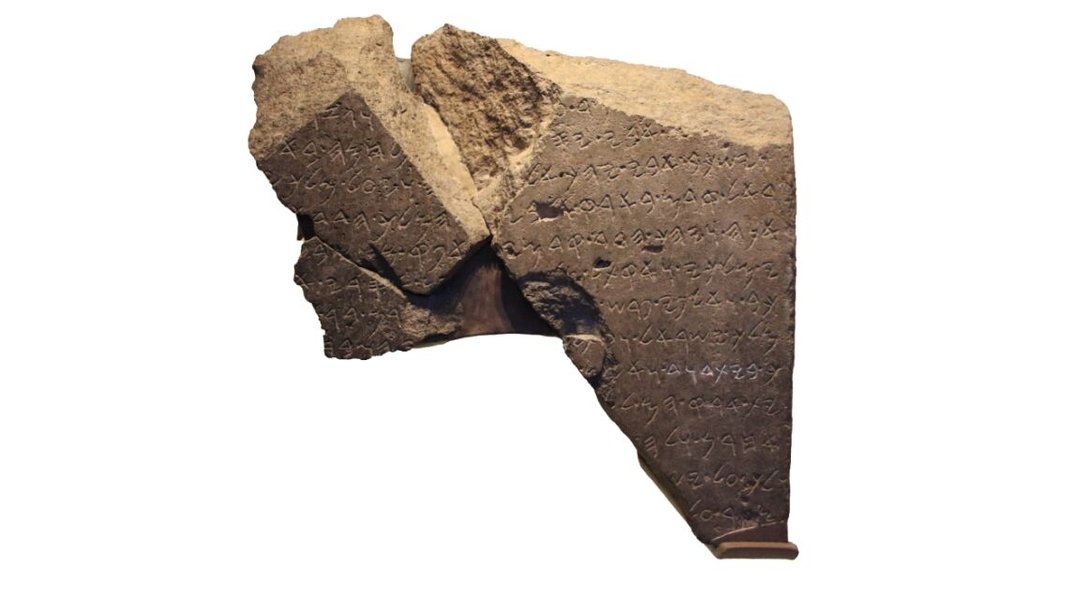
Fragments of the Tel Dan Stele, containing the crucial phrase "House of David".
The "House of David" Inscription
The most electrifying part of the inscription, found on Fragment A, contains the phrase "ביתדוד" (BYTDWD). Scholars overwhelmingly interpret this as "Beit David" or "House of David." In ancient Near Eastern contexts, "House of X" was a standard way to refer to the dynasty or kingdom founded by an individual named X. Therefore, the stele provides clear evidence that, in the 9th century BCE, a neighboring kingdom recognized a political entity in the south (Judah) identified with a founder named David.
Significance of the Find
The Tel Dan Stele is considered monumental because:
- It is the first, and still the only definitive, contemporary or near-contemporary extra-biblical reference to King David or his dynasty.
- It comes from an enemy source (an Aramean king), lending it credibility as it wasn't created for Judahite self-promotion.
- It directly counters the minimalist argument that David was unknown outside of later biblical tradition.
- It confirms that David was recognized not just as an individual, but as the founder of a significant political lineage or kingdom known to surrounding powers.
As biblical archaeologist Eric Cline noted, the discovery effectively ended the debate about whether David existed as a historical person for many mainstream scholars.
Corroborating Clues: Archaeology of the Davidic Era
While the Tel Dan Stele provides a name, other archaeological work helps flesh out the context of the period traditionally associated with David and his successor, Solomon (roughly the 10th century BCE).
Urban Centers and Fortifications
Evidence of an Organized State
Archaeologists have uncovered evidence of significant settlement and construction activity during the 10th century BCE in the region associated with the Kingdom of Judah. Key sites include:
- Khirbet Qeiyafa: A heavily fortified city overlooking the Elah Valley (where the Bible places the David and Goliath confrontation). Excavator Yosef Garfinkel argues its features—including casemate walls, a peripheral belt of houses, and two gates—are characteristic of early Judahite urban planning and date squarely to the time of David.
- Gezer, Hazor, and Megiddo: While often associated more directly with Solomon, the near-identical six-chambered gates found at these strategic sites suggest centralized planning and significant royal building projects during the early Israelite monarchy, fitting the biblical narrative of a developing kingdom initiated by David. Recent radiocarbon dating studies, like one at Gezer, help refine the chronology of this period.
- Network of Cities: Research by archaeologists like Garfinkel proposes a network of five fortified administrative centers (including Khirbet Qeiyafa, Beth Shemesh, Tell en-Naṣbeh, Khirbet ed-Dawwara, and Lachish) within Judah, suggesting a level of political organization and territorial control consistent with a nascent kingdom rather than scattered tribal settlements.
Jerusalem in David's Time
The Capital City Emerges
The Bible portrays Jerusalem as the capital established by David. Archaeological work in the oldest part of the city (often called the "City of David," south of the Temple Mount) has yielded relevant finds:
- The Large Stone Structure: Excavated by Eilat Mazar, this massive public building dates to the 11th-10th centuries BCE. Mazar controversially identified it as King David's palace, based on its location, scale, and dating. While the identification as *the* palace is debated, its existence points to significant monumental construction and political importance in Jerusalem during this period.
- Radiocarbon Dating: Recent large-scale radiocarbon studies (as reported in 2024) challenge older views that Jerusalem was merely a small hill village in the 10th century BCE. The results suggest a more substantial settlement, potentially supporting the biblical concept of it being a capital city.

Ongoing excavations in the City of David area of Jerusalem continue to reveal layers of history from various periods, including the time associated with King David.
Continuity of the Davidic Dynasty
Further indirect evidence comes from later periods. Inscriptions and seal impressions (bullae) bearing the names of later Judahite kings mentioned in the Bible, such as Ahaz, Hezekiah, and Uzziah—all described as descendants of David—have been found. While not proving David himself, they demonstrate the historical reality of the dynasty the Bible claims he founded, aligning with the "House of David" reference on the Tel Dan Stele.
Visualizing the Evidence Landscape
Mapping the Lines of Evidence
The evidence supporting the historicity of King David comes from multiple angles. This mindmap organizes the key categories of evidence discussed:
This visualization highlights how the Tel Dan Stele provides a crucial anchor point (epigraphic evidence), while various archaeological finds provide the physical context for a kingdom in Judah during the relevant period.
Scholarly Perspectives Compared
The interpretation of evidence often varies. This chart visualizes generalized scholarly viewpoints on different aspects related to King David's historicity, comparing older minimalist views with the current general consensus and more maximalist interpretations (which tend to accept more of the biblical narrative at face value). The scores (1-10) represent levels of confidence or acceptance based on available evidence, reflecting an opinionated analysis of scholarly trends.
As the chart illustrates, while the existence of David and his dynasty is now widely accepted (high scores in the consensus view), significant debate continues regarding the size of his kingdom (lower score for the United Monarchy) and the literal accuracy of all biblical details.
The Scholarly Landscape: Consensus and Continuing Debates
A Shift in Perspective
The cumulative weight of the Tel Dan Stele and corroborating archaeological finds has led to a significant shift in scholarship. While a few scholars maintain minimalist positions, the broad consensus now accepts that King David was a real historical figure who founded a dynasty and ruled a kingdom centered in Judah around 1000 BCE. The idea of him being purely mythical is no longer the prevailing view in mainstream academic circles.
The Nature and Scale of David's Kingdom
The primary area of ongoing debate concerns the size, power, and nature of David's kingdom. The Bible describes a vast "United Monarchy" encompassing both Israel (in the north) and Judah (in the south), with David ruling over extensive territories and numerous peoples. However, archaeological evidence for such a large, centralized state in the 10th century BCE remains debated.
- Some scholars argue that the archaeological evidence points to a smaller, though still significant, kingdom centered primarily in Judah. They suggest the concept of the grand United Monarchy might be a later idealization or exaggeration, possibly projecting the importance of the later Judahite kingdom back onto its founder.
- Other scholars maintain that the evidence from sites like Khirbet Qeiyafa, Jerusalem, and potentially the Solomonic gates, does support the existence of a more substantial, centrally organized kingdom, even if it didn't perfectly match every detail of the biblical description.
Therefore, while David's historicity is largely affirmed, understanding the precise political reality of his reign remains an active area of research and discussion, blending archaeological findings with critical analysis of the biblical texts.
Exploring the Evidence Visually
Insights from Archaeological Documentaries
Visual explorations can often provide a clearer understanding of archaeological sites and discoveries. The video below discusses some of the evidence related to King David's kingdom, offering perspectives on the findings and their interpretations. Watching such presentations can help contextualize the textual and archaeological data discussed.
This video, titled "New Evidence for King David's Kingdom," delves into archaeological discoveries presented as supporting the biblical accounts of David. It likely touches upon key sites and artifacts, including potentially the Tel Dan Stele or excavations in Jerusalem, illustrating how ongoing archaeological work continues to inform the discussion about the historical context of figures like King David.
Comparing Narratives: Bible vs. Archaeology
Points of Convergence and Divergence
Understanding the relationship between the biblical portrayal of David and the archaeological record requires comparing their claims. This table summarizes key aspects:
| Feature | Biblical Narrative | Archaeological Findings & Interpretation |
|---|---|---|
| Existence of David | Yes, foundational King of Israel & Judah | Strongly supported as a historical figure, founder of a recognized dynasty ("House of David" on Tel Dan Stele). |
| Capital City | Jerusalem, captured from Jebusites and significantly built up. | Evidence confirms Jerusalem as an important site in the 10th century BCE with monumental structures (e.g., Large Stone Structure) and signs of growing significance. |
| Kingdom Size | Large, United Monarchy spanning both Israel (North) and Judah (South), with regional influence. | Debated. Strong evidence for a significant Judahite kingdom. Extent of control over Israel and the scale of a "United Monarchy" archaeologically less certain and subject to interpretation. |
| Dynasty | Founded a long-lasting royal line ruling from Jerusalem. | Supported by the "House of David" inscription and later seals/inscriptions naming kings explicitly identified as his descendants in the Bible. |
| Timeline | Flourished around 1000 BCE. | Consistent with radiocarbon dating and material culture found at relevant archaeological sites (Iron Age IIA). |
The table shows significant convergence on David's existence, his connection to Jerusalem, the establishment of a dynasty, and the general timeframe. The main point of ongoing discussion remains the precise scale and political structure of his kingdom compared to the biblical description of the United Monarchy.
Frequently Asked Questions (FAQ)
What is the Tel Dan Stele and why is it so important?
The Tel Dan Stele is a broken stone slab inscribed in Aramaic, discovered in 1993 at Tel Dan in northern Israel. Dating to the 9th century BCE, it commemorates the victory of an Aramean king over the kings of Israel and Judah. Its immense importance lies in the fact that it contains the phrase "House of David" (BYTDWD), providing the first and only widely accepted extra-biblical historical evidence for King David's dynasty. It confirmed that a political entity associated with David was known to neighboring kingdoms roughly 150 years after his traditional reign.
Is the archaeological evidence for King David conclusive?
While the Tel Dan Stele is considered strong evidence for the *dynasty* of David, direct archaeological proof specifically naming *King David himself* from his own time (10th century BCE) is still lacking. However, the combination of the Stele, significant 10th-century BCE structures in Jerusalem (like the Large Stone Structure), fortified cities in Judah (like Khirbet Qeiyafa), and evidence for the continuity of the Davidic line has led most scholars to conclude that David was a historical figure. The evidence points strongly towards his existence, even if not every detail can be "proven" in the way a modern event can.
Did King David rule a large empire as the Bible describes?
This is a major point of ongoing scholarly debate. The Bible depicts a large "United Monarchy" under David and Solomon, spanning both Israel and Judah and influencing neighboring regions. While archaeology supports the existence of a significant kingdom centered in Judah during the 10th century BCE, the evidence for its control over Israel and its overall size matching the biblical description is less clear and interpreted differently by various scholars. Some argue the archaeological footprint aligns better with a strong regional kingdom in Judah, suggesting the biblical "empire" might be a later exaggeration or idealization. Others believe the evidence is consistent with a nascent large state.
What other evidence supports King David's existence?
Besides the Tel Dan Stele, supporting evidence is largely contextual:
- Archaeology of the Period: Discoveries like the fortifications at Khirbet Qeiyafa and the Large Stone Structure in Jerusalem show state-level activity in Judah during David's traditional timeframe.
- Dynastic Continuity: Inscriptions and seals from later centuries confirm the historical reality of kings (like Hezekiah) whom the Bible identifies as descendants of David, fitting the "House of David" concept.
- Biblical Narrative: While requiring critical reading, the detailed biblical accounts provide a narrative framework that aligns in many respects (timeline, location, key figures) with the archaeological context.
Has the view on King David changed over time?
Yes, significantly. Before the discovery of the Tel Dan Stele in 1993, skepticism about David's historicity was much more widespread, with some influential scholars ("minimalists") suggesting he was largely, if not entirely, a mythical figure created much later. The Stele provided the first concrete, non-biblical evidence linking the name David to a historical dynasty, forcing a major reassessment. Since then, further archaeological discoveries fitting the 10th-century BCE context have strengthened the case for a historical David, leading to the current consensus that accepts his existence as a real king, even while debating the specifics of his reign.
Recommended Further Exploration
- What does the Tel Dan Stele say exactly in translation?
- Explore the archaeological findings and significance of Khirbet Qeiyafa.
- Compare the archaeological evidence for the reigns of King David and King Solomon.
- Learn about the different scholarly views and debates on the United Monarchy in ancient Israel.
References
Last updated May 1, 2025