
Unraveling the Complex History: Who Was Truly Responsible for Jesus's Crucifixion?
Delving into the historical accounts to clarify the roles of Roman authorities and Jewish leadership in a pivotal ancient event.
The question of who bears responsibility for the death of Jesus of Nazareth is one that has echoed through centuries, often mired in misunderstanding and fraught with grave historical consequences. Understanding this event requires a careful examination of the political, religious, and social dynamics of first-century Judea, a land under Roman occupation.
Key Insights into a Complex Event
- Roman Execution: Historical consensus, supported by biblical accounts, indicates that Jesus was executed by crucifixion, a form of capital punishment exclusively administered by the Roman Empire. Pontius Pilate, the Roman governor of Judea, ultimately ordered the execution.
- Involvement of Jewish Authorities: Certain Jewish religious leaders and members of the Sanhedrin (the Jewish high council) played a significant role in Jesus's arrest and in pressuring Roman authorities for his condemnation, viewing him as a threat to religious and social order.
- Rejection of Collective Guilt: It is historically inaccurate and has been tragically harmful to attribute collective responsibility for Jesus's death to "the Israelites" or the entire Jewish people. Modern scholarship and many religious institutions vehemently reject this notion, which has fueled anti-Semitism for centuries.
The Historical Setting: Judea Under Roman Rule
In the first century CE, Judea was a province of the Roman Empire. While local Jewish authorities like the Sanhedrin had some degree of autonomy in religious and civil matters, the ultimate power, especially concerning capital punishment, rested with the Roman governor. Crucifixion was a brutal Roman method of execution, typically reserved for slaves, non-Roman citizens, and those accused of sedition or rebellion against Rome. It was not a traditional Jewish form of punishment.
Mihály Munkácsy's "Christ Before Pilate" illustrates the confrontation between Jesus and Roman authority.
The Roman Prerogative: Condemnation and Execution
The Gospels and historical analyses consistently identify Pontius Pilate as the official who condemned Jesus to death. Despite any expressed reservations or attempts to shift responsibility (as depicted in some accounts, like the washing of his hands), the legal authority to order a crucifixion in Judea lay with him. Roman soldiers carried out the sentence. Historians note that Jesus was one of thousands of Jews crucified by the Romans, often for reasons perceived as challenging Roman authority or stability.
Pontius Pilate's Decisive Role
Pilate, serving as the Roman prefect of Judea from approximately 26 to 36 CE, faced a volatile political climate. His primary responsibility was to maintain Roman order. While the Gospels portray him as somewhat reluctant, he ultimately yielded to pressure or perceived political necessity in ordering Jesus's crucifixion. The charge, from a Roman perspective, likely centered on sedition or claims of kingship ("King of the Jews"), which would have been seen as a direct challenge to Roman sovereignty and the Emperor.
The Involvement of Jewish Leadership
The New Testament accounts describe specific Jewish leaders, notably high-ranking priests associated with the Temple in Jerusalem and members of the Sanhedrin, as being instrumental in Jesus's arrest and accusation. These leaders, including the High Priest Caiaphas, reportedly viewed Jesus's teachings and growing popularity as a threat to their authority, established religious traditions, and potentially to the fragile peace with Rome. They feared that Jesus's activities might provoke a harsh Roman crackdown.

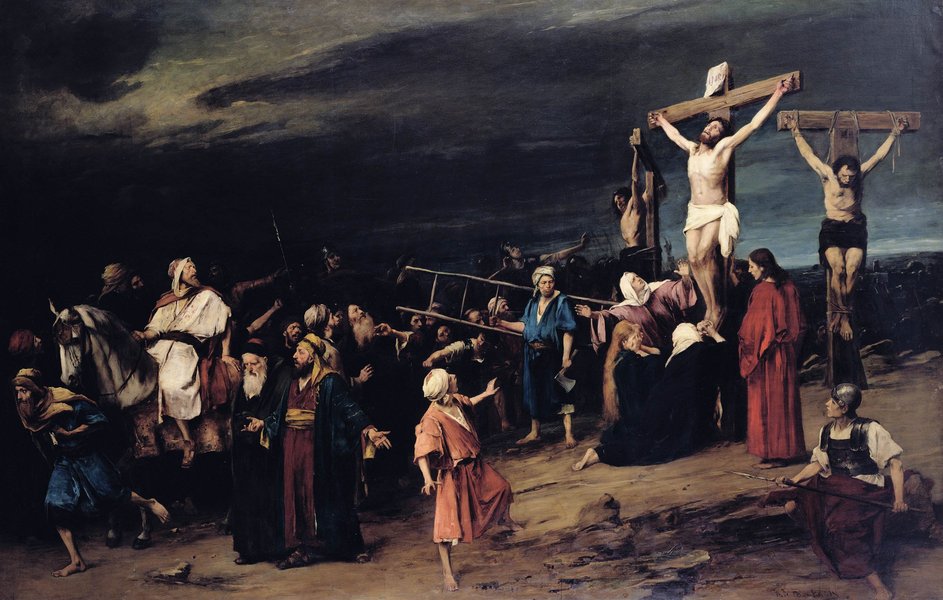
A depiction of the Crucifixion, highlighting the Roman method of execution.
Motivations and Actions
The motivations of these Jewish leaders were complex. Some may have genuinely believed Jesus was a blasphemer or a false prophet. Others were likely concerned about maintaining public order and avoiding Roman intervention, which could lead to loss of life and autonomy. The Gospels depict them arresting Jesus, interrogating him, and then bringing him before Pilate, demanding his execution. It's crucial to note that these were actions of a specific group of influential individuals in Jerusalem, not "the Israelites" or "the Jews" as a monolithic entity.
The Sanhedrin and Caiaphas
The Sanhedrin was the supreme Jewish legal and religious council. Caiaphas, as High Priest, held a significant position. According to the Gospel of John, Caiaphas argued it was "better for you that one man die for the people than that the whole nation perish" (John 11:50), suggesting a pragmatic, albeit harsh, political calculation to prevent a wider conflict with Rome. However, the Sanhedrin under Roman rule did not have the authority to carry out capital punishment by crucifixion for the charges leveled against Jesus.
The "Crowd" Element
Gospel narratives also mention crowds in Jerusalem calling for Jesus's crucifixion. The composition and motivations of this "crowd" are subjects of scholarly debate. It's unlikely to have represented the entire populace of Jerusalem, let alone all Jewish people in Judea or the broader "Israelite" identity. It may have consisted of specific factions influenced by the Temple leadership or agitated for various reasons.
Visualizing Spheres of Influence and Responsibility
The following chart attempts to visualize the relative degrees of influence and direct responsibility of the key groups involved in the events leading to Jesus's crucifixion, based on historical and biblical interpretations. The scales are qualitative and represent an analytical interpretation rather than precise empirical data.
This chart illustrates that Roman authorities held the ultimate power of execution. The Jewish Sanhedrin exerted significant political pressure and religious opposition, initiating arrest procedures. Segments of the crowd in Jerusalem, as depicted in the Gospels, contributed to popular incitement but had no direct authority.
Understanding the Key Actors and Their Roles
The following mindmap offers a simplified overview of the primary entities involved and their interconnected roles in the events culminating in Jesus's crucifixion.
(Religious, Social, Political)"] id2b["Initiated Arrest"] id2c["Accused Jesus before Pilate"] id2d["Lacked Authority for Crucifixion"] id3["Segments of Jerusalem Crowd"] id3a["Influenced by Leaders/Agitation"] id3b["Called for Crucifixion (Gospel Accounts)"] id4["Overarching Context"] id4a["Roman Occupation of Judea"] id4b["Political Tensions"] id4c["Religious Disputes"] id5["Misconception to Avoid"] id5a["Collective Guilt of 'The Israelites' or 'The Jews'"] id5a1["Historically Inaccurate"] id5a2["Source of Anti-Semitism"]
This mindmap highlights that while certain Jewish leaders accused Jesus and brought him to the Roman governor, it was Pontius Pilate and the Roman authorities who ultimately condemned and executed him using a distinctively Roman method.
Summary of Roles and Responsibilities
To clarify the distinct contributions of the primary groups involved, the following table outlines their roles based on historical and biblical sources:
| Entity | Primary Role in Events | Power to Execute by Crucifixion | Key Actions Documented |
|---|---|---|---|
| Roman Authorities (Pontius Pilate) | Final arbiter of Jesus's legal fate; ordered and oversaw execution. | Yes (Exclusive Roman authority) | Interrogated Jesus; sentenced Jesus to crucifixion; Roman soldiers performed the execution. |
| Jewish Leadership (Sanhedrin, Chief Priests) | Instigated arrest; accused Jesus; pressured Pilate for condemnation. | No (under Roman rule for this type of charge/punishment) | Arrested Jesus; held a form of trial/inquiry; presented Jesus to Pilate with accusations. |
| Segments of the Jerusalem Crowd | Voiced support for Jesus's crucifixion as depicted in Gospels. | No | Shouted demands for crucifixion (e.g., "Crucify him!"). |
| Jesus of Nazareth | Subject of accusations and execution. | N/A | Preached, gathered followers, challenged some existing authorities; willingly submitted to arrest according to theological views. |
This table underscores that while multiple actors were involved, the legal authority and physical act of crucifixion were Roman.
Addressing Misconceptions and the Danger of Collective Blame
For centuries, the narrative that "the Jews killed Jesus" has been tragically misused to justify persecution and violence against Jewish people (anti-Semitism). This charge, often called "deicide" (God-killing), is a distortion of history. As emphasized by modern historians and many Christian denominations (including the Catholic Church in documents like Nostra Aetate), responsibility for Jesus's death cannot be attributed to all Jews of that time, nor to Jewish people throughout history.
The actions were those of specific individuals and groups within a complex political and religious environment. Jesus himself was Jewish, his earliest followers were Jewish, and the events unfolded within a Jewish context in Roman-occupied Judea. Blaming an entire people for the actions of a few, or for a Roman execution, is a profound injustice.
This video discusses the historical misconceptions surrounding Jewish culpability in the death of Jesus and its role in fostering anti-Semitism.
The video above delves into how misinterpretations of the events surrounding Jesus's death have been used historically. It underscores the importance of relying on careful historical analysis rather than perpetuating harmful myths. Understanding the distinct roles of Roman power and specific Jewish leadership factions is crucial to dismantling these dangerous narratives.
Theological Interpretations
Beyond the historical question of human agency, many Christian theological perspectives interpret Jesus's death as part of a divine plan for human salvation. From this viewpoint, Jesus willingly laid down his life. While this theological framework offers a different layer of meaning, it does not alter the historical facts regarding who was involved in the earthly events of his trial and execution. Some theological interpretations even suggest a broader human responsibility for sin, making Jesus's sacrifice necessary for all humankind, thereby shifting focus from blaming any particular group.
Frequently Asked Questions (FAQ)
Who ultimately ordered Jesus's execution?
Pontius Pilate, the Roman governor of Judea, ultimately ordered Jesus's execution by crucifixion. This was a Roman legal decision and form of punishment.
What was the role of Jewish leaders in Jesus's death?
Certain Jewish leaders, including members of the Sanhedrin and high priests like Caiaphas, were involved in Jesus's arrest. They viewed him as a religious and social threat and handed him over to Pontius Pilate, urging his execution. However, they did not have the authority under Roman rule to carry out a crucifixion themselves.
Is it accurate to say "the Israelites" or "the Jews" killed Jesus?
No, this is inaccurate and a harmful generalization. The term "Israelites" refers to the ancient Jewish people. While specific Jewish leaders in Jerusalem were involved in the events leading to the crucifixion, the execution itself was performed by Romans. Blaming all Jewish people, then or now, is a historical distortion that has fueled anti-Semitism. Jesus and his early followers were themselves Jewish.
What was crucifixion?
Crucifixion was a brutal method of capital punishment used by the Roman Empire, particularly for slaves, rebels, and non-Roman citizens. It was designed to be a slow, agonizing, and public death, serving as a deterrent. It was not a Jewish form of punishment.
Why did some Jewish leaders want Jesus dead?
According to the Gospels, some Jewish leaders viewed Jesus's teachings as blasphemous and his claims as a challenge to their religious authority. They also feared that his popularity and messianic claims could incite unrest and lead to a violent Roman crackdown, endangering the Jewish people and their limited autonomy.
Recommended Further Exploration
- What was the political situation in Judea during the time of Jesus?
- Explore the historical evidence for Pontius Pilate's role in Roman Judea.
- How did early Christian writings shape the narrative about responsibility for Jesus's death?
- What is the historical impact of the 'deicide' charge against Jews?
References

Last updated May 12, 2025