
Unraveling Key Historical Concepts: From Urban Dwellings to Landmark Legal Battles
A comprehensive exploration of pivotal terms shaping social, economic, and political landscapes.
Key Insights into Historical Concepts
- Tenements were overcrowded urban dwellings that symbolized the harsh realities of industrialization and rapid immigration, leading to significant social reforms.
- Debt Peonage illustrates a pervasive system of coerced labor, akin to slavery, which trapped individuals through insurmountable debt, profoundly impacting marginalized communities.
- Plessy v. Ferguson established the legal precedent of "separate but equal," institutionalizing racial segregation and inequality across the United States for decades.
Decoding Foundational Terms in History
Understanding Urbanization and Labor Conditions
Tenements: The Heart of Urban Strain
Tenements were multi-family urban dwellings, predominantly seen in the late 19th and early 20th centuries, particularly in American cities like New York. They were typically narrow, low-rise apartment buildings, often five to seven stories tall, constructed to provide inexpensive housing for the influx of working-class immigrants and laborers. These buildings were notorious for their poor construction, lack of proper ventilation, insufficient natural light, and inadequate sanitation facilities. Many originated from subdivided single-family homes or older structures converted to accommodate more residents, often by adding floors or building in rear-yard areas. The Lower East Side in New York City became a central hub for such housing, highlighting the challenging living conditions brought about by rapid industrialization and population growth. The widespread issues of disease and fire risk associated with tenements eventually spurred reform efforts, culminating in legislation like the Tenement Act of 1901, which mandated improvements in ventilation, fire safety, and plumbing standards.
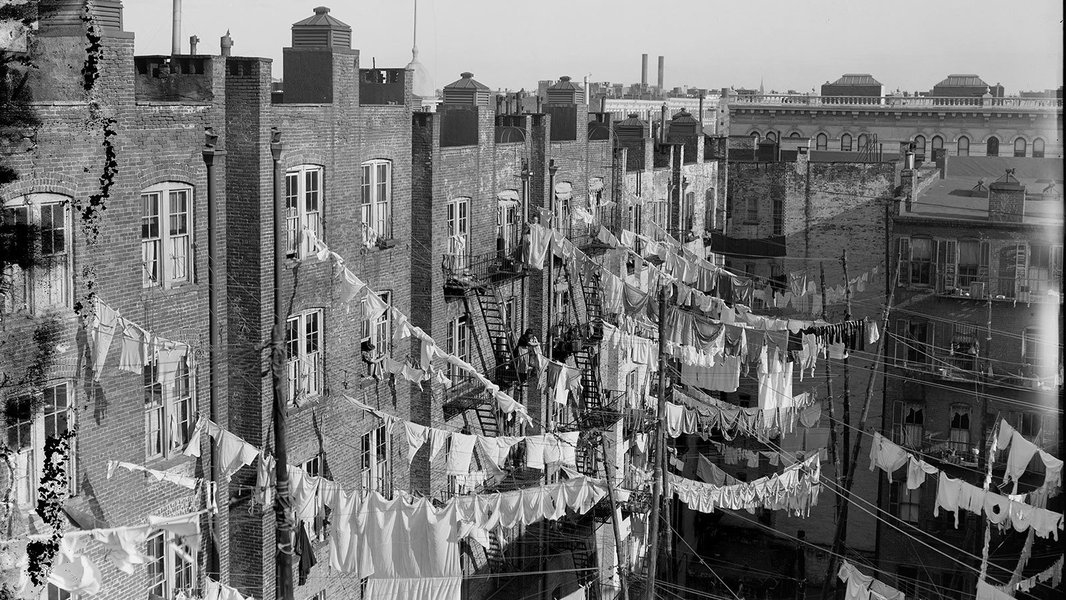
An illustrative depiction of a typical tenement building, characterized by its dense housing and limited amenities.
Strikes: The Voice of Labor
Strikes are organized work stoppages initiated by employees to exert pressure on employers. This form of collective action is typically undertaken to achieve better wages, improved working conditions, enhanced benefits, or recognition of labor rights. Historically, strikes have been a fundamental tool in the labor movement, particularly during periods of industrialization, enabling workers to challenge exploitative practices and demand fairer treatment. They represent a powerful expression of collective bargaining, demonstrating the solidarity and resolve of workers in their pursuit of equitable employment terms.
Anarchists: Advocates for Stateless Societies
Anarchists are individuals who adhere to anarchism, a political philosophy advocating for the abolition of all forms of hierarchical authority and coercive institutions, notably government. They strive for a society founded on voluntary cooperation, mutual aid, and free association, where individuals manage their own affairs without state control. Historically, anarchist movements have often emerged as radical responses to perceived governmental oppression, capitalist exploitation, and social inequality. While some anarchists advocate for peaceful means of achieving their goals, others have historically engaged in direct action, including protests, strikes, and sometimes even violent activities, as tactics to dismantle existing state and capital structures.
Debt Peonage: A Cycle of Servitude
Debt peonage, also known as debt slavery or bonded labor, is a coercive labor system where individuals are forced to work off a debt. This practice effectively traps laborers in a continuous cycle of servitude and poverty, as debts are often manipulated, inflated, or never fully repaid. This system restricts the autonomy of the worker, compelling them to remain with the creditor or employer until the debt is discharged. Historically, debt peonage was prevalent in various regions globally, including post-Civil War Southern United States, particularly among sharecroppers who were disproportionately African Americans, and also in parts of Latin America and Asia. Although legally outlawed, such as by the U.S. Congress in 1867, it persisted through various forms of coercion, vagrancy laws, and economic exploitation. Workers caught in this system were legally forbidden to leave their employer's property until the debt was paid, creating a state of involuntary servitude that often mirrored slavery. This system highlights how economic leverage can be used to deny fundamental freedoms and rights, limiting individual autonomy and providing cheap labor to owners of capital.
This video delves into the historical context of Neoslavery, including Debt Peonage and Jim Crow laws, providing crucial insights into systemic exploitation in the post-Civil War era.
Latifundia: Concentrated Land Ownership
Latifundia are vast landed estates or plantations, a term with historical roots in ancient Rome and widely applied to similar large properties, especially in Latin America. These estates are typically owned by wealthy elites and worked by peasants or laborers, often under exploitative arrangements. The existence of latifundia concentrates land ownership and wealth in the hands of a select few, which significantly limits land accessibility and economic autonomy for the majority of the rural population. This system often perpetuated social hierarchies and economic disparities, contributing to rural poverty and conflict over land rights.
Autonomy: The Right to Self-Governance
Autonomy refers to the condition or the right of self-government, self-rule, or self-determination. It describes the capacity of an individual, community, or political entity to govern itself independently, free from external control or undue influence. In contexts such as debt peonage, the limitation of autonomy refers to the restriction of producers' or laborers' independence due to their indebtedness, which binds them to a creditor and limits their freedom to act or move freely until their debt is repaid.
Peninsulares: Colonial Elites
In the social hierarchy of colonial Latin America, Peninsulares were individuals born in Spain (the Iberian Peninsula) who had migrated to the Spanish colonies. They occupied the highest social and political positions, holding significant power and prestige. This group maintained dominance over other social classes, including the Criollos (Creoles)—those of Spanish descent born in the Americas—and the indigenous populations, largely due to their birthplace in the colonizing power.
Native American History and Government Policy
Indian Removal Act: Forced Displacement
The Indian Removal Act, enacted by the U.S. federal government in 1830, authorized the forced relocation of Native American tribes residing east of the Mississippi River to lands situated west of the river. This policy resulted in the tragic "Trail of Tears," a series of forced displacements during which thousands of Native Americans, including the Cherokee, Creek, Choctaw, Chickasaw, and Seminole nations, endured immense suffering, disease, and death as they were forcibly moved from their ancestral lands. The act reflected a broader federal policy aimed at expanding American settlement and cotton production in the Southeast, disregarding established treaties and Native American sovereignty.
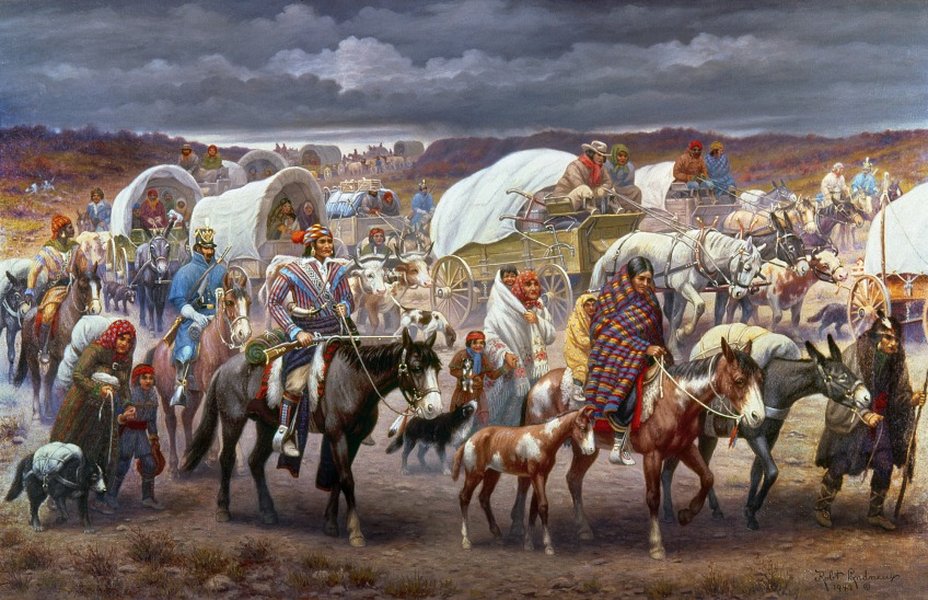
A poignant illustration of the "Trail of Tears," a direct consequence of the Indian Removal Act.
Ghost Dance: A Spiritual Resistance
The Ghost Dance was a spiritual movement that emerged among various Native American tribes in the late 19th century. This religious revitalization movement prophesied the restoration of Native lands, the return of the buffalo, and the disappearance of white settlers, offering hope and a renewed sense of cultural identity amidst increasing pressures from the U.S. government. Adherents believed that performing the dance would bring about these changes and lead to a peaceful renewal of their traditional way of life. However, the movement was often viewed with suspicion by U.S. authorities, culminating in heightened tensions that were a factor leading to the tragic Wounded Knee Massacre in 1890.
Canadian Indian Act: Assimilation and Control
The Indian Act, first enacted in 1876, is a Canadian federal law that regulates the relationship between Indigenous peoples (First Nations, Métis, and Inuit) and the Canadian government. This comprehensive legislation governs aspects such as Indian status, band membership, reserves, and various facets of Indigenous governance, land use, and cultural practices. Historically, the Indian Act has been widely criticized for its role in enforcing policies of assimilation and control over Indigenous populations, contributing to systemic discrimination and the erosion of Indigenous cultures and self-determination. It continues to be a subject of ongoing debate and reform efforts in Canada.
Immigration, Segregation, and Civil Rights
Chinese Exclusion Act: Restricting Immigration
The Chinese Exclusion Act, passed in 1882, was a landmark U.S. federal law that prohibited Chinese laborers from immigrating to the United States and barred Chinese immigrants already residing in the country from naturalizing as U.S. citizens. This act marked the first significant federal law in U.S. history to restrict immigration based on nationality or ethnicity, reflecting widespread anti-Chinese sentiment and economic anxieties of the time. The act remained in effect for over 60 years, profoundly impacting Chinese communities in the U.S. and setting a precedent for future restrictive immigration policies.
Jim Crow Laws: Institutionalized Segregation
Jim Crow laws were state and local statutes enacted primarily in the Southern United States from the late 19th century through the mid-20th century. These laws enforced racial segregation and mandated "separate but equal" facilities for Black and white Americans, institutionalizing systemic discrimination and disenfranchisement of African Americans. They covered various aspects of public life, including education, transportation, housing, and public services, creating a deeply entrenched system of racial inequality. These laws were upheld by the Supreme Court's "separate but equal" doctrine in the Plessy v. Ferguson case, becoming the legal basis for racial segregation for over fifty years.
Plessy v. Ferguson: A Landmark Decision on Segregation
Plessy v. Ferguson was a landmark U.S. Supreme Court case decided on May 18, 1896, that upheld the constitutionality of racial segregation under the "separate but equal" doctrine. The case originated in 1892 when Homer Plessy, an African American man who was seven-eighths white, intentionally sat in a "whites-only" car on a Louisiana train to challenge the state's Separate Car Act of 1890, which required "equal, but separate" accommodations for white and Black passengers. Plessy was arrested and charged, and his lawyers argued that the act violated the Thirteenth and Fourteenth Amendments, which guarantee equal treatment under the law. Judge John H. Ferguson ruled against Plessy, asserting Louisiana's right to regulate railroad companies within state boundaries. The U.S. Supreme Court ultimately affirmed this ruling, concluding that segregation did not imply inferiority as long as the separate facilities were equal. This decision became the legal foundation for racial segregation in the United States for nearly six decades, providing judicial sanction for Jim Crow laws and contributing significantly to widespread racial inequality until it was eventually overturned by Brown v. Board of Education in 1954.
Social Reform and Economic Power
Muckrakers: Exposing Injustice
Muckrakers were investigative journalists and writers in the early 20th century who gained prominence for exposing widespread corruption, social injustices, and abuses in politics, industry, and urban life. Their influential investigative reporting, published in popular magazines and books, played a crucial role in raising public awareness about societal problems and spurred significant progressive reforms during the Progressive Era in the United States. They often focused on issues such as corporate monopolies, poor working conditions, political corruption, and unsanitary food production.
Monopoly: Exclusive Market Control
A monopoly occurs when a single company or entity possesses exclusive control over the supply of a particular commodity, product, or service within a given market. This exclusive control effectively eliminates competition, allowing the monopolist to dictate prices, limit consumer choice, and potentially suppress innovation without fear of rivals. Monopolies can arise through various means, including natural market forces, government grants, or aggressive business practices that eliminate competitors. Due to their potential for consumer exploitation and market distortion, monopolies often necessitate government intervention, such as antitrust laws, to promote fair competition and protect consumer interests.
Suffrage: The Right to Vote
Suffrage refers to the right to vote in political elections. The term is most commonly associated with historical and ongoing movements advocating for the extension of voting rights to disenfranchised groups, such as women, racial minorities, and other marginalized populations. The struggle for universal suffrage has been a central theme in democratic movements worldwide, reflecting the belief that all adult citizens should have a voice in their governance.
19th Amendment: Women's Right to Vote
The 19th Amendment to the U.S. Constitution, ratified in 1920, granted women the right to vote. This landmark amendment marked a significant victory for the women's suffrage movement, culminating decades of activism and advocacy. By prohibiting discrimination in voting rights based on sex, the 19th Amendment fundamentally expanded democratic participation in the United States, affirming women's equal standing in the political process.
Military and International Conflicts
Cavalry: Mounted Warfare
Cavalry refers to military troops who are trained to fight on horseback. Historically, cavalry units played a crucial role in warfare, valued for their rapid movement, shock tactics, and ability to conduct reconnaissance and pursue retreating enemies. Before the advent of mechanized vehicles, cavalry was indispensable for flanking maneuvers, delivering decisive charges, and providing strategic advantages on the battlefield. Their significance diminished with the modernization of armies and the development of tanks and other armored vehicles in the 20th century.
Boers: Dutch Settlers in South Africa
The Boers were descendants of Dutch settlers who established communities in South Africa, primarily as farmers, beginning in the 17th century. They developed a distinct culture and language (Afrikaans) and were known for their independent spirit. In the late 19th and early 20th centuries, the Boers engaged in significant conflicts with British imperial forces during the Boer Wars. These conflicts, driven by issues of land, resources (especially gold and diamonds), and sovereignty, saw the Boers employing effective guerrilla tactics against the larger, more conventional British army.
Guerrilla Warfare: Irregular Tactics
Guerrilla warfare is a form of irregular warfare characterized by small, often lightly armed groups using tactics such as ambushes, sabotage, raids, and hit-and-run attacks against a larger, less mobile, and often more conventional military force. This strategy emphasizes mobility, surprise, and exploiting the terrain to offset disadvantages in conventional military strength. Guerrilla forces often operate from within the civilian population, relying on local support and knowledge of the environment to conduct prolonged resistance campaigns against occupying forces or established governments.
Genocide: Systematic Extermination
Genocide is the deliberate and systematic destruction, in whole or in part, of a national, ethnic, racial, or religious group. This grave crime encompasses a range of acts intended to bring about the physical destruction of such a group, including killing its members, causing serious bodily or mental harm, deliberately inflicting conditions of life calculated to bring about its physical destruction, imposing measures intended to prevent births within the group, and forcibly transferring children of the group to another group. The concept of genocide was formalized in international law following the Holocaust, aiming to prevent and punish such atrocities.
Comparative Analysis of Historical Terms
To further contextualize the historical significance and impact of these terms, we can compare them across several dimensions. This radar chart visualizes the relative impact and scope of select terms, offering an opinionated analysis of their influence on society, economy, and political structures. Higher values indicate a greater perceived impact or relevance in that dimension.
This chart provides a nuanced perspective on the multifaceted impacts of these historical concepts, illustrating how they intersect and diverge in their influence on human societies.
Interconnectedness of Historical Concepts: A Mindmap
The following mindmap illustrates the complex relationships and overlaps between various historical concepts discussed, emphasizing their interconnectedness and influence on one another. This visual representation helps in understanding how developments in one area, such as legal precedents or social conditions, can influence others.
Summary Table of Key Historical Terms
This table provides a concise overview of the 21 historical terms, highlighting their core definitions and broader significance. It serves as a quick reference for understanding their individual meanings and collective impact on historical narratives.
| Term | Definition | Significance/Context |
|---|---|---|
| Tenements | Overcrowded, poorly built urban apartment buildings. | Symbolized harsh living conditions during industrialization; spurred housing reforms. |
| Strikes | Organized work stoppages by employees. | Fundamental tool for collective bargaining and labor rights advocacy. |
| Anarchists | Advocates for stateless, self-managed societies without hierarchical authority. | Often a radical response to state oppression and social inequality. |
| Debt Peonage | System where laborers are bound in servitude due to manipulated debts. | A form of coerced labor akin to slavery, prevalent post-Civil War in the U.S. South. |
| Latifundia | Large landed estates, especially in Latin America. | Concentrated land ownership, perpetuating economic disparities and limiting peasant autonomy. |
| Autonomy | The condition or right of self-government or self-rule. | Crucial for individuals, communities, and political entities to govern independently. |
| Peninsulares | Spaniards born in Spain residing in colonial Latin America. | Held highest social and political status, dominating colonial hierarchy. |
| Indian Removal Act | U.S. federal law authorizing forced relocation of Native American tribes (1830). | Led to the "Trail of Tears," causing immense suffering and displacement. |
| Ghost Dance | Native American spiritual movement (late 19th century). | Prophesied restoration of lands; contributed to tensions leading to Wounded Knee Massacre. |
| Canadian Indian Act | Canadian law regulating affairs related to Indigenous peoples (1876). | Historically enforced assimilation policies; ongoing subject of reform. |
| Chinese Exclusion Act | U.S. federal law prohibiting Chinese immigration (1882). | First significant law restricting immigration based on nationality/ethnicity. |
| Jim Crow Laws | State and local laws enforcing racial segregation in the U.S. South. | Institutionalized systemic discrimination and disenfranchisement of Black Americans. |
| Plessy v. Ferguson | Landmark U.S. Supreme Court case upholding "separate but equal" doctrine (1896). | Legalized racial segregation for decades, reinforcing Jim Crow laws. |
| Muckrakers | Investigative journalists exposing corruption and social injustices (early 20th century). | Helped spur progressive reforms during the Progressive Era. |
| Monopoly | Exclusive control of a commodity or service in a market. | Eliminates competition, allows price manipulation; often requires government intervention. |
| Suffrage | The right to vote in political elections. | Central to democratic movements, advocating voting rights for disenfranchised groups. |
| 19th Amendment | Amendment granting women the right to vote (1920). | Significant victory for the women's suffrage movement; expanded democratic participation. |
| Cavalry | Military troops trained to fight on horseback. | Historically used for rapid movement and combat before mechanization. |
| Boers | Descendants of Dutch settlers in South Africa. | Fought British forces in Boer Wars, employing guerrilla tactics. |
| Guerrilla warfare | Irregular warfare using small groups, ambushes, and raids against larger forces. | Emphasizes mobility and surprise, common in resistance campaigns. |
| Genocide | Deliberate and systematic extermination of a national, racial, ethnic, or religious group. | Grave crime against humanity, defined in international law post-Holocaust. |
Frequently Asked Questions (FAQ)
What was the primary impact of the Plessy v. Ferguson decision?
How did tenements contribute to urban social issues?
What is the core principle of debt peonage?
Who were the Muckrakers and what was their significance?
Conclusion
The terms defined herein represent pivotal moments and concepts that have profoundly shaped social, economic, and political landscapes throughout history. From the challenges of urban living in tenements and the systemic exploitation of debt peonage to the landmark legal battle of Plessy v. Ferguson and the fight for voting rights symbolized by the 19th Amendment, each term provides a window into the complexities of human experience. Understanding these concepts offers crucial insights into the evolution of societies, the struggles for equality, and the continuous efforts to address injustice and foster progress. Their interconnectedness underscores how historical events and movements are rarely isolated, but rather part of a larger tapestry of human development and conflict.
Recommended Further Exploration
- Explore the lasting impact of industrialization on urban development and housing.
- Delve deeper into the history of labor movements and the fight for workers' rights.
- Investigate the comprehensive evolution of civil rights and racial equality in the United States.
- Examine global instances of coerced labor and contemporary forms of modern slavery.