
Unlocking the Secrets of Mahjong: A Comprehensive Guide to Play and Strategy
Delve into the captivating world of Mahjong, from foundational rules to advanced winning tactics.
Key Insights into Mastering Mahjong
- Mahjong is a captivating tile-based game that combines skill, strategy, and a touch of luck, offering a rich and engaging experience for four players.
- The primary objective across most variations is to form a winning hand, typically consisting of four sets (pungs, chows, or kongs) and one pair, declared as "Mahjong."
- Strategic play involves careful observation of opponents, flexible hand development, and understanding tile efficiency, significantly increasing your chances of victory.
Mahjong, a revered tile-based game originating in 19th-century China, has captivated players globally with its intricate blend of strategy, skill, and an element of chance. Similar in concept to the Western card game Rummy, Mahjong involves drawing and discarding tiles to form specific combinations. While numerous regional variations exist—from the traditional Chinese game to the distinct American Mahjong with its annual scoring cards—the core objective remains consistent: to be the first player to form a complete winning hand. This guide will walk you through the fundamental rules, setup, gameplay mechanics, and essential strategies to help you embark on your Mahjong journey.
Decoding the Mahjong Set: Tiles and Their Significance
A standard Mahjong set typically comprises 144 tiles, though some variations may include additional or fewer tiles. Understanding the different types of tiles is crucial for effective play.
The Building Blocks: Tile Categories
- Suit Tiles: These are the most numerous and are divided into three suits, each numbered 1 through 9, with four identical copies of each tile:
- Bamboos (Bams): Represented by bamboo sticks.
- Characters (Cracks or Crak): Depicting Chinese characters.
- Dots (Circles or Dot): Showing circles.
- Honor Tiles: These special tiles do not belong to any suit and are crucial for forming valuable sets:
- Winds: East, South, West, and North (four of each).
- Dragons: Red Dragon, Green Dragon, and White Dragon (four of each).
- Bonus Tiles (Optional): Some variations, particularly American Mahjong, include these tiles, which can significantly enhance scoring:
- Flowers: Often depict different flowers.
- Seasons: Represent the four seasons.
- Jokers: Wildcard tiles that can substitute for other tiles in certain combinations, primarily in American Mahjong.
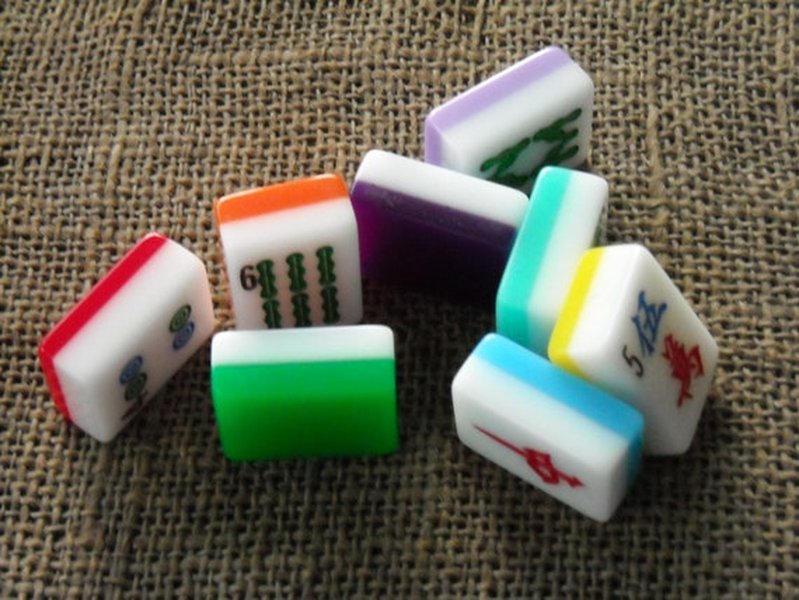
A diverse collection of Mahjong tiles, showcasing the intricate designs of suit and honor tiles.
Setting the Stage: The Mahjong Game Setup
Mahjong is typically played with four players around a square table. The setup ritual is an integral part of the game, steeped in tradition and symbolism.
The Ritual of the Wall
After shuffling all tiles face-down in the center of the table (often called "the dance"), each player constructs a "wall" of tiles in front of them. This involves stacking tiles two high and arranging them in a line. The total number of tiles per wall depends on the variant, but a common practice involves each player building a wall of 18 stacks (36 tiles total), forming a square in the center, symbolizing the Great Wall of China.

The "Great Wall" of Mahjong tiles, built by four players around the table, signifying the beginning of the game.
Determining the Dealer and Initial Deal
A starting dealer (East Wind) is determined, often by rolling dice or drawing wind tiles. The dealer then rolls two dice to determine where to "break the wall" and begin the deal. Tiles are dealt counter-clockwise, with each player receiving an initial hand of 13 tiles, except the dealer who gets 14 (or 13 and then draws a 14th to start the game). These tiles are placed on a rack in front of each player, hidden from opponents.
Gameplay Mechanics: Drawing, Discarding, and Forming Melds
The heart of Mahjong lies in the cyclical process of drawing, discarding, and strategically claiming tiles to form valid combinations, known as "melds."
The Flow of Play
The game proceeds in turns, moving counter-clockwise. On a player's turn, they draw a new tile from the wall. They then assess their hand and discard one tile face-up into the discard pile in the center. The goal is to accumulate sets and a pair to declare Mahjong. If no one calls for a discarded tile, the turn passes to the next player. If the wall runs out before a Mahjong is declared, it's typically a draw, and the dealer redeals.
Understanding Melds: The Path to Mahjong
A winning Mahjong hand typically consists of four sets and one pair (an "eye"). There are three main types of sets:
- Pung (碰): Three identical tiles. A player can call "Pung!" to claim the most recently discarded tile if it completes three identical tiles. When claimed, the pung is exposed face-up on the player's rack.
- Chow (吃): A sequence of three consecutive numbers in the same suit (e.g., 3, 4, 5 of Bamboos). A player can call "Chow!" to claim the most recently discarded tile if it completes a chow, but only if it's discarded by the player to their immediate left. The chow is then exposed.
- Kong (槓): Four identical tiles. A player can call "Kong!" to claim a discarded tile that completes four identical tiles. If they form a kong from their hand, they can also declare it. Upon forming a kong, the player draws an extra tile from the end of the wall. Kongs can be "exposed" or "concealed" depending on how they are formed.
- Pair (眼): Two identical tiles. A pair is necessary to complete a Mahjong hand but cannot be formed by claiming a discarded tile unless it completes the entire winning hand.
The "Charleston" (American Mahjong)
Unique to American Mahjong, the "Charleston" is a tile-passing ritual performed at the beginning of each hand, before regular play begins. Players pass three tiles to the right, then three tiles across, and finally three tiles to the left (with optional second passes). This adds an extra layer of strategy and luck, as players try to improve their hands before the main game even starts.
Understanding the dynamic gameplay of American Mahjong, including the "Charleston" and turn-based actions.
Winning the Game: Declaring Mahjong and Scoring
The game concludes when a player forms a complete hand and declares "Mahjong!" The scoring system can vary significantly depending on the Mahjong variant being played.
The Winning Hand
To win, a player must collect 14 tiles that form four melds (pungs, chows, or kongs) and one pair. The 14th tile is typically drawn from the wall or claimed from a discard. Once a player achieves this, they declare "Mahjong" and reveal their hand.
Scoring Systems
Scoring in Mahjong can be one of the most complex aspects, with different variations using distinct point systems. Some systems reward specific tile combinations ("fans" or "doubles"), while others, like American Mahjong, rely on a National Mah Jongg League (NMJL) card which lists specific winning hands and their point values. Concealed melds (those formed entirely from tiles in a player's hand without claiming discards) are generally worth more points than exposed melds.
Strategic Maneuvers: Enhancing Your Mahjong Game
While luck plays a role in the tiles you draw, Mahjong is undeniably a game of skill and strategy. Developing a keen eye for your hand and your opponents' discards can significantly increase your winning chances.
Key Strategic Principles
- Early Hand Assessment: Upon receiving your initial tiles, quickly assess potential winning hands. In American Mahjong, this involves consulting the NMJL card to find hands that align with your tiles. In other variants, look for existing pairs, potential chows, and pungs.
- Flexibility: Don't commit to a hand too early, especially if your tiles don't strongly support it. Be prepared to shift your strategy based on the tiles you draw and discard, as well as what your opponents are doing.
- Observing Opponents: Pay close attention to the tiles your opponents discard and claim. This can provide valuable clues about what hands they are trying to build and what tiles are "safe" to discard. For instance, if an opponent discards many character tiles, they might not be building a hand in that suit.
- Tile Efficiency: Maximize the potential of your tiles. For example, a 1-4-7 rule suggests that if a player discards a 4, and you can't use it, a 1 or 7 might also be relatively safe to discard later, as they often combine with the 4.
- Discard Strategy: Be mindful of your discards. Avoid discarding "live" tiles (those that could complete an opponent's meld) if possible. Sometimes, discarding a tile that an opponent needs can be unavoidable, but smart discards can limit their progress.
- Value Tiles: In many variations, "Wind" and "Dragon" tiles are considered "value tiles" and can contribute significantly to scoring when forming sets or pairs with them.
Strategic Insights at a Glance
To further illustrate the multifaceted nature of Mahjong strategy, consider the following radar chart. It visually represents the importance of different strategic elements, emphasizing that a balanced approach often leads to success.
This radar chart illustrates that while beginners might focus more on basic hand planning and observing discards, advanced players consistently excel across all strategic dimensions, emphasizing flexibility, precise tile efficiency, and comprehensive risk assessment. The higher scores for advanced players reflect their deeper understanding and application of these principles in dynamic gameplay.
Variations and Nuances
It's important to remember that Mahjong has many variations, and the rules can differ significantly between regions and even within communities. Always clarify the specific rules with your fellow players before starting a game to ensure a smooth and enjoyable experience.
Common Mahjong Rule Variants
The table below highlights some key differences across popular Mahjong variations.
| Feature | Traditional Chinese Mahjong | American Mahjong | Riichi Mahjong (Japanese) |
|---|---|---|---|
| Winning Hand Structure | 4 sets (pungs/chows) + 1 pair | Based on annual NMJL card (specific combinations) | 4 sets (pungs/chows/kongs) + 1 pair, with specific Yaku (scoring patterns) |
| Tile Set Size | Typically 136-144 tiles | Typically 152-166 tiles (includes Jokers, Flowers, Seasons) | Typically 136 tiles |
| Initial Tile Pass | No specific passing ritual | Mandatory "Charleston" passing ritual | No specific passing ritual |
| Scoring System | Based on "fans" or "doubles" for various combinations | Fixed point values on the NMJL card | Complex system involving "Yaku" (scoring patterns) and "Dora" (bonus tiles) |
| Special Rules | Emphasis on concealed vs. exposed hands, specific winning patterns | Jokers, Quints (5 identical tiles), Sextets (6 identical tiles) | Riichi declaration, Dora indicators, Ura-Dora, Red Five tiles |
This table serves as a general overview, and each variant itself can have numerous sub-variants and house rules. The core principles of drawing, discarding, and forming combinations generally apply, but the nuances of winning hands and scoring will be game-specific.
Frequently Asked Questions (FAQ)
What is the main goal of Mahjong?
How many players are needed for a Mahjong game?
What are the different types of tiles in Mahjong?
What is a "Chow," "Pung," and "Kong" in Mahjong?
Is Mahjong purely a game of luck?
Conclusion: The Enduring Appeal of Mahjong
Mahjong is more than just a game; it's a cultural phenomenon that offers endless hours of engaging play. Its blend of luck and strategic depth ensures that no two games are exactly alike. By understanding the tile types, mastering the setup and gameplay mechanics, and applying strategic principles, you can confidently approach the Mahjong table. Remember to clarify specific rules with your fellow players, as regional variations abound. Whether you're aiming for a casual pastime or competitive mastery, the journey of learning Mahjong is a rewarding one, filled with intellectual challenge and social interaction. Embrace the clacking of the tiles and the thrill of declaring "Mahjong!"
Recommended Further Exploration
- Explore advanced Mahjong strategy for different game variants.
- Delve deeper into the intricacies of Mahjong scoring systems.
- Discover the rich history and cultural significance behind the game of Mahjong.
- Learn the specific rules and unique aspects of American Mahjong using the NMJL card.
References

Last updated May 21, 2025