
Unveiling the Web's Hierarchy: How Sites Get Ranked
Explore the world's top websites and the complex factors determining their online visibility.
While you asked to "rank these," the specific items weren't provided. However, based on common interpretations and available information, this response explores two key aspects of ranking on the internet:
- The current ranking of the most visited websites globally.
- How search engines, particularly Google, rank websites based on various factors (Search Engine Optimization or SEO).
Highlights: Understanding Website Rankings
- Top Global Websites: As of early 2025, giants like Google, YouTube, Facebook, Instagram, and X (formerly Twitter) dominate global web traffic, reflecting their integral role in search, entertainment, and social networking.
- Google's Ranking Mechanism: Google utilizes complex, constantly evolving algorithms that assess hundreds of signals to rank websites, primarily focusing on content relevance, quality, authoritativeness, and user experience.
- The Role of SEO: Achieving high rankings requires Search Engine Optimization (SEO), a multi-faceted process involving optimizing website content (on-page SEO), building authority through external links (off-page SEO), and ensuring technical soundness (technical SEO).
Top Visited Websites Globally (Early 2025)
Understanding which websites attract the most visitors provides insight into current internet usage trends. Based on data from Similarweb as of February 1, 2025, here are some of the most popular websites worldwide:
- google.com (Search Engines)
- youtube.com (Streaming & Online TV)
- facebook.com (Social Media Networks)
- instagram.com (Social Media Networks)
- x.com (Social Media Networks)
- whatsapp.com (Social Media Networks)
- wikipedia.org (Dictionaries and Encyclopedias)
- chatgpt.com (Programming and Developer Software)
- reddit.com (Social Media Networks)
- yahoo.co.jp (News & Media Publishers)
- yahoo.com (News & Media Publishers)
- yandex.ru (Search Engines)
- amazon.com (Marketplace)
- tiktok.com (Social Media Networks)
- baidu.com (Search Engines)
- netflix.com (Streaming & Online TV)
- bing.com (Search Engines)
- linkedin.com (Social Media Networks)
- pornhub.com (Adult)
- microsoftonline.com (Programming and Developer Software)
- dzen.ru (Community and Society)
- naver.com (News & Media Publishers)
- live.com (Email)
- office.com (Programming and Developer Software)
- bilibili.com (Animation and Comics)
Note: This list includes the top 25 from the source provided in the research data and reflects rankings based on estimated traffic. Adult sites were included as per the source data. Rankings can fluctuate frequently.
How Search Engines Rank Websites: The SEO Factor
Getting a website listed high in search engine results pages (SERPs), like those on Google, doesn't happen by chance. It's the result of Search Engine Optimization (SEO) – the practice of optimizing a website to meet the criteria used by search engine algorithms.
Google's Algorithmic Approach
Google's ranking system is incredibly complex, relying on numerous algorithms that analyze hundreds of different signals to determine which pages best answer a user's query. Key goals of these algorithms include:
- Understanding the meaning and intent behind a user's search query.
- Assessing the relevance of web pages to that query.
- Evaluating the quality and authoritativeness of the content.
- Measuring the usability and user experience of the pages.
- Considering the context, such as the user's location, search history, and settings.
These algorithms are constantly updated to improve search quality and combat manipulative tactics, meaning SEO requires ongoing effort and adaptation.
Core Pillars of Website Ranking
While the exact weighting of factors is secret and changes over time, SEO efforts generally focus on three main pillars:
1. On-Page SEO: Optimizing Your Content and Structure
This involves optimizing elements directly on your website pages.
- Keyword Research & Integration: Identifying the terms your target audience searches for and naturally incorporating them into titles, headings, body text, image alt text, and meta descriptions. This helps Google understand what your page is about.
- High-Quality Content: Creating original, comprehensive, accurate, and engaging content that fully addresses the user's search intent. Google prioritizes helpful, reliable, people-first content. Freshness and regular updates can also be beneficial.
- Page Structure & Formatting: Using clear headings (H1, H2, H3, etc.), bullet points, short paragraphs, and relevant images or videos to make content easy to read and digest.
- Internal Linking: Linking relevant pages within your own website helps users navigate and search engines understand the site structure and relationship between pages.
- URL Optimization: Using short, descriptive URLs that include relevant keywords.
2. Off-Page SEO: Building Authority and Trust
This focuses on actions taken outside your own website to impact your rankings.
- Backlinks: Earning links from other reputable, relevant websites is one of the most crucial ranking factors. These links act as "votes of confidence," signaling to Google that other sites trust your content. Quality matters more than quantity.
- Brand Mentions & Citations: Mentions of your brand or website, even without a direct link (co-citations), can contribute to perceived authority.
- Social Signals: While not a direct ranking factor, shares and engagement on social media can increase visibility and indirectly lead to more backlinks and traffic.
3. Technical SEO: Ensuring Accessibility and Performance
This ensures that search engines can easily crawl, index, and understand your website, and that users have a good experience.
- Website Speed: Fast-loading pages are crucial for user experience and are a confirmed ranking factor. Tools like Google's PageSpeed Insights can help identify performance bottlenecks.
- Mobile-Friendliness: With most searches happening on mobile devices, having a responsive website that adapts to different screen sizes is essential (mobile-first indexing).
- Site Architecture: A logical site structure makes it easy for users and search engines to find content. An XML sitemap helps search engines discover all your important pages.
- Crawlability & Indexability: Ensuring search engine bots can access and understand your content (using robots.txt correctly, avoiding crawl errors).
- HTTPS Security: Using HTTPS encrypts data between the user's browser and the website, providing security and trust, which is a ranking signal.
- Schema Markup: Adding structured data markup helps search engines understand the context of your content better and can enable rich snippets (e.g., ratings, prices) in search results.
Visualizing Ranking Factors
Mindmap of Key SEO Components
This mindmap illustrates the interconnected nature of the primary areas involved in optimizing a website for better search engine rankings.
Comparative Analysis of Website Types by Ranking Potential
Different types of websites inherently possess varying strengths regarding factors that influence rankings. This radar chart provides a hypothetical comparison across key dimensions often associated with ranking potential. Note that this is an illustrative analysis based on general characteristics, not precise data.
This chart visually suggests how different website categories might score across factors like 'Authority & Trust', 'Content Depth & Quality', 'User Engagement', 'Content Freshness', 'Technical Performance', and 'Global Reach'. For example, News Publishers might excel in 'Content Freshness' and 'Authority', while Social Media platforms lead in 'User Engagement'. Search Engines generally score high across most technical and authority metrics.
Key SEO Ranking Factors Summarized
Achieving and maintaining high search rankings involves continuous effort across various factors. Here's a table summarizing some of the most critical elements and their general importance:
| Ranking Factor Category | Specific Element | General Importance | Description |
|---|---|---|---|
| Content | Relevance & Quality | High | Content directly answers search intent, is comprehensive, accurate, and engaging. |
| Content | Keyword Optimization | High | Strategic use of relevant keywords in titles, headings, body, etc. |
| Content | Content Freshness | Medium | Regularly updated content, especially important for time-sensitive topics. |
| Off-Page | Backlink Quality & Quantity | High | Earning links from authoritative, relevant websites. |
| Off-Page | Domain Authority | High | Overall trustworthiness and authority of the entire website. |
| Technical | Mobile-Friendliness | High | Website displays and functions well on all devices, especially mobile. |
| Technical | Page Speed | High | How quickly page content loads for users. |
| Technical | HTTPS Security | Medium | Website uses secure encryption (https://). |
| Technical | Site Architecture | Medium | Logical structure making content easy to find for users and search engines. |
| User Experience | User Signals (CTR, Bounce Rate, Time on Page) | High | Metrics indicating how users interact with the page from search results. |
| User Experience | Core Web Vitals (LCP, FID, CLS) | Medium | Google's metrics for loading performance, interactivity, and visual stability. |
Note: The "Importance" level is a generalization. The actual impact of each factor can vary depending on the specific search query, competition, and Google's algorithm updates.
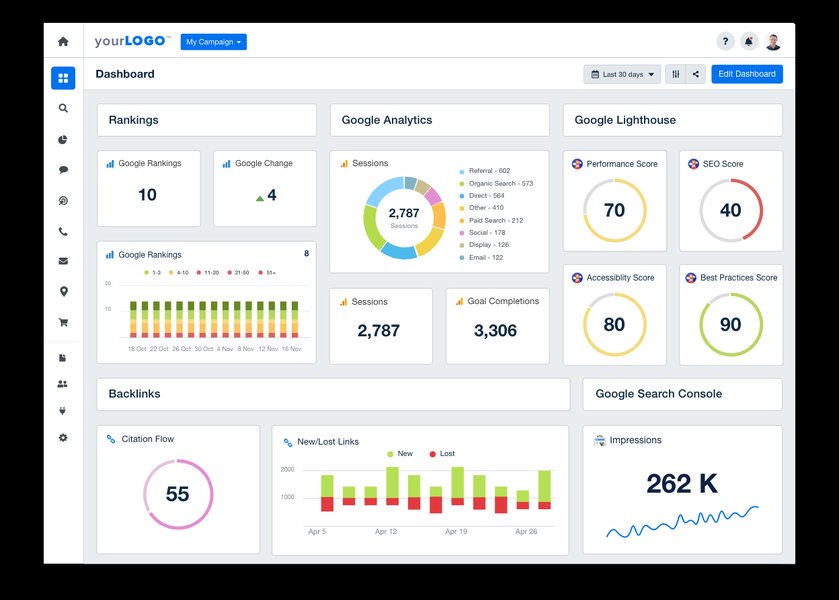
An example of an SEO dashboard used to monitor website performance and ranking factors.
Learning More About SEO
Understanding the fundamentals of SEO is key to improving website visibility. This video provides a beginner-friendly overview of optimizing a website to rank higher in Google search results, covering essential concepts like keyword research and on-page optimization.
The video walks through a step-by-step guide designed for those new to SEO, explaining how to make practical changes to a website that can lead to better rankings. It emphasizes techniques that align with Google's guidelines for providing valuable content and a positive user experience.
Frequently Asked Questions (FAQ) about Website Ranking
How does Google actually rank websites?
Google uses complex algorithms that analyze hundreds of factors. Key considerations include:
- Relevance: How well the content matches the user's search query.
- Quality: The expertise, authoritativeness, and trustworthiness (E-A-T) of the content and the website.
- Backlinks: Links from other reputable websites acting as endorsements.
- User Experience: Factors like page speed, mobile-friendliness, and ease of navigation.
- Freshness: How up-to-date the information is, especially for certain topics.
- Search Intent: Understanding what the user is truly trying to accomplish with their search.
What are the most important ranking factors in 2025?
While Google doesn't reveal exact weightings, consistently important factors include:
- High-quality, relevant content that satisfies user intent.
- Authoritative backlinks from trusted sources.
- Positive user experience signals (page speed, mobile-friendliness, Core Web Vitals).
- Keyword optimization aligned with search intent.
- Overall website authority and topical relevance.
Google's focus on "helpful content" means demonstrating expertise and providing real value is paramount.
How long does it take to rank higher on Google?
There's no fixed timeline. It depends on many variables:
- Competition: Ranking for highly competitive keywords takes longer.
- Website Age & Authority: Established sites often rank faster than new ones.
- Quality of SEO Efforts: Consistent, high-quality optimization yields faster results.
- Content Quality & Quantity: Publishing valuable content regularly helps.
- Technical Health: A technically sound site ranks better.
Generally, you might see initial improvements in a few weeks to months, but significant, stable rankings often take 6 months to a year or longer, requiring ongoing effort.
Can I check my website's ranking for specific keywords?
Yes, several tools and methods exist:
- Google Search Console: A free tool from Google that shows your site's performance in search results, including average position for queries.
- Third-Party SEO Tools: Platforms like Semrush, Ahrefs, Moz Pro, and Sitechecker offer dedicated rank tracking features, often with more detailed insights, competitor analysis, and historical data.
- Manual Checks: Performing Google searches for your target keywords (preferably in incognito mode or using location-specific settings) can give you a rough idea, but results can be personalized.
Using dedicated tools provides more accurate and consistent data than manual checks.
Is it possible to rank a new website quickly?
Ranking quickly (within weeks or a couple of months) is challenging, especially for competitive terms, but possible for less competitive, long-tail keywords if you implement strong on-page SEO from the start and publish exceptional content. However, building the authority needed for broader, high-traffic terms typically takes significant time and consistent effort in both content creation and link building.
Recommended Further Exploration
- What are the best tools for keyword research in 2025?
- How can I build high-quality backlinks for my website?
- Explain the key components of technical SEO for beginners.
- How do user experience signals like Core Web Vitals impact Google rankings?
References
Last updated May 2, 2025