
Understanding the Inner Product and Its Applications in Machine Learning
A detailed guide on inner products, examples, and their use in ML
Key Highlights
- Generalized Dot Product: The inner product extends the concept of the dot product from Euclidean spaces to abstract vector spaces, preserving geometric intuition.
- Geometric Insight in ML: It provides a basis to measure similarity, projection, and angle between vectors, which is essential in algorithms like neural networks and support vector machines (SVM).
- Versatile Applications: From similarity measurements to kernel methods and dimensionality reduction, inner products serve as a backbone in many machine learning techniques.
Definition and Mathematical Foundation
The inner product is a function that takes two vectors from a vector space and returns a real (or complex) scalar, serving as a generalization of the familiar dot product. In a real vector space, the inner product of two vectors u and v, denoted as \( \langle u, v \rangle \), satisfies several key properties:
Fundamental Properties
Linearity
The inner product is linear in each of its arguments. That means for any vectors \( u, v, \) and \( w \), and any scalars \( a \) and \( b \), \[ \langle a \cdot u + b \cdot v, w \rangle = a \langle u, w \rangle + b \langle v, w \rangle. \]
Symmetry (or Conjugate Symmetry)
For real vector spaces, the inner product is symmetric: \[ \langle u, v \rangle = \langle v, u \rangle. \] In the context of complex vector spaces, symmetry is replaced with conjugate symmetry: \[ \langle u, v \rangle = \overline{\langle v, u \rangle}. \]
Positive Definiteness
The inner product of a vector with itself is always non-negative: \[ \langle u, u \rangle \geq 0, \] and is zero if and only if \( u \) is the zero vector.
These properties ensure that the inner product correctly encapsulates notions of length (or norm) and angles between vectors, laying the groundwork for geometric interpretations in vector spaces.
Applications in Machine Learning
In machine learning, the inner product is used in various ways to enhance model performance and enable efficient computations. Its ability to measure similarity and facilitate transformations of data makes it indispensable in several algorithms and processes.
Similarity Measurement
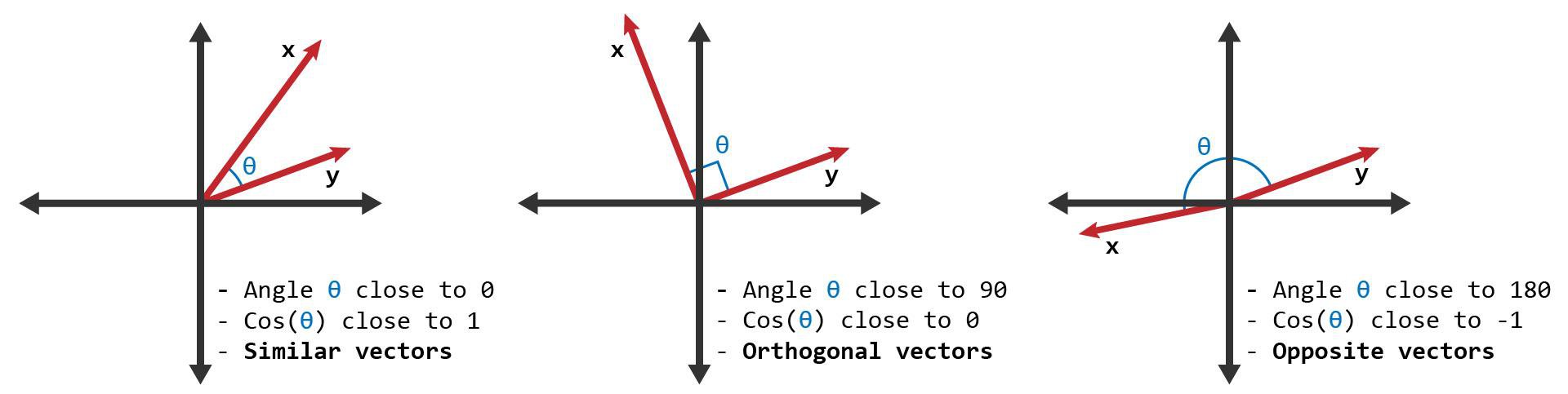
One of the primary uses of the inner product is to measure the similarity between two vectors representing data points. A higher inner product value typically indicates that the vectors are more similar. This characteristic is particularly useful in recommendation systems and clustering algorithms.
Example: Cosine Similarity
Cosine similarity is computed using the inner product. The cosine of the angle between two vectors is given by: \[ \text{Cosine Similarity} = \frac{\langle u, v \rangle}{\|u\| \, \|v\|}, \] where \( \|u\| \) and \( \|v\| \) are the norms (or lengths) of vectors \( u \) and \( v \) respectively. This measure is extensively used in text mining to determine document similarity or in recommendation systems to match user preferences with items.
Projection and Dimensionality Reduction
The inner product comes in handy when projecting one vector onto another, which is a central operation in dimensionality reduction techniques. For example, in Principal Component Analysis (PCA), data is projected onto principal components—new axes that capture the maximum variance—by computing the inner product between the data points and the eigenvectors of the covariance matrix.
Projection Formula
The projection of a vector \( u \) onto a vector \( v \) is given by: \[ \text{Projection} = \left( \frac{\langle u, v \rangle}{\langle v, v \rangle} \right) v. \] This allows algorithms to reduce noise and focus on the most significant features in high-dimensional data.
Kernel Methods in Support Vector Machines (SVM)
In SVM and other kernel-based algorithms, the inner product is generalized via kernel functions to compute similarity in high-dimensional or even infinite-dimensional spaces. This enables the handling of non-linear data without explicitly mapping the data to a higher-dimensional feature space—a concept known as the "kernel trick."
Kernel Trick
A kernel function \( K(u, v) \) often represents an inner product in a transformed space: \[ K(u, v) = \langle \phi(u), \phi(v) \rangle, \] where \( \phi \) is a mapping function to a higher-dimensional space. Common kernels include the polynomial kernel and the Radial Basis Function (RBF) kernel.
Neural Networks and Linear Models
Neural networks and linear regression models fundamentally rely on inner product calculations. In a neuron, the weighted sum of the input features is computed using the inner product. For example, the output of a neuron can be expressed as: \[ \text{Output} = \langle \text{weights}, \text{input} \rangle + \text{bias}. \] These computations determine how well the model captures and transforms the input data, influencing the learning process during training.
Linear Regression Example
In linear regression, the prediction is computed as: \[ \hat{y} = \langle \textbf{w}, \textbf{x} \rangle + b, \] where \( \textbf{w} \) are the weights, \( \textbf{x} \) are the features, and \( b \) is the bias term.
Example of Inner Product Calculation
Let us consider a concrete example of inner product computation with vectors in a two-dimensional space. Suppose we have:
\( u = [3, 2] \) and \( v = [1, 4] \)
The inner product \( \langle u, v \rangle \) is calculated as: \[ \langle u, v \rangle = (3 \times 1) + (2 \times 4) = 3 + 8 = 11. \] This calculation tells us that the results of the element-wise multiplication are summed up to produce a scalar value, which, in this case, represents the similarity or alignment between the two vectors.
Python Example
Here is an illustrative example using Python and NumPy:
# Define two vectors using NumPy
import numpy as np

# Vectors u and v
u = np.array([3, 2])
v = np.array([1, 4])

# Compute the inner product using np.dot
inner_product = np.dot(u, v)

# Display the result
print("The inner product of u and v is:", inner_product)  # Expected output: 11
This code computes the inner product by performing the same operation as the mathematical expression we derived.
Comprehensive Summary Table
| Concept | Description | Machine Learning Application |
|---|---|---|
| Inner Product (Definition) | Generalization of the dot product; measures similarity by returning a scalar. | Used in similarity measurement, projections, and neural network operations. |
| Properties | Linearity, Symmetry (or Conjugate Symmetry), and Positive Definiteness. | Foundation for computations in linear models and kernel methods. |
| Cosine Similarity | Computes the cosine of the angle between two vectors using the inner product. | Document similarity in text mining and recommendation systems. |
| Projection | Projects one vector onto another using the formula \( \left( \frac{\langle u, v \rangle}{\langle v, v \rangle} \right) v \). | Reduces dimensionality and extracts features in PCA. |
| Kernel Methods | Utilizes the inner product in transformed spaces to handle non-linear data. | Support vector machines for non-linear classification. |
| Neural Networks | Calculates weighted sums in each neuron. | Fundamental operation in both forward propagation and training. |
Further Applications and Insights
Recommendation Systems
In recommendation systems, the inner product between feature vectors representing users and items can indicate the level of affinity. For example, if a user’s preferences are encoded in a vector and the characteristics of an item in another, a high inner product suggests a closer match, leading to more accurate recommendations.
Natural Language Processing (NLP)
In NLP, word embeddings (like Word2Vec or GloVe) leverage inner products to measure semantic similarities between words. The computation of similarity via the inner product (often normalized to cosine similarity) can help in tasks such as sentiment analysis, document clustering, and language translation.
Data Classification
Algorithms like logistic regression, SVM, and even certain neural network architectures utilize inner products. In classification, the inner product helps compute decision boundaries by weighing input features appropriately.
Mathematical Representation with LaTeX
Inner products in mathematical notation highlight its properties and application. For vectors \( u, v \in \mathbb{R}^n \), the inner product is given by:
\[ \langle u, v \rangle = \sum_{i=1}^{n} u_i v_i \] where \( u_i \) and \( v_i \) are the components of \( u \) and \( v \) respectively. This compact notation is especially beneficial when dealing with high-dimensional data in machine learning.
References
- Unveiling the Inner Product: The Key to Similarity in Math, Machine Learning, and Beyond - Medium
- Inner Product -- from Wolfram MathWorld
- Inner product space - Wikipedia
- Inner Products and Norms - Mathematics LibreTexts
- Understanding Vectors From a Machine Learning Perspective - Neptune
Recommended Related Queries
Last updated March 22, 2025