
Detection of Indian Sign Language using OpenCV
Exploring innovative computer vision techniques for ISL recognition
Highlights
- Real-Time Gesture Recognition: Implementing fast and efficient detection through live video processing.
- Machine Learning Integration: Leveraging deep learning frameworks such as TensorFlow and Keras with convolutional neural networks.
- Comprehensive Workflow: From image preprocessing and segmentation to model training and real-time implementation.
Overview of Indian Sign Language Detection
The detection of Indian Sign Language (ISL) using OpenCV encompasses a blend of computer vision and machine learning techniques aimed at bridging the communication gap between sign language users and those who do not understand sign language. This initiative is not only a technological advancement but also a social enabler, significantly contributing to accessibility and inclusivity for the deaf and hard-of-hearing communities.
ISL recognition systems distinguish themselves by addressing the unique characteristics of Indian Sign Language such as the usage of one or two hands, specific hand shapes, arm movements, facial expressions, and body dynamics. These elements require specialized detection approaches differing from other sign languages like American Sign Language (ASL), where the technical nuances necessitate adaptations at various stages of image processing and classification.
Technical Approach to ISL Detection
1. Image Preprocessing and Hand Segmentation
The initial stage in ISL detection involves capturing video input or static images and preprocessing them to isolate hand regions accurately. OpenCV is a widely used library in this field due to its robust toolkit for image manipulation and analysis.
Skin Segmentation and Color Space Conversion
Detecting hands effectively involves converting images from RGB to alternative color spaces such as HSV. This conversion helps in enhancing the detection of skin tones, which is crucial for isolating the hand against the background.
Techniques such as Otsu's thresholding and histogram equalization further improve segmentation. The use of masks after color segmentation allows for the application of filters (like Gaussian or Median Blur) that reduce noise while preserving edges that are important for detecting finger outlines and hand contours.
Region of Interest (ROI) Extraction
Once the hand region is segmented from the background, the next step involves defining a Region of Interest (ROI). This involves extracting a subsection of the image that primarily contains the hand, reducing computational overhead and focusing the analysis on relevant areas.
2. Feature Extraction and Gesture Analysis
Following segmentation, relevant features need to be extracted from the hand ROI to identify and distinguish among various ISL gestures. Feature extraction is pivotal because it informs the machine learning model about specific attributes such as finger positions, convex hull properties, and hand contours.
Convex Hull and Contour Analysis
The convex hull method is commonly used to identify the boundaries of the hand. By comparing the actual hand contour with its convex hull, algorithms can detect gaps, which generally correspond to spaces between fingers. This information helps in discerning specific gestures or alphabets in ISL.
Deep Learning Features with CNNs
Convolutional Neural Networks (CNNs) form the backbone of many modern gesture recognition systems. These networks automatically learn and extract features from images, including edge detection, texture recognition, and shape identification, making them ideal for hand gesture classification.
Libraries such as TensorFlow and Keras are frequently employed to build and train CNN models. The trained models then classify the hand gestures extracted from the ROI, providing predictions on the corresponding ISL signs.
3. Model Training and Evaluation
Training a robust ISL detection system requires a substantial dataset and carefully tuned machine learning models. Often, developers either use publicly available datasets or compile custom datasets tailored to the nuances of Indian Sign Language.
Dataset Creation and Preprocessing
Creating an effective dataset involves gathering a diverse set of images that represent various hand gestures in different lighting conditions and backgrounds. The dataset must be labeled accurately to ensure that the model learns to distinguish between similar gestures effectively.
Training with CNNs and Beyond
After preprocessing the data (which includes skin segmentation and noise reduction), the images are fed into a CNN model. The architecture typically involves multiple convolutional layers, pooling layers, and fully connected layers, all culminating in a softmax output that predicts the class of the gesture.
The performance of these models is evaluated using metrics such as accuracy, precision, recall, and F1-score. Tuning hyperparameters like learning rate, batch size, and the number of epochs is essential to achieve optimal results.
4. Real-Time Gesture Recognition System
A key application of ISL detection using OpenCV is in the development of systems that function in real-time. Such systems are critical for enabling live communication, whether installed on a desktop or integrated into mobile platforms.
Live Video Capture and Processing
OpenCV facilitates easy integration with webcams, enabling developers to capture live video streams. The real-time processing pipeline involves capturing frames, applying skin segmentation and hand tracking, and then feeding the processed frames into the pre-trained CNN model for gesture prediction.
Gesture Recognition and Feedback
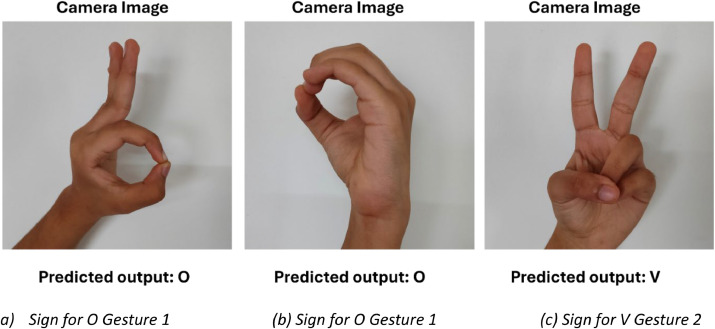
Once the system recognizes a gesture, it can provide immediate feedback such as displaying the translated alphabet or word, and in advanced implementations, even synthesizing speech output. This real-time feedback loop is essential for seamless interaction.
Illustrative Workflow and Development Process
Below is a comprehensive table summarizing the key components and phases in the development of an ISL detection system using OpenCV:
| Component | Techniques/Tools | Details |
|---|---|---|
| Image Acquisition | OpenCV, Webcam | Capture real-time frames or process images |
| Preprocessing | Color Space Conversion, Gaussian Blur, Masking | Convert images to HSV, isolate skin regions, reduce noise |
| Feature Extraction | Convex Hull, Contour Analysis, CNN Layers | Identify hand contours, finger separation, and overall patterns |
| Model Training | TensorFlow, Keras | Train deep learning models such as CNNs with ISL datasets |
| Real-Time Processing | OpenCV, Live Video Streaming | Implement live recognition and display of ISL gestures |
| Evaluation | Accuracy, Precision, Recall | Assess model performance and iterate on training process |
Example Implementation
Python Code for ISL Detection
Below is a simplified Python example demonstrating the key steps in capturing video, processing the frames with OpenCV, and predicting gestures with a TensorFlow/Keras model.
# Import necessary libraries
import cv2
import numpy as np
from tensorflow.keras.models import load_model

# Load the trained ISL gesture recognition model
model = load_model('islcnnmodel.h5')

# Initialize the webcam video capture
cap = cv2.VideoCapture(0)

while True:
    # Capture frame from the webcam
    ret, frame = cap.read()
    if not ret:
        break

    # Convert the image from BGR to HSV color space to detect skin tones
    hsv = cv2.cvtColor(frame, cv2.COLOR_BGR2HSV)

    # Define range for skin color detection
    lower_skin = np.array([0, 48, 80], dtype=np.uint8)
    upper_skin = np.array([20, 255, 255], dtype=np.uint8)

    # Generate mask for skin region
    mask = cv2.inRange(hsv, lower_skin, upper_skin)

    # Smooth the mask to reduce noise
    mask = cv2.GaussianBlur(mask, (5, 5), 0)

    # Extract the Region of Interest (ROI) based on the skin mask
    roi = cv2.bitwise_and(frame, frame, mask=mask)
    roi = cv2.cvtColor(roi, cv2.COLOR_BGR2GRAY)
    roi = cv2.resize(roi, (28, 28))

    # Reshape ROI for the model prediction; adjust dimensions if needed
    roi = roi.reshape((1, 28, 28, 1))
    prediction = model.predict(roi)

    # Extract the predicted gesture from the model's output
    gesture_index = int(np.argmax(prediction))
    cv2.putText(frame, f"Predicted Gesture: {gesture_index}", (10, 30), cv2.FONT_HERSHEY_SIMPLEX, 0.7, (0, 0, 255), 2)

    # Display the frame with predictions
    cv2.imshow('ISL Detection', frame)

    # Exit mechanism when 'q' key is pressed
    if cv2.waitKey(1) & 0xFF == ord('q'):
        break

# Release resources and close windows upon exit
cap.release()
cv2.destroyAllWindows()
This code snippet illustrates fundamental components including skin segmentation, ROI extraction, and model inference for gesture prediction. In a real-world application, further optimizations and error handling will be crucial for robust performance.
Research and Further Resources
Numerous research papers, GitHub repositories, and articles detail the methodologies and planning behind ISL recognition systems using OpenCV. Some notable references include detailed case studies and implementations highlighting deep learning techniques combined with classic image processing approaches for accurate sign language detection.
- INDIAN SIGN LANGUAGE RECOGNITION USING OPEN CV - Ijesat
- Real-time Recognition using OpenCV and CNN - IEEE Xplore
- Indian Sign Language Recognition on GitHub - Arshad221b
- Real-Time Recognition on GitHub - Varshini-E
- Research Article on ISL Detection - MDPI
Recommended Further Exploration
Last updated March 6, 2025