
KBLaM vs RAG: Which AI Knowledge Booster Reigns Supreme?
Unpacking two distinct methods for making Large Language Models smarter with external data.
Large Language Models (LLMs) possess vast general knowledge learned during training, but they often struggle with accessing real-time information, domain-specific facts, or private data they weren't trained on. Knowledge augmentation techniques bridge this gap by integrating external knowledge sources with LLMs. Two prominent approaches dominate this field: the established Retrieval-Augmented Generation (RAG) and the newer Knowledge Base augmented Language Model (KBLaM) developed by Microsoft Research. While both aim to enhance LLM responses, they differ fundamentally in their architecture, how they handle data, and their efficiency.
Key Insights at a Glance
- Architectural Divide: RAG uses a separate, external system to retrieve relevant information before generation, while KBLaM integrates structured knowledge directly into the LLM's internal structure.
- Data Suitability: RAG excels with unstructured text data (like documents, articles), whereas KBLaM is optimized for structured knowledge (like databases, knowledge graphs, tables).
- Efficiency & Scalability: KBLaM demonstrates significant advantages in scalability (linear vs. RAG's potential quadratic complexity) and efficiency, especially for large knowledge bases, often resulting in lower latency and memory usage.
Understanding Retrieval-Augmented Generation (RAG)
The Established Retriever-Generator Duo
Traditional RAG is a popular and widely implemented technique for injecting external knowledge into LLMs. It operates using a two-stage process:
- Retrieval: When a query is received, a retriever module searches an external knowledge base (often a vector database containing embeddings of document chunks) for information relevant to the query. This knowledge base typically consists of unstructured or semi-structured data like PDFs, web pages, support articles, or personal notes. The retrieval is usually based on semantic similarity search (e.g., cosine similarity between query embedding and document chunk embeddings).
- Generation: The retrieved documents or text chunks are then combined with the original user query and fed as context into the LLM's prompt. The LLM uses this augmented context to generate a more informed, accurate, and contextually relevant response.
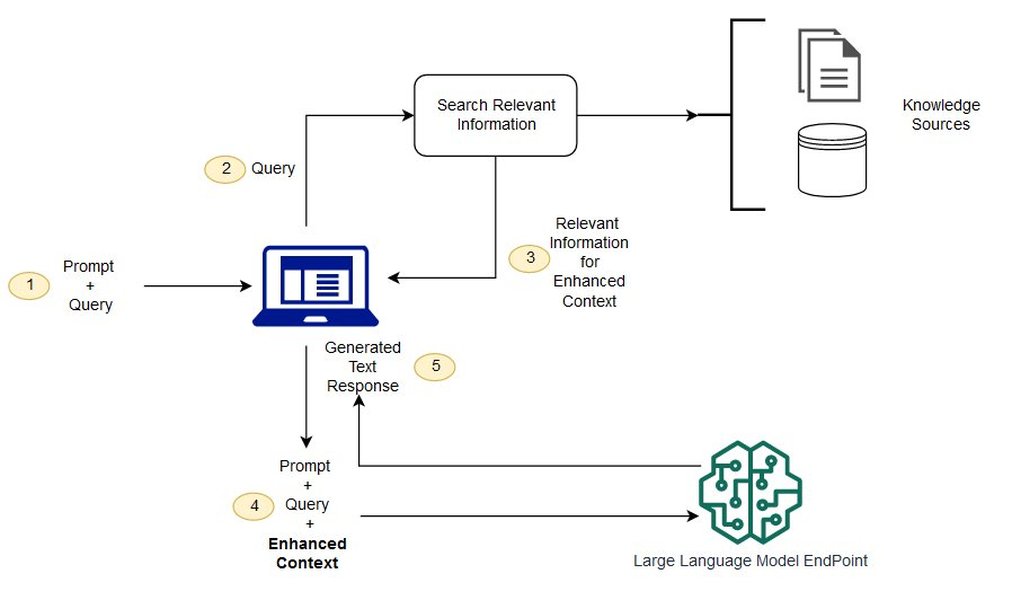
Conceptual flow of a Retrieval-Augmented Generation (RAG) system.
Strengths of RAG
- Unstructured Data Handling: RAG excels at incorporating information from vast corpora of text documents, making it ideal for applications involving news, research papers, or website content.
- Dynamic Knowledge: It can easily access up-to-date information simply by updating the external knowledge base and its index, without needing to modify the LLM itself.
- Reduced Hallucinations: By grounding responses in retrieved evidence, RAG can significantly reduce the tendency of LLMs to "hallucinate" or generate factually incorrect information.
- Maturity and Adoption: RAG is a well-understood and widely adopted framework with established best practices and tooling available.
Challenges with RAG
- Retrieval Bottleneck: The performance heavily depends on the quality and speed of the retrieval step. Inaccurate or irrelevant retrieval leads to poor generation quality.
- Latency Overhead: The external retrieval step adds latency to the response generation process.
- Scalability Concerns: The computational effort, particularly related to the self-attention mechanism processing the combined prompt and retrieved context, can scale quadratically with the amount of retrieved information, potentially becoming a bottleneck for very large contexts or knowledge bases. Managing and indexing large external databases also adds complexity.
- System Complexity: Implementing and maintaining a RAG system requires managing separate components: the retriever (including chunking, embedding, indexing) and the generator (LLM).
Introducing KBLaM: Integrated Knowledge Augmentation
Microsoft's Approach to Embedding Structured Knowledge
KBLaM (Knowledge Base augmented Language Model) represents a newer paradigm developed by Microsoft Research, designed specifically to address some of the limitations of RAG, particularly concerning structured knowledge and scalability. Instead of relying on an external retriever module at inference time, KBLaM integrates structured knowledge directly into the LLM's architecture.
KBLaM integrates structured knowledge directly within the language model.
It achieves this by:
- Encoding Knowledge: Structured knowledge from sources like SQL databases, knowledge graphs (e.g., triples like subject-predicate-object), or structured tables is converted into continuous key-value vector pairs.
- Embedding Knowledge: These key-value pairs are embedded directly within the LLM's attention layers using a modified, efficient rectangular attention mechanism. This allows the model to implicitly access and utilize this structured knowledge during its internal processing.
This internal integration means KBLaM does not require a separate search step for each query; the knowledge is effectively part of the model's accessible parameters during inference, offering a "plug-and-play" capability without necessarily retraining the base LLM.
Strengths of KBLaM
- Efficiency and Scalability: KBLaM's computational cost scales linearly with the size of the integrated knowledge base, a significant advantage over the potential quadratic scaling of RAG. Microsoft's research indicates KBLaM can process thousands of knowledge triples faster and with less memory than RAG handling just a few document chunks.
- Structured Data Optimization: It is specifically designed and optimized for structured, relational knowledge, potentially offering higher precision for queries requiring factual lookups in databases or graphs.
- Reduced Latency: By eliminating the external retrieval step, KBLaM can potentially offer lower end-to-end latency for query responses.
- Lower System Complexity: It avoids the need to build, manage, and optimize a separate retrieval system.
- Dynamic Updates: The integrated knowledge base can be updated without full model retraining, maintaining flexibility.
- Improved Interpretability/Reliability: It can potentially offer better interpretability and has mechanisms to refuse answers if relevant knowledge isn't present in its integrated base, potentially reducing hallucinations.
Challenges with KBLaM
- Structured Data Focus: It is primarily designed for structured data and may be less directly applicable or efficient for augmenting knowledge from large volumes of unstructured text compared to RAG.
- Preprocessing Requirement: Requires a preprocessing step to convert structured knowledge into the specific key-value vector format required for embedding.
- Relative Novelty: Being a newer approach, the ecosystem, tooling, and widespread production experience might be less mature compared to RAG.
- Complex Reasoning: While effective for direct knowledge retrieval, further development might be needed for more complex reasoning tasks spanning multiple knowledge points.
Head-to-Head: KBLaM vs. RAG
A Comparative Overview
The choice between KBLaM and RAG depends heavily on the specific use case, the nature of the knowledge source, and performance requirements. The following table summarizes the key distinctions:
| Feature | RAG (Retrieval-Augmented Generation) | KBLaM (Knowledge Base augmented Language Model) |
|---|---|---|
| Primary Data Type | Unstructured text (documents, articles, web pages) | Structured data (databases, knowledge graphs, tables) |
| Knowledge Integration | External retrieval module fetches context, appended to prompt | Internal integration via key-value pairs in attention layers |
| Retrieval Mechanism | Explicit, separate search step (e.g., vector search) | Implicit retrieval via internal attention mechanisms |
| Scalability Complexity | Potentially Quadratic (with context size/retrieved chunks) | Linear (with knowledge base size) |
| Latency | Higher (due to separate retrieval step) | Potentially Lower (integrated processing) |
| Memory Efficiency | Can be high depending on context size | Generally more memory efficient for large knowledge bases |
| System Complexity | Higher (manages retriever + generator) | Lower (integrated system, but requires specific preprocessing) |
| Dynamic Updates | Update external index/documents | Update internal key-value store (often without retraining) |
| Suitability | Real-time info from text, support bots, news analysis | Fact retrieval from databases, knowledge graph querying, structured data analysis |
Performance Perspectives: Scalability and Efficiency
Why Linear Scaling Matters
One of the most significant practical differences highlighted by research is the scaling behavior. RAG systems, especially those relying on dense vector retrieval and processing large context windows augmented with retrieved text, can face computational challenges. The self-attention mechanism common in LLMs has a computational complexity that scales quadratically with the input sequence length. As more or longer documents are retrieved and added to the prompt, the processing time and memory requirements can increase dramatically.
KBLaM, by contrast, employs a mechanism that allows its computational cost and memory usage to scale linearly with the number of knowledge entries (e.g., triples) integrated. This means that doubling the size of the knowledge base roughly doubles the computational cost, rather than potentially quadrupling it. Microsoft's findings suggest KBLaM can efficiently handle thousands of knowledge entries on a single GPU, significantly outperforming RAG in scenarios involving large, structured knowledge repositories where RAG might struggle with latency and resource consumption when retrieving and processing equivalent amounts of information chunk by chunk.
Comparative Performance Radar
This chart offers a visual comparison based on the typical strengths and weaknesses of each approach across key performance dimensions. Scores are relative estimates (out of 10), where higher indicates better performance or suitability for that dimension.
This radar chart visually summarizes the trade-offs. KBLaM excels in areas related to efficiency and structured data, while RAG holds advantages in handling unstructured information and benefits from a more mature ecosystem.
Conceptualizing the Differences: A Mindmap
Mapping RAG vs. KBLaM
This mindmap illustrates the core concepts, features, and distinctions between RAG and KBLaM knowledge augmentation approaches.
(Retrieval-Augmented Generation)"] id1_1["Mechanism"] id1_1_1["External Retriever"] id1_1_2["Context Appending"] id1_2["Data Focus"] id1_2_1["Unstructured Text
(Docs, Web)"] id1_3["Pros"] id1_3_1["Handles Dynamic Data"] id1_3_2["Good for Text"] id1_3_3["Mature Ecosystem"] id1_4["Cons"] id1_4_1["Retrieval Latency"] id1_4_2["Scalability Issues
(Quadratic Potential)"] id1_4_3["System Complexity"] id2["KBLaM
(Knowledge Base augmented LM)"] id2_1["Mechanism"] id2_1_1["Internal Integration"] id2_1_2["Key-Value Pairs
in Attention Layers"] id2_2["Data Focus"] id2_2_1["Structured Data
(DBs, Graphs, Tables)"] id2_3["Pros"] id2_3_1["High Efficiency"] id2_3_2["Linear Scalability"] id2_3_3["Lower Latency Potential"] id2_3_4["Optimized for Structure"] id2_4["Cons"] id2_4_1["Less Ideal for Unstructured"] id2_4_2["Requires Preprocessing"] id2_4_3["Newer Approach"]
The mindmap highlights the fundamental architectural split: RAG's external, two-step process versus KBLaM's internal, integrated approach, leading to different strengths, weaknesses, and ideal application areas.
Choosing the Right Approach: Use Case Considerations
When to Use RAG vs. KBLaM
The decision between implementing RAG or KBLaM hinges on several factors:
Choose RAG If:
- Your primary knowledge source consists of unstructured documents (e.g., PDFs, Word docs, web pages, emails, support tickets).
- You need to incorporate rapidly changing or real-time information where constant updates to an external index are feasible.
- Your application involves broad, open-domain question answering based on large text corpora.
- You can leverage existing search infrastructure or vector database solutions.
- Absolute lowest latency is less critical than accessing the most current unstructured information.
Choose KBLaM If:
- Your knowledge source is primarily structured (e.g., SQL databases, knowledge graphs, taxonomies, structured tables).
- Scalability and efficiency (lower latency, lower memory usage) for very large knowledge bases are critical requirements.
- You need precise retrieval of factual information from relational data.
- You want to reduce the complexity associated with managing a separate retrieval pipeline.
- Your application operates in a domain with relatively stable, structured knowledge that can be preprocessed into the required key-value format.
In some complex scenarios, hybrid approaches might even be considered, potentially using RAG for unstructured data retrieval and KBLaM-like techniques for integrating core structured knowledge, although this adds further complexity.
Frequently Asked Questions (FAQ)
What is the absolute main difference between RAG and KBLaM?
The core difference lies in how and where external knowledge is accessed. RAG uses a separate, external system to retrieve information (like searching a database) before feeding it to the LLM. KBLaM integrates the knowledge directly into the LLM's internal structure (specifically, its attention layers) as encoded key-value pairs, eliminating the need for an external retrieval step during inference.
Is KBLaM simply better than RAG?
Not necessarily "better" overall, but potentially much better for specific scenarios. KBLaM offers significant advantages in efficiency, scalability, and handling structured data. However, RAG remains highly effective and potentially more suitable for dealing with vast amounts of unstructured, rapidly changing text data. The best choice depends entirely on the use case, data type, and performance priorities.
Can KBLaM work with unstructured documents like PDFs?
KBLaM is primarily designed and optimized for structured data (like database entries or graph triples). While techniques exist to extract structured information *from* unstructured documents (e.g., Named Entity Recognition, Relation Extraction), applying KBLaM directly to raw, unstructured text is not its intended use case. RAG is generally the more direct and suitable approach for augmenting LLMs with knowledge from unstructured documents.
Which approach is easier to implement?
This is debatable and depends on existing infrastructure and expertise. RAG often requires setting up and managing a vector database, indexing pipeline, and retrieval logic, which can be complex. KBLaM avoids the external retriever complexity but requires a specific preprocessing step to encode the structured knowledge into the key-value format suitable for integration. RAG might be perceived as easier to start with due to more available off-the-shelf tools and tutorials, while KBLaM might offer lower *operational* complexity once set up, especially at scale.
Recommended Reading
Explore related topics to deepen your understanding:
- How does KBLaM encode structured knowledge into key-value pairs for LLM integration?
- What are the best practices for optimizing RAG retrieval performance and relevance?
- Compare the computational costs of RAG vs KBLaM at different scales of knowledge bases.
- Are there hybrid approaches combining RAG and KBLaM techniques for knowledge augmentation?
References
 radicaldatascience.wordpress.com
Last updated April 29, 2025