
Unveiling the Symbiotic Dance: How Language and Speech Forge the Path of Logic
Exploring the intricate connections where abstract linguistic systems meet concrete vocal acts to shape rational thought and argumentation.
The relationship between language, speech, and logic is a cornerstone of understanding how humans reason, communicate, and construct meaning. Language provides the systematic framework, speech offers the dynamic medium of expression, and logic supplies the principles for valid inference and truth. Together, they form a complex interplay that has fascinated philosophers, linguists, and logicians for centuries. This exploration delves into how these three pillars support and define each other, shaping our ability to think critically and convey complex ideas.
Core Insights: Language, Speech, and Logic Intertwined
- Language as the Blueprint: Language serves as the foundational structured system of symbols and rules that enables the formulation and expression of logical propositions and arguments.
- Speech as the Active Voice: Speech is the concrete, contextualized use of language, the act of articulating thoughts and logical statements, making them dynamic and interactive.
- Logic as the Guiding Principle: Logic provides the formal rules and methods for evaluating the validity of reasoning expressed through language and manifested in speech, ensuring coherence and truth.
Defining the Trio: Language, Speech, and Logic
To appreciate their relationship, it's crucial to understand each component individually before exploring their synergy.
Language: The System of Meaning
Language is an abstract, structured system of communication comprising symbols (like words, gestures, or signs) and the grammatical rules that govern their combination. It possesses several key dimensions:
- Syntax: The rules for arranging words and symbols to form well-formed sentences.
- Semantics: The study of meaning in language, concerning the relationship between signs, symbols, and what they represent.
- Pragmatics: The study of how context contributes to meaning, considering how language is used in specific situations.
In the context of logic, language—especially formal language—provides the precise toolkit for constructing propositions, which are statements that can be either true or false.
Speech: The Act of Expression
Speech is the vocalized or signed form of language; it's the actual, real-time production and use of language in communication. Unlike the abstract nature of language as a system, speech is:
- Embodied and Physical: Involving articulation, vocalization, or physical gestures.
- Context-Dependent: Its meaning is often heavily influenced by the situation, speaker's intent, and audience.
- Dynamic and Fleeting: Occurring in the moment.
Speech acts, such as asserting, questioning, or commanding, are the fundamental units of linguistic communication and are crucial for conveying logical arguments and engaging in reasoned discourse.
Logic: The Science of Reasoning
Logic is the systematic study of the principles of valid inference and correct reasoning. It is concerned with the structure of arguments, distinguishing good reasoning from bad. Key aspects include:
- Propositions: Statements that assert something and can be evaluated for truth or falsity.
- Inference: The process of deriving logical conclusions from premises.
- Validity: A property of arguments where the conclusion necessarily follows from the premises.
Logic can employ both natural language (the everyday language we speak) and formal languages (symbolic systems designed for precision and lack of ambiguity) to analyze and construct arguments.
The Interplay: How Language and Speech Serve Logic
Language as the Medium for Logical Expression
Language is the fundamental medium through which logical concepts are articulated, shared, and analyzed. It provides the vocabulary and grammatical structures necessary to form propositions—the building blocks of logical arguments. For instance, declarative sentences in natural language often directly correspond to logical statements. The systematic nature of language allows for the creation of complex logical relationships, such as implications ("if...then..."), conjunctions ("and"), and disjunctions ("or"). While natural language can be ambiguous, formal languages developed within logic aim to eliminate such ambiguities, offering a precise framework for reasoning.
Speech: Bringing Logic to Life
If language is the blueprint, speech is the construction. Speech is the active, oral (or signed) manifestation of language, turning abstract logical propositions into communicated realities. Through speech acts, individuals don't just utter words; they perform actions like asserting truths, making claims, posing questions, or issuing commands, all of which can have logical implications. The tone, emphasis, and context of speech can further refine or even alter the perceived logical meaning of a linguistic expression. For example, the same sentence can convey different logical intents depending on how it's spoken.
Speech Act Theory: Words as Actions
Pioneered by philosophers like J.L. Austin and John Searle, Speech Act Theory emphasizes that utterances are not merely descriptive but also performative. When someone speaks, they are performing an action (an "illocutionary act") with a certain force or intent (e.g., promising, warning, apologizing). This theory is crucial because it connects the logical content of statements (their truth conditions) with the pragmatic context of their utterance. For example, asserting "The door is open" is not just stating a fact; it might be an indirect request to close it, depending on context. Logic, particularly informal logic and pragmatics, examines these speech acts to understand the full scope of reasoning in communication.
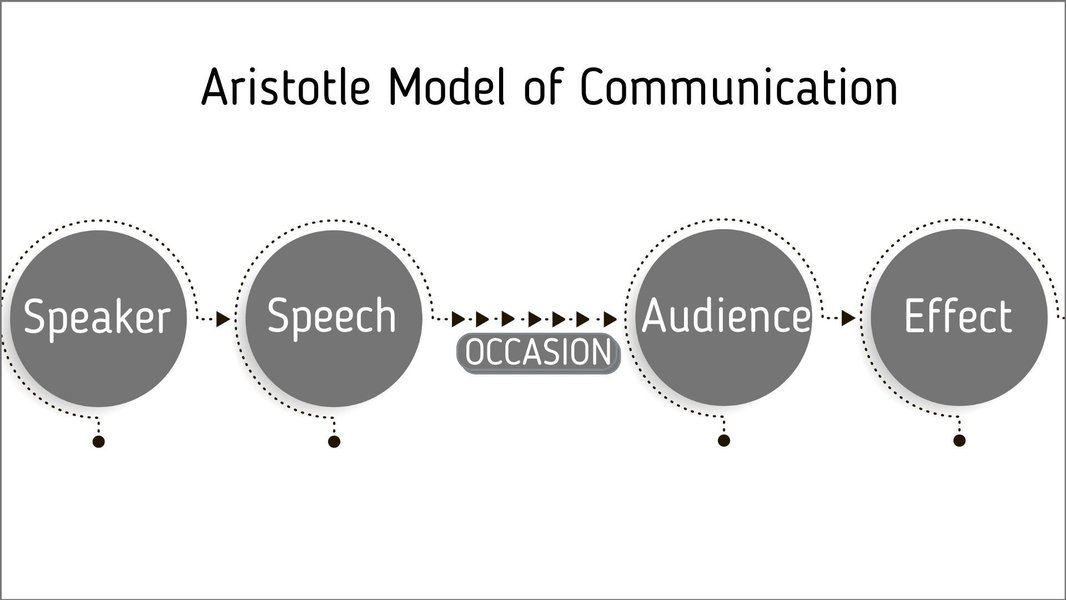
Aristotle's Model of Communication, emphasizing the speaker, speech, occasion, audience, and effect, highlighting the foundational role of structured speech in conveying logical arguments.
Semantics and Pragmatics: Deciphering Meaning
Semantics in Logic and Language
Semantics is the branch of linguistics and logic concerned with meaning. In formal logic, semantics involves assigning interpretations to symbols and determining the truth values of sentences within a formal language. Formal semantics uses mathematical tools to create precise theories about the meaning of natural language expressions, linking them to logical structures. The truth of a statement, a central concern in logic, depends on whether its linguistic representation corresponds to reality, as interpreted through its semantic content.
Pragmatics: The Context of Speech
Pragmatics, in contrast to semantics, focuses on how context influences the interpretation of meaning. It considers the speaker's intention, the communicative setting, and shared background knowledge. Speech is inherently pragmatic. While logic often strives for context-independence, especially in formal systems, the analysis of arguments in natural language (informal logic) must account for pragmatic factors. The intended meaning of a spoken logical argument can differ significantly from its literal semantic content due to implicatures, indirect speech acts, and other pragmatic phenomena.
Visualizing the Connections: A Mindmap of Interrelations
The intricate relationships between language, speech, and logic can be visualized to better understand their distinct roles and overlaps. This mindmap illustrates how these concepts are interconnected, with language providing the system, speech being the act of using that system, and logic offering the framework for reasoning within and about both.
Formal vs. Natural Language in Logical Analysis
A key distinction in the study of logic and language is between formal languages and natural languages.
- Natural Languages (e.g., English, Spanish, Chinese) are the languages that have evolved naturally in human communities. They are rich, expressive, and flexible, but also prone to ambiguity, vagueness, and emotional coloring. Analyzing logical arguments in natural language (the domain of informal logic) requires careful attention to context and potential misinterpretations.
- Formal Languages (e.g., propositional logic, predicate logic, mathematical notation) are artificially constructed systems with precisely defined syntax and semantics. They are designed to eliminate ambiguity and allow for rigorous, systematic deduction. Formal logic uses these languages to model and evaluate the structure of arguments in an idealized way.
While formal logic provides powerful tools for analysis, the everyday practice of reasoning and argumentation largely occurs through speech in natural language. Therefore, understanding how logical principles apply to, and can be extracted from, the complexities of natural language speech remains a vital area of study.
Comparative Aspects: A Radar Chart View
To further illuminate the distinct characteristics and interplay of natural language, speech, and formal logic, the following radar chart provides a comparative visualization across several key dimensions. This helps to highlight their relative strengths and typical attributes in the context of logical reasoning and communication.
This chart illustrates, for example, that speech is highly context-dependent and rich in expression but also prone to ambiguity, whereas formal logic prioritizes low ambiguity and high formality, often at the cost of expressive range found in natural speech. Natural language as a system sits somewhat between these, offering a rich framework that speech actualizes and formal logic refines for specific analytical purposes.
Historical and Philosophical Perspectives
The relationship between language, speech, and logic has been a subject of philosophical inquiry for millennia.
- Ancient Philosophers: Aristotle, for example, explored logic (in his Organon) extensively through the lens of language and argumentation (rhetoric). His work laid foundations for understanding how predicables (categories of things that can be said about a subject) in speech relate to logical analysis.
- Medieval Philosophers: Thinkers like Peter Abelard and William of Ockham investigated theories of reference and the concept of a "mental language," exploring how linguistic terms in speech connect to concepts and reality, a key concern for logic.
- Early Modern and Enlightenment Thinkers: Philosophers like Leibniz envisioned a universal formal language (characteristica universalis) that could perfectly represent thought and allow logical calculation, aiming to transcend the ambiguities of natural language speech.
- 19th and 20th Century Developments:
- Frege, Russell, and Wittgenstein (early): These philosophers spearheaded the development of modern formal logic, seeking to clarify the logical foundations of mathematics and language. They analyzed how linguistic expressions relate to truth and reference.
- Logical Positivism: This movement sought to analyze language through verifiable statements, emphasizing the informative function of language relevant to scientific and logical discourse.
- Ordinary Language Philosophy and Speech Act Theory (Wittgenstein later, Austin, Searle): This shifted focus towards understanding meaning through language use in everyday speech, highlighting the pragmatic and performative aspects of language beyond mere truth-conditional semantics.
- Contemporary Views: Modern linguistics (e.g., Chomsky's generative grammar) explores the innate structures of language that enable logical thought. Computational linguistics and AI apply logical frameworks to model natural language understanding, attempting to bridge the gap between formal logic and the complexities of human speech. Semiotics, the study of signs and symbols, also provides a framework for understanding how logical concepts are encoded in language and expressed through speech.
A discussion featuring philosophers Saul Kripke and Timothy Williamson on language and logic, offering deep insights into their complex relationship from contemporary philosophical perspectives.
This video provides a valuable dialogue between two prominent philosophers, delving into profound questions about how language shapes philosophical inquiry and the fundamental role of logic within it. Their discussion touches upon many of the themes explored here, such as the nature of meaning, reference, and the capacity of language to express logical thought, relevant to both its systematic structure and its use in speech.
Tabular Comparison: Language, Speech, and Formal Logic
To further clarify the distinctions and relationships, the following table outlines key features of natural language (as a system), speech (as its active use), and formal logic (as a specialized system for reasoning):
| Feature | Natural Language (System) | Speech (Act) | Formal Logic (System) |
|---|---|---|---|
| Nature | Abstract system of symbols and rules | Concrete, dynamic realization/use of language | Abstract, precisely defined system for reasoning |
| Primary Function | Communication, expression, thought representation | Real-time communication, social interaction, performing actions | Analysis of argument structure, validation of inference, ensuring precision |
| Form | Vocabulary, grammar, syntax, semantics | Vocalizations, intonation, gestures, pragmatic cues | Symbols, axioms, rules of inference, defined semantics |
| Context Sensitivity | Moderately sensitive (pragmatic rules exist within the system) | Highly sensitive (meaning heavily depends on immediate context) | Minimally sensitive (aims for context-independence) |
| Ambiguity | Potentially high (polysemy, vagueness) | Potentially very high (compounded by delivery, unspoken cues) | Ideally zero (designed for precision) |
| Evaluation Metric | Expressiveness, communicability, learnability | Effectiveness, appropriateness, clarity in context | Validity, soundness, consistency, completeness |
| Connection to Thinking | Provides structures for thought; thought can be linguistically framed | Direct expression of thoughts, often spontaneous | Models idealized rational thought processes |
This table highlights that while language provides the systematic foundation and formal logic offers a rigorous framework for ideal reasoning, it is speech that actualizes language in the messy, dynamic, and context-rich reality of human interaction. Logic, in turn, can be applied to analyze both the underlying linguistic structures and the specific arguments presented in speech.
Frequently Asked Questions (FAQ)
What is the primary role of language in logic?
Language serves as the primary medium for expressing logical concepts, propositions, and arguments. It provides the symbolic system (words, syntax) necessary to construct statements that can be analyzed for truth and to form arguments that can be evaluated for validity. Both natural language and specially designed formal languages are used in logic for these purposes.
How does speech differ from language in a logical context?
Language is the abstract system of rules and symbols, while speech is the actual, concrete use or manifestation of that language in a particular context. In logic, language provides the formal structure for propositions, whereas speech is how these propositions are uttered and communicated, often involving pragmatic elements like speaker intention, tone, and context which can affect the interpretation of logical content.
What are speech acts, and why are they important for logic?
Speech acts are actions performed through utterances, such as asserting, questioning, commanding, or promising. They are important for logic, especially informal logic and pragmatics, because they highlight that language use (speech) is not just about conveying true or false statements (semantics) but also about performing actions with specific intentions (illocutionary force) in a context. Understanding speech acts helps analyze the full meaning and logical commitments involved in real-world arguments.
Can logic analyze natural language effectively, given its ambiguities?
Yes, though it presents challenges. Formal logic often translates natural language arguments into unambiguous formal languages to analyze their structure. Informal logic, on the other hand, develops tools and principles to analyze arguments directly in natural language, taking into account its ambiguities, context-dependence, and pragmatic aspects. Fields like formal semantics and computational linguistics also work on developing precise logical models for natural language meaning.
How has the understanding of language and logic evolved historically?
Historically, logic (e.g., Aristotelian logic) was closely tied to the analysis of arguments in natural language. The 19th and 20th centuries saw the rise of modern formal logic (Frege, Russell), which focused on creating precise symbolic languages. Later, philosophers (like the later Wittgenstein, Austin, Searle) brought renewed attention to ordinary language and speech acts, leading to developments in pragmatics and a richer understanding of how logic applies to everyday communication, complementing formal approaches.
Recommended Further Exploration
- How does formal semantics bridge logic and natural language meaning?
- What are the main differences between informal logic and formal logic in analyzing speech?
- Explore the impact of Chomsky's universal grammar on theories of language and logical thought.
- Investigate the role of logical fallacies in everyday speech and argumentation.
References
Unveiling the Symbiotic Dance: How Language and Speech Forge the Path of Logic
Exploring the intricate connections where abstract linguistic systems meet concrete vocal acts to shape rational thought and argumentation.
The relationship between language, speech, and logic is a cornerstone of understanding how humans reason, communicate, and construct meaning. Language provides the systematic framework, speech offers the dynamic medium of expression, and logic supplies the principles for valid inference and truth. Together, they form a complex interplay that has fascinated philosophers, linguists, and logicians for centuries. This exploration delves into how these three pillars support and define each other, shaping our ability to think critically and convey complex ideas.
Core Insights: Language, Speech, and Logic Intertwined
- Language as the Blueprint: Language serves as the foundational structured system of symbols and rules that enables the formulation and expression of logical propositions and arguments.
- Speech as the Active Voice: Speech is the concrete, contextualized use of language, the act of articulating thoughts and logical statements, making them dynamic and interactive.
- Logic as the Guiding Principle: Logic provides the formal rules and methods for evaluating the validity of reasoning expressed through language and manifested in speech, ensuring coherence and truth.
Defining the Trio: Language, Speech, and Logic
To appreciate their relationship, it's crucial to understand each component individually before exploring their synergy.
Language: The System of Meaning
Language is an abstract, structured system of communication comprising symbols (like words, gestures, or signs) and the grammatical rules that govern their combination. It possesses several key dimensions:
- Syntax: The rules for arranging words and symbols to form well-formed sentences.
- Semantics: The study of meaning in language, concerning the relationship between signs, symbols, and what they represent.
- Pragmatics: The study of how context contributes to meaning, considering how language is used in specific situations.
In the context of logic, language—especially formal language—provides the precise toolkit for constructing propositions, which are statements that can be either true or false.
Speech: The Act of Expression
Speech is the vocalized or signed form of language; it's the actual, real-time production and use of language in communication. Unlike the abstract nature of language as a system, speech is:
- Embodied and Physical: Involving articulation, vocalization, or physical gestures.
- Context-Dependent: Its meaning is often heavily influenced by the situation, speaker's intent, and audience.
- Dynamic and Fleeting: Occurring in the moment.
Speech acts, such as asserting, questioning, or commanding, are the fundamental units of linguistic communication and are crucial for conveying logical arguments and engaging in reasoned discourse.
Logic: The Science of Reasoning
Logic is the systematic study of the principles of valid inference and correct reasoning. It is concerned with the structure of arguments, distinguishing good reasoning from bad. Key aspects include:
- Propositions: Statements that assert something and can be evaluated for truth or falsity.
- Inference: The process of deriving logical conclusions from premises.
- Validity: A property of arguments where the conclusion necessarily follows from the premises.
Logic can employ both natural language (the everyday language we speak) and formal languages (symbolic systems designed for precision and lack of ambiguity) to analyze and construct arguments.
The Interplay: How Language and Speech Serve Logic
Language as the Medium for Logical Expression
Language is the fundamental medium through which logical concepts are articulated, shared, and analyzed. It provides the vocabulary and grammatical structures necessary to form propositions—the building blocks of logical arguments. For instance, declarative sentences in natural language often directly correspond to logical statements. The systematic nature of language allows for the creation of complex logical relationships, such as implications ("if...then..."), conjunctions ("and"), and disjunctions ("or"). While natural language can be ambiguous, formal languages developed within logic aim to eliminate such ambiguities, offering a precise framework for reasoning.
Speech: Bringing Logic to Life
If language is the blueprint, speech is the construction. Speech is the active, oral (or signed) manifestation of language, turning abstract logical propositions into communicated realities. Through speech acts, individuals don't just utter words; they perform actions like asserting truths, making claims, posing questions, or issuing commands, all of which can have logical implications. The tone, emphasis, and context of speech can further refine or even alter the perceived logical meaning of a linguistic expression. For example, the same sentence can convey different logical intents depending on how it's spoken.
Speech Act Theory: Words as Actions
Pioneered by philosophers like J.L. Austin and John Searle, Speech Act Theory emphasizes that utterances are not merely descriptive but also performative. When someone speaks, they are performing an action (an "illocutionary act") with a certain force or intent (e.g., promising, warning, apologizing). This theory is crucial because it connects the logical content of statements (their truth conditions) with the pragmatic context of their utterance. For example, asserting "The door is open" is not just stating a fact; it might be an indirect request to close it, depending on context. Logic, particularly informal logic and pragmatics, examines these speech acts to understand the full scope of reasoning in communication.
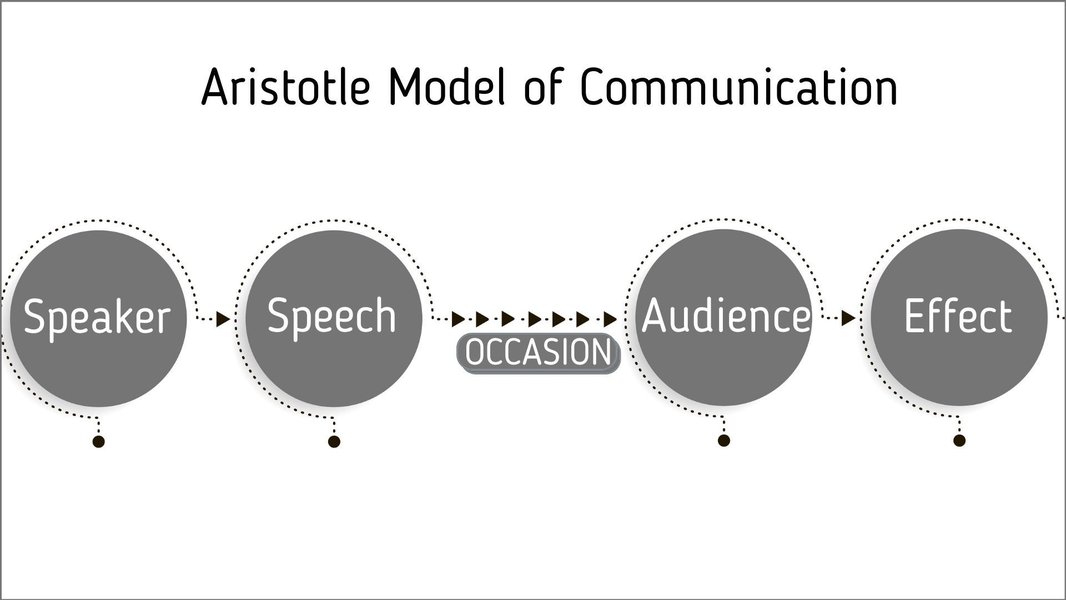
Aristotle's Model of Communication, emphasizing the speaker, speech, occasion, audience, and effect, highlighting the foundational role of structured speech in conveying logical arguments.
Semantics and Pragmatics: Deciphering Meaning
Semantics in Logic and Language
Semantics is the branch of linguistics and logic concerned with meaning. In formal logic, semantics involves assigning interpretations to symbols and determining the truth values of sentences within a formal language. Formal semantics uses mathematical tools to create precise theories about the meaning of natural language expressions, linking them to logical structures. The truth of a statement, a central concern in logic, depends on whether its linguistic representation corresponds to reality, as interpreted through its semantic content.
Pragmatics: The Context of Speech
Pragmatics, in contrast to semantics, focuses on how context influences the interpretation of meaning. It considers the speaker's intention, the communicative setting, and shared background knowledge. Speech is inherently pragmatic. While logic often strives for context-independence, especially in formal systems, the analysis of arguments in natural language (informal logic) must account for pragmatic factors. The intended meaning of a spoken logical argument can differ significantly from its literal semantic content due to implicatures, indirect speech acts, and other pragmatic phenomena.
Visualizing the Connections: A Mindmap of Interrelations
The intricate relationships between language, speech, and logic can be visualized to better understand their distinct roles and overlaps. This mindmap illustrates how these concepts are interconnected, with language providing the system, speech being the act of using that system, and logic offering the framework for reasoning within and about both.
Formal vs. Natural Language in Logical Analysis
A key distinction in the study of logic and language is between formal languages and natural languages.
- Natural Languages (e.g., English, Spanish, Chinese) are the languages that have evolved naturally in human communities. They are rich, expressive, and flexible, but also prone to ambiguity, vagueness, and emotional coloring. Analyzing logical arguments in natural language (the domain of informal logic) requires careful attention to context and potential misinterpretations.
- Formal Languages (e.g., propositional logic, predicate logic, mathematical notation) are artificially constructed systems with precisely defined syntax and semantics. They are designed to eliminate ambiguity and allow for rigorous, systematic deduction. Formal logic uses these languages to model and evaluate the structure of arguments in an idealized way.
While formal logic provides powerful tools for analysis, the everyday practice of reasoning and argumentation largely occurs through speech in natural language. Therefore, understanding how logical principles apply to, and can be extracted from, the complexities of natural language speech remains a vital area of study.
Comparative Aspects: A Radar Chart View
To further illuminate the distinct characteristics and interplay of natural language, speech, and formal logic, the following radar chart provides a comparative visualization across several key dimensions. This helps to highlight their relative strengths and typical attributes in the context of logical reasoning and communication.
This chart illustrates, for example, that speech is highly context-dependent and rich in expression but also prone to ambiguity, whereas formal logic prioritizes low ambiguity and high formality, often at the cost of expressive range found in natural speech. Natural language as a system sits somewhat between these, offering a rich framework that speech actualizes and formal logic refines for specific analytical purposes.
Historical and Philosophical Perspectives
The relationship between language, speech, and logic has been a subject of philosophical inquiry for millennia.
- Ancient Philosophers: Aristotle, for example, explored logic (in his Organon) extensively through the lens of language and argumentation (rhetoric). His work laid foundations for understanding how predicables (categories of things that can be said about a subject) in speech relate to logical analysis.
- Medieval Philosophers: Thinkers like Peter Abelard and William of Ockham investigated theories of reference and the concept of a "mental language," exploring how linguistic terms in speech connect to concepts and reality, a key concern for logic.
- Early Modern and Enlightenment Thinkers: Philosophers like Leibniz envisioned a universal formal language (characteristica universalis) that could perfectly represent thought and allow logical calculation, aiming to transcend the ambiguities of natural language speech.
- 19th and 20th Century Developments:
- Frege, Russell, and Wittgenstein (early): These philosophers spearheaded the development of modern formal logic, seeking to clarify the logical foundations of mathematics and language. They analyzed how linguistic expressions relate to truth and reference.
- Logical Positivism: This movement sought to analyze language through verifiable statements, emphasizing the informative function of language relevant to scientific and logical discourse.
- Ordinary Language Philosophy and Speech Act Theory (Wittgenstein later, Austin, Searle): This shifted focus towards understanding meaning through language use in everyday speech, highlighting the pragmatic and performative aspects of language beyond mere truth-conditional semantics.
- Contemporary Views: Modern linguistics (e.g., Chomsky's generative grammar) explores the innate structures of language that enable logical thought. Computational linguistics and AI apply logical frameworks to model natural language understanding, attempting to bridge the gap between formal logic and the complexities of human speech. Semiotics, the study of signs and symbols, also provides a framework for understanding how logical concepts are encoded in language and expressed through speech.
A discussion featuring philosophers Saul Kripke and Timothy Williamson on language and logic, offering deep insights into their complex relationship from contemporary philosophical perspectives.
This video provides a valuable dialogue between two prominent philosophers, delving into profound questions about how language shapes philosophical inquiry and the fundamental role of logic within it. Their discussion touches upon many of the themes explored here, such as the nature of meaning, reference, and the capacity of language to express logical thought, relevant to both its systematic structure and its use in speech.
Tabular Comparison: Language, Speech, and Formal Logic
To further clarify the distinctions and relationships, the following table outlines key features of natural language (as a system), speech (as its active use), and formal logic (as a specialized system for reasoning):
| Feature | Natural Language (System) | Speech (Act) | Formal Logic (System) |
|---|---|---|---|
| Nature | Abstract system of symbols and rules | Concrete, dynamic realization/use of language | Abstract, precisely defined system for reasoning |
| Primary Function | Communication, expression, thought representation | Real-time communication, social interaction, performing actions | Analysis of argument structure, validation of inference, ensuring precision |
| Form | Vocabulary, grammar, syntax, semantics | Vocalizations, intonation, gestures, pragmatic cues | Symbols, axioms, rules of inference, defined semantics |
| Context Sensitivity | Moderately sensitive (pragmatic rules exist within the system) | Highly sensitive (meaning heavily depends on immediate context) | Minimally sensitive (aims for context-independence) |
| Ambiguity | Potentially high (polysemy, vagueness) | Potentially very high (compounded by delivery, unspoken cues) | Ideally zero (designed for precision) |
| Evaluation Metric | Expressiveness, communicability, learnability | Effectiveness, appropriateness, clarity in context | Validity, soundness, consistency, completeness |
| Connection to Thinking | Provides structures for thought; thought can be linguistically framed | Direct expression of thoughts, often spontaneous | Models idealized rational thought processes |
This table highlights that while language provides the systematic foundation and formal logic offers a rigorous framework for ideal reasoning, it is speech that actualizes language in the messy, dynamic, and context-rich reality of human interaction. Logic, in turn, can be applied to analyze both the underlying linguistic structures and the specific arguments presented in speech.
Frequently Asked Questions (FAQ)
What is the primary role of language in logic?
Language serves as the primary medium for expressing logical concepts, propositions, and arguments. It provides the symbolic system (words, syntax) necessary to construct statements that can be analyzed for truth and to form arguments that can be evaluated for validity. Both natural language and specially designed formal languages are used in logic for these purposes.
How does speech differ from language in a logical context?
Language is the abstract system of rules and symbols, while speech is the actual, concrete use or manifestation of that language in a particular context. In logic, language provides the formal structure for propositions, whereas speech is how these propositions are uttered and communicated, often involving pragmatic elements like speaker intention, tone, and context which can affect the interpretation of logical content.
What are speech acts, and why are they important for logic?
Speech acts are actions performed through utterances, such as asserting, questioning, commanding, or promising. They are important for logic, especially informal logic and pragmatics, because they highlight that language use (speech) is not just about conveying true or false statements (semantics) but also about performing actions with specific intentions (illocutionary force) in a context. Understanding speech acts helps analyze the full meaning and logical commitments involved in real-world arguments.
Can logic analyze natural language effectively, given its ambiguities?
Yes, though it presents challenges. Formal logic often translates natural language arguments into unambiguous formal languages to analyze their structure. Informal logic, on the other hand, develops tools and principles to analyze arguments directly in natural language, taking into account its ambiguities, context-dependence, and pragmatic aspects. Fields like formal semantics and computational linguistics also work on developing precise logical models for natural language meaning.
How has the understanding of language and logic evolved historically?
Historically, logic (e.g., Aristotelian logic) was closely tied to the analysis of arguments in natural language. The 19th and 20th centuries saw the rise of modern formal logic (Frege, Russell), which focused on creating precise symbolic languages. Later, philosophers (like the later Wittgenstein, Austin, Searle) brought renewed attention to ordinary language and speech acts, leading to developments in pragmatics and a richer understanding of how logic applies to everyday communication, complementing formal approaches.
Recommended Further Exploration
- How does formal semantics bridge logic and natural language meaning?
- What are the main differences between informal logic and formal logic in analyzing speech?
- Explore the impact of Chomsky's universal grammar on theories of language and logical thought.
- Investigate the role of logical fallacies in everyday speech and argumentation.
References
 motivatedgrammar.wordpress.com

Last updated May 14, 2025