
Best Practices for L&D Skills Audits to Inform an AI Agent
A Comprehensive Guide for Optimizing Learning and Development with AI
Key Highlights
- Clearly define the objectives and scope of the skills audit to ensure alignment with organizational goals and efficient resource allocation.
- Utilize AI-powered tools for personalized learning experiences, adaptive content delivery, and real-time feedback to enhance employee skills.
- Establish a repeatable process for ongoing skills audits, integrating AI for continuous monitoring and up-to-date skills matrices.
Understanding the Fundamentals of L&D Skills Audits
A Learning and Development (L&D) skills audit is a systematic review of the skills and knowledge that employees possess within an organization. This process helps identify the existing strengths, areas for improvement, and skill gaps that need to be addressed to meet current and future business needs. Conducting a skills audit is crucial for optimizing human capital, building an agile workforce, and aligning L&D strategies with organizational goals.
The primary objective of a skills audit is to identify the current skills and knowledge within an organization and determine what skills are needed for future success. By understanding these needs, organizations can tailor their L&D programs to address specific gaps and ensure that employees have the necessary skills to drive the company forward.
Why Conduct a Skills Audit?
Knowing your organization's current skills and abilities is crucial for success. A skills audit provides data-driven insights to guide workforce planning and development initiatives. Here are some key reasons to conduct a skills audit:
- Identify Skill Gaps: Determine areas where your team is lacking and assess how these gaps may impact project management and organizational performance.
- Align L&D Strategies: Ensure that L&D strategies align with organizational goals and performance, and assess the processes and procedures for capturing learner needs.
- Enhance Learning Outcomes: Improve learning experiences and outcomes for employees by identifying skill or knowledge gaps and underdeveloped areas.
- Improve Employee Performance: A learning and development audit is critical for improving employee performance.
- Cost Efficiency: Identify unnecessary or redundant training areas, leading to more efficient budget allocation.
- Future-Proof Your Workforce: Equip employees with the skills needed to adapt to changing industry trends and organizational goals.
Step-by-Step Guide to Conducting an Effective L&D Skills Audit
Conducting a skills audit involves several key steps, from defining the objectives to implementing the findings. Here’s a detailed guide to help you through the process:
1. Define the Objectives and Scope
Start by clarifying the purpose of the audit. What do you hope to achieve? Clearly define the objectives to ensure that the audit remains focused and aligned with business targets. Consider the organization's challenges, opportunities, and goals to provide a clear direction for the audit.
2. Identify Key Skills and Competencies
Identify the core skills and experiences needed for various roles within the organization. List the skills needed for each role and create a competency framework to assess employees against these skills.
3. Develop Assessment Tools
Create or select appropriate assessment tools to evaluate employee skills and knowledge. These tools may include:
- Self-Assessments: Allow employees to evaluate their own skills and identify areas where they feel they need improvement.
- Manager Evaluations: Gather feedback from managers on their direct reports' skills and performance.
- Tests and Quizzes: Use standardized tests or quizzes to assess specific knowledge and skills.
- Performance Data: Analyze employee performance metrics to identify skill gaps and areas for improvement.
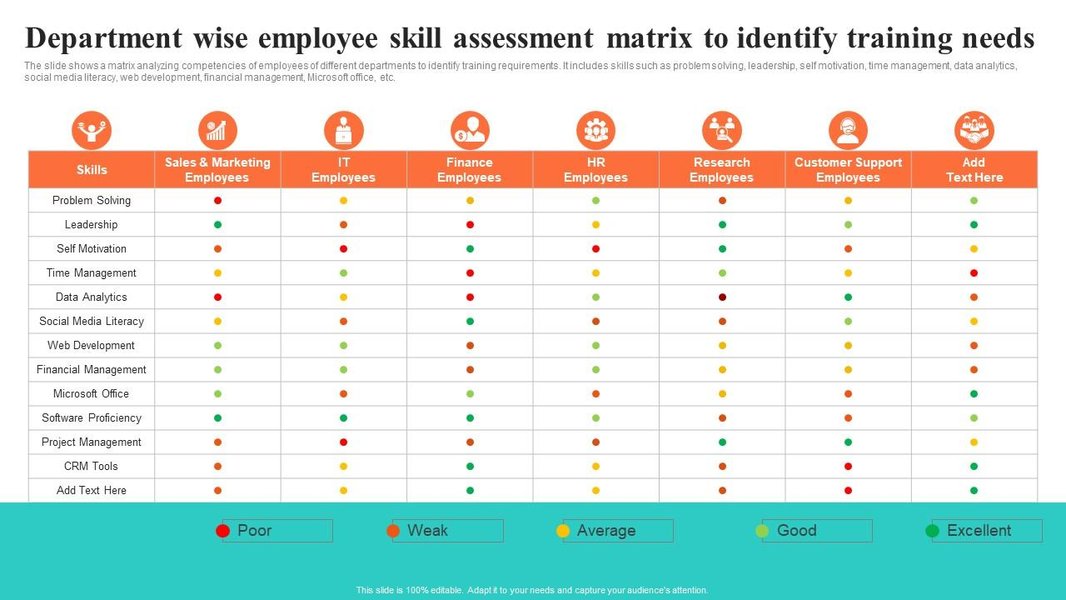
Department-Wise Employee Skill Assessment Matrix
4. Conduct the Skills Audit
Implement the assessment tools and gather data on employee skills and competencies. Ensure that employees understand the purpose of the audit and that their responses will be used to improve L&D programs.
5. Analyze the Results
Analyze the data collected to identify skill gaps and areas of strength within the organization. Look for trends and patterns that can inform L&D strategies and resource allocation.
6. Develop an Action Plan
Based on the audit results, develop an action plan to address the identified skill gaps. This plan should include specific L&D initiatives, such as training programs, workshops, mentoring, and on-the-job training.
7. Implement and Monitor the Plan
Implement the action plan and monitor its effectiveness. Track employee progress and make adjustments as needed to ensure that the L&D initiatives are achieving their intended outcomes.
8. Establish a Repeatable Process
Design for repeatability. A one-off audit might be helpful, but ongoing audits and updated skills matrices are far more valuable. You can create a regular audit cadence, with updates and refreshes built into the workflow.
Integrating AI into L&D Skills Audits
Artificial Intelligence (AI) is transforming the landscape of L&D, offering unprecedented opportunities to personalize learning experiences, automate tasks, and improve the overall effectiveness of training programs. Here’s how you can integrate AI into your L&D skills audits:
AI-Powered Skills Identification
AI can help identify skills within content and infer the skills of individuals. Talent intelligence platforms like Eightfold, Gloat, and SeekOut can infer employee skills and immediately recommend learning solutions.
Personalized Learning Paths
AI algorithms analyze data on learners’ performance, preferences, and progress, enabling the generation of tailor-made content and exercises. This adaptability caters to different learning styles and ensures that learners are consistently challenged at an optimal level, fostering continuous improvement.
AI-Assisted Content Creation
Use AI technology to aid in creating and developing learning content. AI-assisted authoring tools enable subject-matter experts (SMEs) to create learning content with ease and efficiency while maintaining a firm grip on your content strategy.
Corporate Training Workshop
Real-Time Feedback and Coaching
AI systems can provide real-time feedback, helping learners understand their progress and areas for improvement instantly. Chatbots can answer learners’ questions in real-time, and automated nudges and reminders can encourage course completion and understanding.
Predictive Analytics
AI can predict future learning needs based on employee performance, industry trends, and organizational goals. This enables L&D teams to proactively develop training programs that address emerging skill gaps.
Automation of L&D Processes
AI can automate various L&D processes, such as content curation, assessment grading, and administrative tasks. This frees up L&D professionals to focus on more strategic activities, such as designing personalized learning experiences and coaching employees.
Best Practices for Leveraging AI in L&D
To effectively leverage AI in L&D, consider the following best practices:
-
Ensure Data Privacy and Security: Handle learner data responsibly, protect it from unauthorized access, and use it only for legitimate purposes.
-
Provide Human Oversight: AI-generated content is helpful but requires human oversight for accuracy and relevance.
-
Address Ethical Concerns: Be aware of potential biases in AI algorithms and take steps to mitigate them.
-
Focus on Human Skills: Use AI to identify gaps in critical human skills, such as emotional intelligence, adaptability, and critical thinking, and develop targeted programs to address them.
-
Invest in AI-Powered Platforms: Consider investing in a learning platform that has an AI-powered authoring tool to empower SMEs to create learning content efficiently.
Skills Audit Table
Here is a comprehensive table summarizing the key aspects of conducting a skills audit, integrating AI, and best practices for L&D:
| Aspect | Description | AI Integration | Best Practices |
|---|---|---|---|
| Objectives | Clearly define the purpose and scope of the audit. | Use AI to analyze organizational goals and identify relevant skills. | Align objectives with business targets and stakeholder input. |
| Skills Identification | Identify core skills and competencies needed for each role. | Use AI to infer employee skills and recommend learning solutions. | Create a competency framework to assess employees against these skills. |
| Assessment Tools | Develop or select appropriate assessment tools. | Use AI to personalize assessments and provide real-time feedback. | Incorporate self-assessments, manager evaluations, tests, and performance data. |
| Data Analysis | Analyze data to identify skill gaps and areas of strength. | Use AI to identify trends and patterns in the data. | Look for trends and patterns that can inform L&D strategies. |
| Action Plan | Develop an action plan to address skill gaps. | Use AI to recommend personalized learning paths and content. | Include specific L&D initiatives such as training programs and mentoring. |
| Implementation and Monitoring | Implement the action plan and monitor its effectiveness. | Use AI to track employee progress and provide automated nudges. | Make adjustments as needed to ensure the L&D initiatives are achieving their intended outcomes. |
| Repeatable Process | Establish a regular audit cadence with updates and refreshes. | Use AI for continuous monitoring and up-to-date skills matrices. | Design for repeatability to ensure ongoing value and relevance. |
The Role of AI in the Future of L&D
The future of L&D is inextricably linked to AI. As AI technology continues to evolve, it will play an increasingly important role in shaping how organizations train and develop their employees. AI offers the potential to create more personalized, efficient, and effective learning experiences that drive employee engagement, productivity, and retention.
This video titled "Advice for managers: how to conduct a skills audit with your ..." explains how digitalization is rapidly changing the world of work. It emphasizes the importance of getting your team ready for the future by conducting a skills audit. This is relevant because it provides practical advice for managers on how to effectively conduct skills audits, ensuring that the workforce is prepared for the evolving demands of the digital age.
FAQ
What is a skills audit?
A skills audit is a review of the skills and knowledge your employees have. It allows you to see the gaps in their expertise, and understand the areas you need to develop.
Why is a skills audit important?
Knowing your organization's current skills and abilities is crucial for success. It provides data-driven insights to guide workforce planning and development initiatives.
How often should a skills audit be conducted?
Ongoing audits and updated skills matrices are far more valuable than one-off audits. You can create a regular audit cadence, with updates and refreshes built into the workflow.
How can AI help in a skills audit?
AI can help identify skills within content and infer the skills of individuals. It also provides personalized learning paths, real-time feedback, and automation of L&D processes.
What are the benefits of using AI in L&D?
AI offers significant advantages in enhancing the efficiency and effectiveness of L&D programs, such as personalized learning, adjustable delivery of content, and decision-making based on data.
References
Last updated April 15, 2025