
Unlocking Trustworthy AI: Your Guide to Effective AI System Audits
Navigate the complexities of AI auditing to ensure responsibility, manage risks, and harness the power of ethical AI across your enterprise.
Essential Insights into AI Auditing
- Building Trust: AI audits are fundamental for verifying that AI systems operate ethically, fairly, and transparently, fostering confidence among users, regulators, and the public.
- Managing Risk: Identifying and mitigating specific AI risks—like algorithmic bias, security flaws, and data privacy violations—is crucial for preventing harm and ensuring compliance.
- Structured Approach: A successful AI audit program requires clear governance, robust risk assessment, evaluation of IT controls (ITGC/ITAC), and thorough testing of system design and implementation.
Why Auditing AI is Non-Negotiable for Responsible Innovation
Establishing Accountability and Trust
Auditing Artificial Intelligence (AI) systems has become an indispensable practice for organizations striving to implement AI that is both responsible and trustworthy. In an era where AI significantly influences business decisions and customer interactions, ensuring these systems align with ethical principles, regulatory mandates, and societal expectations is paramount. AI audits serve as a critical governance mechanism, providing assurance that AI technologies are developed and deployed in a manner consistent with an organization's values and policies.
Through systematic examination, AI audits help organizations:
- Verify Compliance: Ensure adherence to existing regulations (like GDPR) and emerging AI-specific laws and standards, avoiding legal penalties and reputational damage.
- Promote Fairness: Detect and mitigate biases embedded in algorithms or training data that could lead to discriminatory outcomes in areas like hiring, lending, or customer profiling.
- Enhance Transparency: Evaluate the explainability of AI models, ensuring that decisions can be understood and challenged when necessary.
- Ensure Robustness and Reliability: Confirm that AI systems perform accurately and consistently under various conditions, minimizing errors and unexpected failures.
- Strengthen Security: Identify vulnerabilities specific to AI systems, such as susceptibility to adversarial attacks or data poisoning, and ensure appropriate safeguards are in place.
By rigorously evaluating these aspects, organizations can proactively address potential negative consequences, build confidence with stakeholders, and demonstrate a commitment to ethical AI practices. This structured verification process is key to bridging the gap between AI's potential and its responsible application in the real world.
Navigating the Landscape: Key AI Risks Requiring Audit Attention
Identifying Critical Vulnerabilities
The integration of AI introduces novel and complex risks that demand specific audit focus. Internal audit functions and external auditors must understand these risks to develop effective audit plans and provide meaningful assurance. These risks span data, algorithms, security, compliance, and operations.
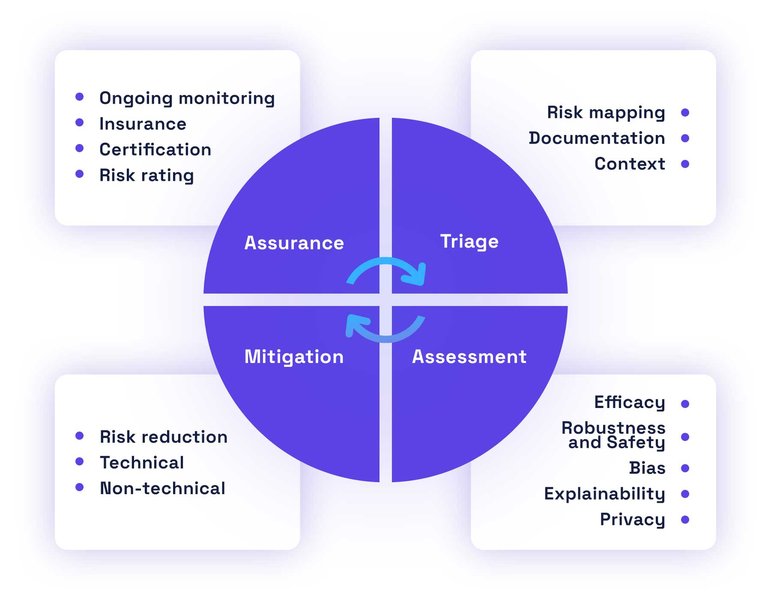
Visual overview of core concepts in AI Auditing.
Data-Related Risks
The foundation of most AI systems is data. Risks include:
- Data Bias: Training data reflecting historical biases can lead AI systems to perpetuate or even amplify discrimination. Audits must scrutinize data sourcing, collection, and pre-processing methods.
- Data Quality and Provenance: Inaccurate, incomplete, or poorly understood data can lead to flawed models and unreliable predictions. Verifying data lineage and quality is crucial.
- Data Privacy: AI systems often process vast amounts of personal or sensitive data, increasing the risk of privacy violations if not handled according to regulations like GDPR. Audits must check data handling, anonymization, and consent mechanisms.
Algorithmic and Model Risks
The AI models themselves present unique challenges:
- Lack of Explainability (Opacity): Complex models ("black boxes") can make it difficult to understand how decisions are reached, hindering accountability and debugging. Audits should assess the need for and implementation of explainability techniques.
- Performance and Accuracy Issues: Models may perform poorly in real-world scenarios, deviate over time (model drift), or produce inaccurate outputs, leading to poor business decisions or negative impacts. Continuous monitoring and validation are key audit areas.
- Algorithmic Bias: Beyond data bias, the model's architecture or objective function can introduce unfairness.
Security Risks
AI systems introduce new attack surfaces:
- Adversarial Attacks: Malicious actors can manipulate AI inputs to cause misclassification or extract sensitive information from the model.
- Data Poisoning: Training data can be subtly corrupted to compromise the model's integrity.
- Model Theft: Intellectual property embedded in trained models can be stolen. Audits need to evaluate defenses against these specific AI threats.
Compliance and Governance Risks
- Regulatory Non-Compliance: Failure to meet evolving AI regulations can result in significant fines and sanctions.
- Lack of Oversight: Insufficient governance structures for AI development, deployment, and monitoring can lead to uncontrolled risks.
- Ethical Violations: AI applications might conflict with societal norms or ethical principles if not carefully designed and overseen.
Operational Risks
- Integration Challenges: Poorly integrated AI can disrupt existing business processes.
- Over-Reliance and Deskilling: Excessive dependence on AI without adequate human oversight can lead to errors and a loss of critical human skills.
- System Failures: AI system malfunctions can cause operational disruptions or safety issues, especially in critical applications.
Prioritizing AI Audit Focus Areas
The following chart provides a conceptual overview of the relative emphasis often placed on different dimensions during an AI audit. The specific focus will vary based on the AI system's application, industry, and risk profile. Dimensions like Security and Compliance typically receive high priority due to regulatory and reputational implications, while Fairness and Data Quality are crucial for ethical and reliable performance.
This visualization helps conceptualize how different facets of AI systems are scrutinized during audits, emphasizing the multi-dimensional nature of ensuring responsible AI.
Where is AI Deployed Across the Enterprise?
Mapping AI Implementation Areas
AI is no longer confined to specific departments; it permeates various layers of the enterprise architecture. Understanding where AI systems are implemented is crucial for scoping audits effectively and identifying context-specific risks.

AI relies on robust infrastructure for development and deployment across the enterprise.
Business Applications (Apps)
This is often the most visible area of AI implementation:
- Customer Relationship Management (CRM): AI analyzes customer data for personalized recommendations, predicts churn, and powers chatbots for customer service.
- Marketing and Sales: AI optimizes advertising spend, segments customers, forecasts sales trends, and automates lead scoring.
- Finance and Accounting: AI assists in fraud detection, risk assessment, invoice processing, and generating financial reports.
- Human Resources: AI tools screen resumes, personalize employee training, and analyze workforce sentiment.
- Process Automation: Robotic Process Automation (RPA) infused with AI automates complex workflows beyond simple rule-based tasks.
Audits in this area focus on algorithmic bias, data privacy in customer data, accuracy of predictions, and impact on user experience.
IT Infrastructure (Infra)
AI is increasingly used to manage and optimize the underlying technology stack:
- Cloud Platforms: AI optimizes resource allocation, manages workloads, and enhances security monitoring in cloud environments (AWS SageMaker, Azure ML, Google AI Platform).
- Data Centers: Predictive maintenance for hardware, energy consumption optimization, and automated incident response.
- AI Development Platforms: Tools and platforms (like MLOps) used to build, train, and deploy models themselves require auditing for access controls, versioning, and security.
Infrastructure audits examine the security of AI platforms, data storage practices, access controls to models and data, and resilience of AI-managed systems.

Specialized hardware and storage are often part of enterprise AI infrastructure.
Networks
AI enhances network management and security:
- Network Security: AI-powered intrusion detection systems (IDS) and Security Information and Event Management (SIEM) tools analyze traffic patterns to identify sophisticated threats in real-time.
- Traffic Optimization: AI predicts network congestion and dynamically routes traffic for better performance.
- Anomaly Detection: Identifying unusual network behavior that might indicate failures or security breaches.
Network AI audits assess the reliability of threat detection, potential for manipulation of AI security tools, and the impact of AI-driven network changes.
Other Operational Areas
AI extends into various other business functions:
- Supply Chain and Logistics: Demand forecasting, route optimization, predictive maintenance for vehicles, warehouse automation.
- Manufacturing: Quality control through computer vision, predictive maintenance for machinery, process optimization.
- Product Development: Analyzing market trends, generating design options, accelerating research and development.
- Physical Security: AI-powered video surveillance and access control systems.
Audits must adapt to the specific risks in these diverse application domains, considering factors like physical safety, intellectual property, and operational reliance.
Conducting an Effective AI Audit Program
A Structured Methodology
A successful AI audit program requires a systematic approach that integrates traditional audit principles with AI-specific considerations. It's not just about checking boxes; it's about understanding the technology, its context, and its potential impact.
1. Governance and Planning
Strong governance forms the bedrock of an AI audit program.
- Establish an Oversight Committee: Create a cross-functional team involving Audit, Risk Management, Compliance, Legal, IT/Security, Data Science, and relevant business units.
- Develop AI Policies and Standards: Define clear organizational guidelines for ethical AI development, data handling, model validation, and deployment.
- Inventory AI Systems: Identify and catalogue all AI systems in use or development across the enterprise.
- Risk-Based Scoping: Prioritize audits based on the criticality and risk profile of AI applications. High-impact systems (e.g., those affecting financials, customer rights, safety) require more rigorous scrutiny.
- Define Audit Objectives: Clearly state what each audit aims to achieve (e.g., assess bias in a hiring tool, verify compliance of a chatbot with data privacy laws).
2. Understanding the AI System and Identifying Risks
Auditors need to gain a deep understanding of the specific AI system being audited.
- Gather Documentation: Collect information on the system's purpose, architecture, algorithms, data sources, training process, and performance metrics.
- Identify Stakeholders: Interview developers, data scientists, business owners, and users.
- Develop Specific Risk Scenarios: Based on the system's context, formulate plausible risk scenarios. Examples:
- Scenario 1 (Bias): "A loan application AI denies applicants from a specific demographic at a disproportionately high rate due to biased training data."
- Scenario 2 (Security): "An attacker introduces malicious data into the training set of a fraud detection model, causing it to ignore certain types of fraudulent transactions."
- Scenario 3 (Performance): "A predictive maintenance AI fails to anticipate a critical equipment failure due to model drift, leading to costly downtime."
- Map Risks to Controls: Identify existing controls designed to mitigate these risks.
3. Evaluating Controls: ITGC and ITAC
Traditional IT controls remain relevant but need adaptation for AI.
- IT General Controls (ITGC) for AI: These foundational controls apply to the AI environment:
- Access Management: Who can access, modify, and deploy AI models and underlying data? Are roles and permissions appropriate?
- Change Management: How are changes to models, algorithms, and data pipelines tracked, tested, and approved? Is there version control?
- Data Management: Are there controls over data quality, integrity, privacy, and security throughout the AI lifecycle?
- System Operations: Are there processes for monitoring AI system performance, handling incidents, and ensuring business continuity?
- IT Application Controls (ITAC) for AI: These controls are embedded within the AI application itself:
- Input Validation: Does the system check the validity and appropriateness of input data?
- Processing Integrity: Are algorithms functioning as intended? Are calculations accurate?
- Output Controls: Are the results reasonable, properly formatted, and distributed securely? Are there mechanisms for human review or override?
- Model Validation: Specific controls ensuring the model's accuracy, fairness, and robustness before and after deployment.
- Audit Trails: Does the system log relevant activities and decisions for traceability?
4. Testing: Design and Implementation
Auditors must test whether controls are suitably designed and operating effectively.
- Test of Design (TOD): Evaluates whether the controls, as designed, are capable of preventing or detecting material misstatements or risks. This often involves walkthroughs, reviewing documentation (policies, system architecture diagrams), and interviewing personnel to understand how controls *should* work. For AI, this includes assessing if the design incorporates fairness checks, appropriate validation strategies, or security protocols.
- Test of Implementation (TOI) / Test of Operating Effectiveness (TOE): Verifies that the designed controls have been implemented and are functioning consistently as intended over time. This involves examining evidence of controls operating, such as:
- Performing data analysis to detect bias or anomalies.
- Running test cases or simulations on the AI model.
- Reviewing system logs and access records.
- Observing processes (e.g., model update procedures).
- Using specialized AI auditing tools to assess fairness, explainability, or robustness.
5. Reporting and Recommendations
- Document Findings: Clearly report identified control weaknesses, risks, and instances of non-compliance.
- Provide Actionable Recommendations: Suggest specific improvements to controls, processes, or governance structures.
- Follow-Up: Track the implementation of recommendations to ensure risks are effectively remediated.
Visualizing the AI Audit Program Structure
The following mind map illustrates the key components and flow of a structured AI audit program, from establishing governance to reporting findings.
Is the control designed properly?"] id4b["Test of Implementation (TOI/TOE)
Is the control operating effectively?"] id4b1["Data Analysis"] id4b2["Simulations"] id4b3["Log Reviews"] id4b4["Process Observation"] id4b5["AI Audit Tools"] id5["5. Reporting & Follow-Up"] id5a["Document Findings"] id5b["Actionable Recommendations"] id5c["Track Remediation"]
Summarizing Key AI Risks and Audit Considerations
To effectively manage the complexities of AI, understanding the specific risks and corresponding audit approaches is essential. The table below summarizes some primary AI risk areas, their potential business impact, and examples of audit procedures designed to address them.
| AI Risk Area | Description | Potential Impact | Example Audit Procedures |
|---|---|---|---|
| Data Bias | Systematic prejudice in training data leading to unfair or discriminatory outcomes. | Reputational damage, legal action, customer dissatisfaction, regulatory fines. | Review data sourcing and collection methods; perform statistical bias testing on datasets and model outputs; assess fairness metrics. |
| Security Vulnerabilities | Weaknesses allowing unauthorized access, data breaches, model manipulation (e.g., adversarial attacks, data poisoning). | Financial loss, IP theft, system compromise, erosion of trust, operational disruption. | Assess access controls to models/data; review security protocols for AI infrastructure; test resilience against known AI attack vectors; evaluate incident response plans. |
| Algorithmic Opacity / Lack of Explainability | Difficulty in understanding how an AI model arrives at its decisions. | Inability to debug errors, challenge decisions, ensure compliance, or build user trust. | Evaluate the need for explainability based on risk; assess implementation of explainability techniques (e.g., SHAP, LIME); review documentation clarity; test understanding by stakeholders. |
| Compliance Violations | Failure to adhere to data privacy laws (e.g., GDPR), industry regulations, or emerging AI-specific legislation. | Legal penalties, fines, operational restrictions, reputational harm. | Review AI system against relevant regulatory requirements; assess data handling procedures; verify consent mechanisms; check documentation for compliance reporting. |
| Performance Degradation / Model Drift | AI model's accuracy or relevance declines over time as real-world data changes. | Poor business decisions, financial losses, safety risks (in critical systems), reduced efficiency. | Review model monitoring procedures; test for performance degradation using current data; assess retraining frequency and validation processes; evaluate alerting mechanisms. |
| Operational Failures | Malfunctions or poor integration leading to disruption of business processes or incorrect actions. | Financial losses, safety incidents, customer service failures, inefficiencies. | Test system integration points; evaluate error handling and recovery procedures; review human oversight mechanisms; assess system reliability and uptime records. |
This table provides a starting point for identifying and addressing common risks associated with enterprise AI systems through targeted audit activities.
Advancing AI Audit Practices: Insights from the Field
Understanding the practical challenges and innovative approaches in AI auditing is crucial. The following video showcases a project focused on assessing bias and potential discrimination in AI systems, offering valuable lessons learned for practitioners aiming to develop effective tools and methodologies for responsible AI evaluation.
This presentation delves into the design and development of practical tools for AI assessment, highlighting the complexities involved in ensuring fairness and mitigating discriminatory impacts. Such insights are vital for refining audit programs and staying abreast of evolving best practices in the field.
Frequently Asked Questions (FAQ) about AI Auditing
What is the difference between internal and external AI audits?
Internal AI audits are typically conducted by an organization's own internal audit function. Their primary goal is to provide assurance to management and the board that AI risks are being managed effectively and that AI systems align with internal policies and objectives. They often focus on improving internal processes and controls.
External AI audits are performed by independent third parties. They often aim to provide assurance to external stakeholders (like regulators, customers, or the public) about an AI system's compliance, fairness, security, or reliability. They may result in certifications or public reports verifying adherence to specific standards or regulations.
Why is auditing Generative AI particularly challenging?
Auditing Generative AI (like large language models) presents unique challenges due to:
- Complexity and Opacity: The sheer scale and intricate workings of models like GPT make them harder to understand and explain.
- Non-Deterministic Outputs: These models can produce varied outputs for the same input, making traditional testing methods difficult.
- Potential for Hallucinations: They can generate plausible but factually incorrect or nonsensical information.
- Vast Training Data: Auditing the massive datasets used for training for bias or privacy issues is complex.
- Emergent Capabilities: Models may exhibit unexpected behaviors not explicitly trained for.
- Misinformation and Malicious Use: The potential for generating deepfakes, spam, or harmful content requires specific risk assessment and control evaluation.
Auditors need new methodologies, skills, and tools to effectively assess risks associated with generative AI.
What skills do auditors need for AI audits?
Auditors need a blend of traditional audit skills and new technical competencies:
- Understanding of AI Concepts: Familiarity with machine learning, algorithms, data science principles, and AI lifecycle stages.
- Data Analytics Skills: Ability to analyze large datasets to test models, identify anomalies, and assess data quality.
- Risk Assessment Acumen: Ability to identify and evaluate unique AI-related risks (bias, security, ethics).
- Knowledge of Regulations and Frameworks: Understanding relevant laws, standards (e.g., ISO/IEC 42001), and ethical guidelines for AI.
- IT Controls Knowledge: Understanding ITGC and ITAC, adapted for AI environments.
- Communication Skills: Ability to effectively communicate complex technical findings to non-technical stakeholders.
- Critical Thinking and Skepticism: Maintaining professional skepticism when evaluating AI systems and vendor claims.
Continuous learning is essential as AI technology and regulations evolve.
How often should AI systems be audited?
The frequency of AI audits depends on several factors:
- Risk Level: High-risk systems (e.g., those impacting safety, finance, or human rights) should be audited more frequently, potentially continuously or annually.
- Regulatory Requirements: Some regulations may mandate specific audit frequencies.
- System Criticality: How essential is the AI system to business operations?
- Rate of Change: Systems that undergo frequent updates (model retraining, feature changes) require more frequent audits.
- Performance Monitoring: Indications of performance degradation or unexpected behavior might trigger an ad-hoc audit.
A risk-based approach is generally recommended, combining periodic full audits with ongoing monitoring and targeted reviews.
Can AI itself be used to audit AI?
Yes, AI can be a powerful tool within the audit process itself, including auditing other AI systems. Potential applications include:
- Automated Testing: AI can analyze vast amounts of log data or model outputs to detect anomalies, biases, or performance issues faster than humans.
- Bias Detection Tools: Specialized AI tools can help quantify fairness metrics and identify potential biases in datasets or models.
- Continuous Monitoring: AI can monitor AI systems in real-time for deviations from expected behavior or compliance breaches.
- Risk Assessment: AI can analyze patterns to help auditors identify high-risk areas within AI systems or processes.
However, it's crucial that the AI tools used for auditing are themselves validated and trustworthy. Human oversight remains essential to interpret results, apply professional judgment, and address the limitations of automated auditing tools.
References
- AI Audit: Ensuring Responsible & Compliant AI Systems [2024] - AiMultiple
- AI-Powered Audit, Risk, and Compliance: Keys to Implementing the Latest Technology - AuditBoard
- How internal audit can adapt to AI - EY
- Managing the risks of generative AI - PwC
- Top 5 Benefits of AI in Auditing - DataSnipper
- Artificial intelligence in auditing: Leveraging benefits and avoiding risk - Becker
- AI Auditing: Ensuring Ethical and Efficient AI Systems - Centraleyes
- 5 AI Auditing Frameworks to Encourage Accountability - AuditBoard
Recommended Further Exploration
Last updated April 20, 2025