
Evaluating the Limit of (e^x - x - 1)/x² as x Approaches 0
A detailed exploration using L'Hôpital's Rule and Taylor series
Key Highlights
- Application of L'Hôpital's Rule: The limit is evaluated through successive derivatives.
- Taylor Series Expansion: An alternative verification method expanding e^x confirms the result.
- Structured Derivation: Step-by-step analysis starting with the indeterminate form is provided.
Understanding the Problem
The problem at hand is to compute the limit:
\( \lim_{x \to 0} \frac{e^x - x - 1}{x^2} \)
When we substitute \(x=0\) into the expression, the numerator becomes \(e^0 - 0 - 1 = 1 - 1 = 0\) and the denominator is \(0^2 = 0\). This results in the indeterminate form \(\frac{0}{0}\) which signals that we need to use a strategy such as L'Hôpital's Rule to evaluate the limit. Additionally, the Taylor series expansion of \(e^x\) serves as a verification method.
Method 1: Utilizing L'Hôpital's Rule
Step-by-Step Process
L'Hôpital's Rule enables us to resolve limits that result in indeterminate forms like \(\frac{0}{0}\). The rule states that if \(\lim_{x \to c} \frac{f(x)}{g(x)}\) results in an indeterminate form, then, given the functions are differentiable near the point \(c\), the limit is equivalent to:
\( \lim_{x \to c} \frac{f'(x)}{g'(x)} \)
We apply this rule to our expression in steps:
First Application of L'Hôpital's Rule
Our function is:
\( f(x) = e^x - x - 1 \)
Its derivative is:
\( f'(x) = e^x - 1 \)
The denominator function is:
\( g(x) = x^2 \)
Its derivative is:
\( g'(x) = 2x \)
Thus, we reformulate the original limit as:
\( \lim_{x \to 0} \frac{e^x - 1}{2x} \)
Substituting \(x=0\) again results in \( \frac{e^0 - 1}{2\cdot0} = \frac{0}{0}\). The indeterminate form persists, necessitating a second application of L'Hôpital's Rule.
Second Application of L'Hôpital's Rule
We now differentiate the numerator and denominator once more:
Derivative of \( e^x - 1 \):
\( (e^x - 1)' = e^x \)
Derivative of \( 2x \):
\( (2x)' = 2 \)
The limit then becomes:
\( \lim_{x \to 0} \frac{e^x}{2} \)
Since \(e^x\) is continuous, we substitute \(x=0\):
\( \frac{e^0}{2} = \frac{1}{2} \)
This is the final value of the limit using L'Hôpital's Rule.
Method 2: Using Taylor Series Expansion
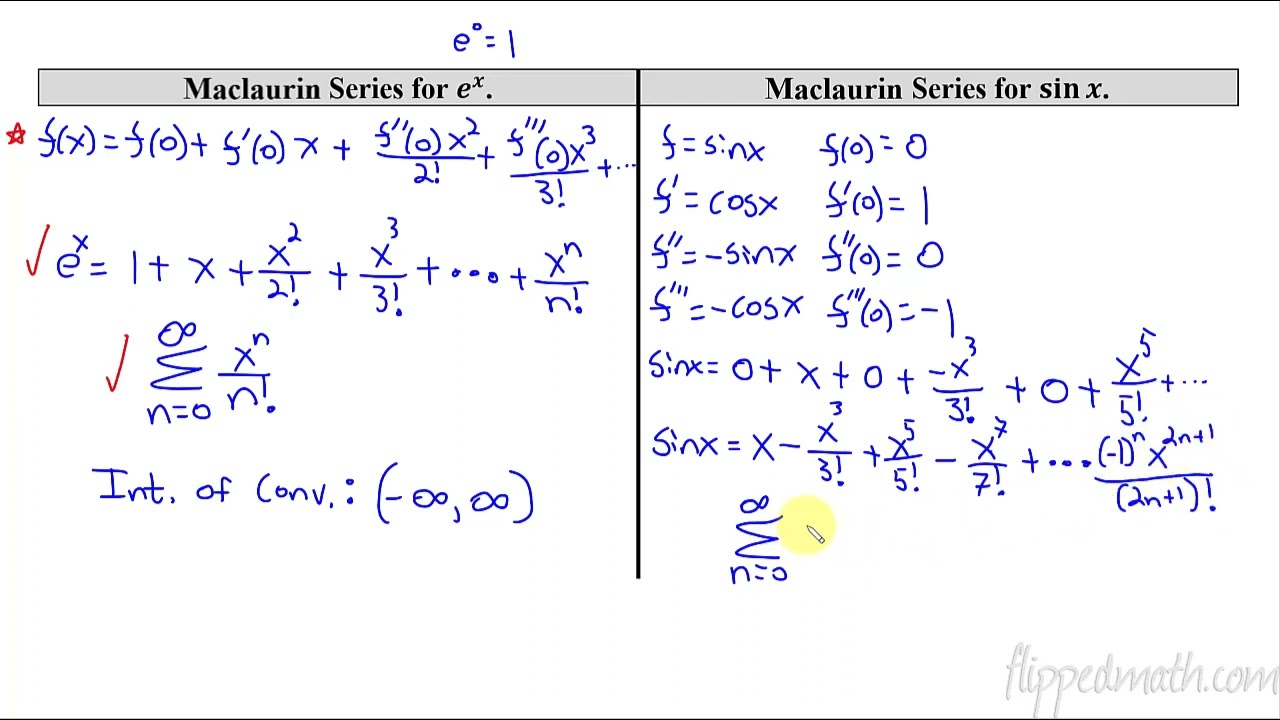
Another effective method to evaluate the limit involves using the Taylor series expansion of the exponential function \(e^x\) around \(x = 0\). The Taylor series expansion is:
\( e^x = 1 + x + \frac{x^2}{2!} + \frac{x^3}{3!} + \cdots \)
Plugging this expansion into our expression, we obtain:
\( \frac{(1 + x + \frac{x^2}{2} + \frac{x^3}{6} + \cdots) - x - 1}{x^2} \)
Notice that the constant term and the linear term cancel out:
\( = \frac{\frac{x^2}{2} + \frac{x^3}{6} + \cdots}{x^2} \)
Dividing numerator and denominator by \(x^2\) gives:
\( = \frac{1}{2} + \frac{x}{6} + \cdots \)
As \(x\) approaches 0, all higher-order terms vanish, leaving us with:
\( \frac{1}{2} \)
This confirms the result obtained using L'Hôpital's Rule.
Comparative Analysis of the Two Methods
Overview
Both methods yield the same result for the limit:
\( \frac{1}{2} \)
However, each method has its own advantages:
L'Hôpital's Rule
This rule provides a systematic approach where you differentiate the numerator and the denominator until the indeterminate form is resolved. It is particularly useful when the derivatives simplify the function without altering its limit properties.
Taylor Series Expansion
The Taylor series approach offers insight into the behavior of the function in the vicinity of \(x=0\). By expanding the function into its series form, it is easy to see which terms will dominate as \(x\) becomes very small. This method also serves as a valuable check for the limit computed using L'Hôpital's method.
Structured Derivation Table
The following table summarizes the derivation steps for clarity:
| Step | Description | Result |
|---|---|---|
| Initial Form | Substitute \(x=0\) in \( \frac{e^x - x - 1}{x^2} \) | \(\frac{0}{0}\) (Indeterminate) |
| First Derivative |
Differentiate numerator: \( \frac{d}{dx}(e^x - x - 1) = e^x - 1 \) Differentiate denominator: \( \frac{d}{dx}(x^2) = 2x \) |
New limit: \( \lim_{x \to 0} \frac{e^x - 1}{2x} \) |
| Second Derivative |
Differentiate numerator: \( \frac{d}{dx}(e^x - 1) = e^x \) Differentiate denominator: \( \frac{d}{dx}(2x) = 2 \) |
Final limit: \( \lim_{x \to 0} \frac{e^x}{2} = \frac{1}{2} \) |
Conceptual Insights
The evaluation of the given limit provides a clear example of handling indeterminate forms using analytical methods. Whether you choose L'Hôpital's Rule or the Taylor series expansion, both techniques converge to the same answer when applied carefully. This consistency between methods is critical for validating the correctness of the approach.
The problem exemplifies the relationship between differentiation and series expansion. Both approaches not only reveal the underlying structure of the function but also highlight the power of calculus in resolving seemingly ambiguous expressions.
Extended Discussion on L'Hôpital's Rule
Mathematical Justification
L'Hôpital's Rule is rigorously justified under the assumptions that the functions involved are differentiable in a neighborhood around the point of interest (excluding the point itself if necessary) and that the denominator’s derivative does not vanish in that neighborhood except possibly at the point. In our case, the requirements are met, allowing us to confidently apply the rule multiple times.
Additionally, L'Hôpital's Rule is invaluable when dealing with indeterminate forms like \(0/0\) or \(\infty/\infty\). Its repeated application in more complex limits, as demonstrated above, provides a systematic route to resolve such issues.
Taylor Series: A Broader Perspective
The Taylor series expansion deepens the analysis by expressing functions as infinite sums of their derivatives at a specific point. When we apply this to \(e^x\), the expansion not only helps in limit evaluation but also plays a crucial role in approximating functions in many areas of applied mathematics, including engineering and physics.
Through the Taylor series, one can also understand the behavior of the function beyond the quadratic term in the expansion. Although for this specific limit only the quadratic term is needed, the method opens the door to analyzing higher degree approximations and error estimations.
Final Result and Verification
After careful application of both L'Hôpital's Rule and the Taylor series expansion method, the limit is determined as:
\( \boxed{\frac{1}{2}} \)
Both methods confirm this result, underscoring the consistency and reliability of classical calculus techniques in addressing indeterminate limits.
References
- How do you evaluate (e^x - x - 1)/x^2? - Socratic
- Limit Calculator - Mathway
-
Wolfram|Alpha Limit Calculator
- Paul's Online Math Notes - Taylor Series
- Evaluate Limit (e^x - x - 1)/x^2 - Tell Us The Answer
Recommended Further Queries
Last updated March 18, 2025