
Unlocking Matrix Mysteries: A Deep Dive into Your A and C Matrices
Exploring definitions, calculations, and potential operations for your given matrices.
Essential Insights: Key Takeaways
- Matrix A Decoded: We'll explicitly calculate the 2x2 matrix A using your formula \(a_{ij} = 2i - 3j\).
- Interpreting Matrix C: Your notation for C suggests two component matrices, which we'll label C1 (3x2) and C2 (2x3). We'll explore their product, C = C1 * C2.
- Multiplication Possibilities: We will investigate which matrix multiplications are valid between A, C1, and C2, and compute the results for valid pairs.
Understanding Matrix A: Definition and Calculation
Constructing Your 2x2 Matrix
You've defined matrix A as \(A = (a_{ij}) \in M_2(\mathbb{R})\), where each element \(a_{ij}\) is determined by the formula \(a_{ij} = 2i - 3j\). The notation \(M_2(\mathbb{R})\) signifies that A is a 2x2 matrix with real number entries. Here, 'i' represents the row number (1 or 2) and 'j' represents the column number (1 or 2).
Let's calculate each element of matrix A:
- For \(a_{11}\) (row 1, column 1): \(a_{11} = 2(1) - 3(1) = 2 - 3 = -1\)
- For \(a_{12}\) (row 1, column 2): \(a_{12} = 2(1) - 3(2) = 2 - 6 = -4\)
- For \(a_{21}\) (row 2, column 1): \(a_{21} = 2(2) - 3(1) = 4 - 3 = 1\)
- For \(a_{22}\) (row 2, column 2): \(a_{22} = 2(2) - 3(2) = 4 - 6 = -2\)
Therefore, matrix A is:
\[ A = \begin{pmatrix} -1 & -4 \ 1 & -2 \end{pmatrix} \]Interpreting and Defining Matrix C
The Components: C1 and C2
The way matrix C is presented suggests it might be composed of two distinct matrices, or perhaps their product. Let's denote these potential component matrices as C1 and C2 for clarity:
The first part, let's call it C1, is a 3x2 matrix (3 rows, 2 columns):
\[ C_1 = \begin{pmatrix} 1 & 0 \ 2 & 0 \ 1 & 1 \end{pmatrix} \]The second part, let's call it C2, is a 2x3 matrix (2 rows, 3 columns):
\[ C_2 = \begin{pmatrix} 1 & 0 & -1 \ 1 & 1 & 0 \end{pmatrix} \]A common interpretation when matrices are presented this way, without an explicit operator, is that they might be intended for multiplication, particularly if their dimensions are compatible for such an operation.
The Combined Matrix: C as the Product C1 * C2
If the intention was for C to be the product of C1 and C2 (i.e., \(C = C_1 \cdot C_2\)), this multiplication is indeed possible. Matrix C1 has dimensions 3x2, and matrix C2 has dimensions 2x3. Since the number of columns in C1 (which is 2) matches the number of rows in C2 (which is 2), their product \(C_1 \cdot C_2\) is defined. The resulting matrix C will have the number of rows of C1 and the number of columns of C2, making C a 3x3 matrix.
Let's compute the product \(C = C_1 \cdot C_2\):
\[ C = C_1 \cdot C_2 = \begin{pmatrix} 1 & 0 \ 2 & 0 \ 1 & 1 \end{pmatrix} \begin{pmatrix} 1 & 0 & -1 \ 1 & 1 & 0 \end{pmatrix} \] The elements of C (\(c_{ij}\)) are calculated as follows:- \(c_{11} = (1)(1) + (0)(1) = 1 + 0 = 1\)
- \(c_{12} = (1)(0) + (0)(1) = 0 + 0 = 0\)
- \(c_{13} = (1)(-1) + (0)(0) = -1 + 0 = -1\)
- \(c_{21} = (2)(1) + (0)(1) = 2 + 0 = 2\)
- \(c_{22} = (2)(0) + (0)(1) = 0 + 0 = 0\)
- \(c_{23} = (2)(-1) + (0)(0) = -2 + 0 = -2\)
- \(c_{31} = (1)(1) + (1)(1) = 1 + 1 = 2\)
- \(c_{32} = (1)(0) + (1)(1) = 0 + 1 = 1\)
- \(c_{33} = (1)(-1) + (1)(0) = -1 + 0 = -1\)
So, the resulting matrix C is:
\[ C = \begin{pmatrix} 1 & 0 & -1 \ 2 & 0 & -2 \ 2 & 1 & -1 \end{pmatrix} \]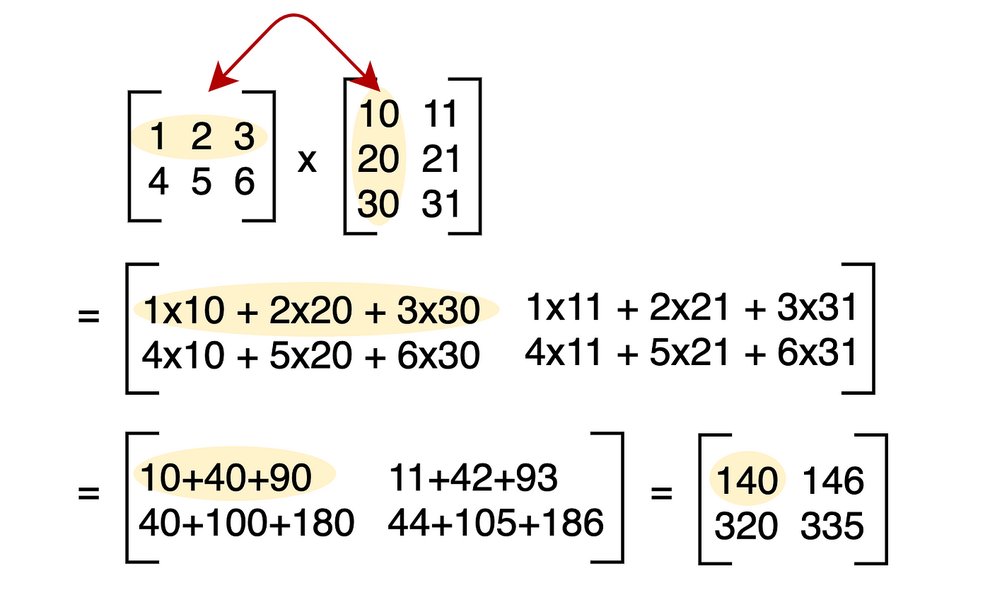
Illustrating how matrix dimensions dictate the possibility and outcome of multiplication.
Exploring Potential Matrix Operations
The Cardinal Rule of Matrix Multiplication
Matrix multiplication is a cornerstone of linear algebra, but it comes with a critical rule: for the product of two matrices, say P times Q (P·Q), to be defined, the number of columns in matrix P must be equal to the number of rows in matrix Q. If P is an \(m \times n\) matrix and Q is an \(n \times p\) matrix, their product PQ will be an \(m \times p\) matrix. It's also vital to remember that matrix multiplication is generally not commutative, meaning \(P \cdot Q\) is usually not the same as \(Q \cdot P\) (in fact, \(Q \cdot P\) might not even be defined).
Possible Products Involving A, C1, and C2
Given our matrices:
- \(A\) is 2x2: \( \begin{pmatrix} -1 & -4 \ 1 & -2 \end{pmatrix} \)
- \(C_1\) is 3x2: \( \begin{pmatrix} 1 & 0 \ 2 & 0 \ 1 & 1 \end{pmatrix} \)
- \(C_2\) is 2x3: \( \begin{pmatrix} 1 & 0 & -1 \ 1 & 1 & 0 \end{pmatrix} \)
Product A · C2
Matrix A (2x2) and C2 (2x3). The number of columns in A (2) equals the number of rows in C2 (2). So, \(A \cdot C_2\) is defined, and the result will be a 2x3 matrix.
\[ A \cdot C_2 = \begin{pmatrix} -1 & -4 \ 1 & -2 \end{pmatrix} \begin{pmatrix} 1 & 0 & -1 \ 1 & 1 & 0 \end{pmatrix} \] Calculating the elements:- Row 1, Col 1: \((-1)(1) + (-4)(1) = -1 - 4 = -5\)
- Row 1, Col 2: \((-1)(0) + (-4)(1) = 0 - 4 = -4\)
- Row 1, Col 3: \((-1)(-1) + (-4)(0) = 1 + 0 = 1\)
- Row 2, Col 1: \((1)(1) + (-2)(1) = 1 - 2 = -1\)
- Row 2, Col 2: \((1)(0) + (-2)(1) = 0 - 2 = -2\)
- Row 2, Col 3: \((1)(-1) + (-2)(0) = -1 + 0 = -1\)
Product C1 · A
Matrix C1 (3x2) and A (2x2). The number of columns in C1 (2) equals the number of rows in A (2). So, \(C_1 \cdot A\) is defined, and the result will be a 3x2 matrix.
\[ C_1 \cdot A = \begin{pmatrix} 1 & 0 \ 2 & 0 \ 1 & 1 \end{pmatrix} \begin{pmatrix} -1 & -4 \ 1 & -2 \end{pmatrix} \] Calculating the elements:- Row 1, Col 1: \((1)(-1) + (0)(1) = -1 + 0 = -1\)
- Row 1, Col 2: \((1)(-4) + (0)(-2) = -4 + 0 = -4\)
- Row 2, Col 1: \((2)(-1) + (0)(1) = -2 + 0 = -2\)
- Row 2, Col 2: \((2)(-4) + (0)(-2) = -8 + 0 = -8\)
- Row 3, Col 1: \((1)(-1) + (1)(1) = -1 + 1 = 0\)
- Row 3, Col 2: \((1)(-4) + (1)(-2) = -4 - 2 = -6\)
Summary of Valid Multiplications
Let's summarize the compatibility of various multiplications between A, C1, and C2. The table below shows the operation, whether it's defined, and if so, the dimensions of the resulting matrix.
| Operation | A Dimensions | C1 Dimensions | C2 Dimensions | Is Defined? | Resulting Dimensions |
|---|---|---|---|---|---|
| \(A \cdot C_1\) | 2x2 | 3x2 | - | No (cols A (2) ≠ rows C1 (3)) | N/A |
| \(C_1 \cdot A\) | 2x2 | 3x2 | - | Yes (cols C1 (2) = rows A (2)) | 3x2 |
| \(A \cdot C_2\) | 2x2 | - | 2x3 | Yes (cols A (2) = rows C2 (2)) | 2x3 |
| \(C_2 \cdot A\) | 2x2 | - | 2x3 | No (cols C2 (3) ≠ rows A (2)) | N/A |
| \(C_1 \cdot C_2\) | - | 3x2 | 2x3 | Yes (cols C1 (2) = rows C2 (2)) | 3x3 (This is our matrix C) |
| \(C_2 \cdot C_1\) | - | 3x2 | 2x3 | No (cols C2 (3) ≠ rows C1 (3)) | N/A |
Visualizing Matrix Operation Compatibility
To offer a different perspective on these multiplication possibilities, the radar chart below illustrates the dimensions of the resulting matrices for various potential products. If a product is not defined, its resulting rows and columns are represented by a baseline value (1 in this chart, with the axis minimum set to 0.5 for clarity). Defined products will show their actual resulting row and column counts.
This chart visually confirms which operations are viable and what size of matrix they would produce. For example, \(C_1 \cdot A\) results in a 3x2 matrix (3 rows, 2 columns), while \(A \cdot C_1\) is undefined (shown as 1 row, 1 column for plotting purposes, indicating it's not a valid operation yielding a multi-dimensional matrix).
Matrix Relationships at a Glance
The mind map below provides a hierarchical overview of the matrices discussed, their definitions, and the key products we've calculated. It helps to visualize the connections between the initial information and the derived matrices and operations.
Formula: aij = 2i - 3j"] A_val["Calculated A:
(-1 -4)
( 1 -2)"] C_Interp["Interpreted Matrix C"] C1["Matrix C1 (3x2)
(1 0)
(2 0)
(1 1)"] C2["Matrix C2 (2x3)
(1 0 -1)
(1 1 0)"] Products["Key Matrix Products"] C1C2_Product["C = C1 · C2 (3x3)
(1 0 -1)
(2 0 -2)
(2 1 -1)"] AC2_Product["A · C2 (2x3)
(-5 -4 1)
(-1 -2 -1)"] C1A_Product["C1 · A (3x2)
(-1 -4)
(-2 -8)
( 0 -6)"]
This mind map summarizes the journey from your initial query to the explicit forms of matrices A, C1, C2, and the significant products like \(C_1 \cdot C_2\), \(A \cdot C_2\), and \(C_1 \cdot A\).
Deep Dive into Matrix Multiplication
To further solidify your understanding of how matrix multiplication works, the following video provides a clear and concise explanation with examples. It covers the fundamental rules and techniques for multiplying matrices, which are essential for the calculations we've performed.
This video, "How To Multiply Matrices - Quick & Easy!", explains how to determine the size of the resultant matrix and walks through the multiplication process, reinforcing the concepts applied to matrices A, C1, and C2.
Frequently Asked Questions (FAQ)
Recommended Further Exploration
If you'd like to delve deeper into matrix algebra, consider exploring these related topics:
- How do you calculate the determinant of a 2x2 matrix?
- What are the applications of matrix multiplication in real-world scenarios?
- Can you explain how to find the inverse of a matrix?
- What are other common matrix operations besides multiplication?
References
Last updated May 12, 2025