
Microsoft Phi-3: Unlocking Big AI Potential in Small Packages
Discover Microsoft's powerful, efficient, and open-source family of Small Language Models (SLMs).
Highlights: Key Insights into Phi-3
- Powerful Performance in a Small Size: Phi-3 models deliver capabilities comparable to or exceeding much larger language models (LLMs) on various benchmarks, despite having significantly fewer parameters.
- Efficiency and Cost-Effectiveness: Designed for lower computational cost and reduced latency, Phi-3 models are ideal for resource-constrained environments, including edge devices and applications requiring real-time responses.
- Open Source and Accessible: Released under the MIT license, Phi-3 models are available on platforms like Microsoft Azure, Hugging Face, and Ollama, fostering broad adoption and innovation.
What is the Microsoft Phi-3 Family?
Microsoft Phi-3 represents a family of cutting-edge Small Language Models (SLMs) developed by Microsoft AI. Unlike giant Large Language Models (LLMs) that require massive computational resources, Phi-3 models are designed to be remarkably capable yet significantly smaller, more efficient, and cost-effective. They are open-source, making advanced AI accessible to a wider range of developers and applications.
The core idea behind Phi-3 is to achieve high performance not just through scale, but through quality. Microsoft focused on training these models using exceptionally high-quality, curated datasets, combining filtered public web data with carefully generated synthetic data designed to enhance reasoning, coding, and mathematical abilities.
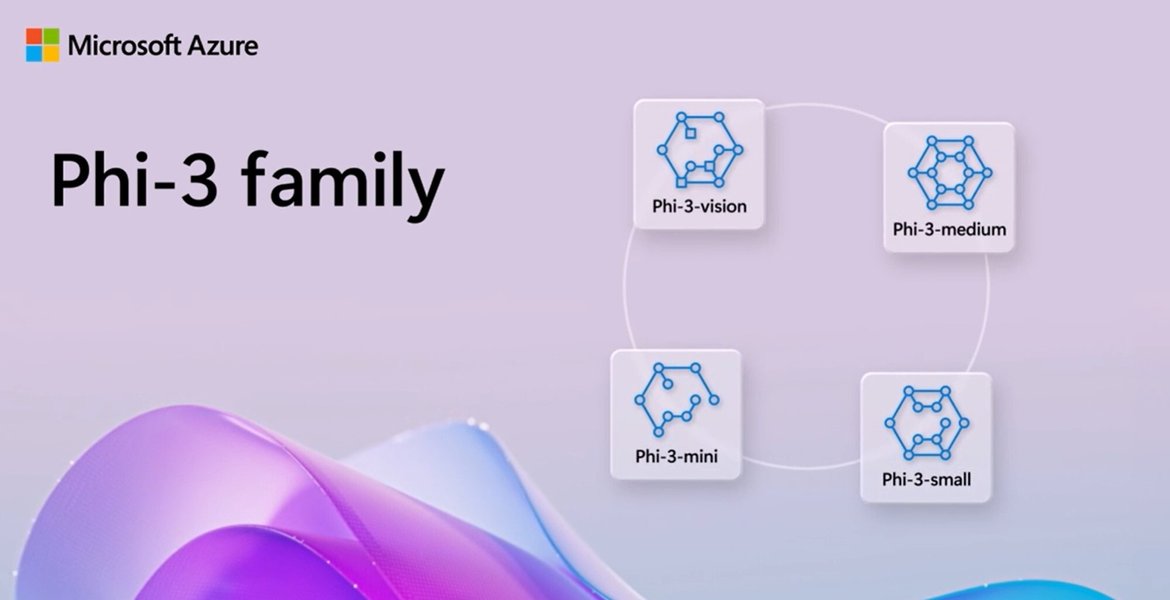
Visual representation of the Phi-3 model family concept.
Meet the Phi-3 Models
The Phi-3 family isn't monolithic; it comprises several models tailored for different needs:
- Phi-3-mini: The smallest in the family (3.8 billion parameters), optimized for on-device deployment and tasks requiring minimal resources. Available in variants supporting different context lengths, including a 128K token version (Phi-3-mini-128K-instruct) for analyzing long documents.
- Phi-3-small: A mid-tier option (7 billion parameters) offering a balance between capability and resource usage.
- Phi-3-medium: A larger model within the SLM category (14 billion parameters), providing enhanced performance and a larger context window for more complex tasks.
- Phi-3-vision: A multimodal model capable of interpreting and reasoning about both text and visual inputs (images).
- Phi-3.5 & Phi-4: Future additions hinted at, aiming to unify the Phi series with potentially enhanced multilingual support and further performance improvements, though specific details are emerging.
Core Strengths and Innovations
Phi-3 models stand out due to several key characteristics and the innovative approaches behind their development.
Exceptional Performance-to-Size Ratio
Despite their relatively small parameter counts, Phi-3 models consistently punch above their weight. Benchmarks show they often outperform models of the same size and even significantly larger ones across various domains:
- Language understanding and generation
- Logical reasoning and problem-solving
- Mathematical capabilities
- Coding proficiency (especially in Python)
This remarkable efficiency stems primarily from Microsoft's unique training methodology.
High-Quality Training Data Philosophy
Instead of solely relying on the sheer volume of web data, Microsoft curated a "textbook quality" dataset. This involved:
- Filtering Public Data: Selecting high-quality, informative content from publicly available sources.
- Synthetic Data Generation: Creating custom data designed to teach specific reasoning patterns, akin to learning from examples and exercises in a textbook.
- Curriculum Learning: Structuring the training process to build foundational knowledge before tackling more complex concepts.
This focus on data quality, rather than just quantity, imbues Phi-3 models with stronger reasoning and coherence capabilities relative to their size.
Efficiency and Cost-Effectiveness
The smaller footprint of Phi-3 models translates directly into practical benefits:
- Lower Computational Costs: Requires less processing power for both training (fine-tuning) and inference (running the model).
- Reduced Latency: Faster response times, crucial for interactive applications like chatbots or real-time analytics.
- Edge Deployment: Enables deployment on devices with limited resources, such as smartphones, laptops, or IoT hardware, allowing for offline operation and enhanced data privacy.
Multimodal Capabilities: Introducing Phi-3 Vision
The Phi-3 family extends beyond text with Phi-3-vision. This model integrates visual understanding, allowing it to:
- Analyze images and answer questions about them.
- Describe visual scenes in text.
- Perform tasks that require reasoning across both text and image data (e.g., interpreting charts and graphs within documents).
This opens up new possibilities for applications in areas like accessibility, content analysis, and human-computer interaction.
Open Source and Broad Accessibility
Microsoft has released the Phi-3 models under the permissive MIT license. This encourages widespread adoption, experimentation, and development by the AI community. Key access points include:
- Microsoft Azure AI Studio: For scalable deployment, fine-tuning, and integration with other Azure services.
- Hugging Face: A popular platform for accessing and experimenting with AI models.
- Ollama: Facilitates running models locally on personal machines.
- GitHub (PhiCookBook): Provides code examples, tutorials, and resources for developers.
Optimizations, such as ONNX runtime support, further enhance cross-platform compatibility.
Commitment to Responsible AI
The development of Phi-3 adheres to Microsoft's Responsible AI Standard. This involves focusing on principles like:
- Accountability
- Transparency
- Fairness
- Reliability and Safety
- Privacy and Security
- Inclusiveness
The models undergo rigorous safety evaluations, including post-training alignment (fine-tuning for safety) and red-teaming (simulating adversarial attacks) to mitigate potential harms and biases.
Visualizing Phi-3 Model Attributes
To better understand the relative strengths of different Phi-3 models, the following chart provides an illustrative comparison across key dimensions. Note that these are qualitative assessments based on available information, highlighting the trade-offs between model size and specific capabilities.
This chart illustrates how different models balance capabilities. For instance, Phi-3 Mini excels in efficiency and cost, making it ideal for edge devices, while Phi-3 Medium offers higher overall performance at the cost of more resources. Phi-3 Vision uniquely adds strong multimodal capabilities.
Exploring the Phi-3 Ecosystem
The diagram below provides a mindmap overview of the key aspects surrounding the Microsoft Phi-3 family of models.
This mindmap visually connects the different models within the Phi-3 family to their core features, the innovative training methods used, where they can be accessed, and the types of applications they enable.
Comparing the Phi-3 Models
The following table summarizes the key differences between the main publicly available Phi-3 models:
| Model | Parameters | Key Strengths | Ideal Use Cases |
|---|---|---|---|
| Phi-3-mini | 3.8 Billion | Highest efficiency, lowest resource use, suitable for on-device, 128K context variant available. | Mobile applications, offline tasks, simple chatbots, document analysis (128K). |
| Phi-3-small | 7 Billion | Good balance of performance and efficiency. | More complex tasks than mini, moderate resource environments, content generation. |
| Phi-3-medium | 14 Billion | Highest performance within the SLM family, better complex reasoning and coding. | Demanding language tasks, coding assistance, analytical applications requiring higher accuracy. |
| Phi-3-vision | Based on SLM (likely mini/small) + Vision Components | Processes and reasons about text and images. | Image captioning, visual Q&A, analyzing documents with mixed content, accessibility tools. |
Video Introduction: The Phi-3 Family
For a concise overview directly from Microsoft, watch the introductory video below. It highlights the vision behind the Phi-3 family and showcases their potential as powerful, accessible small language models.
This video emphasizes the design goals of creating capable yet efficient models, democratizing access to advanced AI through openness, and enabling new applications through features like multimodal understanding in Phi-3 Vision.
Potential Applications and Use Cases
The versatility and efficiency of the Phi-3 family open doors to a wide range of applications across various industries:
- Business Process Automation: Powering intelligent digital assistants (copilots), automating customer service responses, and streamlining workflows with natural language understanding.
- Developer Productivity: Assisting with code generation, debugging, explanation, and translation across programming languages.
- Content Creation: Generating high-quality text for marketing copy, articles, summaries, emails, and creative writing.
- Data Analysis and Summarization: Extracting insights from large text documents (especially with the 128K context variant), summarizing reports, and answering questions based on provided data.
- Multimodal Solutions (with Phi-3 Vision): Enabling applications like image captioning for accessibility, visual search, interpreting medical images alongside reports, or analyzing retail shelf layouts.
- Education: Creating personalized learning tools, tutoring systems, and aids for understanding complex subjects.
- Edge AI: Running AI tasks directly on devices for applications requiring low latency, offline functionality, or enhanced data privacy (e.g., smart devices, in-vehicle assistants, remote agricultural monitoring).
A Note on Limitations
While highly capable in reasoning and task execution, it's important to note that due to their smaller size compared to massive LLMs like GPT-4, Phi-3 models may have limitations in recalling vast amounts of factual trivia or general world knowledge. Their strength lies more in processing and reasoning based on the context provided or the specific skills they were trained on. As with any AI model, outputs, especially those involving factual claims, should be verified when high accuracy is critical.
Frequently Asked Questions (FAQ)
What makes Phi-3 different from Large Language Models (LLMs) like GPT-4?
The main differences lie in size, resource requirements, and training philosophy. Phi-3 models are Small Language Models (SLMs) with billions of parameters (e.g., 3.8B to 14B), whereas LLMs like GPT-4 have hundreds of billions or trillions. This makes Phi-3:
- More Efficient: Lower compute cost, faster inference, suitable for edge devices.
- More Accessible: Easier and cheaper to fine-tune and deploy.
- Quality-Focused Training: Trained on highly curated, "textbook quality" data, emphasizing reasoning over rote memorization of vast web data.
LLMs typically excel at retaining broader factual knowledge due to their size, while Phi-3 aims for strong reasoning and task performance within a more compact model.
What is Phi-3 Vision?
Phi-3 Vision is a multimodal model within the Phi-3 family. It combines the language understanding capabilities of a Phi-3 text model with the ability to process and interpret visual information (images). This allows it to perform tasks that require understanding both text and images simultaneously, such as describing pictures, answering questions about visual content, and analyzing charts or diagrams within documents.
Where can I access and use Phi-3 models?
Phi-3 models are designed for accessibility and are available through several platforms:
- Microsoft Azure AI Studio: For cloud-based deployment, fine-tuning, and integration with Azure services.
- Hugging Face: A popular hub for AI models where you can download, explore, and experiment with Phi-3.
- Ollama: A tool that simplifies running language models like Phi-3 locally on your own computer.
- GitHub (PhiCookBook): Offers code examples and usage guides.
They are released under the open-source MIT license.
Are Phi-3 models safe to use?
Microsoft developed Phi-3 models following their Responsible AI Standard, which includes principles for safety, fairness, transparency, and accountability. The models undergo safety alignment during post-training and rigorous testing, including red-teaming, to identify and mitigate potential risks like generating harmful content or exhibiting biases. While significant effort is made to ensure safety, like all AI models, careful implementation and monitoring are recommended, especially in sensitive applications.
What are the main advantages of using Phi-3?
The key advantages include:
- High Performance: Strong capabilities in reasoning, coding, and language tasks, often exceeding larger models.
- Efficiency: Lower computational cost and faster response times compared to LLMs.
- Cost-Effectiveness: Reduced deployment and operational costs.
- Versatility: Suitable for a wide range of applications, including on-device/edge scenarios.
- Accessibility: Open-source license and availability on multiple platforms.
- Multimodal Options: Phi-3 Vision adds image understanding capabilities.
Recommended Further Exploration
- How do the different Microsoft Phi-3 models (Mini, Small, Medium) compare in performance and use cases?
- What are the steps involved in fine-tuning a Phi-3 model for a specific task using Azure AI or Hugging Face?
- What specific tasks can Microsoft Phi-3 Vision perform, and what are its limitations?
- How does Microsoft Phi-3 compare against other popular small language models like Mistral 7B or Llama 3 8B?
References
Last updated May 4, 2025