
Unveiling the Next Wave of Nuclear: How Do Molten Salt Reactors Stack Up Against Conventional Designs?
A deep dive into the critical differences in safety, efficiency, and waste management between these nuclear technologies.
The quest for cleaner, safer, and more efficient energy sources has intensified interest in advanced nuclear reactor designs. Among these, Molten Salt Reactors (MSRs) present a compelling alternative to traditional nuclear reactors, primarily Light Water Reactors (LWRs), which have been the mainstay of the nuclear power industry for decades. Understanding their comparative strengths and weaknesses is crucial for evaluating the future landscape of nuclear energy, especially as of May 2025.
Key Distinctions at a Glance
- Operational Paradigm Shift: MSRs typically utilize fuel dissolved in molten salt or solid fuel with molten salt coolants, operating at higher temperatures (600-700°C+) and near-atmospheric pressures, unlike traditional reactors that use solid fuel rods and high-pressure water coolant (~150 atm).
- Enhanced Safety Profile: MSRs boast inherent and passive safety features, such as "freeze plugs" that allow fuel to drain into secure tanks during emergencies, and a negative temperature coefficient. This contrasts with the active safety systems required by traditional reactors.
- Superior Efficiency and Waste Management: The high operating temperatures of MSRs lead to greater thermal efficiency (40-50%+). They also promise significantly higher fuel burnup, reduced nuclear waste volume, and the potential to transmute long-lived radioactive isotopes into shorter-lived ones, including options to utilize thorium.
Core Differences: Design and Operation
The fundamental architecture and operational mechanics of Molten Salt Reactors diverge significantly from those of traditional nuclear power plants, such as Pressurized Water Reactors (PWRs) and Boiling Water Reactors (BWRs).
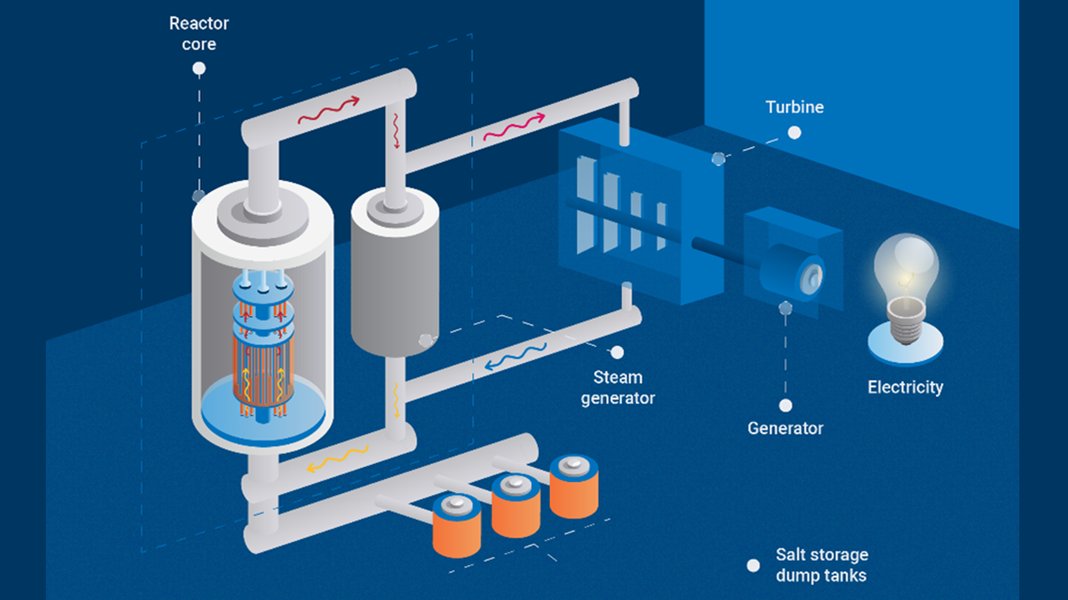
Molten Salt Reactors represent an innovative approach to nuclear energy generation. Image courtesy of IAEA.
Fuel Form and Coolant: A Liquid Revolution
Traditional Reactors: Solid Fuel and Water Cooling
Conventional reactors, predominantly LWRs, employ solid fuel, typically uranium oxide (UO2) pellets encased in zirconium alloy rods. Water serves a dual purpose: as a coolant to transfer heat and as a moderator to slow down neutrons, making them more likely to cause further fission. This system has been refined over decades but comes with inherent limitations tied to the properties of solid fuel and water under reactor conditions.
Molten Salt Reactors: Fluid Fuel and/or Coolant
MSRs represent a paradigm shift. In many designs, the nuclear fuel (e.g., uranium, plutonium, or thorium compounds) is dissolved directly into a high-temperature molten fluoride or chloride salt mixture, which also acts as the primary coolant. This liquid fuel form allows for continuous online processing and refueling without reactor shutdown. Some MSR designs utilize solid fuel but employ molten salts as a high-performance coolant, still offering advantages in temperature and pressure.
Operating Temperature and Pressure: Efficiency Meets Safety
Traditional Reactors: High Pressure, Moderate Temperature
LWRs operate at high pressures (around 150 atmospheres for PWRs) to keep the water coolant in a liquid state at operating temperatures of approximately 300-330°C. These high pressures necessitate robust and expensive containment structures and piping systems to mitigate the risks associated with a loss-of-coolant accident (LOCA).
Molten Salt Reactors: Low Pressure, High Temperature
MSRs, conversely, can operate at much higher temperatures (typically 600°C to over 700°C) while remaining at or near atmospheric pressure. This is because molten salts have very high boiling points. The low-pressure operation significantly reduces mechanical stresses on the reactor vessel and piping, inherently lowering the risk of explosive failures and simplifying containment requirements. The higher temperatures also open avenues for more efficient electricity generation and direct use in industrial heat applications like hydrogen production or desalination.
Safety Paradigms: A Comparative Look
Safety is a paramount concern in nuclear energy. MSRs introduce several features that fundamentally enhance safety profiles compared to traditional reactor designs.
Inherent vs. Active Safety Mechanisms
Traditional Reactors: Reliance on Engineered Active Systems
Traditional reactors rely heavily on complex active safety systems, including emergency core cooling systems (ECCS), backup power generators, and multiple redundant pumps and valves. While effective, these systems require power and mechanical operation to function, making them susceptible to common-mode failures or station blackout scenarios.
Molten Salt Reactors: Embracing Passive and Inherent Safety
MSRs are designed with inherent and passive safety features. A key characteristic is their strong negative temperature coefficient of reactivity: as the fuel salt temperature increases, the nuclear reaction rate naturally decreases, preventing runaway chain reactions. Many MSR designs incorporate a "freeze plug" – a section of pipe containing solidified salt that is actively cooled. If power is lost or temperatures rise excessively, this plug melts, allowing the liquid fuel salt to passively drain into subcritical, passively cooled dump tanks, safely halting the fission process without human intervention or external power. This is often described as a "walkaway safe" feature.
Low-Pressure Operation Benefits
The low operating pressure of MSRs eliminates the risk of high-pressure steam explosions or energetic dispersal of radioactive materials that are a concern in traditional high-pressure water-cooled reactors. The absence of water as a coolant also means no production of explosive hydrogen gas during severe accident scenarios, a lesson learned from incidents like Fukushima. Furthermore, radioactive fission products, such as volatile iodine and cesium, tend to remain dissolved within the molten salt, reducing their potential for release into the environment in an accident scenario.
Efficiency and Performance Metrics
MSRs offer potential breakthroughs in thermal efficiency and operational flexibility, directly impacting their economic viability and role in future energy grids.
Thermal Efficiency: More Power from Less Fuel
Traditional Reactors: Limited by Water's Properties
The operating temperatures of LWRs limit their thermal efficiency (the conversion of heat into electricity) to around 30-35%. This is a constraint imposed by the thermodynamic properties of water and the materials used in the reactor core.
Molten Salt Reactors: Harnessing Higher Temperatures
Thanks to their much higher operating temperatures (600°C+), MSRs can achieve significantly higher thermal efficiencies, potentially in the range of 40-50% or even higher when coupled with advanced power conversion cycles (e.g., Brayton cycle using helium or supercritical CO2). This improved efficiency means more electricity can be generated from a given amount of thermal energy, leading to better fuel economy and reduced environmental impact per unit of energy produced.
Operational Flexibility and Grid Stability
MSRs with liquid fuel offer the potential for online refueling and continuous removal of fission products. This reduces the need for lengthy shutdown periods typical of traditional reactors for refueling, improving the reactor's capacity factor and overall availability. Some MSR designs are also well-suited for load-following (adjusting power output to match electricity demand), making them more compatible with intermittent renewable energy sources on the grid.
This video visually explains the fundamentals of molten salt nuclear reactors and how they differ from conventional light water reactors, offering insights into their operational principles.
Fuel Cycle and Waste Management: A Sustainable Approach?
One of the most significant potential advantages of MSRs lies in their fuel cycle flexibility and their ability to dramatically alter the landscape of nuclear waste management.
Fuel Utilization and Burnup: Getting More from the Atom
Traditional Reactors: Low Burnup and Once-Through Cycle
Traditional LWRs typically achieve a low "burnup" of their fuel, meaning only a small percentage (around 1-5%) of the initial uranium is actually fissioned before the fuel rods are discharged as spent nuclear fuel. Most operate on a "once-through" fuel cycle, where spent fuel is considered waste to be disposed of.
Molten Salt Reactors: High Burnup and Closed Fuel Cycles
MSRs can achieve much higher fuel burnup rates. Because the fuel is liquid and can be processed online, fission products that "poison" the chain reaction can be continuously removed, and fresh fuel can be added. This allows for a far greater percentage of the fissile and fertile material to be consumed. Some MSR designs, particularly fast-spectrum MSRs, can even "burn" existing nuclear waste (transuranic elements like plutonium and americium) from traditional reactors, converting long-lived waste into shorter-lived fission products or stable isotopes.
Waste Characteristics and Volume: Reducing the Burden
By achieving higher burnup and enabling the recycling of actinides, MSRs can significantly reduce the volume and long-term radiotoxicity of nuclear waste. Instead of large quantities of spent fuel rods requiring geological disposal for hundreds of thousands of years, MSRs could produce a smaller stream of fission product waste with much shorter hazardous lifetimes (on the order of 300-500 years for many key isotopes to decay to background levels).
The Thorium Fuel Cycle Potential
MSRs are particularly well-suited to utilizing thorium as a fuel. Thorium (Th-232) is more abundant than uranium and, when irradiated in a reactor, can be converted into fissile uranium-233 (U-233). The thorium fuel cycle in MSRs offers several potential benefits, including enhanced proliferation resistance (as U-233 is harder to weaponize than plutonium and is always contaminated with U-232, a strong gamma emitter) and the production of less long-lived transuranic waste compared to the uranium-plutonium cycle used in traditional reactors. China has notably made progress, successfully operating an experimental thorium-fueled MSR and reloading it with fresh fuel without shutdown, a significant milestone.
Comparative Reactor Attributes
The following chart provides a visual comparison of key attributes between typical Molten Salt Reactors and Traditional Light Water Reactors. Scores are on a scale where higher values generally indicate a more favorable characteristic (e.g., higher safety, better efficiency, lower waste impact). Technology Maturity reflects how developed and deployed the technology is.
This radar chart illustrates that MSRs generally score higher on safety, efficiency, fuel utilization, and waste profile, but are less technologically mature. Traditional LWRs are highly mature but score lower on these other performance and safety metrics.
Material Science and Technological Challenges
Despite their compelling advantages, MSRs are not without significant technical hurdles that must be overcome for widespread commercial deployment.
Corrosion and Material Durability
One of the primary challenges for MSRs is the corrosive nature of high-temperature molten salts, particularly fluoride salts, which can aggressively attack many conventional structural materials. Significant research is ongoing to develop and qualify advanced alloys (e.g., nickel-based superalloys like Hastelloy N) and other materials that can withstand these harsh conditions for the decades-long operational lifetime of a reactor. Ensuring material integrity is crucial for the safety and economic viability of MSRs.
Tritium Management
MSRs, particularly those using lithium-containing fluoride salts (like FLiBe, a common choice for its neutronic properties), can produce tritium, a radioactive isotope of hydrogen. Tritium is very small and can diffuse through structural materials at high temperatures. Effective tritium capture and management systems are therefore necessary to prevent its release into the environment and to ensure worker safety. This adds complexity to the plant design and operation.
Visualizing the Comparison: MSRs vs. Traditional Reactors
The mindmap below provides a hierarchical overview of the key differentiating features between Molten Salt Reactors and Traditional Nuclear Reactors, touching upon fuel, operation, safety, and waste characteristics.
Liquid (dissolved in salt)
or solid with salt coolant"] id1_2["Coolant:
Molten Salt"] id1_3["Operating Pressure:
Low / Atmospheric"] id1_4["Operating Temperature:
High (600°C - 700°C+)"] id1_5["Thermal Efficiency:
Higher (40-50%+)"] id1_6["Safety Features:
Primarily Passive & Inherent
(e.g., freeze plugs, negative temp. coefficient)"] id1_7["Waste Profile:
Lower volume, shorter half-life potential,
can burn existing waste"] id1_8["Fuel Cycle:
Online refueling/processing,
Thorium cycle potential, high burnup"] id1_9["Key Challenges:
Material corrosion,
Tritium management,
Technology development & licensing"] id2["Traditional Reactors (e.g., LWRs)"] id2_1["Fuel Form:
Solid (e.g., UO2 rods)"] id2_2["Coolant:
Water"] id2_3["Operating Pressure:
High (e.g., ~150 atm for PWR)"] id2_4["Operating Temperature:
Lower (~300°C - 330°C)"] id2_5["Thermal Efficiency:
Lower (~30-35%)"] id2_6["Safety Features:
Primarily Active engineered systems,
robust containment structures"] id2_7["Waste Profile:
Higher volume, long half-life solid waste"] id2_8["Fuel Cycle:
Offline refueling (shutdown required),
Uranium-Plutonium cycle, low burnup"] id2_9["Key Strengths:
Mature, well-established technology,
existing regulatory framework"]
Economic and Deployment Considerations
The economic case and deployment pathway for MSRs are still evolving but show promise compared to the often high costs and long construction times of traditional large-scale nuclear plants.
Construction and Operational Costs
Traditional nuclear reactors, particularly large gigawatt-scale LWRs, are known for their high upfront capital costs and lengthy construction periods, often spanning a decade or more. These are driven by the need for massive, reinforced containment structures to handle high pressures, complex piping, and extensive safety systems.
MSRs, especially those designed as Small Modular Reactors (SMRs), offer the potential for reduced construction costs and timelines. Factory fabrication of components can improve quality control and speed up assembly. The low-pressure operation reduces the need for expensive, thick-walled reactor vessels and containment buildings. Higher thermal efficiency also means more electricity output for a given reactor size, potentially improving overall economics. However, as a newer technology, MSRs face initial costs associated with R&D, first-of-a-kind engineering, and developing new supply chains for specialized materials and components.
Development Status and Future Outlook
While the concept of MSRs dates back to the 1950s and 1960s (e.g., the Molten Salt Reactor Experiment at Oak Ridge National Laboratory), the technology is still in the development and demonstration phase. Traditional LWRs, in contrast, are a mature technology with hundreds of units operating worldwide and a well-established regulatory framework.
There is a global resurgence of interest in MSRs, with numerous private companies and national laboratories in countries like the USA, Canada, China, and various European nations actively developing different MSR designs. Some developers aim for commercial deployment in the mid-2030s. China's progress with its thorium MSR is a notable recent advancement. Challenges remain in licensing these novel reactor types, scaling up production, and demonstrating long-term operational reliability and economic competitiveness.
Summary of Key Comparative Aspects
The table below provides a concise summary of the primary differences between Molten Salt Reactors and Traditional Light Water Reactors across several key parameters.
| Aspect | Traditional Reactors (e.g., LWRs) | Molten Salt Reactors (MSRs) |
|---|---|---|
| Fuel Form | Solid (e.g., UO2 rods) | Liquid (fuel dissolved in salt) or Solid with salt coolant |
| Coolant | Water | Molten Salt (Fluoride or Chloride based) |
| Moderator | Water (typically) | Graphite (often), Salt itself (in some fast spectrum designs), or none (fast spectrum) |
| Operating Temperature | ~300-330°C | ~600-700°C+ (can exceed 1000°C in some concepts) |
| Operating Pressure | High (e.g., ~150 atm for PWR) | Low (near atmospheric) |
| Thermal Efficiency | ~30-35% | ~40-50%+, potentially higher |
| Safety Systems | Primarily Active (pumps, emergency cooling) | Primarily Passive & Inherent (e.g., freeze plug, negative temperature coefficient) |
| Fuel Burnup | Low (typically 1-5% of initial heavy metal) | High (potential for >>5%, approaching full utilization in some concepts) |
| Waste Volume & Radiotoxicity | Higher volume, significant long-lived actinides | Potentially significantly lower volume, shorter-lived fission products, actinide burning capabilities |
| Refueling | Offline (reactor shutdown required) | Online (continuous, for many liquid-fueled designs) |
| Proliferation Resistance | Varies; spent fuel contains plutonium | Potentially higher (e.g., thorium cycle, denatured fuel, online processing can limit access to weapons-usable material) |
| Technology Maturity | Mature, widely deployed, established industry | Under development, prototypes emerging, R&D intensive |
| Key Challenges | Long-term waste management, accident risk perception, high capital costs, complex safety systems | Material corrosion, tritium management, remote handling of radioactive salt, regulatory development, scaling up |
Frequently Asked Questions (FAQ)
Recommended Further Exploration
- What are the specific material science breakthroughs needed for commercial MSR deployment?
- How does the thorium fuel cycle in MSRs impact nuclear proliferation risks?
- What is the current regulatory landscape for licensing advanced Molten Salt Reactors globally?
- Can Molten Salt Reactors effectively consume existing stockpiles of nuclear waste from traditional reactors?
References
Last updated May 6, 2025