
Unveiling the Inner Workings: A Deep Dive into the Conductive Labs NDLR MIDI Device
Explore the sophisticated architecture and creative potential of this unique MIDI powerhouse for generative music and performance.
The Conductive Labs NDLR (often pronounced "noodler") stands out in the electronic music landscape as a distinctive MIDI device engineered for generative composition, polyphonic sequencing, and intuitive performance control. It empowers musicians to craft intricate musical narratives, often without traditional keyboard proficiency, by translating music theory concepts into accessible controls. This document delves into the comprehensive technical details of the NDLR.
Core Highlights of the NDLR
- Multi-Part Polyphonic Engine: The NDLR orchestrates four independent MIDI parts—Pad, Drone, and two Motifs—capable of controlling up to eight synthesizers simultaneously, fostering complex harmonic and melodic interactions.
- Generative Music & Modulation Powerhouse: Featuring an 8x8 modulation matrix, multiple LFOs, and randomizers, the NDLR excels at creating evolving soundscapes and intricate patterns, with deep control over musical parameters.
- Versatile Connectivity Hub: Equipped with dual 5-pin DIN MIDI I/O, four USB virtual MIDI ports, and 3.5mm sync jacks, the NDLR seamlessly integrates into diverse hardware and software setups, acting as a MIDI merger and splitter.
Architectural Overview and Core Functionality
The NDLR is fundamentally a four-part polyphonic sequenced MIDI arpeggiator, chord generator, drone player, and MIDI controller. Its design philosophy centers on making complex music theory accessible. Users select a key, mode, and chord progression, and the NDLR ensures all generated MIDI output remains harmonically coherent and rhythmically synchronized. It's a tool for jamming, composing, and performing, particularly suited for electronic music genres like ambient, techno, and electronica.
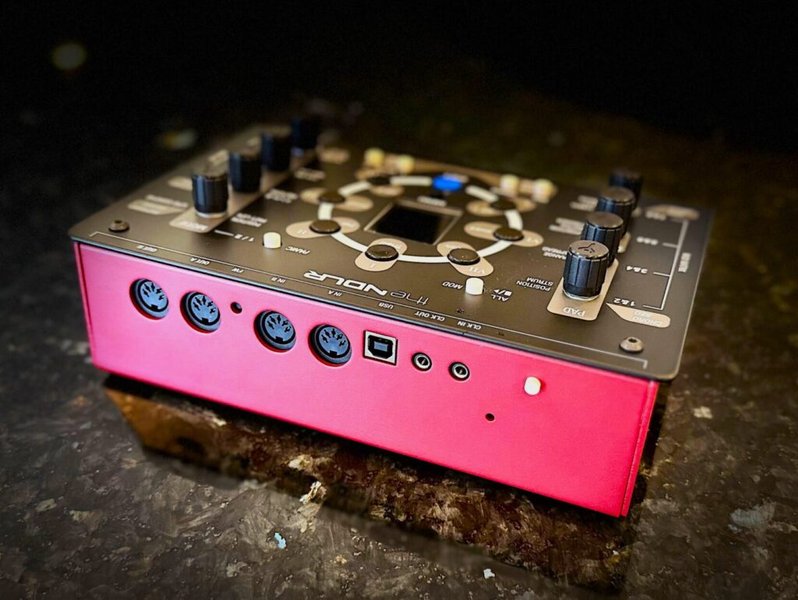
The Conductive Labs NDLR (Rev2 pictured), showcasing its interface with rotary encoders and chord buttons.
Hardware Specifications
The NDLR is designed for both studio and live performance environments, balancing robust construction with user-friendly controls.
Physical Design and Controls
The device typically measures around 9 inches wide, 6.3 inches long, and 2.8 inches high (22.8 x 16 x 7.1 cm), with a weight of approximately 1.1 lbs (0.5 kg). Central to its interface is a 1.8-inch color LCD screen (128x160 resolution), providing real-time visual feedback on parameters, patterns, and chords. User interaction is facilitated by eight rotary encoders (many with push-button functionality for parameter selection and adjustment) and seven dedicated chord buttons for selecting chord degrees and types. Additional buttons manage play/pause for each part, global transport, menu navigation, and shifting functions.
Power Requirements
The NDLR is USB 2.0 powered, drawing approximately 5V DC and 125mA. This low power consumption allows it to be powered by a standard computer USB port, a USB hub, a dedicated USB power supply, or a portable USB battery pack, enhancing its portability.
Hardware Revisions: Rev1 vs. Rev2
Conductive Labs has released updated versions of the NDLR:
- NDLR Rev1: Characterized by a blue/gray enclosure base. Early units featured smooth-turning (non-detented) encoders, while later Rev1 units incorporated detented (clicky) encoders and lower-pressure buttons.
- NDLR Rev2: Debuted in 2023, this version features a powder-coated red aluminum base and a soft power button. Internally, it boasts a faster processor and an updated microcontroller design, utilizing more readily available components. The out-of-the-box firmware for Rev2 is typically version 2.0.011 or newer.
This table summarizes the key differences between the revisions:
| Feature | NDLR Rev1 | NDLR Rev2 |
|---|---|---|
| Enclosure Base Color | Blue/Gray | Powder-coated Red |
| Power Button | Hard (physical switch) | Soft (momentary button) |
| Processor/MCU | Original specification | Faster, updated microcontroller |
| Encoders (typical) | Smooth (early units), Detented (later units) | Detented |
| Button Feel | Varied (later Rev1 had lower pressure) | Consistent, often lower pressure |
| Initial Firmware Series | Pre-2.x.xxx versions | 2.0.011 or newer |
Connectivity Matrix
The NDLR is rich in connectivity options, designed to be the central MIDI brain in a setup.
MIDI Ports
It includes two standard 5-pin DIN MIDI inputs and two 5-pin DIN MIDI outputs (labeled Out A and Out B). This allows for direct connection to a wide array of hardware synthesizers, drum machines, and other MIDI gear. The NDLR also functions as a MIDI merger (combining signals from both DIN inputs and USB inputs) and a MIDI splitter (routing parts to different physical outputs).
USB MIDI
A single USB port provides power and offers four virtual USB MIDI input/output ports. This makes it class-compliant with Windows, macOS, and Linux systems, enabling seamless integration with Digital Audio Workstations (DAWs), software synthesizers on computers, and even MIDI-capable apps on devices like iPads.
Synchronization
For timing, the NDLR features 1/8" (3.5mm) TRS jacks for Clock In and Clock Out. The clock input supports 5V pulses, typically at 24 PPQN (Pulses Per Quarter Note). The clock output rate is configurable to various PPQN values (e.g., 1, 2, 4, 24) and can be divided by different ratios (1:1 to 1:32), ensuring tight synchronization with modular synthesizers, sequencers, and other rhythm-critical equipment. Some models or extensions may also offer CV/Gate outputs with high refresh rates for direct modular synth control.
Sequencing and Performance Capabilities
The heart of the NDLR lies in its unique approach to sequencing and real-time musical interaction.
The Four Independent Parts
The NDLR generates MIDI across four distinct, simultaneously playable parts:
- Pad: Designed for generating sustained chords, lush pads, or ambient textures.
- Drone: Produces continuous, often slowly evolving, single notes or simple intervals, providing a harmonic foundation.
- Motif 1 & Motif 2: These are two independent sequenced arpeggiators/melodic sequencers. They create evolving melodic lines and rhythmic patterns based on the selected chord and scale, with extensive user control over range, density, rhythm, and pattern.
Each part can be assigned to a specific MIDI channel (1-16) and routed to any combination of the physical MIDI outputs or USB MIDI ports, allowing for control of up to eight separate synthesizers or sound sources.
Chord Sequencer and Music Theory Integration
The NDLR features an intuitive chord sequencer. Users can select a key and mode (e.g., C Major, D Dorian), and then use the seven chord buttons to define a chord progression by selecting chord degrees (I, ii, iii, IV, V, vi, vii) and types (major, minor, diminished, etc.). The device ensures that all generated notes from the four parts conform to the currently active chord within the selected key and mode. It can also intelligently filter incoming MIDI notes, blocking those not in the selected key, and allows for real-time transposition and chord type changes via external MIDI control.
Pattern and Rhythm Generation
For the Motif parts, the NDLR offers sophisticated pattern and rhythm editors. Users can choose from preset patterns and rhythms or create their own. It employs concepts like Euclidean rhythms and parametric sequencing to generate complex and musically interesting rhythmic variations. Start/stop buttons are available for each part, along with a global play/stop and a panic button (to silence all MIDI notes).
Deep Dive into Modulation
The NDLR's generative power is significantly enhanced by its comprehensive modulation system.
The radar chart above illustrates a qualitative assessment of the NDLR's strengths across key functional areas. "Sequencing Depth" refers to its ability to create complex and varied musical phrases. "Modulation Power" highlights the extensive internal routing for dynamic changes. "Connectivity Versatility" points to its broad compatibility with other gear. "Live Performance Control" reflects its suitability for real-time manipulation, and "Generative Capability" underscores its strength in creating evolving, non-linear musical ideas. The NDLR scores highly in these aspects, particularly in generative music creation and modulation flexibility.
The Modulation Matrix
A cornerstone of its dynamic capabilities is the 8x8 modulation matrix. This allows users to route up to eight modulation sources to eight destinations. Sources include LFOs, randomizers, velocity, external MIDI CCs, and chord changes. Destinations can be nearly any internal NDLR parameter (such as motif density, range, rhythm parameters, LFO speeds) or can be configured to send MIDI CC messages to external devices. This allows for intricate, evolving sonic textures and patterns.
LFOs and Randomizers
The NDLR includes three versatile Low-Frequency Oscillators (LFOs) and two randomizers. LFO speeds can be displayed in seconds or synced to musical divisions of the master BPM (e.g., quarter notes, half notes) or run freely. These LFOs and randomizers serve as powerful sources within the modulation matrix, breathing life and movement into sequences and controlled parameters.
Visualizing NDLR's Architecture: A Mindmap
To better understand how these components interrelate, the following mindmap provides a visual overview of the Conductive Labs NDLR's key features and systems. It outlines the core functionalities, hardware aspects, connectivity options, and the powerful sequencing and modulation engines that define this unique MIDI device.
Firmware, Software, and Ecosystem
Conductive Labs actively supports the NDLR with ongoing firmware development.
Firmware Updates
Firmware updates are released periodically, introducing new features, enhancements, and bug fixes. These updates are crucial for expanding the device's capabilities and refining its performance. Updates are performed via a direct USB connection to a computer (Windows, macOS, or Linux), using a utility provided by Conductive Labs. It is generally recommended to avoid USB hubs during the firmware update process to ensure stability.
Software Compatibility and Control
As a class-compliant MIDI device, the NDLR works with any MIDI-compatible software, DAWs, or hardware without needing special drivers. Most of its parameters are MIDI CC addressable, allowing for deep external control from other MIDI controllers or automation from a DAW. Detailed MIDI implementation charts are available in the user manual.
Exploring the NDLR in Action
To see and hear the NDLR's capabilities, the following video provides an excellent overview and demonstration. It showcases its workflow, generative potential, and how it can be used to control various synthesizers to create complex musical pieces.
Loopop's review offers a comprehensive look at the NDLR's features and creative applications.
Frequently Asked Questions (FAQ)
What are the main differences between NDLR Rev1 and Rev2?
How is the NDLR powered?
Can the NDLR control software synthesizers (VSTs)?
What kind of music is the NDLR best suited for?
Recommended Further Exploration
- Discover methods for integrating the NDLR with a Digital Audio Workstation for recording and production workflows.
- Learn about advanced modulation routing and techniques to unlock deeper creative possibilities with the NDLR.
- Read about user experiences and various creative workflows people have developed using the NDLR.
- See how the NDLR stacks up against other MIDI sequencers and arpeggiators in terms of features and performance.
References

Last updated May 21, 2025