
Unpacking the NVIDIA GB200 NVL72: Are EQ Chips Part of the Equation?
Delving into the complex interconnects and signal integrity components of NVIDIA's powerhouse AI rack.
The NVIDIA GB200 NVL72 is a marvel of engineering, packing immense AI processing power into a single, liquid-cooled rack. Understanding its intricate components, especially those ensuring flawless high-speed communication, is key. While the term "EQ chips" (Equalizer chips) isn't standard terminology for a major listed component of the NVL72, the function of signal equalization is absolutely critical. Let's explore where this function resides within the system.
Key Insights into NVL72 Interconnects & Equalization
- Integrated Signal Integrity: The NVL72 primarily relies on integrated components like NVSwitch ASICs, BlueField-3 DPUs, and high-speed transceivers/cables to manage signal equalization, rather than listing standalone "EQ chips" as major components.
- NVSwitch ASICs are Central: The core of the high-bandwidth NVLink fabric is managed by 18 NVSwitch ASICs (Application-Specific Integrated Circuits) distributed across 9 switch trays, playing a vital role in both connectivity and signal integrity.
- Potential Role of ACCs: Active Copper Cables (ACCs), which might be used for shorter connections within the rack, can contain discrete equalizer chips (often 8 per cable). However, the exact number and type of cables used per NVL72 aren't publicly specified by NVIDIA, making a total count of such chips speculative.
Understanding the NVL72 Interconnect Architecture
The GB200 NVL72 system is designed as a massive, unified computing powerhouse, connecting numerous processors and accelerators with extremely high bandwidth. This requires a sophisticated interconnect architecture.
Core Compute Components
At its heart, the NVL72 rack integrates:
- 72 NVIDIA Blackwell GPUs: Providing the primary AI acceleration capabilities.
- 36 NVIDIA Grace CPUs: Offering high-performance general-purpose processing tightly coupled with the GPUs.
These components are housed within 18 compute nodes, each containing two GB200 Superchips (1 Grace CPU + 2 Blackwell GPUs per Superchip).
The NVLink Fabric and NVSwitch System
To enable these 72 GPUs to function as a single, coherent processing domain, NVIDIA employs its fifth-generation NVLink technology and a dedicated NVSwitch system. This fabric provides an astounding 130 TB/s of bi-directional bandwidth between the GPUs.
- NVLink Switch Trays: The rack includes 9 dedicated switch trays.
- NVSwitch ASICs: Each switch tray houses 2 NVSwitch ASICs, totaling 18 NVSwitch ASICs per NVL72 rack.
These NVSwitch ASICs are crucial. They not only route the massive data flows between GPUs but also incorporate advanced SerDes (Serializer/Deserializer) technology. This technology inherently includes signal conditioning and equalization functions to ensure data integrity across the high-speed electrical links of the NVLink fabric.
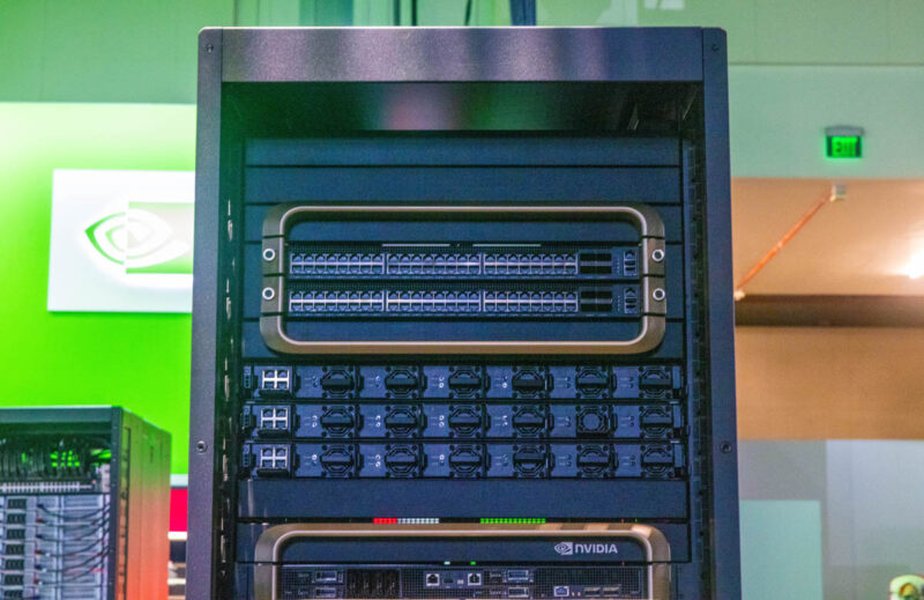
Diagram showing the NVLink Switch trays within the NVIDIA DGX GB200 NVL72 system.
The Role of Signal Equalization ("EQ")
In any system transmitting data at extremely high speeds over electrical conductors (like copper traces on a PCB or copper cables), the signal degrades over distance. Equalization techniques are essential to counteract this degradation and ensure error-free communication.
What are Equalizer (EQ) Chips?
Function and Purpose
Equalizer chips are specialized integrated circuits designed to compensate for signal losses and distortions that occur in high-speed data transmission channels. They essentially "clean up" the signal, boosting certain frequencies and filtering noise, allowing data to be reliably recovered at the receiving end. They can be placed at the transmitter, receiver, or sometimes within the cable assembly itself.
Integrated Equalization in NVL72
Instead of relying heavily on numerous discrete EQ chips scattered throughout the system, the NVL72 architecture integrates equalization capabilities into several key components:
- NVSwitch ASICs: As mentioned, the sophisticated SerDes within the 18 NVSwitch ASICs handles equalization for the core NVLink fabric.
- BlueField-3 DPUs: Each of the 18 compute nodes contains a BlueField-3 Data Processing Unit (DPU). These DPUs manage network traffic (like InfiniBand or Ethernet) and storage communications. Their high-speed network interfaces also incorporate advanced signal conditioning and equalization.
- GPU/CPU I/O: The input/output interfaces on the Blackwell GPUs and Grace CPUs themselves contain complex circuitry to manage signal integrity for connections like NVLink-C2C and PCIe.
- Transceivers: Whether using optical transceivers or electrical cable assemblies, the modules connecting the NVL72 to external networks or storage inherently include circuitry for driving signals and ensuring their quality, often involving equalization.
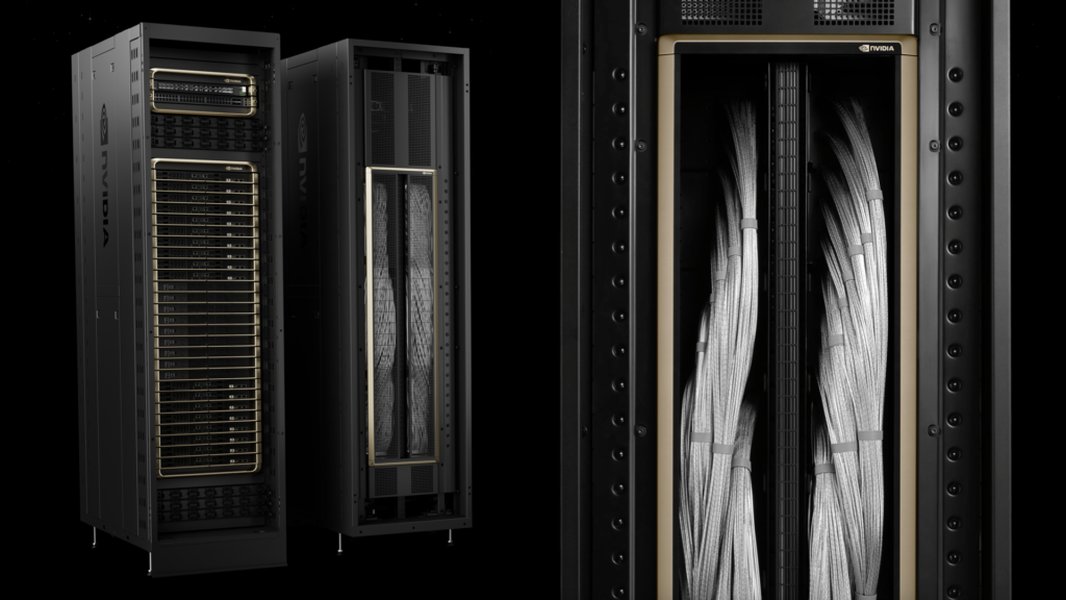
The NVIDIA GB200 NVL72 rack integrates multiple components for high-performance computing.
Exploring Active Copper Cables (ACCs) and Discrete EQ Chips
While much equalization is integrated, there's another place where discrete EQ chips *might* appear: within certain types of cables.
What are Active Copper Cables (ACCs)?
ACCs are copper cables that include active electronic components (like equalizer or retimer chips) within the connector housings or cable assembly. These chips boost the signal, allowing copper cables to achieve higher speeds or longer distances than passive copper cables.
EQ Chips within ACCs
Possibility in NVL72
Some industry reports suggest that components like 1.6T (1.6 Terabits per second) ACCs might be used in NVL72 deployments or similar high-density systems. Such high-speed ACCs often rely on integrated EQ chips to function reliably. For instance, a common configuration for such cables involves 8 EQ chips per ACC (4 at each end). Suppliers like Macom are known to provide such chips for the data center market.
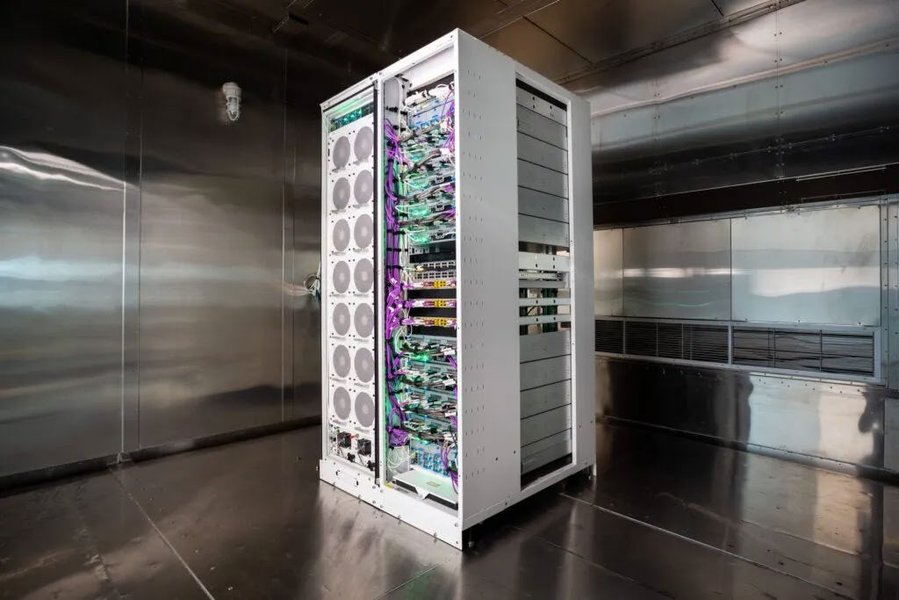
High-speed interconnects like Active Copper Cables (ACCs) may contain equalizer chips.
The Challenge of Counting
While it's plausible that ACCs with integrated EQ chips are used within or between NVL72 racks, NVIDIA does not publicly specify the exact type and quantity of all internal and external cabling used for a standard NVL72 configuration. Therefore, calculating a precise total number of discrete EQ chips potentially present in ACCs is not possible based on available public information. Any specific number (like the estimate of 288 derived from assuming 36 ACCs with 8 chips each) should be treated as speculative and dependent on unconfirmed assumptions about the cabling configuration.
In essence, the NVL72 achieves signal integrity primarily through equalization integrated into its main ASICs (NVSwitch, DPUs, GPU/CPU I/O) and transceivers. While discrete EQ chips might exist within specific ACCs used, their total number per rack isn't a defined specification.
Component Roles in the NVL72 Ecosystem
To visualize how different components contribute to the overall system, consider the following analysis. This radar chart provides an opinionated perspective on the relative importance of key components across different functional dimensions within the NVL72 rack.
This chart highlights the specialized roles of each component. GPUs dominate raw compute, NVSwitch ASICs dominate interconnect bandwidth management and signal integrity for the NVLink fabric, while DPUs focus on network/storage offload. Potential EQ chips in ACCs would have a very focused role solely on signal integrity within their specific cable link.
Visualizing the NVL72 Component Hierarchy
The following mindmap illustrates the relationship between the major subsystems and components within a single NVIDIA GB200 NVL72 rack:
This map shows how the compute nodes, containing CPUs, GPUs, and DPUs, are interconnected via the sophisticated NVLink Switch System, which relies on NVSwitch ASICs. Various physical interconnects (NVLink, PCIe, Networking cables) tie everything together, supported by essential cooling and power infrastructure.
Key Component Summary Table
Here's a quick reference table summarizing the primary compute and interconnect management components within the NVL72 rack:
| Component | Quantity per Rack | Primary Function |
|---|---|---|
| NVIDIA Blackwell GPU | 72 | AI Acceleration, High-Performance Computing |
| NVIDIA Grace CPU | 36 | General Purpose Processing, System Management |
| NVSwitch ASIC | 18 | NVLink Fabric Routing, High-Bandwidth Interconnect Management, Signal Integrity |
| NVIDIA BlueField-3 DPU | 18 | Network Interface (Ethernet/InfiniBand), Storage Offload, Security Acceleration |
| EQ Chip (within ACCs) | Unknown / Variable | Signal Equalization (if ACCs are used and contain them) |
Video Overview: Blackwell NVL72 Rack
For a visual walkthrough and further explanation of the components and structure of the NVIDIA Blackwell NVL72 rack, the following video provides valuable insights:
This video covers the overall design, including the arrangement of GPUs and the significance of the interconnect system, helping to contextualize the roles of the components discussed above.
Frequently Asked Questions (FAQ)
So, are there separate "EQ chips" in the NVL72 rack?
Generally, the NVIDIA GB200 NVL72 does not list standalone "EQ chips" as primary, distinct components in its official architecture documentation. The critical function of signal equalization for high-speed links is primarily handled by capabilities integrated within other major components like the 18 NVSwitch ASICs, the 18 BlueField-3 DPUs, the GPU/CPU I/O controllers, and the transceivers or cable assemblies used. Active Copper Cables (ACCs), if used, *may* contain discrete EQ chips, but the specific cabling configuration and thus the total number of such chips per rack isn't publicly specified by NVIDIA.
What are the main chips managing the high-speed interconnect?
The primary chips managing the massive 130 TB/s NVLink interconnect fabric between the 72 Blackwell GPUs are the 18 NVSwitch ASICs. These are located on the 9 NVLink switch trays within the rack. They handle the complex routing and ensure signal integrity for the core GPU-to-GPU communication.
What are the BlueField-3 DPUs used for in the NVL72?
Each of the 18 compute nodes in an NVL72 rack includes one NVIDIA BlueField-3 DPU. Their main roles are to offload and accelerate networking tasks (like managing Ethernet or InfiniBand connections), storage access (connecting to network storage), and security functions. This frees up the Grace CPUs and Blackwell GPUs to focus on computation.
Why is signal equalization important in a system like the NVL72?
Signal equalization is crucial because the NVL72 relies on extremely high-speed data transmission (tens or hundreds of Gigabits per second per lane) over electrical pathways (like PCB traces and copper cables). Over distance, these signals degrade due to effects like attenuation (loss of strength) and dispersion (signal spreading). Equalization techniques counteract these effects, ensuring the data signals remain clean and can be accurately interpreted by the receiving components, which is essential for the reliable operation of the entire system.
Recommended Further Exploration
- Explore the detailed architecture of the NVIDIA NVSwitch system used in the GB200 NVL72.
- Understand the specific functions and benefits of BlueField-3 DPUs within large-scale AI clusters.
- Compare Active Copper Cables (ACC), passive Direct Attach Copper (DAC), and optical interconnects for data center applications.
- Investigate the significant power consumption and sophisticated liquid cooling solutions required for the NVIDIA GB200 NVL72 rack.
References
Last updated May 3, 2025