
Unraveling the Genesis of Artificial Intelligence: From Ancient Dreams to Modern Marvels
Explore the fascinating journey of AI, from its earliest conceptual roots to its formal establishment and transformative impact today.
Key Milestones in AI's Origin Story
- Ancient Foundations: The bedrock of AI was laid thousands of years ago with philosophical inquiries into intelligence and the imaginative pursuit of automatons.
- Mid-20th Century Birth: The formal discipline of AI was established in the 1940s and 1950s, catalyzed by pioneering theoretical work and a landmark conference.
- Continuous Evolution: AI has steadily advanced through cycles of research, fueled by increasing computational power and groundbreaking algorithmic innovations, leading to its current sophisticated state.
Artificial Intelligence (AI) is not a sudden invention but rather the culmination of millennia of human curiosity about intelligence and the desire to automate complex tasks. Its origins trace back to ancient philosophical musings and early mechanical innovations, evolving through critical theoretical breakthroughs in the 20th century to become the multifaceted field we know today. Understanding "where AI came from" involves exploring its conceptual roots, its formal academic birth, and the pivotal developments that shaped its trajectory.
The Deep Roots: Ancient Ideas and Early Automatons
The notion of artificial beings possessing intelligence or performing human-like actions is far older than modern computing. Across various ancient cultures, myths and stories often featured automatons or mechanical constructs that mimicked life. These early imaginings, while purely conceptual or rudimentary in their physical realization, planted the seed for what would much later become AI.
Philosophical Precursors and Early Logic
Beyond mythical figures, ancient philosophers in Greece, China, and India laid crucial intellectual groundwork by developing structured methods of logic and formal reasoning. By the first millennium BCE, principles of deduction and systematic thought were well-established, creating a cognitive framework that would eventually underpin computational theories. This ancient emphasis on formalizing thought processes was a critical, albeit indirect, precursor to AI.
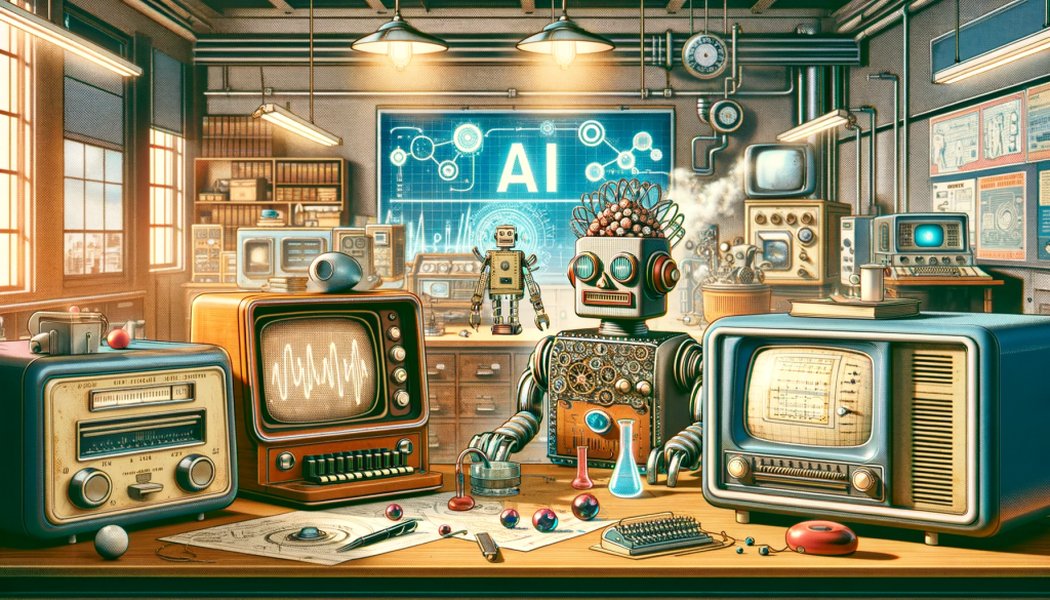
An artistic representation of early AI concepts, blending vintage technology with robotic elements.
The Mid-20th Century Revolution: Formalizing AI
The true "birth" of modern AI as a scientific discipline occurred in the mid-20th century, particularly between the 1940s and 1950s. This period saw theoretical breakthroughs in mathematics and computer science that transitioned the concept of machine intelligence from philosophical abstraction to a tangible field of study.
Alan Turing: The Pioneer of Machine Intelligence
A pivotal figure in the genesis of AI is Alan Mathison Turing, a British mathematician and computer scientist. His work laid the theoretical groundwork for modern computing and machine intelligence:
- **"Intelligent Machinery" (1948):** In this foundational report, Turing introduced many central concepts of AI, exploring the potential for machines to perform tasks requiring human intelligence, such as learning and problem-solving.
- **The Turing Test (1950):** In his seminal paper, "Computing Machinery and Intelligence," Turing proposed a practical method to assess machine intelligence. The "Turing Test" suggests that if a machine's responses are indistinguishable from a human's in a conversation, it can be considered to exhibit intelligence. This shifted the focus from abstract definitions of intelligence to observable, measurable behavior.
The Dartmouth Conference: Coining the Term and Launching a Field
The formal establishment of AI as an academic discipline is widely attributed to the "Dartmouth Summer Research Project on Artificial Intelligence." This workshop, held in 1956, was a watershed moment:
- **John McCarthy:** Often credited as the "father of AI," McCarthy coined the term "artificial intelligence" in 1955 when proposing the Dartmouth workshop. He, along with Marvin Minsky, Nathaniel Rochester, and Claude Shannon, organized the event.
- **Foundational Belief:** The workshop's organizers shared the belief that "every aspect of learning or any other feature of intelligence can in principle be so precisely described that a machine can be made to simulate it." This optimistic outlook fueled early research directions.
- **Formal Establishment:** The Dartmouth Conference brought together pioneering researchers and officially cemented AI as a distinct field of study, setting the stage for subsequent advancements.
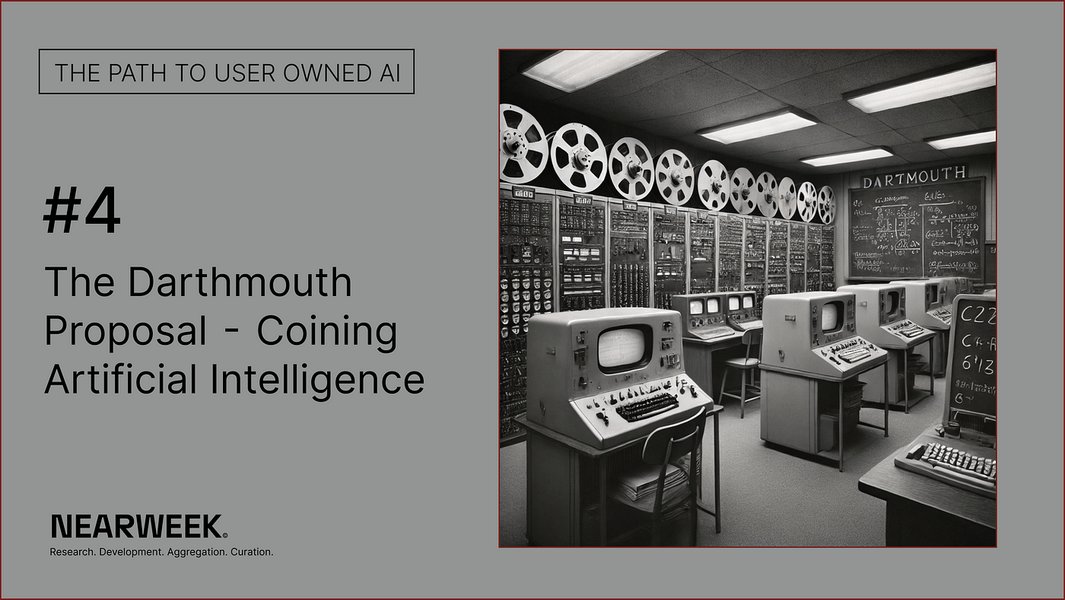
A visual representation of the Dartmouth Proposal, a pivotal moment in the history of AI.
Early Innovations and Evolutionary Pathways
Following the Dartmouth Conference, AI research flourished, leading to the development of groundbreaking programs and concepts that laid the foundation for modern AI systems. The 1950s and 1960s were particularly fertile years for initial breakthroughs.
Pioneering Programs and Concepts
- Artificial Neural Networks:
- **SNARC (1951):** Marvin Minsky and Dean Edmunds constructed the Stochastic Neural Analog Reinforcement Calculator, the first artificial neural network. This analog computer simulated 40 neuron-like units, demonstrating early machine learning capabilities.
- **Perceptron (1957):** Frank Rosenblatt developed the Perceptron, an early artificial neural network capable of learning from data and making simple classifications. It became a foundational element for subsequent neural network research.
- Problem Solving and Reasoning:
- **Logic Theorist and General Problem Solver:** Developed by Allen Newell and Herbert A. Simon in the early 1960s, these programs were among the first to mimic human problem-solving abilities using computational methods.
- **LISP:** John McCarthy developed LISP (LISt Processor) in the early 1960s, an early programming language specifically designed for AI applications, emphasizing symbolic computation.
- Natural Language Processing (NLP):
- **STUDENT (1964):** Daniel Bobrow developed this early NLP program to solve algebra word problems.
- **ELIZA (1966):** Joseph Weizenbaum created ELIZA, a celebrated early computer program that could engage in human-like conversations, sometimes leading users to believe it possessed human emotions.
- Robotics and Integrated AI:
- **Shakey the Robot (late 1960s):** Developed by the Stanford Research Institute, Shakey was the world's first mobile intelligent robot. It integrated AI, computer vision, navigation, and NLP, demonstrating complex capabilities.
Cycles of Progress and "AI Winters"
AI's journey was not linear; it experienced periods of immense optimism followed by "AI winters"—periods of reduced funding and interest when initial bold predictions outpaced technological capabilities. However, core research continued, leading to breakthroughs in the 1980s with developments like:
- **Probabilistic Reasoning:** Judea Pearl's work on probabilistic reasoning and Bayesian networks in the 1980s revolutionized how AI systems could handle uncertainty, significantly influencing expert systems and decision-making algorithms.
- **Association for the Advancement of Artificial Intelligence (AAAI):** Founded in 1980, this organization helped galvanize the field and foster collaboration during periods of fluctuating interest.
The Accelerating Pace: Modern AI Evolution
The 1990s and 2000s saw significant growth, propelled by increasing computational power and the availability of vast datasets. The 2010s marked a major turning point with the resurgence of deep learning, largely driven by the accelerated adoption of Graphics Processing Units (GPUs) for training complex neural networks.
Deep Learning and Generative AI
Breakthroughs in deep learning have led to the powerful modern AI applications we see today, particularly in fields like computer vision and natural language processing. The development of generative AI models, such as OpenAI's GPT series (e.g., GPT-2 in 2019 and ChatGPT's public launch in November 2022), highlights the accelerating pace of AI advancements. These models can generate human-like text and responses by learning from massive datasets.
The rapid increase in AI capabilities is underscored by the observation that the doubling time of AI training computation has shortened to approximately six months in recent years. This exponential growth continues to push the boundaries of what AI can achieve, leading to its widespread integration into various technologies and everyday life.
The radar chart above illustrates a conceptual assessment of various foundational elements and historical figures that contributed to the origin and evolution of Artificial Intelligence. Each axis represents a crucial aspect, and the data points indicate the perceived influence or presence of these elements across different developmental phases of AI. For instance, 'Theoretical Foundations' and 'Problem-Solving Algorithms' were strong from early on, while 'Deep Learning Scalability' and 'Ethical Considerations' have become significantly more prominent in modern AI development.
Evolutionary Milestones and Key Contributors
The journey of AI is marked by numerous critical developments and the contributions of many brilliant minds. The table below summarizes some of the most significant milestones and the individuals or organizations that played a crucial role.
| Period | Key Milestones/Concepts | Pioneering Figures/Entities | Significance |
|---|---|---|---|
| Ancient Times | Myths of Automatons, Formal Logic | Ancient Philosophers (Greece, China, India), Inventors (e.g., Leonardo da Vinci) | Conceptualized intelligent machines and laid intellectual groundwork for systematic thought. |
| 1930s-1940s | Universal Computing Machine, "Intelligent Machinery" Report, Turing Test | Alan Turing | Established theoretical foundations for modern computers and a practical framework for assessing machine intelligence. |
| 1950s | Coining of "Artificial Intelligence," Dartmouth Conference, SNARC, Perceptron | John McCarthy, Marvin Minsky, Nathaniel Rochester, Claude Shannon, Dean Edmunds, Frank Rosenblatt | Formalized AI as an academic discipline, initiated research into neural networks, and developed early learning algorithms. |
| 1960s | LISP programming language, Logic Theorist, General Problem Solver, STUDENT, ELIZA, Shakey the Robot | John McCarthy, Allen Newell, Herbert A. Simon, Daniel Bobrow, Joseph Weizenbaum, Stanford Research Institute | Developed specialized AI languages, programs for problem-solving, natural language interaction, and integrated robotics. |
| 1980s | Probabilistic Reasoning, Bayesian Networks, Establishment of AAAI | Judea Pearl, Association for the Advancement of Artificial Intelligence (AAAI) | Introduced methods for handling uncertainty in AI, leading to more robust decision-making systems and renewed interest in the field. |
| 1990s-2000s | Advancements in Convolutional Neural Networks (CNNs), Increased Computational Power | Yann LeCun, Yoshua Bengio | Improved image and pattern recognition, laying groundwork for deep learning success. |
| 2010s-Present | Deep Learning powered by GPUs, Generative AI (GPT series), Rapid Increase in Training Computation | OpenAI and other research organizations | Enabled significant breakthroughs in various domains, leading to highly capable AI systems like large language models and widespread AI adoption. |
Visualizing AI's Intellectual Lineage
To further illustrate the interconnectedness of concepts and milestones in AI's history, the following mindmap provides a visual overview of its intellectual lineage, highlighting key contributors and their interconnected ideas from philosophical roots to modern applications.
This mindmap visually connects the major concepts, figures, and developments, illustrating how each stage built upon previous ideas to form the comprehensive field of AI.
A Glimpse into AI's Historical Journey
To further contextualize the evolution of AI, this video provides a concise overview of its history, highlighting key moments from its early conceptualization to its modern-day manifestations. It underscores how incremental advancements across various disciplines have collectively contributed to the sophisticated AI systems we interact with today.
"The complete history of Artificial Intelligence: Alan Turing to..." This video offers a chronological journey through AI's development, illustrating the milestones discussed in this response.
Frequently Asked Questions (FAQ)
What is the "birth year" of modern AI?
Who coined the term "Artificial Intelligence"?
What was the significance of the Turing Test?
Did AI development face challenges or periods of stagnation?
Conclusion
The origins of Artificial Intelligence are a rich tapestry woven from ancient philosophical inquiries, rigorous mathematical logic, and groundbreaking computer science innovations. From the earliest dreams of thinking machines to Alan Turing's theoretical blueprints and John McCarthy's coining of the term and formalization of the field at the Dartmouth Conference, AI has undergone a profound evolution. While its journey has seen periods of both rapid progress and setbacks, the continuous pursuit of replicating and extending human intelligence through technology has led to the advanced, pervasive AI systems that characterize our modern world. Its history is a testament to human ingenuity and the enduring quest to understand and enhance intelligence itself.
Recommended Further Exploration
- How has AI impacted various sectors of society?
- What are the emerging trends shaping the future of AI technology?
- What ethical challenges and considerations accompany the rapid advancement of AI?
- What are the different categories and applications of artificial intelligence today?