
Unlock Advanced Pickleball Doubles: Mastering the Third Shot Drop for Seamless Teamwork
Elevate your game by transforming this crucial shot into a cornerstone of coordinated strategy and on-court dominance.
The third shot drop is widely recognized as a game-changing skill in pickleball, particularly in doubles play. It's more than just a defensive maneuver; it's a strategic offensive setup that allows your team to transition effectively from the baseline to the non-volley zone (NVZ), or "kitchen." Mastering this shot is paramount for players looking to advance beyond intermediate levels, as it dictates the flow of the rally and creates opportunities for synchronized teamwork. This guide will delve into the intricacies of the third shot drop, offering techniques, drills, and teamwork strategies to accelerate your progress in advanced pickleball doubles.
Essential Insights: Key Takeaways
- Strategic Transition: The third shot drop is primarily used by the serving team to neutralize the opponents' net advantage and create a safe passage to advance to the kitchen line.
- Technique is Paramount: Mastering the drop requires a soft touch, precise placement, and a controlled swing, typically using the shoulder and forearm rather than excessive wrist action.
- Teamwork Catalyst: A well-executed third shot drop is a linchpin for effective doubles teamwork, enabling coordinated movement, better court positioning, and enhanced communication.
Understanding the Third Shot Drop: The Gateway to Advanced Play
In a typical pickleball rally, the serve is the first shot, the return is the second, and the subsequent shot by the serving team is the third shot. This third shot can be a drive, a lob, or, most strategically in many doubles situations, a drop. The third shot drop is a soft, arcing shot designed to land gently in the opponent's non-volley zone. Its primary purpose is to give the serving team time to move forward from the baseline to the kitchen line, thereby neutralizing the inherent advantage the returning team has by already being established at the net.
Why is the Third Shot Drop So Critical?
Control of the kitchen line is often control of the point in pickleball. The third shot drop is the most reliable way for the serving team to earn their way to the kitchen. Without it, teams are often stuck at the baseline, vulnerable to aggressive shots from opponents at the net. While some high-level players might vary their third shot choices, for the vast majority of competitive players aiming for a 3.5+ level and beyond, a consistent third shot drop is non-negotiable.
It transforms a defensive situation (serving team at the baseline) into a neutral or offensive one (both teams at the kitchen line, ready to dink and look for opportunities). This transition is fundamental to advanced doubles strategy and relies heavily on the precision of the third shot drop.
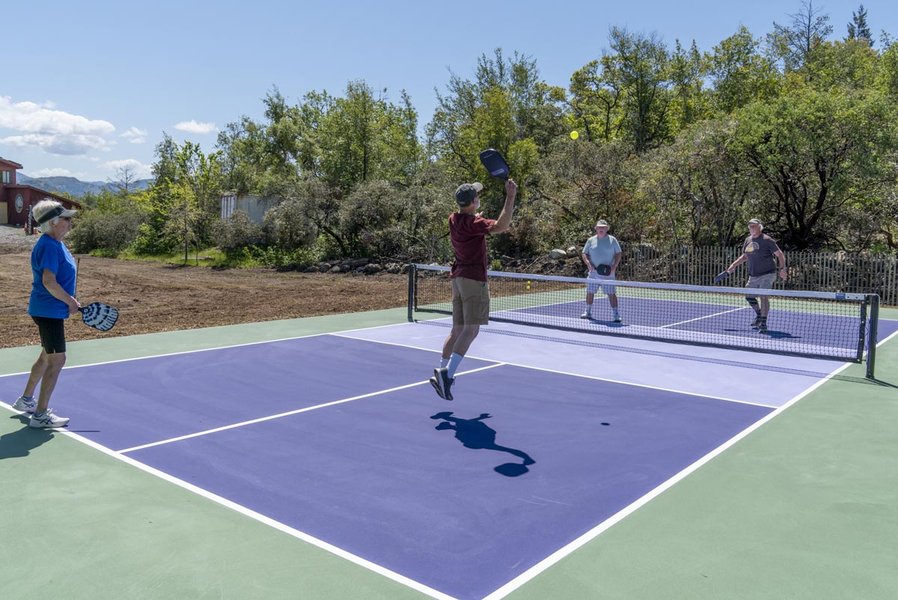
Players engaging in a dynamic rally, showcasing the importance of net positioning often set up by a successful third shot.
Mastering the Mechanics of the Third Shot Drop
Executing a consistent and effective third shot drop requires attention to several technical elements. It's a finesse shot, prioritizing touch and placement over power.
Core Technique Components
Positioning and Preparation
Start at or near the baseline. As the return comes towards you, prepare early. A balanced stance is crucial for control.
Grip and Paddle Face
Maintain a relatively light grip pressure, often described as holding a bird – firm enough not to let it go, but gentle enough not to crush it. The paddle face should be slightly open to lift the ball and create the desired arc.
The Swing: Shoulder-Led Motion
The swing should be smooth and controlled, originating more from the shoulder and forearm than the wrist. Think of it as a gentle lifting or pushing motion. Keep your wrist relatively stable or locked through the contact to avoid inconsistent flicks that can lead to errors. The motion is often compared to a soft volley or a long dink.
Contact Point
Aim to contact the ball in front of your body, ideally at or below waist level. Hitting the ball out in front allows for better control and the ability to guide the shot.
Trajectory and Aim: The Gentle Arc
The goal is for the ball to travel in a high arc, peaking on your side of the net and then descending softly into the opponent's kitchen. It should land just over the net, making it difficult for your opponents to attack aggressively. Precision is key; the ball should ideally land near the kitchen line, forcing a low contact point for the opponent.
Follow-Through
Your follow-through should be in the direction of your target, concise and controlled. Avoid abrupt or jerky movements.
Adding Spin (Optional but Advanced)
Some players impart a slight underspin (slice) on the ball. This can help the ball die or skid a bit upon landing, making it even tougher for opponents. However, mastering the basic flat or slightly lifted drop should be the priority.
Common Mistakes to Avoid
- Too Much Power: Hitting the ball too hard, causing it to sail long or high, giving opponents an easy put-away.
- Excessive Wrist Action: Leading to inconsistent height and depth, often resulting in nets or pop-ups.
- Hitting Too Flat: Not enough arc to clear the net safely and drop into the kitchen.
- Not Moving In: Failing to follow the drop shot to the net, negating its primary purpose.
Strategic Comparison: Drop vs. Drive on the Third Shot
Understanding when to drop and when to drive the third shot is a key element of advanced pickleball strategy. The following table compares these two crucial options:
| Feature | Third Shot Drop | Third Shot Drive |
|---|---|---|
| Primary Goal | Neutralize opponents, allow safe approach to the NVZ. | Catch opponents off guard, hit a winner, or force an error. |
| Ideal Situation | Opponents are established at the net; deep return of serve. | Opponents are out of position; shallow or weak return of serve; creating surprise. |
| Ball Trajectory | High arc, soft landing in NVZ. | Lower, faster trajectory, often aimed at feet or open court. |
| Pace | Slow, controlled. | Fast, aggressive. |
| Risk Level | Lower risk if executed well, but requires precision. | Higher risk, more potential for unforced errors if not executed well. |
| Impact on Team's Net Approach | Facilitates a controlled advance to the NVZ for both partners. | Can allow for a quick advance if successful, but less time to get set if defended. |
| Opponent's Likely Response | Dink, volley, or attempt a reset. | Block, counter-drive, or defensive shot. |
While the third shot drop is often the higher percentage play for advancing to the net, mixing in drives keeps opponents honest and can be effective if the return is short or an opponent has a weaker backhand or is slow to react.
Accelerating Advanced Doubles Drills for Enhanced Teamwork
Once the fundamentals of the third shot drop are understood, integrating it into doubles drills is crucial for developing teamwork and on-court synergy. These drills focus not just on hitting the shot, but on the subsequent movements and communication.
The radar chart above illustrates potential skill development in key areas of advanced doubles play. The "Before" dataset represents typical skill levels prior to intensive focus on third shot drop integration and teamwork drills. The "After" dataset shows the significant improvements achievable through dedicated practice, highlighting how mastering the third shot drop acts as a catalyst for overall team performance, enhancing everything from precision in shot execution to the fluidity of partner communication and court coverage.
Key Drills for Third Shot Drops and Teamwork
1. Baseline to Kitchen Drop Drill
Objective: Develop consistency and accuracy in hitting third shot drops.
Execution: Player A is at the baseline, Player B (feeder) is at the opposite kitchen line. Player B feeds balls (simulating returns of serve) to Player A, who practices hitting third shot drops into Player B's kitchen. Focus on height, depth, and softness. Player B can give feedback on where the ball lands. Switch roles.
Teamwork Element: Although basic, this drill builds the foundation. The partner can practice calling "good" or "short/long" to simulate game feedback.
2. Third Shot Drop and Advance Drill
Objective: Practice hitting the third shot drop and immediately transitioning to the net with your partner.
Execution: Player A serves. Player B (on the other side) returns the serve deep to Player A. Player A hits a third shot drop. Both Player A and their partner (Player C, starting at the baseline with A) then move forward to the NVZ line. Player B and their partner (Player D, at the NVZ) play out the point, focusing on dinking.
Teamwork Element: Crucial for timing the advance. Player A hits, Player C moves in tandem. Communication like "Moving in!" or "Got it!" is essential. The partner of the player hitting the third shot should anticipate the advance and move slightly ahead or in unison to establish net presence.
3. The Ultimate 2-Person Doubles Drill
Objective: Simulate a full doubles game scenario with only two players, focusing on all aspects including the third shot.
Execution: Player 1 serves. Player 2 returns and comes to the net. Player 1 then hits a third shot (drop or drive) and also advances to their net. The point is played out. This drill allows practice of serve, return, third shots, dinks, volleys, and transition zone play in a dynamic setting.
Teamwork Element: While playing solo on one side, it forces the player to think like a doubles team, covering the court and making strategic decisions about third shots that would facilitate a partner's advance.
The "Ultimate 2-Person Pickleball Doubles Drill" video demonstrates how two players can simulate a full doubles match, offering an excellent way to practice the third shot drop and subsequent net transition in a game-like context. This drill is invaluable for honing decision-making and flow in doubles play.
4. Transition Zone Control Drill
Objective: Improve play in the "no man's land" or transition zone, often encountered after a third shot drop.
Execution: One team (Players A & B) starts at the kitchen. The other team (Players C & D) starts in the transition zone. Players A & B feed balls to C & D, who practice hitting resets, half-volleys, or aggressive dinks, all while trying to move forward to the kitchen line. The third shot drop often results in the hitting team being in this zone.
Teamwork Element: Players C & D must coordinate their movements and shot selection to effectively gain control of the kitchen. Communication about who is taking which ball and how to cover space is critical.
5. Dink and Drop Purposeful Drills
Objective: Refine touch and control necessary for both dinks and drops, and practice strategic placement.
Execution: Four players are in a dinking rally. However, one player on each side is designated to occasionally receive a slightly deeper "feed" (simulating a short return) which they must play as a third-shot-style drop back into the kitchen. The rally continues. Alternatively, a "hot seat" dinking drill where players must make a certain number of successful dinks before playing out the point helps build consistency needed for drops.
Teamwork Element: Continuous communication about dink placement ("middle," "cross-court," "line") and readiness for a slightly different shot (the drop) improves reactive teamwork.
Cultivating Teamwork Through the Third Shot Drop
A successful third shot drop is only half the battle; what follows is equally important for teamwork.
Third Shot Drop & Teamwork"] id1["Mastering the Third Shot Drop"] id1a["Core Techniques"] id1a1["Positioning & Stance"] id1a2["Grip & Paddle Angle"] id1a3["Swing Mechanics (Shoulder-led)"] id1a4["Targeting the Kitchen"] id1a5["Adding Spin (Slice)"] id1b["Crucial Drills"] id1b1["Baseline to Kitchen Drops"] id1b2["Drop & Advance (Transition)"] id1b3["Ultimate 2-Person Drill"] id1b4["Dinking for Touch"] id2["Synergizing Teamwork"] id2a["On-Court Communication"] id2a1["Calling Shots (You/Me)"] id2a2["Signaling Intentions"] id2a3["Confirming Strategy"] id2b["Coordinated Movement"] id2b1["Advancing Together Post-Drop"] id2b2["Covering Gaps & Middle"] id2b3["Poaching Opportunities"] id2c["Strategic Advantages"] id2c1["Neutralizing Opponent's Net Play"] id2c2["Setting Up Offensive Dink Rallies"] id2c3["Exploiting Opponent Weaknesses"]
This mindmap outlines the interconnectedness of mastering the third shot drop and enhancing doubles teamwork. Successfully executing the drop (left branch) involves specific techniques and drills. This mastery then directly feeds into improved teamwork (right branch) through better communication, coordinated court movement, and the ability to capitalize on strategic advantages created by the effective third shot.
Key Teamwork Strategies
Communication is Constant
Pre-Point: Briefly discuss strategy, e.g., "Let's target their backhand on the third." During the Shot: The partner of the player hitting the third shot might call "Good!" or "Watch the line!" Post-Shot: As you advance, call "Mine!" or "Yours!" for the next ball. Simple calls like "In!" or "Cover!" are vital.
Synchronized Advancement
When one partner hits a good third shot drop, both players should move to the NVZ line together, like "a string connects them." The non-hitting partner should anticipate and often start moving slightly earlier if the drop looks promising. This prevents gaps and ensures you arrive at the kitchen as a unified front.
Court Positioning and Coverage
After the drop, aim to establish strong net positions. The player who hit the drop often covers the line, while the partner might shade towards the middle, depending on the opponents' tendencies. Understanding each other's court coverage responsibilities is key.
Reading the Opponent and Adapting
Observe how opponents react to your drops. Do they try to attack it? Do they dink it back predictably? Use this information to anticipate their next shot and adjust your positioning or shot selection. If they start cheating forward expecting a drop, a surprise third shot drive might be effective.
Building Trust and Anticipation
Consistent practice of third shot scenarios builds trust. You learn your partner's tendencies with their drop (e.g., usually cross-court, sometimes short). This allows for better anticipation and quicker reactions to the ensuing play.
Frequently Asked Questions (FAQ)
What is the primary goal of a third shot drop?
How long does it typically take to master the third shot drop?
Should I always hit a third shot drop in doubles?
How does my partner's positioning affect my third shot drop strategy?
Conclusion
Mastering the third shot drop is a transformative step in becoming an advanced pickleball doubles player. It's not just about the individual skill of hitting the shot, but about how that skill integrates into your team's overall strategy, movement, and communication. By focusing on the techniques outlined, consistently practicing targeted drills, and consciously working on teamwork dynamics, you and your partner can significantly elevate your game, control more points, and ultimately achieve greater success on the court. The journey to mastering this shot is an investment that pays substantial dividends in advanced doubles play.
Recommended
- Explore advanced dinking strategies to complement your third shot drop and dominate net play.
- Learn specific communication cues and signals to improve coordination with your pickleball partner.
- Discover when and how to strategically deploy the third shot drive to surprise opponents.
- Find more drills focused on mastering the critical transition from baseline to the non-volley zone.