
Unraveling Polymorphism: Many Forms, Unified Behavior in Programming and Beyond
Exploring a Core Concept of Object-Oriented Programming and its Real-World Analogues
Key Insights into Polymorphism
- Versatile Behavior: Polymorphism, meaning "many forms," allows a single interface or symbol to represent multiple different types or behaviors, enabling objects to respond uniquely to the same message based on their specific type.
- Code Flexibility and Reusability: As a fundamental pillar of Object-Oriented Programming (OOP), alongside encapsulation and inheritance, polymorphism promotes highly flexible, reusable, and maintainable code, especially in complex software systems.
- Compile-Time vs. Run-Time: Polymorphism manifests in two primary forms: static (compile-time), typically achieved through method overloading, and dynamic (run-time), accomplished via method overriding and virtual functions, offering distinct advantages and trade-offs in performance and flexibility.
Polymorphism, a term derived from Greek words "poly" (many) and "morph" (forms), is a fundamental concept not only in computer science but also observed in the natural world. In programming, it signifies the ability of an entity to take on multiple forms or to provide a single interface for various underlying data types. This powerful concept allows objects to behave differently based on their specific class or context, leading to more adaptable, scalable, and manageable codebases.
The Essence of Polymorphism in Programming
In the realm of programming language theory and type theory, polymorphism is defined as the use of one symbol to represent multiple different types. More specifically, in object-oriented programming (OOP), it enables the provision of a single interface to entities of different data types. This means you can interact with different objects in a uniform way, even though their internal implementations might vary significantly.
Polymorphism as a Pillar of OOP
Polymorphism is often considered the third pillar of Object-Oriented Programming, following encapsulation and inheritance. These three concepts collectively empower developers to create robust, modular, and extensible software. Inheritance establishes a parent-child relationship between classes, allowing subclasses to inherit attributes and methods from a superclass. Polymorphism then leverages this inheritance to allow these inherited methods to perform different tasks based on the specific object type at runtime.
How Polymorphism Works: A Deeper Dive
At its core, polymorphism works by defining a common interface or method in a base (parent) class, which can then be overridden or implemented differently by its derived (child) classes. When a method is called on an object through a reference to its base class type, the specific implementation executed is determined by the actual type of the object at the time of execution. This mechanism allows for dynamic behavior and greater flexibility in program design.
Types of Polymorphism
Polymorphism primarily manifests in two forms within programming languages, each offering distinct characteristics and applications:
Static (Compile-Time) Polymorphism
Static polymorphism, also known as compile-time polymorphism, occurs when the compiler determines which method implementation to call at compile time. This type of polymorphism is primarily achieved through:
- Method Overloading: This involves defining multiple methods within the same class that share the same name but have different parameter lists (different number of arguments, different types of arguments, or a different order of arguments). The compiler selects the appropriate method based on the arguments provided during the method call. A common example is the
print()method in many languages, which can print values of various data types (e.g., integers, strings, characters). - Operator Overloading (where supported): In languages like C++, operators (like
+,-,*) can be overloaded to perform different operations depending on the types of operands. For instance, the+operator can perform numerical addition for integers and concatenation for strings. While Java does not support user-defined operator overloading, some built-in operators exhibit this behavior.
Static polymorphism generally offers faster execution due to the absence of dynamic dispatch overhead. It also allows for greater static analysis by compilers, aiding in optimization and early error detection.
Dynamic (Run-Time) Polymorphism
Dynamic polymorphism, also referred to as run-time polymorphism, occurs when the method call is resolved at runtime. This form is crucial for creating highly flexible and extensible systems and is primarily achieved through:
- Method Overriding: This happens when a subclass provides its own specific implementation of a method that is already defined in its superclass. The method signature (name and parameters) must be the same in both the superclass and subclass. When the method is invoked on an object, the Java Virtual Machine (JVM) (or equivalent runtime environment) determines which version of the method to execute based on the actual type of the object, not the reference type.
- Virtual Functions (C++): In C++, dynamic polymorphism is enabled through virtual functions. Declaring a base class method as
virtualallows derived classes to override it. When a pointer or reference to the base class points to a derived class object, calling the virtual method invokes the derived class's implementation.
Dynamic polymorphism provides the flexibility to override methods dynamically, allowing new functionalities to be added without modifying existing code. However, it introduces a slight runtime overhead due to the lookup process required to determine the correct method to invoke (e.g., in a v-table).
Real-World Analogies of Polymorphism
Understanding polymorphism becomes much clearer when we connect it to real-world scenarios. The concept of "many forms" is prevalent in everyday life:
The Versatile Person
Consider a person. The same individual can play many roles depending on the context. A man can be a father at home, an employee at work, a student in a class, and a friend among peers. In each context, he interacts and behaves differently, yet he is still the same person. This illustrates how a single entity can exhibit different behaviors based on its role or environment.
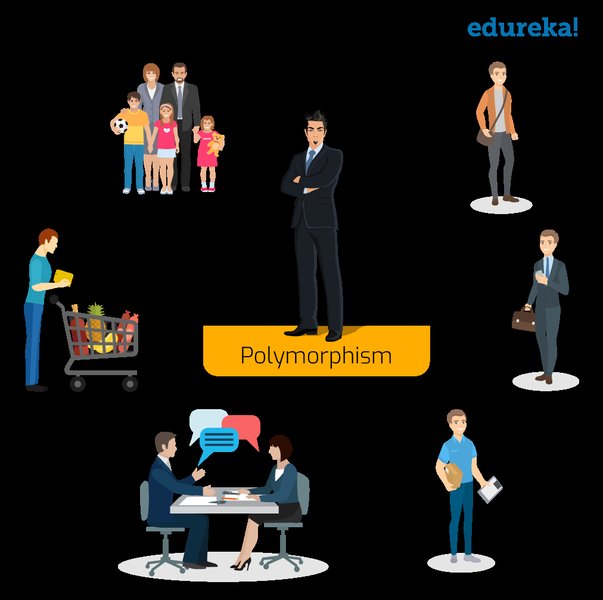
A man portrayed in multiple roles: father, employee, student, friend, illustrating polymorphism.
The Multifunctional Mobile Phone
A mobile phone is an excellent example of polymorphism. It serves as a telephone, a camera, an alarm clock, a music player, and a navigation device, among many other functions. When you interact with the phone, you use a common interface (the screen and buttons), but the underlying functionality (making a call, taking a photo, setting an alarm) changes based on the application you open or the action you perform. The mobile phone "object" takes on many forms of utility.
The Universal Button
Another simple yet profound example is a button. Everyone knows how to use a button: you press it. However, what the button "does" depends entirely on what it is connected to and the context in which it is used. A button on a TV remote changes channels, a button on a coffee machine brews coffee, and a button in an elevator calls the lift. The interface (pressing the button) is the same, but the outcome is polymorphic.
Benefits and Practical Applications
Polymorphism is not merely an academic concept; its practical applications are vast and contribute significantly to the development of robust and scalable software systems.
Enhanced Code Flexibility and Reusability
One of the primary benefits of polymorphism is its ability to promote code flexibility and reusability. By treating objects of different types as objects of a common superclass, developers can write generic code that operates on a wide range of objects. This reduces code duplication and makes systems easier to modify and extend.
// Example of Polymorphism in Java (Method Overriding)
class Animal {
    void makeSound() {
        System.out.println("The animal makes a sound");
    }
}

class Dog extends Animal {
    @Override
    void makeSound() {
        System.out.println("The dog barks: Woof woof!");
    }
}

class Cat extends Animal {
    @Override
    void makeSound() {
        System.out.println("The cat meows: Meow!");
    }
}

public class Zoo {
    public static void main(String[] args) {
        Animal myDog = new Dog(); // Polymorphic reference
        Animal myCat = new Cat(); // Polymorphic reference

        myDog.makeSound(); // Calls Dog's makeSound()
        myCat.makeSound(); // Calls Cat's makeSound()

        // Can also be used in collections
        Animal[] animals = new Animal[2];
        animals[0] = new Dog();
        animals[1] = new Cat();

        for (Animal a : animals) {
            a.makeSound(); // Each animal makes its specific sound
        }
    }
}
Simplified Code Management
In large software projects, managing different object types can become complex. Polymorphism simplifies this by allowing a single variable to refer to objects of different classes, as long as those classes share a common base class or interface. This abstraction simplifies the interaction with objects, as the calling code doesn't need to know the specific concrete type of the object at compile time.
Dynamic Behavior and Extensibility
Polymorphism facilitates dynamic behavior, where the exact code executed is determined at runtime based on the object's actual type. This is particularly useful in scenarios like graphical user interfaces (GUIs), where different shapes (circles, squares, triangles) might need to be drawn or manipulated using a common "draw" method. New shapes can be added without altering the core drawing logic, demonstrating high extensibility.
This radar chart visually compares the benefits offered by a polymorphic approach versus a non-polymorphic approach in software development. As depicted, polymorphism significantly enhances code reusability, maintainability, flexibility, and scalability. While it might sometimes slightly impact initial readability for beginners due to abstract concepts, its long-term advantages in complex systems are clear.
Polymorphism Across Languages
Polymorphism is not exclusive to a single programming language but is a core feature supported by most object-oriented languages, including Java, C#, C++, and Python. While the underlying concept remains consistent, the syntax and implementation details may vary.
Java Polymorphism
Java heavily utilizes polymorphism through method overloading (static) and method overriding (dynamic). Its strong type checking and JVM's runtime dispatch mechanisms make it a robust environment for implementing polymorphic designs.
C# Polymorphism
Similar to Java, C# implements polymorphism using method overloading and overriding. It leverages virtual and override keywords to facilitate dynamic polymorphism, allowing objects of derived classes to be treated as base class objects at runtime.
C++ Polymorphism
C++ offers both static and dynamic polymorphism. Static polymorphism is achieved through function overloading and template programming, while dynamic polymorphism relies on virtual functions and pointers/references to base classes.
Python Polymorphism
Python, being a dynamically typed language, handles polymorphism more implicitly. Methods with the same name can be called on different objects, and the interpreter determines the correct method based on the object's type at runtime. This "duck typing" approach (if it walks like a duck and quacks like a duck, then it must be a duck) inherently supports polymorphic behavior.
Understanding the Differences: Overloading vs. Overriding
While both method overloading and method overriding are forms of polymorphism, they operate at different stages of the program execution and serve different purposes. It's crucial to distinguish between them for effective OOP design.
| Feature | Method Overloading (Static Polymorphism) | Method Overriding (Dynamic Polymorphism) |
|---|---|---|
| Definition | Multiple methods in the same class with the same name but different parameters. | Subclass provides a specific implementation for a method already defined in its superclass. |
| Binding Time | Compile-time (early binding) | Run-time (late binding) |
| Signature | Method name is same, parameters are different. | Method name and parameters are same (signature identical to superclass method). |
| Scope | Within the same class. | Across superclass and subclass (requires inheritance). |
| Return Type | Can be different. | Must be same (or covariant in some languages). |
| Keywords (Java) | No specific keyword needed. | @Override annotation (optional, but good practice). |
| Keywords (C++) | No specific keyword needed for overloading. | virtual keyword in base class, override in derived class (C++11 and later). |
| Use Case | Providing multiple ways to perform a similar operation (e.g., adding different number of arguments). | Allowing specific behavior for derived classes while maintaining a common interface. |
The Biological Roots of Polymorphism
The term "polymorphism" itself is borrowed from biology, where it describes the occurrence of two or more clearly different morphs or forms, also referred to as alternative phenotypes, in the population of a species. This biological concept of "many forms" parallels its usage in computer science:
- Genetic Polymorphism: In genetics, it refers to variations in genes that result in different traits (e.g., human blood types, fur color in animals).
- Sexual Dimorphism: A common example is sexual dimorphism, where males and females of the same species exhibit distinct forms.
- Social Insects: Colonies of social insects like ants or bees display polymorphism, with different castes (queen, workers, soldiers) having distinct forms and functions.
This biological origin underscores the fundamental idea of a single underlying entity manifesting in diverse ways, which is precisely what polymorphism achieves in programming.
Watch and Learn: Polymorphism Explained
To further solidify your understanding of polymorphism, especially its application in Java, this animated video provides a clear and engaging explanation with real-life analogies. It delves into the core concepts and demonstrates how polymorphism facilitates flexible, reusable, and maintainable code in Object-Oriented Programming.
Polymorphism in Java Explained with Animated Real-Life Examples
Frequently Asked Questions (FAQ)
What is polymorphism in simple terms?
Why is polymorphism important in OOP?
What are the main types of polymorphism?
Can you give a non-programming example of polymorphism?
Does polymorphism always require inheritance?
Conclusion
Polymorphism stands as a testament to the power of abstraction and flexibility in programming. By enabling entities to assume "many forms," it empowers developers to craft elegant, maintainable, and highly extensible software architectures. Whether through method overloading at compile time or method overriding at runtime, polymorphism allows for dynamic behavior, reduced code duplication, and simplified system management. Its roots in biological principles further highlight its intuitive nature, making it an indispensable concept for anyone venturing into object-oriented programming.
Recommended Further Exploration
- How is polymorphism different from inheritance and encapsulation?
- Advanced uses of dynamic polymorphism in software design
- Exploring the trade-offs between static and dynamic polymorphism
- Polymorphism in functional programming paradigms