
Analysis of Additional Power Requirement for Climbing Performance
Detailed calculation showing why extra battery power is needed for a 600kg airplane to climb 1000m in 3 minutes
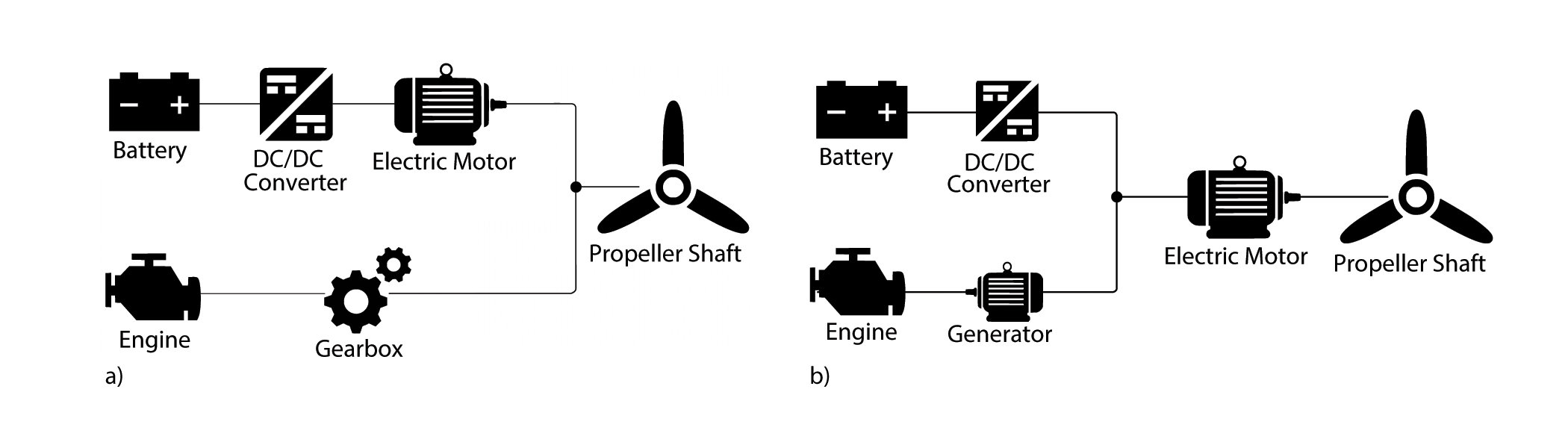
Key Highlights
- Energy Requirement: The airplane must gain almost 5.89 million Joules of potential energy to climb 1000 meters.
- Power Deficit: The required climb power of approximately 32.7 kW exceeds the 24 kW output from the fuel cells.
- Battery Necessity: The additional approximately 8.7 kW required necessitates using the large rechargeable battery in the hybrid system.
Introduction
In aircraft design, the determination of power requirements for specific maneuvers such as climbing is critical. The current scenario involves a small airplane of mass 600 kg that is propelled by an electric motor, primarily powered by fuel cells. The fuel cells deliver a maximum output of 24 kW. However, the airplane is tasked with climbing to an altitude of 1000 m in a timeframe of 3 minutes. Given these parameters, it becomes essential to analyze the energy and power demands during this climb, and to determine whether the fuel cells alone can achieve this task or if an additional energy source – in this case, a large rechargeable battery – is required.
Calculation of Energy and Power Requirements
Step 1: Calculating the Required Potential Energy
The energy needed to lift an object in a gravitational field is determined by the gravitational potential energy (GPE) formula:
Gravitational Potential Energy (GPE)
The formula for gravitational potential energy is given by:
\( \text{GPE} = m \times g \times h \)
Where:
- m is the mass of the airplane (600 kg)
- g is the gravitational acceleration (~9.81 m/s2)
- h is the vertical displacement (1000 m)
Inserting the values gives:
\( \text{GPE} = 600 \, \text{kg} \times 9.81 \, \text{m/s}^2 \times 1000 \, \text{m} \)
This calculation yields:
\( \text{GPE} = 5,886,000 \, \text{Joules} \)
Step 2: Determining the Power Required for the Climb
Power is defined as the rate at which energy is transferred or converted. The necessary power to perform the climb can be analyzed by dividing the energy required by the time available for the climb.
Power Calculation
The formula for power is:
\( P = \frac{E}{t} \)
Where:
- E is the energy required (5,886,000 Joules)
- t is the time period for the climb. Given 3 minutes, this is converted to seconds: \( t = 3 \times 60 = 180 \, \text{seconds} \)
Therefore, the power required is:
\( P = \frac{5,886,000 \, \text{J}}{180 \, \text{s}} = 32,700 \, \text{Watts} \)
Expressed in kilowatts, this is:
\( 32.7 \, \text{kW} \)
Step 3: Comparison with Available Fuel Cell Power
The electric motor onboard the airplane is powered by fuel cells that can supply a maximum total power of 24 kW. When compared with the required 32.7 kW calculated for the climb, there is an evident shortfall.
Power Deficit Calculation
To determine the deficit:
\( \text{Deficit} = \text{Required Power} - \text{Fuel Cell Power} \)
\( \text{Deficit} = 32.7 \, \text{kW} - 24 \, \text{kW} = 8.7 \, \text{kW} \)
Thus, there is an 8.7 kW power shortfall that the fuel cell alone cannot overcome.
The Role of the Rechargeable Battery
Given the calculated power deficit, a supplementary power source becomes a necessity. This is where the onboard rechargeable battery comes into play. The battery's function in the hybrid system is to provide the additional power required during peak operational phases, such as a climb.
By supplying an extra 8.7 kW, the recharged battery bridges the gap between the 24 kW provided by the fuel cells and the total 32.7 kW required during the climb phase. This hybrid approach ensures that the electric motor receives sufficient power to maintain the necessary rate of energy output for the maneuver.
Detailed Breakdown of Energy and Power Distribution
Below is a table summarizing the energy and power specifications for the climb:
| Parameter | Value | Description |
|---|---|---|
| Mass (m) | 600 kg | The mass of the airplane |
| Gravitational Acceleration (g) | 9.81 m/s2 | Acceleration due to gravity |
| Height (h) | 1000 m | The target altitude |
| Calculated Potential Energy (GPE) | 5,886,000 J | Energy required to reach 1000 m |
| Time (t) | 180 s | Time allowed for the climb (3 minutes) |
| Required Power | 32,700 W (32.7 kW) | Power needed to meet climb requirements |
| Fuel Cell Output | 24,000 W (24 kW) | Maximum power available from fuel cells |
| Power Deficit | 8,700 W (8.7 kW) | The additional power required, supplied by the battery |
Implications for Hybrid Electric Aircraft Systems
Hybrid electric aircraft rely on the complementary use of multiple energy sources to optimize performance and efficiency. In scenarios where peak power is required—such as during a climb—the fuel cells, while adept at providing steady-state power, may fall short due to intrinsic limitations in their instantaneous power output. The integration of a rechargeable battery mitigates this shortfall by offering a rapid discharge capability for short bursts of high power, exemplified by the 8.7 kW shortfall identified in our calculations.
This arrangement not only provides the necessary power boost during transient operations but also improves overall fuel efficiency and reduces the strain on fuel cell systems. The practical engineering challenge lies in ensuring that the energy management system effectively coordinates the power contributions of both the fuel cells and the battery, maintaining system balance and protecting the components from overloading.
Energy Management and System Synergy
Cooperative Operation
A well-designed energy management system is crucial for hybrid electric aircraft. This system monitors power requirements and dynamically distributes the load between the fuel cells and the battery. During steady flight conditions, the fuel cells may operate at or near their rated power, ensuring efficient long-duration operation. However, when additional power is needed—for instance, during the rapid climb challenge—the battery quickly discharges its stored energy to meet the deficit.
Key Functions of the Energy Management System
- Monitoring: Continuous tracking of power output from both the fuel cells and the battery.
- Balancing: Distributing power demands optimally to extend component lifespan and ensure reliability under peak loads.
- Load Sharing: Rapidly engaging the battery to supply transient loads that exceed the fuel cell’s capabilities.
- Efficiency Optimization: Minimizing energy losses by operating each power source in its most efficient range.
The ability to seamlessly transition between different energy sources underpins the operational success of hybrid electric aircraft, particularly when critical maneuvers such as rapid climbs are involved.
Extended Analysis on Climb Dynamics
Additional Considerations
Beyond the basics of energy and power calculation, several other factors influence the performance of an airplane during a climb:
Aerodynamic Drag
Although the primary focus here is on gravitational potential energy, aerodynamic drag also affects the total energy demand during a climb. Drag increases with speed and altitude, and the energy management strategy must consider this factor to ensure sufficient power reserves are available. However, for the purpose of this analysis, we assume that the calculation of potential energy is the dominant factor.
Engine Efficiency
Efficiency losses in the propulsion system and auxiliary equipment may require the actual available power to be higher than the theoretical calculations. In practical design, it is common to include a safety margin to account for these losses. Nevertheless, given the calculated deficit of 8.7 kW, even conservative efficiency adjustments would still underscore the necessity for an additional energy source.
Weight Considerations
The mass of the airplane is instrumental in determining the energy required for a climb. Should the design or operational profile lead to changes in mass (for example, additional payload or fuel reserves), the power requirements would change proportionally. In this scenario, the 600kg assumption provides a benchmark for analysis.
Real-World Significance and Practical Design Choices
In the design of electric and hybrid electric aircraft, power management challenges are particularly acute during phases of flight that demand high power output in a short time frame. The calculation here clearly demonstrates that relying solely on fuel cells—while advantageous for sustained energy release—would be insufficient in meeting the surge power requirements demanded by a rapid climb, such as achieving 1000 m in 3 minutes.
Therefore, incorporating a large rechargeable battery is not merely a design embellishment but a necessary solution for safely meeting the performance criteria. The extra 8.7 kW from the battery ensures that the aircraft can dynamically respond to the power demands of the climb without stressing the fuel cell system beyond its design limits.
Summarizing the Calculation and Final Assessment
Let’s consolidate the steps taken in our calculation:
- Step 1: Calculate the gravitational potential energy necessary to raise a 600 kg airplane to 1000 m, which resulted in 5,886,000 J.
- Step 2: Determine the rate of energy usage (power) needed to perform this climb in 180 seconds, arriving at 32.7 kW.
- Step 3: Compare this 32.7 kW requirement with the 24 kW output capability of the fuel cells, revealing an 8.7 kW deficit.
- Step 4: Conclude that to meet this power requirement and safely achieve the climb, an auxiliary power source in the form of a large rechargeable battery is indispensable.
This systematic approach underscores the importance of accounting for both energy and power parameters in aircraft design. The calculations validate that the fuel cell system alone is inadequate and that the hybrid configuration, with a battery assisting during peak power demands, is essential.
Conclusion and Final Thoughts
In conclusion, the energy calculations demonstrate that a 600 kg airplane requires approximately 5.89 million Joules of gravitational potential energy to climb to 1000 meters. Performing this climb in 3 minutes necessitates a continuous power output of about 32.7 kW. Since the fuel cells can only supply a maximum of 24 kW, there is a clear 8.7 kW shortfall that must be compensated by an additional power source—the onboard rechargeable battery. This hybrid power system is essential not only for meeting transient peak power demands during maneuvers like climbs but also for ensuring overall system efficiency, reliability, and safety in modern electric aircraft design.
The integration of a battery into the powertrain exemplifies a pragmatic engineering solution, allowing for rapid power supplementation when needed while relying on fuel cells for sustained operations. This synergy between different energy sources is a hallmark of contemporary hybrid electric propulsion systems, which are increasingly employed in innovative aerospace designs.
References
- Optimal Sizing of Fuel Cell and Battery in a Direct-Hybrid for Electric Aircraft - MDPI
-
Power Management Control and Delivery Module for a Hybrid Electric Aircraft using Fuel Cell and Battery - ScienceDirect
Recommended Additional Queries
Last updated February 22, 2025