
Unlocking Quantum Potential: A Deep Dive into Crafting NV Center Nanodiamonds via MPCVD
Discover the intricate steps and critical parameters for synthesizing high-quality nanodiamonds with nitrogen-vacancy centers using Microwave Plasma Chemical Vapor Deposition.
Nitrogen-Vacancy (NV) centers in nanodiamonds represent a groundbreaking class of quantum materials. An NV center is a point defect within the diamond's crystal lattice, composed of a nitrogen atom substituting a carbon atom, positioned next to a vacant lattice site. These tiny imperfections imbue nanodiamonds with remarkable optical and spin properties, making them invaluable for a diverse range of cutting-edge applications, from quantum computing and sensing to advanced bioimaging. The Microwave Plasma Chemical Vapor Deposition (MPCVD) process stands out as a sophisticated and highly controllable method for synthesizing these specialized nanodiamonds. This technique allows for the precise incorporation of nitrogen and the creation of vacancies, leading to high-purity materials with tailored NV center characteristics.
Key Insights into NV Nanodiamond Synthesis
- Precise Control is Paramount: Successful NV center formation via MPCVD hinges on meticulous control over gas composition (methane, hydrogen, nitrogen), temperature, pressure, and microwave power.
- In-Situ Doping Advantage: Introducing nitrogen during the diamond growth phase (in-situ doping) generally leads to more uniform NV center distribution compared to post-growth implantation methods.
- Post-Growth Optimization is Crucial: Steps like annealing and sometimes irradiation are essential after the initial growth to activate and stabilize NV centers, enhancing their quantum properties.
The Journey of an NV Nanodiamond: The MPCVD Process Unveiled
The preparation of nanodiamonds hosting NV centers through MPCVD is a multi-stage process requiring careful orchestration of physical and chemical parameters. Below is a comprehensive guide to this fascinating synthesis method.
1. Substrate Preparation: Laying the Foundation
The journey begins with the substrate, which acts as the template for diamond growth. For nanodiamond synthesis, specific preparation is key.
Seed Layer Application
To promote the growth of discrete nanodiamonds rather than a continuous film, the substrate (commonly silicon, quartz, or sapphire) is typically "seeded." This involves applying a layer of ultra-small diamond nanoparticles (often 3-10 nm in size, sometimes from detonation nanodiamond powder). These seeds act as nucleation sites for the MPCVD growth. The substrate undergoes rigorous cleaning, often involving ultrasonic baths and acid treatments, to remove any contaminants that could interfere with the growth process or the quality of the NV centers.
Substrate Surface Treatment
Techniques like scratching the substrate surface or plasma pre-treatment can also be employed to enhance the density of nucleation sites, promoting a higher yield of nanodiamonds.
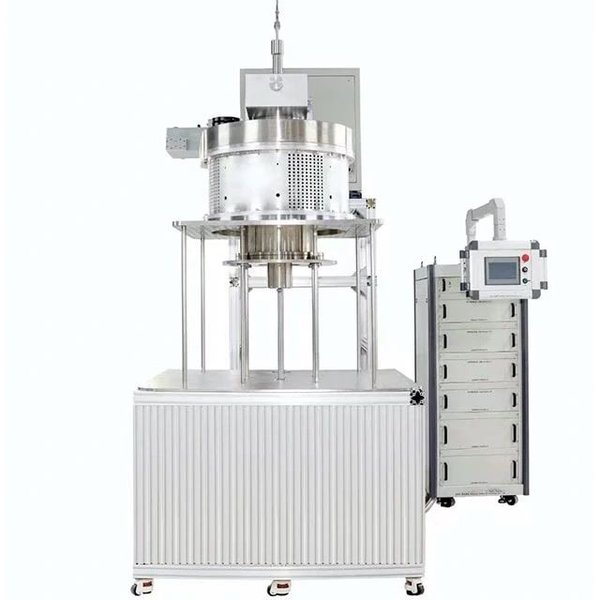
A typical Microwave Plasma Chemical Vapor Deposition (MPCVD) system used for synthesizing diamond materials.
2. MPCVD System Setup and Gas Chemistry
The MPCVD chamber is where the magic happens. It's configured to create a stable plasma environment conducive to diamond growth.
Gas Mixture Configuration
The primary gases used are:
- Hydrogen (H₂): Acts as a carrier gas and plays a crucial role in etching non-diamond carbon phases, ensuring high-quality diamond growth.
- Methane (CH₄): Serves as the primary carbon source for diamond formation. The CH₄:H₂ ratio is critical; higher methane concentrations (e.g., >4% CH₄ in H₂) tend to favor the formation of nanocrystalline diamond structures over larger single crystals or continuous films.
- Nitrogen (N₂): Introduced in controlled, small percentages (ranging from a few parts per million (ppm) to around 0.5-10%, depending on the desired NV density) for nitrogen doping. This is the "N" in the NV center.
Chamber Conditions
The substrate is placed within the chamber. Some advanced setups utilize vertical substrate placement, which can expose seeds to varying plasma conditions, aiding in parameter optimization.
3. The Growth Phase: Diamond Deposition and Nitrogen Incorporation
With the system prepared, the growth process begins under tightly controlled conditions.
Plasma Ignition and Maintenance
Microwave power (typically 500 W to 5 kW, depending on chamber size and design) is applied to ionize the gas mixture, generating a high-density plasma. This plasma dissociates methane and hydrogen molecules into reactive species (carbon-containing radicals and atomic hydrogen) essential for diamond synthesis.
Key Growth Parameters
- Temperature: The substrate temperature is meticulously maintained, typically between 700°C and 1200°C (often around 800-950°C for NV-nanodiamonds). This temperature influences nucleation, growth rate, and crystal quality.
- Pressure: The chamber pressure is usually kept in the range of 20 to 300 Torr (typically 30-100 Torr for nanodiamonds). Higher pressures can increase the concentration of active species, potentially enhancing growth rates.
- Growth Duration: The deposition time is controlled to achieve the desired nanodiamond size, ranging from minutes to several hours.
In-Situ Nitrogen Doping
During the diamond growth, nitrogen atoms from the N₂ gas are incorporated into the diamond lattice, substituting carbon atoms. This forms substitutional nitrogen defects (often referred to as P1 centers), which are precursors to NV centers.
4. Vacancy Creation and NV Center Formation
The "V" in NV center stands for vacancy. Creating these lattice vacancies and pairing them with the incorporated nitrogen atoms is the next critical phase.
Vacancy Generation
Vacancies can be generated through several mechanisms:- During Growth: The plasma environment itself can generate a certain concentration of vacancies. Adjusting plasma parameters can influence this.
- Post-Growth Irradiation: This is a common method to increase vacancy concentration. The grown diamond material is irradiated with high-energy particles such as electrons, protons, or ions. The energy and fluence of irradiation are chosen to create an optimal density of vacancies without excessively damaging the diamond lattice.
Annealing: The Key to NV Formation
After vacancy creation (either during growth or via irradiation), the diamond material is annealed. This involves heating the nanodiamonds to high temperatures, typically above 800°C (often 800-1000°C), in a vacuum or an inert atmosphere. The heat provides the energy needed for the vacancies to become mobile within the diamond lattice. These mobile vacancies can then encounter the previously incorporated substitutional nitrogen atoms and bind with them, forming the stable Nitrogen-Vacancy (NV) centers.

Illustration depicting the crystal structure of diamond, where NV centers are formed as point defects.
5. Post-Growth Treatments and Optimization
Further treatments can refine the properties of the NV centers.
Surface Termination
The surface chemistry of nanodiamonds significantly affects the charge state (NV⁰ neutral or NV⁻ negatively charged, the latter being more desirable for many quantum applications) and photostability of the NV centers. Treatments with oxygen or hydrogen plasmas can modify the surface termination, optimizing these properties.
Further Optimization
Techniques such as combining surface chemistry tuning with proton beam irradiation have been shown to enhance the optical properties of NV⁻ centers in nanodiamonds.
6. Dispersion and Characterization
Once synthesized, the NV-containing nanodiamonds are often processed for specific applications.
Nanodiamond Dispersion
For many applications and for detailed characterization of individual NV centers, the nanodiamonds need to be dispersed, often onto a substrate like glass. Spin coating is a common technique used to achieve a relatively uniform distribution of individual nanodiamond particles.
Verification and Quality Control
The presence, quality, and properties of the NV centers are confirmed using various analytical techniques:- Photoluminescence (PL) Spectroscopy: Detects the characteristic fluorescence of NV centers (zero-phonon line typically at 637 nm for NV⁻ and 575 nm for NV⁰).
- Optically Detected Magnetic Resonance (ODMR): Used to identify the spin state and coherence properties of the NV centers.
- Electron Microscopy (SEM/TEM): To analyze the size, morphology, and crystalline quality of the nanodiamonds.
- Electron Spin Resonance (ESR)/Electron Paramagnetic Resonance (EPR): Measures spin properties, including coherence times.
Process Parameters Overview Table
The following table summarizes the key stages and typical parameters involved in the MPCVD synthesis of NV-center nanodiamonds. These parameters can vary significantly based on the specific MPCVD system and desired nanodiamond characteristics.
| Stage | Key Parameters/Actions | Typical Values/Description |
|---|---|---|
| Substrate Preparation | Material, Cleaning, Seeding | Silicon, Quartz, Sapphire; Ultrasonic cleaning, acid wash; Nanodiamond seeds (3-10 nm) |
| MPCVD Gas Mixture | Primary Gases, Dopant | H₂ (carrier), CH₄ (carbon source, >4% for nanocrystalline), N₂ (dopant, ppm to few %) |
| Growth Conditions | Microwave Power, Temperature, Pressure | 500 W - 5 kW; 700°C - 1200°C; 20 - 300 Torr |
| Nitrogen Incorporation | Method | In-situ during MPCVD growth |
| Vacancy Creation | Method | During plasma growth or post-growth irradiation (electrons, protons, ions) |
| NV Center Formation | Process | Annealing at >800°C (typically 800-1000°C) |
| Post-Growth Treatment | Optimization | Surface termination (O₂, H₂ plasma), additional irradiation/annealing |
| Characterization | Techniques | PL, ODMR, SEM, TEM, ESR/EPR |
Visualizing Synthesis Factors: A Radar Chart Perspective
The MPCVD process for NV-nanodiamond synthesis involves balancing several critical factors. The radar chart below provides a qualitative comparison of these aspects. Higher values indicate better performance or control for that specific factor in an idealized MPCVD setup aimed at high-quality NV-nanodiamonds.
This chart illustrates that while MPCVD offers excellent control over purity and crystalline quality, aspects like achieving perfect size uniformity for nanodiamonds and process scalability present ongoing areas for optimization. Cost-effectiveness is considered moderate, especially at the research and development scale.
Mapping the MPCVD Process for NV Nanodiamonds
The following mindmap provides a visual overview of the interconnected stages and key influencing factors in the preparation of NV center nanodiamonds using the MPCVD technique. It highlights the journey from raw materials to functional quantum materials.
(Electrons, Protons, Ions)"] ["Annealing (800-1000°C+)"] ["Vacancy Migration"] ["Nitrogen-Vacancy Pairing"] ["5. Post-Growth Treatments"] ["Surface Termination (O₂, H₂)"] ["Optical Property Enhancement"] ["6. Characterization & Processing"] ["Photoluminescence (PL)"] ["Optically Detected Magnetic Resonance (ODMR)"] ["Electron Microscopy (SEM/TEM)"] ["Nanodiamond Dispersion"] ["Influencing Factors"] ["Purity of Gases"] ["Substrate Quality"] ["Plasma Stability & Uniformity"] ["Precise Parameter Control"] ["Applications"] ["Quantum Sensing"] ["Quantum Computing"] ["Bioimaging"] ["Spintronics"]
This mindmap shows the core stages from substrate preparation to characterization, along with critical process parameters and factors that influence the final quality and properties of the NV nanodiamonds.
Visualizing the MPCVD Process in Action
To better understand the fundamental MPCVD diamond growth technique, the following video provides a general overview of how diamonds are grown in a laboratory using this method. While it may not focus specifically on NV center nanodiamonds, it illustrates the core principles of the deposition process which are foundational to their synthesis.
Video demonstrating the general process of growing diamonds using Microwave Plasma Chemical Vapor Deposition (MPCVD).
This video explains that MPCVD is a method for growing high-quality diamond films by using microwave energy to create a plasma from a gas mixture, typically containing a carbon source (like methane) and hydrogen. The plasma facilitates the dissociation of gas molecules into active species that then deposit as diamond on a substrate. This controlled environment allows for the synthesis of high-purity diamond materials, which is essential for creating quantum-grade NV centers when nitrogen is appropriately introduced and vacancies are formed.
Challenges and Future Directions
While MPCVD is a powerful technique, some challenges remain. Achieving large-area uniform films or highly monodisperse nanodiamonds can be difficult. Controlling the precise location and orientation of individual NV centers is an ongoing area of intense research. Agglomeration of nanodiamonds can also be an issue. Future advancements will likely focus on improving scalability, enhancing the coherence times of NV spins, and developing methods for deterministic placement of NV centers within the nanodiamonds for optimized device performance.
Frequently Asked Questions (FAQ)
What is an NV center in a nanodiamond?
Why is MPCVD a preferred method for creating NV nanodiamonds?
What are the main gases used in the MPCVD process for NV nanodiamonds?
How are vacancies created for NV centers?
What is the purpose of annealing in NV center formation?
What are some applications of NV center nanodiamonds?
Conclusion
The preparation of nitrogen-vacancy center nanodiamonds via the MPCVD process is a sophisticated endeavor that lies at the intersection of materials science, plasma physics, and quantum engineering. It demands meticulous control over numerous parameters to achieve nanodiamonds with the desired size, purity, and density of high-quality NV centers. Despite the complexities, the exceptional properties of these quantum materials make them highly sought after for transformative technologies. Ongoing research continues to refine synthesis techniques, pushing the boundaries of what's possible in quantum sensing, computing, and beyond.
Recommended Further Exploration
- Explore the distinct properties and applications of NV⁻ (negatively charged) versus NV⁰ (neutral) centers.
- Investigate the influence of diamond substrate crystallographic orientation on the preferential alignment of NV centers.
- Learn about advanced methods for achieving deterministic placement and individual control of NV centers.
- Understand the advantages and disadvantages of MPCVD compared to other nanodiamond synthesis techniques like High-Pressure High-Temperature (HPHT) and detonation.
References
Last updated May 22, 2025