
Python's GIL: The Single-Lane Highway of Multithreading
Understanding Python's Global Interpreter Lock and why it makes your multi-core processor run like a single-core one
Key Insights About Python's GIL
- The GIL allows only one thread to execute Python code at a time, essentially serializing your multi-threaded programs
- It exists primarily to simplify memory management and prevent data corruption in Python's reference counting system
- While limiting CPU-bound performance, it can be bypassed using multiprocessing, C extensions, or alternative Python implementations
What is the Global Interpreter Lock (GIL)?
Imagine a busy highway that, despite having multiple lanes (CPU cores), only allows one car (thread) to travel at a time. This is essentially what Python's Global Interpreter Lock (GIL) does - it's a mutex (mutual exclusion lock) that ensures only one thread can execute Python bytecode at any given moment, regardless of how many cores your processor has.
The GIL is a fundamental part of CPython (the standard Python implementation) that has existed since the language's early days. It's important to understand that the GIL operates at the Python interpreter level - it's not a limitation of your hardware or operating system, but rather a design decision in how Python executes code.
The GIL Explained Simply
When a Python program runs with multiple threads:
- Only one thread can hold the GIL and execute Python code at any time
- When a thread wants to run, it must first acquire the GIL
- If the GIL is already held by another thread, the requesting thread must wait
- The GIL is released periodically by the interpreter (after a certain number of bytecode instructions)
- This gives other threads a chance to acquire the GIL and run
Why is the GIL Required?
The GIL exists for several important reasons:
Memory Management Safety
Python uses reference counting for memory management, which means it keeps track of how many references exist to each object. When the count reaches zero, the memory is freed. Without the GIL, multiple threads might modify these reference counts simultaneously, leading to memory leaks or crashes due to premature memory deallocation.
Reference Counting in Action
Consider this scenario without a GIL:
- Thread A and Thread B both reference the same object
- Both threads try to release their reference simultaneously
- The reference count should decrease from 2 to 0
- Due to race conditions, it might decrease only once (from 2 to 1)
- The object never gets freed, causing a memory leak
C Extension Compatibility
Many Python libraries are written in C or interface with C code. These extensions often aren't thread-safe. The GIL ensures that only one thread accesses these libraries at a time, preventing crashes and unpredictable behavior.
Simplicity of Implementation
The GIL greatly simplifies the Python interpreter's design. Without it, extensive locking would be needed throughout the interpreter and standard library, increasing complexity and potentially introducing bugs.
Uses and Benefits of the GIL
Despite its limitations, the GIL offers several advantages:
Simpler Thread-Safe Programming
The GIL makes Python programs more robust by preventing many common threading issues. Developers don't need to worry about complex thread synchronization for most operations, reducing the likelihood of race conditions and deadlocks.
Better Single-Threaded Performance
For single-threaded applications (which are common), the GIL actually improves performance by eliminating the need for explicit locks on objects. This is why Python excels in many single-threaded scenarios.
I/O Operations Work Well
The GIL is automatically released during I/O operations (like reading files or making network requests). This means I/O-bound multithreaded programs can still achieve concurrency because threads spend most of their time waiting for I/O to complete while other threads can run.
This radar chart shows how Python with GIL compares to multiprocessing solutions and non-GIL languages across different performance metrics. Note how Python with GIL excels in simplicity and memory safety but falls short in CPU-bound performance and parallelism.
Disadvantages of the GIL
The GIL has several significant drawbacks:
Limited Multi-Core Utilization
The most significant disadvantage is that the GIL prevents Python from fully utilizing multiple CPU cores for CPU-bound tasks. Even on a machine with many cores, a CPU-intensive Python program using threads will effectively use only one core at a time.
Performance Bottleneck
For CPU-bound applications, the GIL becomes a severe bottleneck, as threads must wait for each other to release the GIL. This can make multithreaded CPU-intensive Python programs perform no better (or sometimes worse due to overhead) than their single-threaded counterparts.
The Irony of Threading
Adding more threads to a CPU-bound Python application often doesn't improve performance and can sometimes degrade it due to the overhead of thread switching and GIL contention.
Complex Workarounds Required
Developers must resort to more complex architectures (like multiprocessing) to achieve true parallelism, increasing the complexity of Python applications.
| Task Type | Effect of GIL | Recommended Approach | Performance Impact |
|---|---|---|---|
| CPU-bound (calculations, data processing) | Severe limitation - only one thread can execute at a time | Multiprocessing, C extensions | High negative impact |
| I/O-bound (file operations, network requests) | Minimal impact - GIL is released during I/O operations | Threading, asyncio | Low negative impact |
| Mixed workloads | Partial limitation - depends on CPU vs I/O ratio | Hybrid approaches (threading + multiprocessing) | Moderate negative impact |
| Single-threaded applications | No limitation - may even improve performance | Standard Python | Positive impact |
Workarounds for the GIL
Fortunately, several strategies can help bypass or mitigate the limitations of the GIL:
Multiprocessing
The most common workaround is to use Python's multiprocessing module, which creates separate Python processes instead of threads. Each process has its own Python interpreter and memory space with its own GIL, allowing true parallel execution across multiple CPU cores.
Code Example
from multiprocessing import Pool

def cpu_bound_task(x):
    # Some CPU-intensive calculation
    return x * x

if __name__ == '__main__':
    # Using multiple processes to execute in parallel
    with Pool(processes=4) as pool:
        results = pool.map(cpu_bound_task, range(10000))
Asynchronous Programming
For I/O-bound tasks, asynchronous programming with asyncio can provide excellent concurrency without needing multiple threads or processes. This approach uses a single thread but efficiently manages multiple concurrent tasks.
C Extensions and Native Libraries
Many performance-critical Python libraries like NumPy, SciPy, and Pandas release the GIL during computationally intensive operations. These libraries are written in C or other languages and only use Python for their API, allowing them to achieve parallelism despite the GIL.
Alternative Python Implementations
Some Python implementations like Jython (Python on the JVM) and IronPython (Python on .NET) don't have a GIL and can take advantage of true multithreading. However, they may lack compatibility with some Python packages or have other limitations.
Future: No-GIL Python (PEP 703)
There's ongoing work to make the GIL optional in CPython. PEP 703 proposes changes to CPython that would allow it to run without the GIL. This would be a significant change that could dramatically improve Python's performance on multi-core systems for CPU-bound tasks.
Understanding GIL in Context
Watch: The Problem with Python's GIL Explained
This video provides an excellent explanation of the Global Interpreter Lock in Python and why it's considered a significant drawback by many Python developers. It discusses the technical reasons behind the GIL, its implications for performance, and potential future developments.
GIL Visualization
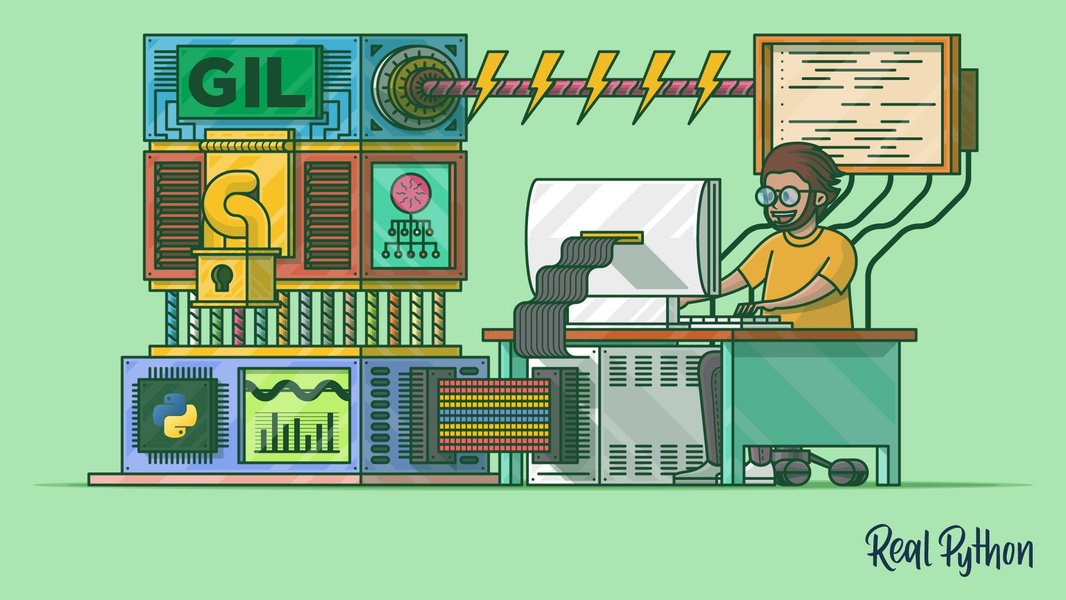
This image from Real Python illustrates how the Global Interpreter Lock works in Python. Only one thread can hold the GIL at any time, preventing true parallel execution of Python bytecode. When a thread performs I/O operations, it releases the GIL, allowing another thread to execute.
Frequently Asked Questions
References
- What Is the Python Global Interpreter Lock (GIL)? - Real Python
- What is the Python Global Interpreter Lock (GIL) - GeeksforGeeks
- Global Interpreter Lock - Wikipedia
- GlobalInterpreterLock - Python Wiki
- PEP 703 – Making the Global Interpreter Lock Optional in CPython
- Understanding Python's Global Interpreter Lock (GIL) Mechanism - Dev.to
- Why Do Python Developers Hate The GIL? - Super Fast Python
Recommended Searches
Last updated April 7, 2025