
Unveiling the Power of Onion Architecture in Python: A Practical Guide with Celery, Redis, MySQL, and Authorization
Discover how to build robust, maintainable Python applications by layering responsibilities and integrating essential modern technologies.
The Onion Architecture is a software design pattern that promotes a clear separation of concerns, enhances testability, and improves the maintainability of applications. By structuring your Python project in concentric layers, with dependencies always pointing inwards, you can build systems that are resilient to change and easier to understand. This guide will walk you through integrating Python with Celery for asynchronous tasks, Redis for caching and message brokering, MySQL for persistent storage, and robust user authorization, all within the Onion Architecture framework.
Key Highlights of This Approach
- Enhanced Maintainability & Testability: Isolating business logic from infrastructure concerns means changes in one area (e.g., database) are less likely to impact others. Core logic can be tested independently.
- Clear Dependency Management: Dependencies flow strictly inwards, preventing the core domain from being coupled to specific technologies or frameworks.
- Scalable Component Integration: Seamlessly incorporate powerful tools like Celery for background processing, Redis for high-performance caching and messaging, and MySQL for reliable data storage, all while maintaining architectural integrity.
Understanding the Onion Architecture
The Onion Architecture, similar to Hexagonal (Ports and Adapters) or Clean Architecture, organizes an application into several concentric layers. The central idea is that the inner layers define the core business logic and entities, while outer layers handle infrastructure, UI, and external service interactions. The golden rule is the Dependency Rule: source code dependencies can only point inwards. Nothing in an inner layer can know anything at all about something in an outer layer.
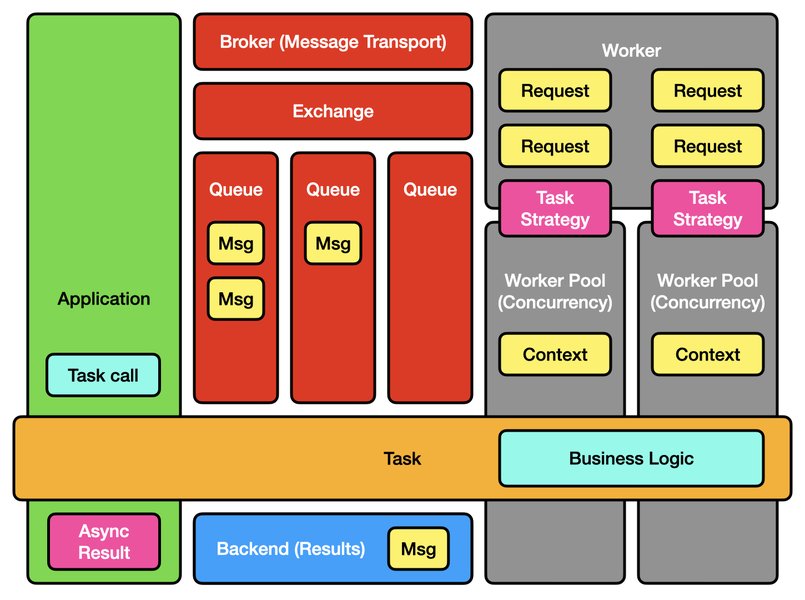
Conceptual diagram of Celery components. While this image shows Celery's architecture, imagine a similar layered approach for your entire application.
Core Layers Explained
1. Domain Layer (The Core)
This is the heart of the application. It contains:
- Domain Entities: Objects representing core business concepts (e.g.,
User,Product,Order). They encapsulate data and behavior intrinsic to the entity. - Domain Services: Business logic that doesn't naturally fit within a single entity. It orchestrates operations involving multiple entities.
- Repository Interfaces (Contracts): Abstract definitions for data access operations. The domain layer defines what data operations are needed, not how they are implemented. These interfaces ensure the domain remains independent of specific database technologies.
2. Application Layer (Use Cases)
This layer orchestrates the application's use cases. It contains:
- Application Services: Implement specific application functionalities by coordinating domain entities and domain services. They handle tasks like input validation (for application rules, not business rules), transaction management, and calling repository implementations through their interfaces.
- Data Transfer Objects (DTOs): Simple objects used to pass data between layers, particularly between the application and presentation/infrastructure layers.
3. Infrastructure Layer (External Concerns)
This is the outermost layer and handles all external concerns and technical details. It contains:
- Repository Implementations: Concrete implementations of the repository interfaces defined in the domain layer (e.g.,
MySQLUserRepositoryimplementingIUserRepository). This is where MySQL interactions happen. - Caching Mechanisms: Implementations for caching strategies, often using Redis.
- Message Queues: Integration with systems like Celery, using Redis as a broker, for handling asynchronous tasks.
- External Service Integrations: Adapters for communicating with third-party APIs.
- User Authorization Mechanisms: Implementation of user authentication and authorization checks, potentially interacting with databases or identity providers.
- Frameworks and Drivers: Web frameworks (like Flask or FastAPI), ORMs (like SQLAlchemy), database drivers, etc.
4. Presentation Layer (Interfaces)
This layer is responsible for presenting information to the user and handling user input. Examples include:
- Web APIs (REST, GraphQL endpoints built with Flask, FastAPI, Django).
- Command-Line Interfaces (CLIs).
- Graphical User Interfaces (GUIs).
Visualizing Component Roles in Onion Architecture
The following mindmap illustrates how various components like Python, Celery, Redis, MySQL, and User Authorization mechanisms are typically placed within the Onion Architecture's layers. This visualization helps in understanding the separation of concerns and dependency flow.
Python Implementation: Structure and Snippets
A typical project structure might look like this:
    my_onion_app/
    ├── domain/
    │   ├── entities.py         # e.g., User class
    │   ├── interfaces.py       # e.g., IUserRepository
    │   └── services.py         # e.g., CoreAuthRules
    ├── application/
    │   ├── use_cases.py        # e.g., RegisterUserUseCase, ProcessPaymentUseCase
    │   ├── dto.py              # Data Transfer Objects
    │   └── tasks.py            # Celery task definitions (can also be in infrastructure)
    ├── infrastructure/
    │   ├── persistence/
    │   │   └── mysql_repositories.py # MySQLUserRepository implementation
    │   ├── caching/
    │   │   └── redis_cache.py      # Redis cache implementation
    │   ├── messaging/
    │   │   └── celery_setup.py     # Celery app configuration
    │   └── auth/
    │       └── authorization_service.py # JWT handling, permission checks
    └── presentation/
        └── api/
            └── controllers.py      # Flask/FastAPI routes
Example Snippets
Domain Layer: Entity and Repository Interface
    # domain/entities.py
    from dataclasses import dataclass
    from typing import List

    @dataclass
    class User:
        id: int
        username: str
        hashed_password: str
        roles: List[str]

        def has_role(self, role_name: str) -> bool:
            return role_name in self.roles

    # domain/interfaces.py
    from abc import ABC, abstractmethod
    from typing import Optional
    from .entities import User

    class IUserRepository(ABC):
        @abstractmethod
        def get_by_username(self, username: str) -> Optional[User]:
            pass

        @abstractmethod
        def save(self, user: User) -> User:
            pass
Application Layer: Use Case and Celery Task Definition
    # application/use_cases.py
    from domain.entities import User
    from domain.interfaces import IUserRepository
    from .dto import UserRegistrationDTO
    # Assuming celery_app is initialized elsewhere (e.g., infrastructure.messaging.celery_setup)
    from infrastructure.messaging.celery_setup import celery_app # Or a more abstract task dispatcher

    class RegisterUserUseCase:
        def __init__(self, user_repository: IUserRepository):
            self.user_repository = user_repository

        def execute(self, user_dto: UserRegistrationDTO) -> User:
            # Simplified: In reality, hash password, validate, etc.
            new_user = User(
                id=0, # Or generate ID
                username=user_dto.username,
                hashed_password=f"hashed_{user_dto.password}", # HASH THIS PROPERLY!
                roles=["user"]
            )
            created_user = self.user_repository.save(new_user)

            # Trigger a background task, e.g., send welcome email
            send_welcome_email_task.delay(created_user.id)
            return created_user

    # application/tasks.py (or infrastructure/messaging/tasks.py)
    from infrastructure.messaging.celery_setup import celery_app
    # Import necessary services or repositories if tasks interact with them directly
    # For example, to fetch user details if only ID is passed

    @celery_app.task(name="tasks.send_welcome_email")
    def send_welcome_email_task(user_id: int):
        # Fetch user details using an application service or repository
        # For example: user_service.get_user_details(user_id)
        # Then send email
        print(f"Simulating sending welcome email to user ID: {user_id}")
        # Actual email sending logic here
        return f"Welcome email task processed for user {user_id}"
Note on Celery Task Context: Accessing request-specific data like request.user directly in Celery tasks is generally discouraged as tasks run out of the web request's context. It's better to pass necessary identifiers (like user_id) or relevant data to the Celery task when it's invoked. The task can then use application services or repositories to fetch any further required information.
Infrastructure Layer: MySQL Repository, Redis Cache, and Celery Setup
Below is a conceptual representation of MySQL and Redis integration. Redis is often used to cache frequently accessed data from MySQL, reducing database load and improving response times.
Redis can significantly boost MySQL performance by acting as a caching layer.
    # infrastructure/persistence/mysql_repositories.py
    from typing import Optional
    from domain.entities import User
    from domain.interfaces import IUserRepository
    # Assume you have a SQLAlchemy session or similar DB connection factory
    # from .database import SessionLocal

    class MySQLUserRepository(IUserRepository):
        def __init__(self, db_session_factory): # e.g., SQLAlchemy session factory
            self.db_session_factory = db_session_factory

        def get_by_username(self, username: str) -> Optional[User]:
            # session = self.db_session_factory()
            # user_model = session.query(UserModel).filter(UserModel.username == username).first()
            # session.close()
            # if user_model:
            #     return User(id=user_model.id, username=user_model.username, ...)
            print(f"MySQL: Fetching user by username {username}") # Placeholder
            return None # Placeholder

        def save(self, user: User) -> User:
            # session = self.db_session_factory()
            # user_model = UserModel(**vars(user)) # Adapt to your ORM model
            # session.add(user_model)
            # session.commit()
            # session.refresh(user_model)
            # user.id = user_model.id # Update user ID from DB
            # session.close()
            print(f"MySQL: Saving user {user.username}") # Placeholder
            user.id = 123 # Simulate DB generated ID
            return user # Placeholder

    # infrastructure/caching/redis_cache.py
    import redis

    class RedisCache:
        def __init__(self, host='localhost', port=6379):
            self.client = redis.Redis(host=host, port=port, decode_responses=True)

        def get(self, key: str) -> Optional[str]:
            return self.client.get(key)

        def set(self, key: str, value: str, expire_seconds: int = 3600):
            self.client.set(key, value, ex=expire_seconds)

    # infrastructure/messaging/celery_setup.py
    from celery import Celery

    # Redis is used as both the message broker and the result backend here
    celery_app = Celery(
        'my_onion_app_tasks',
        broker='redis://localhost:6379/0',
        backend='redis://localhost:6379/0',
        include=['application.tasks'] # Points to where task definitions are
    )

    celery_app.conf.update(
        task_serializer='json',
        accept_content=['json'],
        result_serializer='json',
        timezone='UTC',
        enable_utc=True,
    )
User Authorization in the Infrastructure Layer
User authorization mechanisms, such as validating JWT tokens or checking session cookies, are typically implemented in the Infrastructure layer. These mechanisms might be invoked by the Presentation layer (e.g., API middleware) or Application services.
    # infrastructure/auth/authorization_service.py
    import jwt # PyJWT library
    from datetime import datetime, timedelta
    from domain.entities import User # For context, or use simplified user representation

    SECRET_KEY = "YOUR_VERY_SECRET_KEY" # Store this securely!
    ALGORITHM = "HS256"
    ACCESS_TOKEN_EXPIRE_MINUTES = 30

    class AuthorizationService:
        def create_access_token(self, data: dict) -> str:
            to_encode = data.copy()
            expire = datetime.utcnow() + timedelta(minutes=ACCESS_TOKEN_EXPIRE_MINUTES)
            to_encode.update({"exp": expire})
            encoded_jwt = jwt.encode(to_encode, SECRET_KEY, algorithm=ALGORITHM)
            return encoded_jwt

        def verify_token(self, token: str) -> Optional[dict]: # Returns payload on success
            try:
                payload = jwt.decode(token, SECRET_KEY, algorithms=[ALGORITHM])
                return payload
            except jwt.PyJWTError:
                return None

        # This could interact with IUserRepository or a User DTO
        def get_current_user(self, token: str) -> Optional[User]: # Simplified
            payload = self.verify_token(token)
            if not payload or 'sub' not in payload: # 'sub' typically stores username or user_id
                return None
            # In a real app, fetch user from DB via repository using payload['sub']
            # For simplicity, we'll mock it
            # user = user_repository.get_by_username(payload['sub'])
            # return user
            print(f"Auth: User {payload['sub']} verified from token.")
            # This is a mock. In a real scenario, fetch full user details.
            return User(id=1, username=payload['sub'], hashed_password="", roles=payload.get("roles", []))
Component Interaction Analysis
This radar chart provides an opinionated analysis of how different components (Celery, Redis, MySQL, User Authorization Module) contribute to or are characterized by various architectural aspects within the Onion Architecture framework. For instance, Celery greatly enhances scalability, while a robust User Authorization module is critical for security.
This chart helps visualize the strengths and considerations for each major component. For example, Redis significantly boosts performance and scalability, while the User Authorization module is paramount for security but can add complexity.
Integrating Technologies: A Summary Table
The following table summarizes how each technology (Python, Celery, Redis, MySQL, User Authorization) fits into the different layers of the Onion Architecture.
| Layer | Python (Language) | MySQL (Database) | Redis (Cache/Broker) | Celery (Task Queue) | User Authorization |
|---|---|---|---|---|---|
| Domain Layer | Core entities, business logic, interfaces defined as Python classes and abstract methods. | N/A (Defines interfaces for data access, not implementation). | N/A (Defines interfaces for caching if needed, not implementation). | N/A (Defines interfaces for task dispatching if abstracting, not implementation). | Core business rules related to authorization (e.g., what roles can perform what actions conceptually). |
| Application Layer | Application services, use cases, DTOs implemented in Python. Orchestrates domain logic. | Interacts via Repository Interfaces defined in Domain Layer. | Interacts via Cache Interfaces (if defined) or directly with abstract task dispatchers. | Defines and triggers Celery tasks (or interacts with an abstraction for task dispatching). Tasks themselves may call application services. | Orchestrates authorization checks, applies application-specific authorization rules. May use DTOs for user/role information. |
| Infrastructure Layer | Python used for implementing adapters, repositories, specific framework glue code. | Concrete repository implementations (e.g., using SQLAlchemy with Python) interacting with the MySQL server. | Concrete cache implementations (Python Redis client). Celery broker/backend configuration using Redis. | Celery worker implementation, Celery app configuration. Tasks are executed here. | Concrete implementation of authorization (e.g., JWT validation using Python libraries, session management, database lookups for permissions). |
| Presentation Layer | Python web frameworks (Flask, FastAPI, Django) handle HTTP requests and responses. | N/A (Indirectly through Application Layer). | N/A (Indirectly through Application Layer). | N/A (Indirectly through Application Layer). | Receives credentials, passes tokens. May have decorators or middleware to invoke authorization services from Infrastructure. |
Visualizing Onion Architecture in Action
To better understand the foundational concepts of Onion Architecture (which shares principles with Clean Architecture and Hexagonal Architecture), the following video provides a concise overview. It explains how these architectural patterns help in building maintainable and testable software by emphasizing the separation of concerns and dependency inversion.
"Onion Architecture - Software Design Patterns Explained" provides a great introduction to the core ideas.
Frequently Asked Questions (FAQ)
What are the main benefits of using Onion Architecture? ▼
The primary benefits include:
- Improved Maintainability: Changes in external elements like databases or UI frameworks have minimal impact on the core business logic.
- Enhanced Testability: The core domain logic can be tested in isolation without external dependencies, leading to more reliable unit tests.
- Flexibility: Easier to swap out infrastructure components (e.g., changing database provider, messaging queue) because the core application depends on abstractions, not concrete implementations.
- Clear Separation of Concerns: Each layer has a distinct responsibility, making the codebase easier to understand and manage.
How does User Authorization fit into Onion Architecture? ▼
User authorization can be multi-faceted:
- Domain Layer: May define core authorization rules or concepts (e.g., "a User entity has Roles," "an Admin role can perform X").
- Application Layer: Orchestrates authorization checks for specific use cases, often by invoking services from the Infrastructure layer. It might decide, based on domain rules and user context, whether an action is permitted.
- Infrastructure Layer: Implements the actual mechanisms for checking authorization (e.g., validating JWT tokens, querying a database for user roles and permissions, interacting with an OAuth provider). It provides these capabilities to the Application Layer through interfaces if needed.
- Presentation Layer: Often the entry point for authentication (collecting credentials) and can apply coarse-grained authorization (e.g., route guards checking if a user is logged in or has a basic role) by calling services from lower layers.
Where should Celery tasks be defined and how are they triggered? ▼
Celery task definitions can reside either in the Application Layer (if they are closely tied to use cases) or the Infrastructure Layer (as part of the messaging setup). A common practice is to define tasks in a dedicated `tasks.py` module within the application package.
Tasks are typically triggered from the Application Layer (e.g., within an application service after a primary operation completes) using Celery's `delay()` or `send_task()` methods. The application service would decide when to trigger a task, but the task itself is executed by a Celery worker, which is an Infrastructure concern.
Redis is commonly used as the message broker and result backend for Celery, configured in the Infrastructure Layer.
How does Python's dynamic typing affect Onion Architecture implementation? ▼
Python's dynamic typing offers flexibility but requires discipline to maintain clear architectural boundaries.
- Interfaces: While Python doesn't have explicit interfaces like Java or C#, Abstract Base Classes (ABCs) from the `abc` module are commonly used to define contracts that concrete implementations in the Infrastructure layer must adhere to. This enforces the Dependency Inversion Principle.
- Type Hinting: Using Python's type hints (as shown in the examples) significantly improves code clarity and helps static analysis tools catch type errors, making it easier to understand data flow between layers and enforce contracts.
- Dependency Injection: Explicitly injecting dependencies (e.g., passing a repository implementation to an application service's constructor) is crucial for decoupling layers, regardless of static or dynamic typing.
Careful design and conventions are key to leveraging Python's flexibility without compromising architectural integrity.
Recommended Further Exploration
- Explore how Domain-Driven Design (DDD) principles can complement Onion Architecture in Python for complex business domains.
- Investigate advanced Celery patterns, such as task chaining, error handling, and monitoring for large-scale applications.
- Learn more about comprehensive security strategies, including OAuth2, role-based access control (RBAC), and attribute-based access control (ABAC) in Python.
- Analyze various caching patterns (e.g., read-through, write-through, cache-aside) using Redis to optimize performance in a layered architecture.
References
Last updated May 8, 2025