
Optimizing Dynamic Data Caching with Redis Lists in Python
Strategies for Efficiently Managing Frequently Updated Lists in Redis
Key Insights for Dynamic Redis List Management
- Redis Lists are Ideal for Append/Prepend Operations: Redis lists are optimized for adding and removing elements from their head (left) or tail (right) using commands like
LPUSH,RPUSH,LPOP, andRPOP. This makes them highly efficient for scenarios acting as queues or stacks. - Direct Element Updates are Less Efficient: While Redis offers the
LSETcommand to update an element by its index, it has a time complexity of O(N) for elements not at the head or tail. For frequent mid-list updates, alternative data structures or strategies might be more suitable. - Serialization is Key for Complex Python Objects: To store Python objects or nested data structures in Redis lists, you must serialize them (e.g., using JSON or Pickle) before storage and deserialize upon retrieval. The
redis-pyclient is the go-to library for Python interactions.
Caching frequently updated lists in Redis presents a common challenge in application development. While Redis is renowned for its speed and in-memory data storage, the suitability of its list data type for highly dynamic content depends on the specific update patterns. This comprehensive guide will explore how to effectively cache and update lists in Redis, particularly when dealing with frequent modifications, leveraging Python for practical implementation.
Understanding Redis Lists: Strengths and Limitations
Redis lists are essentially linked lists of string values, ordered by insertion. They are highly efficient for operations that involve adding or removing elements from either end, making them perfect for implementing queues, stacks, or simple timelines. However, their linked-list nature implies certain performance characteristics for updates.
The Structure and Core Operations of Redis Lists
Redis lists store an ordered collection of strings. Unlike arrays, they are not limited to a fixed size and can expand or shrink dynamically. The core commands for manipulating Redis lists are:
LPUSH [key] [element...]: Adds one or more elements to the left (head) of the list.RPUSH [key] [element...]: Adds one or more elements to the right (tail) of the list.LPOP [key]: Removes and returns the first element from the left (head) of the list.RPOP [key]: Removes and returns the last element from the right (tail) of the list.LRANGE [key] [start] [stop]: Returns a range of elements from the list.LREM [key] [count] [value]: Removes the firstcountoccurrences of elements equal tovaluefrom the list.LINDEX [key] [index]: Returns the element at the specified index.LLEN [key]: Returns the length of the list.
These commands offer O(1) time complexity for operations at the head or tail, making them incredibly fast. However, operations requiring traversal through the list, such as LSET (update by index) or LINSERT (insert before/after a specific value), have an O(N) time complexity, where N is the length of the list. This is a critical consideration for frequently updated lists.
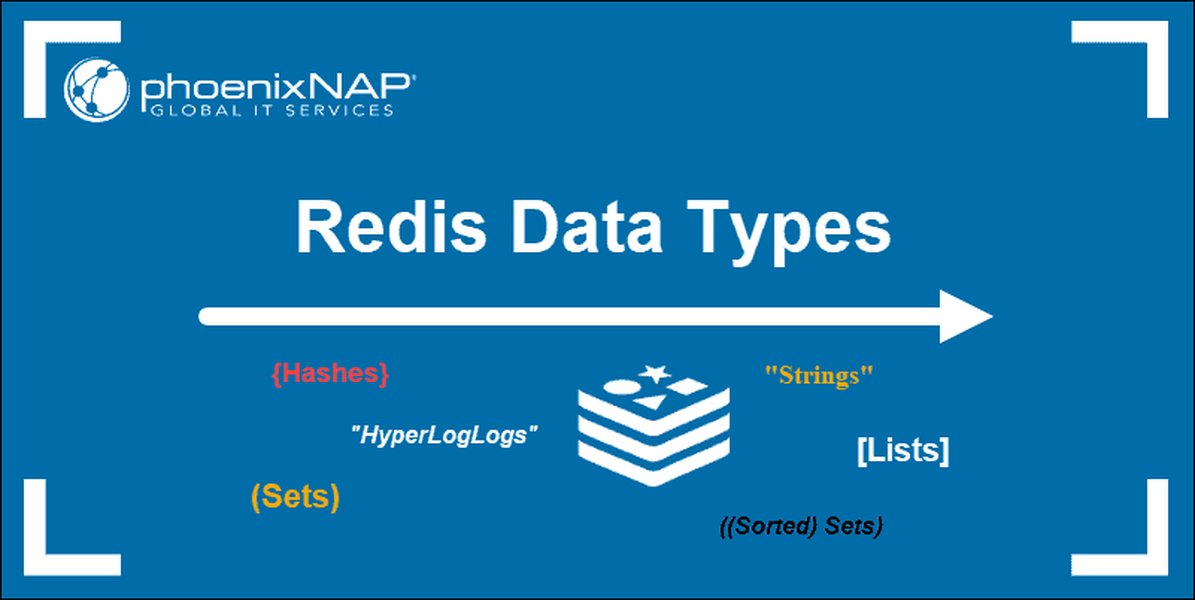
An illustrative diagram showcasing various Redis data types, including lists, which are central to managing ordered collections.
When Redis Lists Excel for Dynamic Data
Redis lists are an excellent choice for caching dynamic data in scenarios where:
- Activity Feeds/Timelines: Storing the most recent 500 feeds for a user, where new feeds are pushed to the head (
LPUSH) and old ones are trimmed (LTRIM). Deletion of a specific feed, if required, might necessitate retrieving the list, modifying it in application memory, and then overwriting the Redis list or usingLREM. - Task Queues: Implementing producer-consumer patterns where tasks are pushed to one end (e.g.,
RPUSH) and workers pop them from the other (e.g.,LPOPor blockingBLPOP). - Message Logs: Storing ordered log entries where new entries are always appended.
The atomic nature of Redis list operations ensures data integrity even with multiple clients simultaneously interacting with the same list.
Strategies for Updating Redis List Items Frequently
Given the O(N) complexity for mid-list updates, direct modifications to elements within a large Redis list should be minimized if performance is critical. Here are several strategies to handle frequently updated list data:
1. Updating by Index (LSET)
The LSET command allows you to set the value of an element at a specific index. This is viable if you know the exact index of the item you wish to update.
        import redis

        r = redis.Redis(decode_responses=True)
        list_key = "my_dynamic_list"

        # Initialize the list
        r.rpush(list_key, "item1", "item2", "item3", "item4")
        print(f"Initial list: {r.lrange(list_key, 0, -1)}")

        # Update an item by index
        index_to_update = 1
        new_value = "updated_item2"
        r.lset(list_key, index_to_update, new_value)
        print(f"List after update at index {index_to_update}: {r.lrange(list_key, 0, -1)}")

        # Attempt to update an out-of-bounds index will raise an error
        try:
            r.lset(list_key, 10, "non_existent_item")
        except redis.ResponseError as e:
            print(f"Error updating out-of-bounds index: {e}")
While straightforward, if your update logic requires finding an item first (e.g., by its value) to determine its index, this can involve an LINDEX or LRANGE operation (O(N)), followed by an LSET (another O(N)), making the overall operation O(N) for arbitrary mid-list updates.
2. Read, Modify, and Overwrite
For more complex updates, especially those involving multiple elements or conditional logic, a common pattern is to retrieve the entire list, modify it in your application's memory, and then overwrite the old list in Redis. This approach ensures atomicity if wrapped within a Redis transaction (MULTI/EXEC) or Lua script.
        import redis
        import json

        r = redis.Redis(decode_responses=True)
        list_key = "complex_data_list"

        # Example: List of dictionaries
        data = [
            {"id": 1, "name": "Apple", "price": 1.0},
            {"id": 2, "name": "Banana", "price": 0.5},
            {"id": 3, "name": "Cherry", "price": 2.0}
        ]

        # Store serialized data
        r.delete(list_key) # Clear existing list
        for item in data:
            r.rpush(list_key, json.dumps(item))
        print(f"Initial list: {[json.loads(s) for s in r.lrange(list_key, 0, -1)]}")

        # Update an item's price
        item_id_to_update = 2
        new_price = 0.75

        # Retrieve, modify, and overwrite (in a transaction)
        with r.pipeline() as pipe:
            pipe.watch(list_key) # Watch the key for changes
            current_list_raw = pipe.lrange(list_key, 0, -1)
            current_list_parsed = [json.loads(s) for s in current_list_raw]

            found_and_updated = False
            for item in current_list_parsed:
                if item.get("id") == item_id_to_update:
                    item["price"] = new_price
                    found_and_updated = True
                    break

            if found_and_updated:
                pipe.multi() # Start transaction
                pipe.delete(list_key) # Delete old list
                for item in current_list_parsed:
                    pipe.rpush(list_key, json.dumps(item))
                pipe.execute()
                print(f"List after modifying item {item_id_to_update}: {[json.loads(s) for s in r.lrange(list_key, 0, -1)]}")
            else:
                pipe.unwatch()
                print(f"Item with ID {item_id_to_update} not found.")
This approach can be effective for moderate list sizes but might become inefficient for very large lists due to network overhead and memory consumption on the application side. The WATCH command within a pipeline helps ensure atomicity by detecting if the list was modified by another client during the read-modify cycle.
3. Using Hashes or Sorted Sets for Item Management
If frequent updates to specific elements within a conceptual "list" are common, Redis's other data structures might be more appropriate. Hashes and Sorted Sets offer O(1) or O(log N) complexity for item updates, respectively.
- Hashes: If each item in your list has a unique identifier, you could store your list as a Redis Hash. Each field in the hash would be the item's ID, and the value would be the item itself (serialized). Updating an item is then an
HSEToperation, which is O(1). However, maintaining order would require a separate mechanism (e.g., another Redis List of IDs). - Sorted Sets: For lists where items need to be ordered by a specific score (e.g., timestamp, priority), a Sorted Set is an excellent alternative. Updating an item's score or value is an
ZADDoperation, which is O(log N).
Consider the trade-offs: while Hashes and Sorted Sets offer faster individual item updates, they introduce complexity if you still need to preserve insertion order or retrieve ranges of items in the exact sequence they were added without relying on the score.
Implementing Redis Caching with Python (redis-py)
The redis-py library is the official Python client for Redis and provides a robust interface for interacting with Redis data structures, including lists. To get started, ensure you have it installed:
pip install redis
Connecting to Redis and Basic List Operations
Here's a basic example of connecting to Redis and performing common list operations using redis-py:
        import redis

        # Connect to Redis (default is localhost:6379, db=0)
        # decode_responses=True ensures responses are decoded as strings instead of bytes
        r = redis.Redis(host='localhost', port=6379, db=0, decode_responses=True)

        list_key = "my_python_list"

        # Clear the list for a clean start
        r.delete(list_key)

        # Add elements to the right (tail)
        r.rpush(list_key, "element_A", "element_B", "element_C")
        print(f"List after RPUSH: {r.lrange(list_key, 0, -1)}")

        # Add elements to the left (head)
        r.lpush(list_key, "element_Z", "element_Y")
        print(f"List after LPUSH: {r.lrange(list_key, 0, -1)}")

        # Get elements by range (0 to -1 means all elements)
        all_elements = r.lrange(list_key, 0, -1)
        print(f"All elements: {all_elements}")

        # Get element at a specific index
        third_element = r.lindex(list_key, 2)
        print(f"Third element (index 2): {third_element}")

        # Remove elements from the left (head)
        popped_left = r.lpop(list_key)
        print(f"Popped from left: {popped_left}, List now: {r.lrange(list_key, 0, -1)}")

        # Remove elements from the right (tail)
        popped_right = r.rpop(list_key)
        print(f"Popped from right: {popped_right}, List now: {r.lrange(list_key, 0, -1)}")

        # Get list length
        list_length = r.llen(list_key)
        print(f"List length: {list_length}")
Handling Complex Data Types (Serialization)
Redis lists store string values. If you need to cache more complex Python objects (e.g., dictionaries, custom classes), you must serialize them into a string format before storing and deserialize them upon retrieval. Common serialization methods include JSON or Pickle.
        import redis
        import json
        import pickle

        r = redis.Redis(decode_responses=True) # decode_responses=True only for string responses

        # Using JSON for dictionaries
        json_list_key = "json_data_list"
        data_to_store = [{"id": 1, "name": "Alice"}, {"id": 2, "name": "Bob"}]

        r.delete(json_list_key)
        for item in data_to_store:
            r.rpush(json_list_key, json.dumps(item)) # Store as JSON string

        retrieved_json_data = [json.loads(s) for s in r.lrange(json_list_key, 0, -1)]
        print(f"JSON list (retrieved): {retrieved_json_data}")

        # Using Pickle for more complex Python objects (e.g., classes)
        class User:
            def __init__(self, uid, username):
                self.uid = uid
                self.username = username

            def __repr__(self):
                return f"User(uid={self.uid}, username='{self.username}')"

        pickle_list_key = "pickle_data_list"
        user_objects = [User(101, "charlie"), User(102, "diana")]

        r_bytes = redis.Redis(decode_responses=False) # Important: Pickle returns bytes
        r_bytes.delete(pickle_list_key)
        for obj in user_objects:
            r_bytes.rpush(pickle_list_key, pickle.dumps(obj)) # Store as bytes

        retrieved_pickle_data_raw = r_bytes.lrange(pickle_list_key, 0, -1)
        retrieved_pickle_data = [pickle.loads(b) for b in retrieved_pickle_data_raw]
        print(f"Pickle list (retrieved): {retrieved_pickle_data}")
JSON is generally preferred for interoperability and readability, while Pickle is suitable for Python-specific objects that might not have a direct JSON representation.
Considerations for Frequent Updates and Cache Invalidation
When dealing with frequently updated data, careful consideration of cache invalidation and consistency is crucial. If your Redis list is a cache for a primary data store, you need a strategy to ensure the cache reflects the latest data.
Cache Invalidation Strategies
For dynamic data, the common cache invalidation strategies include:
- Write-Through/Write-Back: Update the primary data store and then immediately update Redis (write-through) or defer the Redis update (write-back). For lists, this might involve re-fetching and repopulating the list in Redis after a change in the source.
- Time-to-Live (TTL): Set an expiration time on the Redis key. While not ideal for immediate consistency for frequently updated items, it ensures stale data eventually expires. Redis lists themselves don't have per-element TTLs, but the entire list key can expire using
EXPIREorSETEX. - Pub/Sub or Keyspace Notifications: Redis Keyspace Notifications allow clients to subscribe to events happening on the Redis data set (e.g., a key being modified or deleted). This can trigger an application to update its cache. For more direct application-level messaging, Redis Pub/Sub can be used to broadcast updates that signal clients to refresh specific cached data.
Ensuring Data Consistency
Concurrent updates from multiple clients can lead to race conditions and inconsistent data in Redis lists. To mitigate this:
- Transactions (
MULTI/EXEC): Group multiple Redis commands into a single atomic operation. This ensures that either all commands in the transaction are executed, or none are. - Lua Scripting: For complex atomic operations, Lua scripting allows you to execute a script directly on the Redis server, guaranteeing atomicity and minimizing network round-trips. This is particularly powerful for read-modify-write patterns.
- Distributed Locks: Implement a distributed lock using Redis (e.g., with Redlock) to ensure only one client can modify a specific list at a time. This adds overhead but ensures strong consistency.
Performance Considerations and Optimization
When managing frequently updated lists in Redis, performance is paramount. Here's a radar chart illustrating various performance characteristics relevant to Redis list operations for dynamic data, along with a table comparing different update methods.
The radar chart above visualizes the performance characteristics of different Redis list operations in the context of frequently updated data. Efficiency at Ends refers to LPUSH/RPUSH/LPOP/RPOP operations. Mid-List Update Efficiency considers LSET and LREM. Concurrency Handling rates how well the operation naturally supports multiple clients. Memory Usage reflects the impact on Redis memory, while Atomic Guarantees indicates built-in atomicity.
Comparison of Update Methodologies for Redis Lists
The following table summarizes the characteristics and best use cases for different methods of handling updates to list-like data in Redis:
| Update Methodology | Redis Data Type | Time Complexity for Update | Best Use Case | Considerations for Frequent Updates |
|---|---|---|---|---|
| Append/Prepend (LPUSH/RPUSH) | List | O(1) | Queues, Stacks, Activity Feeds (new items at ends) | Highly efficient for additions/removals at ends; not for mid-list updates. |
| Direct Index Update (LSET) | List | O(N) (N is list length) | Rare, precise updates where index is known. | Inefficient for large lists or frequent mid-list changes. |
| Read-Modify-Overwrite (Application Logic) | List | O(N) (for LRANGE + RPUSH/LPUSH) | Complex, conditional updates; small to moderate lists. | High network overhead for large lists; requires transactional control for atomicity. |
| Using Hashes for Items | Hash + List (for order) | O(1) (for HSET) | Managing distinct items with unique IDs. | Requires separate Redis List to maintain order; fetching ordered list involves two Redis calls. |
| Using Sorted Sets for Items | Sorted Set | O(log N) (for ZADD/ZREM) | Ordered lists where items have a sortable score (e.g., timestamp, priority). | Excellent for ordered updates and range queries; score must be meaningful for ordering. |
Real-World Applications and Best Practices
Queues and Rate Limiting
Redis lists are frequently employed for building robust message queues and implementing rate limiters. For example, a list can store a series of requests or events, with producers using LPUSH to add to the queue and consumers using RPOP or BRPOP (blocking pop) to process them. This pattern is highly effective for distributing tasks to background workers.
An in-depth video demonstrating how to implement queues using Redis with Python.
Session Management and User Activity
For managing user sessions or recent activity lists (e.g., "last 500 viewed items"), Redis lists are very effective. New activities can be prepended, and the list can be trimmed using LTRIM to maintain a fixed size. While deleting an item from the middle of a user's activity list might be complex with Redis lists directly, the trade-off for fast appends and reads at the ends is often acceptable.
General Caching Principles
Regardless of the data structure, best practices for Redis caching include:
- Choosing the Right Data: Cache data that is frequently read, expensive to compute, or rarely changes. For frequently updated lists, focus on patterns that align with Redis list strengths (appends/prepends).
- Setting Expiration Policies: Use
EXPIREto automatically remove stale data and manage memory. - Monitoring Performance: Regularly monitor Redis performance metrics to identify bottlenecks and optimize usage.
- Regular Updates: Keep your Redis server updated to patch security vulnerabilities and benefit from performance improvements.
Frequently Asked Questions
What is the difference between LPUSH and RPUSH?
LPUSH adds elements to the left (head) of the list, while RPUSH adds elements to the right (tail) of the list. They are both O(1) operations.Can I update an element in the middle of a Redis list efficiently?
LSET is an O(N) operation, meaning its performance degrades linearly with the size of the list. For frequent mid-list updates, consider alternative Redis data structures like Hashes or Sorted Sets.How do I store Python dictionaries or objects in a Redis list?
json.dumps() or Pickle via pickle.dumps()) before pushing them to the list. When retrieving, deserialize them using json.loads() or pickle.loads().Is Redis suitable for caching data that updates very frequently?
Conclusion
Caching lists and updating their items frequently in Redis is a common pattern for enhancing application performance and scalability. While Redis Lists are exceptionally fast for operations at their ends (pushes and pops), direct mid-list updates can be less efficient due to their linked-list implementation. For scenarios demanding frequent arbitrary element updates, exploring Redis Hashes or Sorted Sets might offer better performance characteristics. Regardless of the chosen approach, proper serialization for complex data types, careful consideration of consistency through transactions or Lua scripting, and robust cache invalidation strategies are essential for a successful and performant Redis caching implementation.
Recommended Further Exploration
- Explore other Redis data structures and their caching applications.
- Learn how to implement Redis transactions for atomic operations in Python.
- Discover how Redis Pub/Sub can be used for real-time cache invalidation.
- Dive into best practices for optimizing Redis performance in production environments.