
Beyond qsort: Unlocking Superior Sorting Speed in Linux Environments
An In-Depth Comparison of qsort, fluxsort, and quadsort, and the Realities of Upgrading System Sort Utilities.
Highlights: Key Insights
- Performance Leap: Modern algorithms like
fluxsortandquadsortsignificantly outperform the standard C library'sqsortin speed, stability, and adaptivity, especially on contemporary hardware. - Drop-in Potential (in Code): Both
fluxsortandquadsortare designed with aqsort-compatible interface, making them strong candidates for upgrading in-memory sorting within C/C++ applications. - System
sortis Different: Replacing the Linux command-linesortutility is a complex endeavor, as it's a feature-rich tool for file-based sorting, not just an in-memory algorithm. Library functions likefluxsortcannot directly substitute it without substantial development.
Unveiling the Contenders: qsort, fluxsort, and quadsort
When it comes to sorting data in C-based environments, developers have traditionally relied on the standard library's qsort function. However, the landscape of sorting algorithms is ever-evolving, with newer contenders like fluxsort and quadsort emerging, promising substantial improvements. Let's delve into each of these.
qsort: The Standard Bearer
qsort is the de facto sorting function provided by the C standard library. Its specific implementation can vary; for instance, GLIBC (commonly used on Linux) often employs a mergesort variant. While widely available and familiar, qsort has several characteristics to note:
- Algorithm: Typically a Quicksort variant, but some implementations (like GLIBC's) use Mergesort.
- Stability: The stability of
qsort(whether elements with equal values maintain their relative order) is implementation-dependent and it's often unstable. - Performance: Generally,
qsortis considered a baseline. It can be slower than more modern, specialized algorithms, especially for large datasets or on CPUs with advanced architectural features. Its reliance on function pointers for comparisons can also introduce overhead. - Adaptivity: Traditional
qsortimplementations may not be highly adaptive to pre-existing order in the data.
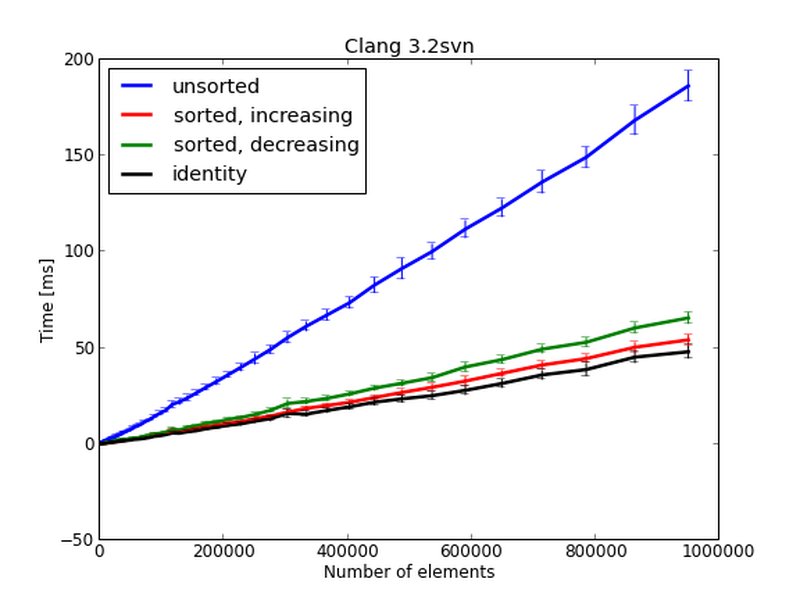
A benchmark illustrating qsort performance, often used as a baseline for comparison.
fluxsort: The Hybrid Speedster
Developed by "scandum," fluxsort is a high-performance sorting algorithm designed to be a superior alternative to qsort. It offers a compelling blend of features:
- Algorithm: A sophisticated hybrid, combining elements of Quicksort and Mergesort. It is notably "branchless" in critical sections, meaning it avoids conditional branches that can slow down modern CPUs.
- Stability:
fluxsortis a stable sorting algorithm. - Performance: Benchmarks consistently show
fluxsortto be significantly faster than typicalqsortimplementations, sometimes by a factor of 2x or more, especially on random data. It employs techniques like stable partitioning and optimized pivoting. It may require an auxiliary buffer (out-of-place partitioning). - Adaptivity: It's highly adaptive, meaning its performance can improve if the data is already partially sorted. It uses top-down analysis to detect patterns.
- Interface: Crucially,
fluxsortoffers the same function signature asqsort, making it a potential "drop-in" replacement in C code.
quadsort: The Adaptive Merger
Also from "scandum," quadsort is another advanced sorting algorithm, focusing on the strengths of Mergesort with modern optimizations:
- Algorithm: A branchless, stable, and adaptive Mergesort. It's designed for high performance across various data distributions.
- Stability:
quadsortis a stable sorting algorithm. - Performance: It often rivals or even surpasses
fluxsortin certain scenarios, particularly with partially sorted data or when sorting small arrays and primitive types. It uses techniques like "quad merging." Likefluxsort, it's significantly faster than standardqsort. - Adaptivity: Highly adaptive, utilizing bottom-up run detection to efficiently handle real-world data patterns.
- Interface: Similar to
fluxsort,quadsorttypically provides aqsort-compatible interface.
Head-to-Head: Performance and Characteristics
Comparing these algorithms reveals distinct advantages for fluxsort and quadsort over the traditional qsort, especially in demanding applications. Their design philosophies focus on leveraging modern CPU architectures and handling diverse data patterns efficiently.
Speed and Efficiency
Benchmarks consistently demonstrate that both fluxsort and quadsort outperform qsort by a significant margin, often being 2 to 2.5 times faster on random data. Their branchless design minimizes CPU pipeline stalls, and their adaptive nature allows them to capitalize on any existing order in the data, reducing unnecessary comparisons and operations.
- Random Data: Both
fluxsortandquadsortexcel here due to efficient partitioning/merging strategies and branch prediction friendliness. - Ordered/Patterned Data: Their adaptivity shines; for instance,
fluxsortcan analyze data upfront to detect sorted runs, whilequadsort's Mergesort foundation is naturally efficient with pre-sorted sequences.
Stability and Adaptivity
Stability is a key differentiator. While qsort's stability is implementation-dependent (and often it's unstable), both fluxsort and quadsort are explicitly designed to be stable. This is crucial for applications where maintaining the relative order of equal elements is important (e.g., sorting a list of people by city, then by name, preserving the city sort). Their adaptive mechanisms further enhance performance on "real-world" data, which is rarely perfectly random.
Memory Usage and Implementation
qsort is often an in-place sort (for Quicksort variants), though Mergesort versions will require extra space. fluxsort uses an out-of-place partitioning strategy, which generally requires a temporary buffer roughly the size of the array being sorted. quadsort, being a Mergesort variant, also typically involves temporary space for merging, but is optimized for cache efficiency. The performance gains from these modern algorithms often justify the additional memory, especially when RAM is plentiful.
The following table summarizes the key characteristics of these sorting algorithms:
| Feature | qsort (Typical) | fluxsort | quadsort |
|---|---|---|---|
| Algorithm Type | Quicksort/Mergesort (varies) | Branchless Quicksort/Mergesort Hybrid | Branchless Adaptive Mergesort |
| Stability | Implementation-dependent (often Unstable) | Stable | Stable |
| Adaptivity | Low to Moderate | High (Top-down analysis) | High (Bottom-up run detection) |
| Relative Speed (General) | Baseline | Very Fast (often 2-2.5x qsort) | Very Fast (often 2-2.5x qsort, excels on some patterns) |
| Branchlessness | No (typically) | Yes (in critical paths) | Yes (in critical paths) |
| Primary Use Case | General-purpose in-memory sorting (C standard library) | High-performance, stable in-memory sorting; qsort replacement |
High-performance, stable in-memory sorting; strong with patterns; qsort replacement |
| Interface (C) | Standard qsort signature |
qsort-compatible signature |
qsort-compatible signature |
| Auxiliary Memory | Varies (can be O(log n) or O(n)) | O(n) for buffer | O(n) for merging |
To visualize their comparative strengths, consider the following radar chart. It subjectively rates the algorithms on key attributes, with higher values indicating better performance or more desirable characteristics on a scale of 1 to 10 (where 1 is low/poor and 10 is high/excellent).
Note: The radar chart represents a qualitative assessment based on available information. Actual performance can vary based on specific data, hardware, and compiler optimizations.
The Quest to Upgrade Linux sort: Feasibility and Alternatives
A common question is whether these high-performance in-memory sorting algorithms like fluxsort or quadsort can replace the standard Linux sort command-line utility. The answer is nuanced.
Understanding the Linux sort Command
The Linux sort command (typically part of GNU coreutils) is a powerful and versatile utility designed for sorting lines of text from files or standard input. Its capabilities extend far beyond simple in-memory array sorting:
- File-Based Operations: It primarily operates on files, capable of handling datasets much larger than system RAM (external sorting).
- Text Processing: It's built for text, with options for defining sort keys based on fields, character positions, and delimiters.
- Rich Feature Set: It supports numeric sorting, month sorting, human-readable number sorting, reverse order, unique line output, case-insensitive sorting, locale-specific collation, and parallel execution.
In essence, qsort, fluxsort, and quadsort are library functions intended for programmers to sort data structures *within their programs*. The Linux sort command is a *standalone application* that uses its own optimized sorting logic tailored for its specific tasks.
Can Library Functions Replace a System Utility?
Directly replacing the system's sort executable with a simple wrapper around fluxsort or quadsort is not feasible if one expects to retain the full functionality and robustness of the original utility. The library functions operate on contiguous memory blocks (arrays) and require data to be loaded into RAM. They don't inherently understand file I/O, text parsing, or the myriad options the sort command provides.
Integrating Advanced Sorts: Practical Approaches
While a direct swap is impractical, there are ways to leverage the speed of fluxsort or quadsort:
Option 1: Replacing qsort in Your C/C++ Programs
This is the most direct and intended use case. If you have C or C++ code that uses the standard qsort() for performance-critical in-memory sorting, you can often replace it with fluxsort() or quadsort() for a significant speed boost. Since they typically share the same interface, this can be a relatively straightforward code change.
For example, to use fluxsort in a C program:
// Make sure fluxsort.h is in your include path and fluxsort.c is compiled and linked
// #include "fluxsort.h"

// Assuming fluxsort is declared elsewhere or you link its object file
// For demonstration, here's a typical qsort-compatible function prototype:
void fluxsort_placeholder(void *array, size_t nmemb, size_t size, int (*compar)(const void *, const void *));
// In a real scenario, you'd use the actual fluxsort function.

int compare_integers(const void *a, const void *b) {
    int int_a = *((const int*)a);
    int int_b = *((const int*)b);
    if (int_a < int_b) return -1;
    if (int_a > int_b) return 1;
    return 0;
}

int main() {
    int data[] = {5, 1, 4, 2, 8, 0, 3, 7, 9, 6};
    size_t num_elements = sizeof(data) / sizeof(data[0]);

    // Original qsort call:
    // qsort(data, num_elements, sizeof(int), compare_integers);

    // Using fluxsort (or quadsort with its respective function name):
    // fluxsort_placeholder(data, num_elements, sizeof(int), compare_integers);
    // Replace fluxsort_placeholder with the actual fluxsort function name from its library.
    // For instance, if the library provides <code>flux_sort, use that.
    // Ensure you have obtained and compiled fluxsort.c and link it with your program.
    // Example compilation: gcc your_program.c fluxsort.c -o your_program -O3

    // ... print sorted data ...
    return 0;
}
Note: The code snippet above is illustrative. You would need to obtain the fluxsort (or quadsort) source code, compile it, and link it with your application.
Option 2: Building a Custom Sorting Tool
One could develop a new command-line utility that uses fluxsort or quadsort as its core sorting engine. This custom tool would need to:
- Implement its own logic for reading data from files or standard input.
- Parse lines of text and prepare them for in-memory sorting.
- Handle memory management, especially for larger inputs (though it might not match
sort's external sorting). - Implement any desired command-line options (e.g., for key definitions, numeric sort).
- Write the sorted data to output.
sort command.
Option 3: Modifying coreutils (Expert Level)
A highly advanced and generally discouraged approach for most users would be to modify the source code of GNU coreutils itself, attempting to integrate fluxsort or quadsort into its sort utility. This requires deep knowledge of C programming, the coreutils codebase, and Linux system internals, and carries risks of system instability if not done correctly. It would also make system updates more complex.
The following mindmap illustrates the relationships and potential integration paths:
This mindmap helps to clarify that while in-memory sorting libraries are powerful components, the system sort utility serves a broader, more complex role.
Choosing Your Champion: Which Algorithm for Which Task?
When deciding which algorithm to use, consider the context:
- For replacing
qsortin existing C/C++ code for better in-memory performance:fluxsortis often an excellent general-purpose choice due to its hybrid nature, high speed on random data, stability, and adaptivity.quadsortcan be preferable if your data often has significant pre-existing order, or if you specifically favor a Mergesort-based approach. Its performance on small arrays is also notable.- Benchmarking with your specific data patterns and hardware is always the best way to make a definitive choice between
fluxsortandquadsort. Both are substantial upgrades over typicalqsortimplementations.
- For general-purpose file sorting on the command line:
- The standard Linux
sortcommand remains the most practical and robust tool for most users. It is highly optimized for its tasks, feature-rich, and handles large files gracefully. Consider exploring its options like--parallel=Nfor potential speedups on multi-core systems or-Sto control memory usage.
- The standard Linux
To gain a more fundamental understanding of sorting algorithm concepts like Quicksort (a basis for fluxsort) and Mergesort (a basis for quadsort), the following video provides a helpful overview:
This video offers insights into different levels of sorting algorithms, including concepts relevant to Quicksort.
Frequently Asked Questions (FAQ)
What makes fluxsort and quadsort generally faster than qsort?
fluxsort and quadsort are faster due to several modern design principles:
- Branchless Operations: They minimize conditional branches in performance-critical code sections. Modern CPUs can execute straight-line code much faster than code with frequent branches, which can cause pipeline flushes.
- Adaptivity: They intelligently adapt to existing order in the data (e.g., partially sorted arrays, runs of identical values), reducing unnecessary work.
- Cache Efficiency: Their memory access patterns are often designed to make better use of CPU caches.
- Specialized Techniques: They employ advanced algorithmic techniques like stable partitioning (fluxsort) or quad-merging (quadsort) that are highly optimized.
- In contrast, traditional
qsortimplementations might not be as optimized for these aspects of modern hardware.
Are fluxsort and quadsort always stable?
Yes, both fluxsort and quadsort are designed and advertised as stable sorting algorithms. This means that if two elements have equal values according to the comparison function, their relative order in the input array will be preserved in the sorted output array. This is a significant advantage over many qsort implementations, which are often unstable.
Is it risky to modify the `coreutils` package to change the system `sort`?
Yes, modifying essential system packages like coreutils is generally risky and not recommended for most users. Potential risks include:
- System Instability: Incorrect modifications can lead to crashes or unexpected behavior in the
sortcommand or other utilities that might depend on its standard behavior. - Security Vulnerabilities: Introducing new code could inadvertently create security holes.
- Update Complications: System updates might overwrite your custom changes or fail if they detect modified files. Maintaining your custom version across updates would be an ongoing effort.
- It requires a deep understanding of the C language, the specific codebase of
coreutils, and Linux system administration. For performance gains, it's safer to use custom tools or optimize at the application level.
How do I compile and use fluxsort or quadsort in my C/C++ project?
Typically, the process involves these steps:
- Obtain the Source Code: Clone or download the source code (usually a
.cand.hfile) from the official repository (e.g., scandum's GitHub forfluxsortorquadsort). - Include in Your Project: Add the
.cfile to your project's source files to be compiled, and include the.hheader file in your C/C++ files where you want to use the sorting function. - Compile and Link: Compile the algorithm's
.cfile along with your own source code. For example, with GCC:
Ensure you use optimization flags likegcc -O3 your_program.c path/to/fluxsort.c -o your_program-O3for best performance. - Call the Function: Replace calls to
qsort()with calls tofluxsort()orquadsort()(using the exact function name provided by the library), passing the same arguments.
What if I need to sort very large files that don't fit in memory?
For files larger than available RAM, in-memory sorting algorithms like qsort, fluxsort, or quadsort are not directly suitable on their own because they require the entire dataset to be loaded into memory. In such cases, you should rely on utilities designed for external sorting, such as:
- The standard Linux
sortcommand: It is specifically designed to handle large files by using temporary disk space to sort data in chunks and then merge them. - Specialized big data tools or libraries that implement external sorting algorithms if you are working within a larger data processing framework.
If building a custom solution, you would need to implement an external sorting algorithm yourself, which typically involves reading chunks of the file, sorting them in memory (where fluxsort or quadsort could be used for these in-memory chunks), writing sorted chunks to temporary files, and then merging these temporary files.
Recommended Further Exploration
- Investigate detailed benchmarks comparing fluxsort and quadsort across various data types and sizes.
- Explore how specific CPU architectural features influence the performance gains from branchless sorting algorithms.
- Learn about the principles and practical steps for implementing an external sorting mechanism that utilizes fluxsort for sorting in-memory chunks.
- Compare a wider range of modern sorting algorithms like Timsort and pdqsort alongside fluxsort and quadsort.
References
Last updated May 14, 2025