
Microsoft's Quantum Computer Breakthrough
Exploring the Innovations Behind Microsoft's Quantum Revolution
Highlights
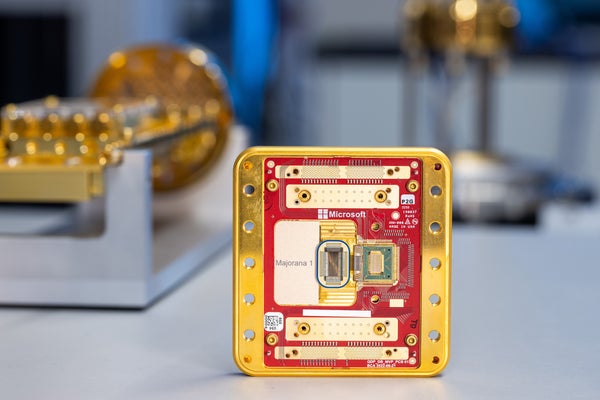
- Majorana 1 Chip: A groundbreaking quantum processing unit built using topological qubits.
- Scalability and Fault-Tolerance: Aiming to reach up to one million stable qubits, promising industrial-scale applications.
- Azure Quantum Integration: Cloud-based platform supporting quantum hardware innovations and diverse quantum software tools.
Introduction to Microsoft's Quantum Ambitions
Microsoft has positioned itself at the forefront of the quantum computing revolution with its ambitious efforts to develop practical, scalable quantum computers. At the heart of this initiative lies the innovative Majorana 1 chip, a quantum processing unit (QPU) that leverages a novel approach using topological qubits. This breakthrough is not only a triumph in quantum hardware design but also a significant leap toward realizing quantum computers capable of solving previously intractable problems in fields such as pharmaceuticals, materials science, and even environmental sustainability.
The Majorana 1 Chip: A Deep Dive
Overview of the Chip
The Majorana 1 chip represents the world’s first quantum processing unit powered by topological qubits—a new breed of qubits that rely on an exotic state of matter. Unlike traditional qubit designs that utilize fragile quantum states, the Majorana approach benefits from a built-in resilience against environmental noise. The chip is constructed using a breakthrough material known as a topoconductor, which facilitates the observation and manipulation of Majorana quasiparticles. These particles are central to the chip's design as they form the basis of the topological qubits.
Topological Qubits and Their Advantages
Conventional qubits, used by many current quantum computing prototypes, tend to be highly sensitive to their surroundings, making them prone to error and decoherence. In contrast, topological qubits exploit a unique phase of matter that is not described by the standard solid, liquid, or gas states; this state is sometimes referred to as a new state of matter in the realm of quantum physics. Through the properties of topology, the information encoded in these qubits is protected from many typical sources of error, allowing for more reliable and stable computation.
Stability is a crucial factor when it comes to scaling up quantum computers. Microsoft’s approach with topological qubits is designed to mitigate error rates intrinsic to quantum systems. The Majorana 1 chip, which currently integrates eight topological qubits, serves as a proof-of-concept for future, larger-scale systems. The resilience provided by topological protection paves the way for the ambitious goal of scaling up quantum processors to incorporate up to one million qubits on a single chip. This level of scalability is key to tackling industrial-scale problems that require immense computational power.
Scalability and the Path to Fault-Tolerant Quantum Computers
Achieving Million-Qubit Systems
One of the major thrusts of Microsoft’s quantum computing program is the plan to develop quantum systems that can host up to a million qubits. Achieving such scalability is not simply a matter of replicating the small-scale system; rather, it requires profound innovations in both hardware design and error correction protocols. Microsoft’s strategy is underpinned by the belief that a million stable qubits are necessary to solve the most complex and computationally heavy problems in science and industry.
Fault-Tolerance and Error Correction
Fault-tolerant quantum computing is an essential milestone on the road to making quantum computers practical for everyday usage. Microsoft is targeting fault-tolerance by leveraging the intrinsic stability of topological qubits. These qubits, thanks to their unique phase of matter, are hypothesized to require fewer error correction measures compared to conventional qubit types. This inherent robustness is instrumental in reducing the overhead associated with error correction, thereby making it feasible to operate a large-scale quantum computer that can handle real-world applications.
Microsoft Azure Quantum and the Quantum Ecosystem
Cloud-Based Quantum Computing Platform
Microsoft’s quantum computing efforts are integrated into its broader cloud ecosystem through the Azure Quantum platform. This platform is designed to make quantum computing accessible to researchers, developers, and businesses by providing a cloud-based environment that supports not only Microsoft’s own hardware developments but also a range of quantum processors from other industry leaders. Azure Quantum combines high-performance computing and advanced quantum hardware, providing an infrastructure for both experimentation and application development.
Software and Programming Tools
In addition to its hardware advancements, Microsoft has been developing a suite of software tools aimed at democratizing access to quantum computing. Using the Q# programming language, developers can write quantum algorithms that are then executed on both simulated and actual quantum hardware available through Azure Quantum. The platform also integrates with classical high-performance computing resources, thereby enabling hybrid systems where quantum and classical computing work in tandem to solve complex problems.
Industrial and Societal Impact
Solving Meaningful, Industrial-Scale Problems
The promise of quantum computing lies in its potential to address problems that are unsolvable by classical computers. Microsoft’s quantum initiatives are designed with this overarching goal in mind. The ability to scale to a million qubits could revolutionize fields such as material science, chemical simulation, cryptography, and even environmental modeling.
One illustrative example is the potential application in the field of materials science, where quantum computers could simulate molecular interactions with unprecedented accuracy. This could lead to breakthroughs in designing self-healing materials or discovering new compounds with tailored properties for various industrial applications. In environmental science, quantum computing might offer powerful tools for modeling climate systems, enabling more precise predictions and potentially innovative solutions to global warming challenges.
Collaborative Research and Government Partnerships
Microsoft’s quantum research also benefits from significant collaborations and partnerships with research institutions, government agencies, and industry consortiums. For instance, the partnership with prominent organizations like DARPA has been pivotal for advancing Microsoft’s work on fault-tolerant quantum computing. Initiatives under programs such as the Underexplored Systems for Utility-Scale Quantum Computing have provided funding and technical support, reinforcing the country’s broader push toward developing quantum technologies that can drive national and global innovation.
Technical Details and Innovations
Understanding Topoconductors and Majorana Particles
At the heart of the Majorana 1 chip lies a sophisticated material science breakthrough involving the use of topoconductors. These materials are engineered to enable the observation and control of Majorana particles, which are quasiparticles theorized to be their own antiparticles. Their unique behavior underpins the formation of topological qubits, providing the necessary stability for robust quantum computation.
The utilization of topoconductors in the Majorana 1 chip represents a pioneering development in quantum hardware. By capitalizing on the exotic physical properties of these materials, Microsoft’s researchers have created a system that is fundamentally different from traditional quantum processors. In this new system, the qubits derive their error resistance not from complex error-correcting algorithms alone, but from the inherent physical properties of the material—a property that could drastically simplify the requirements for scaling quantum computations.
Comparative Technological Landscape
The global race in quantum computing markets sees significant contributions from multiple technology giants. Microsoft’s approach, centered on topological qubits, sets it apart from competitors who typically rely on superconducting or trapped-ion qubit architectures. While other companies have achieved quantum computational demonstrations, Microsoft asserts that its strategy offers a more promising path to scalability and long-term fault tolerance.
This competition fosters an environment of rapid technological improvement. The introduction of the Majorana 1 chip is a defining moment in this competition, as it brings a new perspective on how quantum information can be preserved and processed with far fewer errors. Microsoft's strategy is not only to develop hardware but also to integrate a full ecosystem—spanning hardware, software, and cloud infrastructure—to ensure that its quantum computing solutions are practical and scalable.
A Glimpse into the Future
Timeline and Development Roadmap
The journey leading up to the unveiling of the Majorana 1 chip has been a long and methodical process, with Microsoft’s researchers dedicating nearly two decades to solving the complex challenges of quantum hardware. This roadmap is characterized by iterative improvements and bold innovations designed to address specific limitations of previous qubit implementations.
The immediate focus is on demonstrating the fault tolerance and stability of topological qubits on a smaller scale. Once these attributes are verified in practical implementations, the plan is to incrementally scale up the number of qubits while refining error correction protocols and software integration. The eventual target is a fully fault-tolerant, million-qubit quantum computer that can run complex simulations and solve industrial-scale problems in a fraction of the time required by classical supercomputers.
Integration with Classical Computing
A hallmark of Microsoft’s quantum strategy is the blend of quantum and classical computing architectures. Quantum processors are not envisioned as stand-alone devices; rather, they will operate alongside classical computing infrastructures. Hybrid systems, where quantum accelerators work in tandem with traditional high-performance computing clusters, are expected to optimize performance and broaden the range of solvable problems.
In this hybrid model, the classical computer handles tasks that are well-suited for conventional processing while offloading specific quantum-enhanced computations to the quantum processor. This integrated approach leverages the best of both worlds, ensuring that computational resources are utilized in a balanced and efficient manner.
Practical Applications in Industry and Research
Accelerating Material and Chemical Discoveries
One of the most promising applications of Microsoft’s quantum technology is in the realm of materials science and chemistry. Quantum computers have the potential to model molecular structures and chemical reactions at a level of detail unachievable by classical computers. This can lead to groundbreaking discoveries in the development of new materials, more efficient catalysts, and drug compounds with enhanced efficacy.
For instance, developments in self-healing materials could rely on quantum simulations that predict molecular behavior under stress. Similarly, in the field of battery research, quantum computational methods might help identify new compounds that improve energy storage, leading to longer-lasting and more efficient batteries. These advancements have far-reaching implications across various industries, including renewable energy, electronics, and healthcare.
Environmental and Societal Impacts
Beyond industrial applications, quantum computing holds the promise of addressing some of the most pressing challenges of our time. Complex environmental models, such as those predicting climate change patterns or the behavior of pollutants, require processing capabilities beyond those of today’s conventional supercomputers. A scalable, fault-tolerant quantum computer could dramatically improve the accuracy and speed of these simulations, enabling more effective responses to environmental crises.
Moreover, quantum computing may contribute to advancements in cryptography and cybersecurity by solving fundamental problems in mathematics that underpin existing encryption protocols. While this poses challenges to current cryptographic systems, it also drives the development of quantum-resistant algorithms, ensuring that data security evolves alongside quantum advancements.
Visualization and Comparative Analysis
Techological Features at a Glance
The following table provides a comparative overview of the key technological features pertinent to Microsoft’s quantum computing initiative:
| Feature | Description | Advantage |
|---|---|---|
| Majorana 1 Chip | Quantum processing unit using topological qubits | Enhanced stability and error resistance |
| Topoconductor Material | Breakthrough material enabling topological qubit performance | Vital for observing and controlling Majorana particles |
| Scalability | Design to scale up to one million qubits | Capability to solve industrial scale problems |
| Azure Quantum Platform | Cloud integration for quantum and classical computing | Accessible, hybrid system for developers and researchers |
| Fault-Tolerance | Leveraging topological properties for inherent error correction | Reduced need for extensive error correction protocols |
Challenges and the Road Ahead
Overcoming Engineering and Scientific Hurdles
As with any pioneering technology, the journey toward a fully functional and scalable quantum computer is marked by significant challenges. Key obstacles include material imperfections, environmental noise, and the difficulty of integrating quantum components with classical infrastructure. Microsoft’s research efforts are focused on addressing these challenges head-on through continuous materials science research, improved qubit architecture, and the development of robust error correction methodologies.
The long development cycle, spanning nearly two decades of dedicated research, illustrates the complexity of engineering solutions that can harness the peculiar properties of quantum mechanics while assuring reliability and performance. Microsoft’s commitment to iterative development and rigorous testing under experimental conditions plays a critical role in overcoming these challenges.
Future Prospects and Technological Synergies
Looking ahead, Microsoft’s quantum computing initiatives hold promise not only through incremental improvements in hardware performance but also via synergistic integration with other advanced technologies. The rise of artificial intelligence, high-performance classical computing, and advanced simulation tools complement the development of quantum systems. By interfacing quantum processors with these technologies through platforms like Azure Quantum, Microsoft is creating a comprehensive ecosystem aimed at accelerating scientific discovery and driving industrial innovation.
The anticipated breakthroughs in quantum computing are expected to spur transformative changes across various sectors. As quantum processors become more reliable and accessible via cloud platforms, a broader range of researchers and developers will be able to experiment with and deploy quantum algorithms, leading to an exponential growth in groundbreaking applications. This synergy between different technological domains is a clear indicator of how quantum computing might redefine computational paradigms in the coming decades.
Conclusion
Microsoft's quantum computing journey is a testament to the relentless pursuit of innovation in the quest for computational breakthroughs. With the transformative Majorana 1 chip, underpinned by topological qubits and constructed from innovative topoconductor materials, Microsoft is paving the way for a new era of fault-tolerant, scalable quantum computing. The integration of this cutting-edge hardware within the Azure Quantum ecosystem further bolsters the potential for real-world applications, from advanced material simulation and chemical discovery to environmental modeling and cybersecurity.
As the technological landscape evolves, Microsoft’s strategy—characterized by a focus on stability, fault-tolerance, and hybrid quantum-classical computing—demonstrates a thoughtful approach to tackling some of the most challenging problems of our time. By pushing the boundaries of material science and quantum mechanics, Microsoft not only competes rigorously in the quantum computing race but also lays the groundwork for transformative societal benefits.
In summary, Microsoft’s advances in quantum computing, driven by the Majorana 1 chip and supported by an integrated cloud ecosystem, represent a critical milestone. With their rigorous focus on fault-tolerant design, scalability to potentially one million qubits, and strategic collaborations with leading research institutions and government agencies, they are setting the stage for the next generation of computing technology—a technology that promises to address complex industrial challenges and redefine scientific discovery.
References
- BBC News - Microsoft’s Quantum Breakthrough
- CNET - Microsoft’s Majorana 1 Chip
- New York Times - Microsoft Quantum Computing
-
Microsoft Azure Quantum - Official Page
- Forbes - Quantum Computing Breakthrough
Recommended
Last updated February 22, 2025