
Quantum Entanglement Explained
Unveiling the Mysteries of Interconnected Quantum States
Key Takeaways
- Instantaneous Correlation: Entangled particles exhibit linked properties, regardless of the distance separating them.
- Foundation of Quantum Technologies: Entanglement is pivotal for advancements in quantum computing, cryptography, and teleportation.
- Experimental Validation: Numerous experiments, including the violation of Bell inequalities, have confirmed the existence of quantum entanglement.
Introduction to Quantum Entanglement
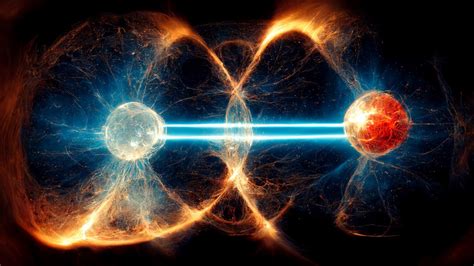
Quantum entanglement is one of the most fascinating and counterintuitive phenomena in the realm of quantum mechanics. It describes a situation where two or more particles become interconnected in such a way that the quantum state of each particle cannot be described independently of the state of the others, regardless of the spatial separation between them. This interconnectedness persists even when entangled particles are separated by vast distances, challenging our classical understanding of the physical universe.
Understanding the Core Concepts
Superposition and Correlation
At the heart of quantum entanglement lies the principle of superposition. Unlike classical objects, which exist in a definite state, quantum particles can exist in multiple states simultaneously. When particles become entangled, their individual superpositions are combined into a shared quantum state. This means that the properties of one particle are intrinsically linked to those of the other, leading to strong correlations between them.
For example, consider two entangled photons with correlated polarizations. If one photon is measured and found to be vertically polarized, the other photon, regardless of the distance separating them, will instantaneously be determined to be horizontally polarized. This correlation holds true despite the absence of any classical communication between the particles.
Non-Separable States
Mathematically, an entangled system is represented by a quantum state that cannot be factored into the product of the states of individual particles. Instead, the state of the system is a superposition of multiple product states, indicating that the particles are an inseparable whole. This non-separability is a key feature that distinguishes entangled states from classical correlated states.
No Faster-Than-Light Communication
While quantum entanglement involves instantaneous correlations between particles, it does not enable faster-than-light communication. The measurement outcomes are inherently random, and it's impossible to control the state of one particle to transmit information to the other. This limitation ensures consistency with Einstein's theory of special relativity, which prohibits any form of faster-than-light signaling.
Historical Context and Einstein's Skepticism
The concept of quantum entanglement was famously critiqued by Albert Einstein, who referred to it as "spooky action at a distance." Einstein, along with Boris Podolsky and Nathan Rosen, formulated the EPR paradox to challenge the completeness of quantum mechanics. They proposed that if quantum mechanics were complete, it would imply instantaneous influences between distant particles, which seemed untenable within the framework of relativity.
However, subsequent theoretical developments and experimental validations have firmly established entanglement as a genuine and fundamental aspect of quantum physics, despite its non-intuitive nature.
Experimental Verification of Quantum Entanglement
Bell's Inequalities and Their Violation
John Bell formulated a set of inequalities—now known as Bell's inequalities—that provided a way to test the predictions of quantum mechanics against those of local hidden variable theories, which posit that particles carry predetermined properties that are merely revealed upon measurement.
Experimental tests of Bell's inequalities have consistently shown violations predicted by quantum mechanics, thereby providing strong evidence against local hidden variable theories and affirming the non-local nature of quantum entanglement.
Modern Experiments
Advancements in experimental physics have enabled more precise and large-scale tests of entanglement. Notable experiments include those that close various "loopholes" in earlier tests, such as the detection loophole and the locality loophole, thereby reinforcing the robustness of entanglement as a fundamental quantum phenomenon.
In 2022, groundbreaking experiments further demonstrated entanglement over unprecedented distances and with greater numbers of particles, opening new avenues for practical applications in technology.
Applications of Quantum Entanglement
Quantum Computing
Quantum entanglement is a cornerstone of quantum computing. Entangled qubits enable quantum computers to perform complex calculations exponentially faster than classical computers for certain tasks. This is achieved through phenomena like quantum parallelism, where entangled states allow the simultaneous processing of multiple computational paths.
Quantum Cryptography
In quantum cryptography, entanglement provides a means for creating secure communication channels. Quantum key distribution (QKD) leverages entangled photons to detect eavesdropping, as any attempt to intercept the entangled states disrupts their correlation, thereby alerting the communicating parties to the presence of an intruder.
Quantum Teleportation
Quantum teleportation utilizes entanglement to transfer quantum states from one location to another without physically sending the particles themselves. This process relies on the entanglement between particles and classical communication to achieve the transfer, maintaining the integrity of the quantum information.
Precision Metrology and Sensing
Entangled states are employed in precision metrology to enhance the sensitivity and accuracy of measurements beyond classical limits. By exploiting quantum correlations, entanglement enables the detection of subtle changes in physical systems, leading to advancements in fields like gravitational wave detection and atomic clocks.
Theoretical Implications and Future Directions
Challenges to Classical Intuitions
Quantum entanglement challenges classical notions of separability and locality. The non-local correlations observed in entangled systems suggest a level of interconnectedness that transcends classical spatial and temporal boundaries. This has profound implications for our understanding of reality and the fundamental nature of the universe.
Integration with Relativity
One of the ongoing challenges in theoretical physics is reconciling quantum entanglement with general relativity. Efforts to develop a coherent theory of quantum gravity seek to bridge the gap between these two foundational pillars, potentially unveiling deeper insights into the fabric of spacetime and the quantum nature of gravity.
Advancements in Quantum Networks
The development of quantum networks relies heavily on entanglement to enable secure and efficient communication across distributed systems. Quantum repeaters and entanglement swapping techniques are being refined to extend the range and robustness of entangled connections, paving the way for a quantum internet.
Exploration of Multi-Particle Entanglement
While much of the research has focused on bi-particle entanglement, increasing interest is directed towards multi-particle entangled states. Understanding and harnessing the complexities of many-body entanglement could unlock new computational paradigms and deepen our comprehension of quantum phase transitions and exotic states of matter.
Practical Considerations and Limitations
Decoherence and Environmental Interactions
Maintaining entangled states in practical applications is challenged by decoherence, which arises from interactions between the quantum system and its environment. Decoherence leads to the loss of quantum correlations, necessitating robust error-correction techniques and isolation strategies to preserve entanglement in real-world scenarios.
Scalability of Quantum Systems
Scaling quantum systems to accommodate larger numbers of entangled particles remains a significant technical hurdle. As the complexity of entangled states increases, so does the difficulty of controlling and maintaining coherence across the entire system. Innovations in quantum architecture and materials science are critical to overcoming these challenges.
Resource Requirements and Practical Implementation
The implementation of quantum technologies based on entanglement requires substantial resources, including low-temperature environments, precise manipulation of quantum states, and advanced fabrication techniques. Balancing these requirements with practical constraints is essential for the widespread adoption of quantum solutions.
Future Horizons in Quantum Entanglement Research
Quantum Networks and the Quantum Internet
Transformative developments in quantum networking aim to establish a quantum internet, where entanglement connects quantum devices across the globe. Such a network would enable unprecedented levels of security, computation, and data processing, revolutionizing communication infrastructures.
Integration with Emerging Technologies
Quantum entanglement is expected to synergize with other emerging technologies, such as artificial intelligence and nanotechnology. The fusion of these fields could lead to innovative solutions and applications that leverage the strengths of quantum mechanics to address complex challenges.
Exploring the Foundations of Quantum Mechanics
Continued exploration of quantum entanglement contributes to our fundamental understanding of quantum mechanics and its philosophical implications. Questions about the nature of reality, causality, and information flow remain at the forefront of theoretical inquiries, driving deeper investigations into the quantum realm.
Conclusion
Quantum entanglement stands as a testament to the enigmatic and profound nature of quantum mechanics. Its unique properties not only challenge our classical perceptions of the universe but also pave the way for groundbreaking technological advancements. As research progresses, the intricate dance of entangled particles promises to unlock new frontiers in science and technology, heralding a new era of quantum innovation.
References
Last updated January 16, 2025