
Unveiling Score Entropy: A Leap Forward in Text Generation with Discrete Diffusion Models
Discover the groundbreaking research empowering diffusion models to master the complexities of natural language.
The challenge of applying powerful diffusion models, renowned for their success in generating continuous data like images, to the discrete realm of natural language has been a significant hurdle in AI. A pivotal research paper, "Discrete Diffusion Modeling by Estimating the Ratios of the Data Distribution," introduces a novel solution: Score Entropy Discrete Diffusion (SEDD) models. This work marks a substantial advancement, potentially reshaping the landscape of text generation.
Essential Insights: Key Takeaways
- Novel Loss Function: SEDD introduces "score entropy," a groundbreaking loss function meticulously designed to enable diffusion models to effectively learn from and generate discrete data, specifically text.
- Competitive Performance: These models demonstrate performance that is not only competitive with but, in several aspects, surpasses established autoregressive models like GPT-2, particularly in perplexity and the quality of generated text without requiring annealing techniques.
- Enhanced Flexibility & Control: SEDD offers significant algorithmic advantages, including remarkable efficiency and enhanced control over the generation process, such as the ability to perform controllable text infilling.
The Challenge: Diffusion Models and the Discrete Data Dilemma
Why Text Posed a Unique Problem for Traditional Diffusion
Diffusion models operate through a two-stage process: a forward process that gradually adds noise to data until it becomes pure noise, and a reverse process that learns to denoise this data back into a coherent sample. In continuous domains like image generation, this is often achieved using "score matching," which relies on the gradients of the data distribution. However, natural language is composed of discrete units (words or tokens), lacking the smooth, continuous structure that score matching thrives on. Directly applying these traditional methods to text often leads to instability and suboptimal performance, failing to capture the intricate dependencies and structures inherent in language.
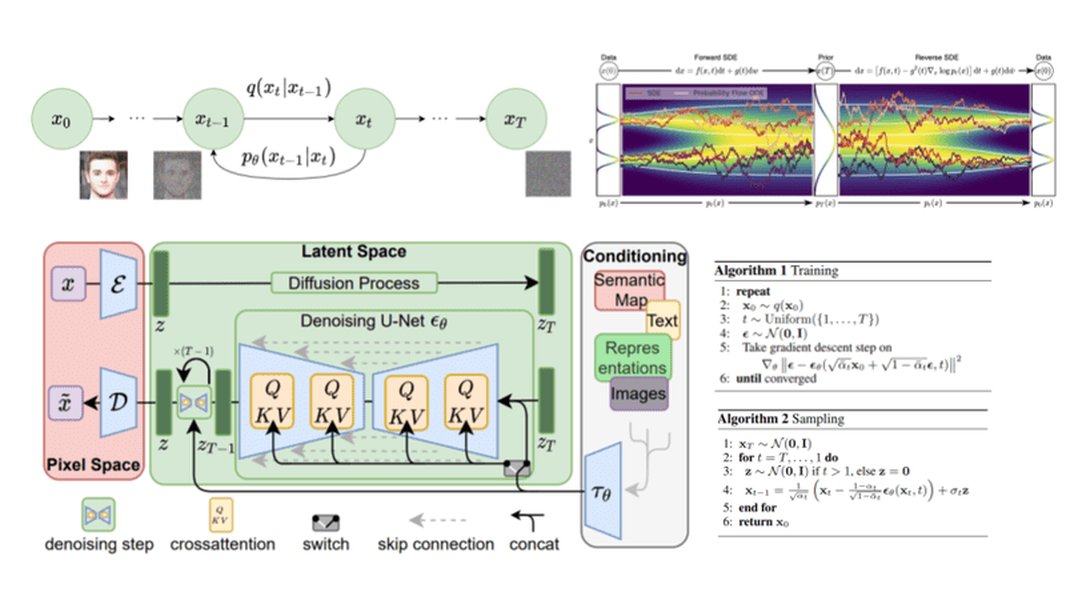
A general illustration of the diffusion model process, involving a forward noising stage and a learned reverse denoising stage.
The Breakthrough: Introducing Score Entropy Discrete Diffusion (SEDD) Models
The research by Aaron Lou, Chenlin Meng, and Stefano Ermon introduces Score Entropy Discrete Diffusion (SEDD) models as a potent solution to this challenge. SEDD models are specifically architected to train diffusion processes on discrete data structures like text, opening new avenues for generative AI in natural language processing.
The Core Innovation: The Score Entropy Loss Function
At the heart of SEDD lies the novel "score entropy" loss function. This isn't merely an adaptation of existing techniques but a principled extension of score matching tailored for discrete spaces. Here's how it works:
- Estimating Data Distribution Ratios: Instead of relying on gradients, score entropy focuses on estimating the ratios of the data distribution. This approach is more amenable to the discrete nature of text.
- The Concrete Score: The loss function is designed to help the model learn and recover the "concrete score." Given a predefined neighborhood structure (e.g., how words can change to nearby words), the concrete score represents the rate of change of probabilities concerning local, directional changes in the input sequence. This is crucial for principled discrete diffusion.
- Theoretical Foundation: The score entropy loss can be understood as an evidence lower bound (ELBO) derived using mathematical tools like Dynkin's formula, providing a robust theoretical underpinning for its effectiveness.
This innovative loss function allows SEDD models to effectively parameterize a reverse discrete diffusion process, moving from a noisy sequence of tokens toward a coherent and meaningful text output.
SEDD Model Architecture and Mechanism
SEDD models operate by learning to reverse a diffusion process specifically designed for discrete sequences. Unlike autoregressive models that generate text sequentially (e.g., word by word from left to right), SEDD models can approach generation more holistically.
Reverse Diffusion Process
The model starts with a sequence that is entirely or partially noised (random tokens) and iteratively refines it. In each step of this reverse process, the model predicts a less noisy version of the sequence, guided by the learned score entropy. This iterative denoising continues until a clean, high-quality text sample is generated.
Holistic Generation Potential
This mechanism offers greater flexibility. Because the model learns the underlying structure of the data distribution across the entire sequence, it's not confined to unidirectional generation. This opens up possibilities for more complex generation tasks.
Putting SEDD to the Test: Experimental Triumphs
The efficacy of SEDD models isn't just theoretical. Extensive experiments demonstrate significant performance gains and unique advantages over existing methods.
Performance Benchmarks: Outshining Contemporaries
SEDD models have been rigorously evaluated on standard language modeling tasks, with perplexity being a key metric (lower perplexity indicates the model is less surprised by unseen text, implying better predictive power and generation quality).
- Superiority over Discrete Diffusion Peers: SEDD models have shown a remarkable reduction in perplexity by 25-75% compared to previous discrete diffusion approaches.
- Competitive with Autoregressive Giants: Impressively, SEDD models exhibit performance on par with, and in some cases exceeding, that of strong autoregressive models like GPT-2, especially when GPT-2 is used without annealing techniques (like temperature scaling). SEDD can achieve 6-8 times better generative perplexity than an un-annealed GPT-2.
Efficiency and Algorithmic Advantages
Beyond raw performance, SEDD models bring notable practical benefits:
- Reduced Computational Cost: SEDD can produce text of similar quality to other models with significantly fewer network evaluations—sometimes up to 32 times fewer. This translates to faster generation and lower computational resource requirements.
- No Need for Annealing: Unlike many generative models that require techniques like temperature scaling (annealing) to produce faithful and diverse text, SEDD models can generate high-quality text directly, simplifying the generation pipeline.
- Increased Training Stability: The score entropy loss contributes to more stable training dynamics compared to earlier attempts at discrete diffusion, which could suffer from instabilities.
Unlocking New Capabilities: Controllable Generation and Infilling
Perhaps one of the most exciting aspects of SEDD is its enhanced control over the text generation process:
- Controllable Infilling: Autoregressive models primarily generate text from left to right. SEDD, however, excels at "infilling"—generating text to fill in missing parts within a given prefix and suffix, or even more complex conditional generation tasks. This capability matches the quality of nucleus sampling in autoregressive models while offering greater flexibility.
- Flexible Generation Strategies: The underlying mechanism of SEDD allows for various generation strategies beyond simple prompting, offering more nuanced control over the output.
Visualizing SEDD's Strengths: A Comparative Outlook
To better understand the advantages of Score Entropy Discrete Diffusion (SEDD) models, the radar chart below provides a visual comparison against traditional autoregressive models (like GPT-2 scale) and prior discrete diffusion attempts. The metrics evaluated are all on a "higher is better" scale, reflecting key attributes of generative models. SEDD models generally exhibit a more well-rounded and advanced profile.
Conceptualizing SEDD: A Mindmap Overview
The mindmap below illustrates the core concepts, components, and implications of Score Entropy Discrete Diffusion models, providing a structured overview of this innovative approach to text generation.
for Discrete Data (Text)"] id1_2["Limitations of Traditional
Score Matching"] id2["Core Innovation: Score Entropy Loss"] id2_1["Extension of Score Matching
to Discrete Spaces"] id2_2["Estimates Ratios of
Data Distribution"] id2_3["Learns 'Concrete Score'"] id2_4["Based on Dynkin's Formula (ELBO)"] id3["SEDD Model Characteristics"] id3_1["Parameterizes Reverse
Discrete Diffusion Process"] id3_2["Iterative Denoising of Sequences"] id3_3["Holistic (Non-Autoregressive)
Generation Potential"] id4["Key Advantages & Performance"] id4_1["Improved Perplexity
(vs. other diffusion & AR models)"] id4_2["High-Quality Text Generation
Without Annealing"] id4_3["Computational Efficiency
(Fewer Network Evaluations)"] id4_4["Enhanced Stability"] id4_5["Controllable Infilling &
Flexible Generation"] id5["Broader Impact & Applications"] id5_1["Alternative to Autoregressive
Language Models"] id5_2["Potential Beyond Text
(e.g., Protein Design, Discrete Data)"] id5_3["Advances Probabilistic
Modeling for Discrete Domains"] id6["Implementation"] id6_1["PyTorch Code Available
(Open Source)"]
Broader Horizons: Implications and Future Directions
The introduction of SEDD models and the score entropy loss function carries significant implications for the field of machine learning and specifically for natural language processing:
- Challenging Autoregressive Dominance: For a long time, autoregressive models have been the dominant paradigm in language modeling. SEDD presents a viable and, in some ways, superior alternative, potentially shifting research focus.
- New Avenues for Discrete Data Modeling: The principles behind score entropy are not limited to text. They can be extended to other forms of discrete data, such as genomic sequences, protein structures, or other symbolic sequences, opening up new research frontiers.
- Inspiration for Future Models: This work could inspire the development of new types of generative models that combine the strengths of diffusion processes with the unique characteristics of discrete data.
Comparing SEDD: A Tabular Overview
The following table provides a concise comparison of Score Entropy Discrete Diffusion (SEDD) models against traditional autoregressive models (like GPT-2) and earlier attempts at applying diffusion models to text.
| Feature | SEDD Models | Autoregressive Models (e.g., GPT-2) | Prior Discrete Diffusion Attempts |
|---|---|---|---|
| Primary Data Type | Discrete (e.g., text) | Discrete (e.g., text) | Discrete (often struggled with text) |
| Core Loss Function | Score Entropy | Cross-Entropy (typically) | Varied, often adaptations of Score Matching |
| Perplexity (vs. GPT-2 un-annealed) | Lower / Better | Baseline / Higher | Generally Higher / Poorer |
| Generation Direction | Flexible (e.g., infilling, holistic) | Primarily Left-to-Right | Limited flexibility |
| Annealing Required for Quality | No | Often Yes (e.g., temperature scaling) | Often Yes |
| Computational Efficiency (Evaluations) | High (fewer evaluations for similar quality) | Moderate to High | Variable, often lower |
| Controllable Infilling | Yes, strong capability | Limited / More complex to achieve | Limited |
| Training Stability | Improved | Generally Stable | Can be unstable |
Delving Deeper: A Video Explainer
For a more in-depth understanding of discrete diffusion modeling and the concepts related to score entropy, the following video provides valuable insights. It discusses the paper "Discrete Diffusion Modeling by Estimating the Ratios of the Data Distribution," touching upon key concepts like score entropy for learning and how these models are advancing text generation capabilities.
This presentation can help visualize and further clarify the technical contributions and significance of SEDD models in the context of modern generative AI research.
Frequently Asked Questions (FAQ)
What is score entropy in the context of text diffusion models?
Score entropy is a novel loss function introduced for training diffusion models on discrete data, such as text. It extends the principles of score matching (used in continuous diffusion models) to discrete domains by focusing on estimating the ratios of the data distribution. This allows the model to learn a "concrete score," which guides the reverse diffusion process to generate coherent text from noise.
How do SEDD models differ from autoregressive models like GPT-2?
SEDD models differ from autoregressive models like GPT-2 in several key ways:
- Generation Process: Autoregressive models generate text sequentially (e.g., token by token, left to right). SEDD models use a diffusion process, starting from a noisy sequence and iteratively refining it, allowing for more holistic and flexible generation.
- Controllability: SEDD models offer enhanced controllability, such as effective text infilling (generating text within a given prefix and suffix), which is more challenging for strictly left-to-right autoregressive models.
- Efficiency: SEDD can achieve comparable or better quality with fewer network evaluations and without needing techniques like temperature scaling, which are often used with autoregressive models.
What are the main advantages of using SEDD for text generation?
The main advantages include:
- High-Quality Text Generation: SEDD models achieve competitive perplexity and generation quality, outperforming previous discrete diffusion methods and rivaling strong autoregressive models.
- Computational Efficiency: They can produce high-quality results with significantly fewer network evaluations.
- No Need for Annealing: Faithful text can be generated without complex annealing schedules or temperature scaling.
- Enhanced Control and Flexibility: SEDD supports controllable infilling and other non-sequential generation strategies.
- Improved Stability: The score entropy loss function contributes to more stable training for discrete diffusion.
Can SEDD models be used for tasks other than left-to-right text generation?
Yes, a significant advantage of SEDD models is their flexibility beyond simple left-to-right text generation. They are particularly well-suited for tasks like:
- Text Infilling: Filling in missing portions of text given surrounding context.
- Conditional Generation: Generating text based on more complex conditions or constraints.
- Non-Autoregressive Generation: The underlying diffusion mechanism allows for parallel or holistic sequence generation, which can be faster in some scenarios.
Where can I find the implementation of SEDD models?
The authors have made a PyTorch implementation of Score Entropy Discrete Diffusion (SEDD) models publicly available. You can typically find it on GitHub. The primary repository is often linked in the original research paper or related publications. For instance, one such repository is `louaaron/Score-Entropy-Discrete-Diffusion` on GitHub.
Recommended Further Exploration
To delve deeper into related topics, consider exploring these queries:
- How does the concrete score in SEDD models relate to traditional score matching in continuous diffusion models?
- What are the specific challenges in applying diffusion models to other types of discrete data like protein sequences or molecular structures?
- Explore the mathematical derivation of the score entropy loss function and its connection to Dynkin's formula.
- Compare the controllable generation capabilities of SEDD models with other advanced techniques like instruction-tuned language models.
References
Last updated May 6, 2025