
Unveiling the Shadowy Corridors: The Intricate Influence of Secret Societies on Governments
Explore how clandestine organizations, from ancient brotherhoods to modern elite networks, have historically and subtly shaped the course of governance.
Key Insights into Secret Society Influence
- Historical Footprint: Secret societies like the Freemasons and the Bavarian Illuminati played significant roles in shaping historical movements, including the American Revolution and Enlightenment thought, primarily through the ideals and actions of their influential members rather than direct control.
- Mechanisms of Soft Power: Modern influence primarily stems from networking, elite socialization, and off-the-record discussions among powerful individuals within these societies, fostering informal coordination and shared agendas that can subtly impact policy.
- Distinction from Conspiracy: While secret societies have undeniably intersected with power structures, the notion of them exercising monolithic, overarching control over governments is largely unsubstantiated and often rooted in conspiracy theories.
The concept of secret societies wielding power behind the scenes has long captured public imagination, fueling both fascination and suspicion. From ancient mystery cults to contemporary elite networks, these organizations, defined by their concealed activities, membership, or inner workings, have certainly left their mark on history. The question of whether they actively influence governments is multifaceted, requiring a careful distinction between historical fact, subtle soft power, and popular conspiracy narratives.
A Historical Tapestry of Clandestine Connections
Throughout history, secret societies have emerged and evolved, often interacting with governmental structures in various capacities. Their influence has been diverse, ranging from fostering revolutionary ideals to facilitating informal political networking.
Pioneers of Political Thought: The Enlightenment Era
The Freemasons: Architects of Republics?
One of the most widely recognized secret societies, the Freemasons, boasts a long and influential history. Many prominent figures in the American Revolution and the early U.S. government, including George Washington and Benjamin Franklin, were Freemasons. This fraternal organization, embodying Enlightenment ideals such as constitutional government, republicanism, and secularism, undeniably had members who wielded significant political and social influence during formative periods. While they did not directly govern, their shared principles and the influential positions of their members contributed to the political landscape of their time.
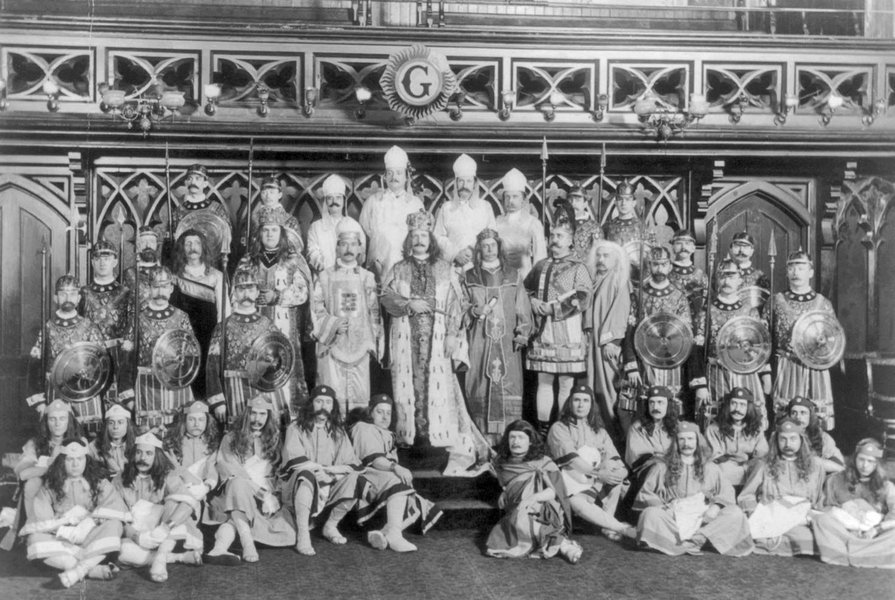
Freemasons in traditional regalia, 1902.
The Bavarian Illuminati: A Brief Spark, a Lasting Myth
Founded on May 1, 1776, by Adam Weishaupt in Bavaria, the Illuminati aimed to counter religious influence in public life, prevent state power abuses, and advocate for progressive ideals like women's education and equality. Though officially disbanded by the late 1780s due to government suppression, the Illuminati has become a central figure in popular culture, often portrayed as a powerful, shadowy organization controlling global politics. However, concrete evidence of the original Bavarian Illuminati exercising lasting, direct control over governments is absent. Their historical impact lies more in the ideals they propagated during the Enlightenment, which resonated with broader revolutionary thought.
Collegiate and Elite Networks: Skull and Bones
Skull and Bones, a collegiate secret society at Yale University, has historically included members who later ascended to prominent political roles, notably U.S. presidents George H.W. Bush and George W. Bush. The presence of such influential figures within its ranks naturally fuels speculation about its potential for behind-the-scenes influence. While its rituals remain secret, the extent of its influence beyond informal networking and the cultivation of shared ideals among its powerful alumni is difficult to definitively ascertain.
Ancient Orders with Temporal Power: Knights Templar
In medieval Europe, semi-secret orders like the Knights Templar held considerable political and financial sway. Their vast wealth and military power allowed them to influence monarchs and crusades, demonstrating a localized yet significant governmental impact during their era. Their story underscores how, at certain historical junctures, organizations with secretive elements could amass substantial temporal power that intersected with official governance.
Mechanisms of Subtle Influence on Governance
While the direct, conspiratorial control of governments by secret societies lacks credible evidence, their influence often manifests through more subtle and informal mechanisms. These methods leverage the exclusive nature of such groups to foster connections and shape perspectives among powerful individuals.
Networking and Elite Socialization
Many secret societies function as exclusive networks where influential individuals—including politicians, business leaders, and academics—can forge relationships and exchange ideas away from public scrutiny. This environment facilitates "soft social influence," where personal connections and private discussions can subtly guide decision-making and policy formulation. For instance, the Bilderberg Group, often described as an elite meeting rather than a traditional secret society, facilitates off-the-record discussions among global elites that can indirectly shape policy. Having a personal connection with a politician, forged in these private settings, can indeed influence how decisions are made and policies are enacted.
Shared Ideologies and Mutual Support
Secret societies often cultivate and promote specific political, social, or philosophical ideologies. Members who then assume public roles may carry these philosophies into their work, potentially influencing policy direction or public opinion. The collective adherence to certain ideals within these groups can lead to a convergence of actions among members in positions of power, even without explicit, coordinated directives.
Off-the-Record Discussions and Information Exchange
The private nature of secret society gatherings allows for candid discussions among powerful individuals. These "off-the-record" conversations can become conduits for agendas and strategies, influencing policy decisions without the accountability and transparency typically associated with public governance. This is where subtle shaping of ideas and informal coordination can occur, impacting governmental outcomes through shared perspectives and agreements.
Understanding the Nuances: Influence vs. Control
It's crucial to differentiate between influence—which can be informal, social, or historical—and outright control. While secret societies have undeniably had members in positions of power and have at times shaped historical events, the pervasive notion that they monolithically control governments is a common theme in conspiracy theories.
Complexity of Modern Governance
Modern governments are complex systems, influenced by a multitude of actors, institutions, special interest groups, and public opinion. The diffuse nature of governmental power makes it highly improbable for a single, centralized, secret entity to exert total, long-term control. Societal change is driven by multifaceted movements and shifts, not solely by clandestine groups.
The Allure of Conspiracy Theories
The secrecy inherent in these organizations, combined with public mistrust of elites, often fuels elaborate conspiracy theories. While historical conspiracies do exist, they rarely involve the kind of detailed, global, long-term control often attributed to secret societies. The narrative of hidden puppeteers manipulating world events is a powerful one, but it generally lacks concrete, verifiable evidence.
Assessing the Contemporary Impact of Secret Societies
To provide a clearer perspective on the perceived and actual influence of various secret societies, here is a radar chart based on an analysis of their historical activities, documented membership, and the nature of their influence. This chart aims to visually represent the nuances of their impact rather than offering definitive statistical data.
This radar chart illustrates the varying degrees to which different secret societies exhibit characteristics related to governmental influence. For example, the Freemasons score high on historical political impact and philanthropic activities, reflecting their well-documented contributions. The Bavarian Illuminati, despite its short lifespan, shows high prominence in conspiracy theories and strong ideological propagation. Skull and Bones, on the other hand, excels in networking and elite access, indicative of its role as a pipeline to influential positions. The "Direct Governmental Control (Perceived)" axis helps visualize the difference between public perception and actual documented influence.
Diving Deeper: Visualizing the Pillars of Influence
The intricate ways in which secret societies can influence governmental structures can be visualized as a mindmap, illustrating the various pathways—from historical impact to subtle networking—that contribute to their overall effect on politics and society.
Freemasons' Role"] id3["Enlightenment Ideals
Bavarian Illuminati"] id4["Medieval Power
Knights Templar"] id5["Anti-Masonic Movements
Public Perception"] id6["Mechanisms of Influence"] id7["Networking & Elite Socialization"] id8["Private Gatherings
Bilderberg Group"] id9["Informal Policy Discussion"] id10["Shared Ideologies & Support"] id11["Members in High Office"] id12["Shaping Public Opinion"] id13["Covert Support & Operations"] id14["Pre-Civil War Factions"] id15["Government Use of Societies"] id16["Modern Context & Realities"] id17["Focus on Soft Power"] id18["Networks for the Powerful"] id19["Influence Across Sectors"] id20["Conspiracy Theories vs. Fact"] id21["Lack of Monolithic Control Evidence"] id22["Complexity of Power Diffusion"] id23["Public Mistrust of Elites"]
This mindmap outlines the core aspects of secret society influence. It branches out into historical impact, detailing how groups like the Freemasons and Illuminati shaped political thought and events. It then explores the modern mechanisms of influence, such as networking and shared ideologies, which foster subtle "soft power." Finally, it addresses the crucial distinction between factual influence and the widespread conspiracy theories that often overshadow the true nature of these organizations.
Understanding Secrecy: A Look Inside the Freemasons
To further contextualize the nature of secret societies, it's beneficial to observe how even organizations widely known, like the Freemasons, maintain elements of secrecy while operating within public view. The video below offers a rare glimpse into one of the oldest and largest worldwide fraternities.
Inside the Freemasons: An Exclusive Look at the United Grand Lodge of England.
This video provides an "Inside the Freemasons" perspective, showcasing the United Grand Lodge of England as it celebrates its 300th anniversary. It highlights the organization's attempt to open its doors and demystify some aspects of its operations, despite its traditional secrecy. This unique insight helps to illustrate that while certain aspects of these societies remain private, their existence and some of their activities are public knowledge. It offers a valuable counterpoint to the pervasive myths surrounding absolute secrecy and global control, demonstrating how a historical "secret society" operates in the modern era, balancing tradition with contemporary transparency.
Comparative Analysis of Secret Society Influence
To provide a structured overview, the table below summarizes key characteristics and aspects of influence for several prominent secret societies mentioned in the discussion. This comparison helps in understanding their varying roles and the nature of their impact on governments and society.
| Secret Society | Historical Period | Primary Influence Mechanism | Notable Members/Connections | Impact on Governments | Conspiracy Theories Prominence |
|---|---|---|---|---|---|
| Freemasons | 18th Century - Present | Ideological propagation, networking, philanthropic activities | George Washington, Benjamin Franklin (U.S. Founding Fathers) | Shaped Enlightenment ideals and early American republicanism; members in influential political roles | High (e.g., control of world events) |
| Bavarian Illuminati | 1776 - late 1780s | Advocacy for secularism and egalitarianism; opposition to state/religious abuse | Adam Weishaupt, prominent writers/thinkers | Influenced Enlightenment thought; short-lived official existence; became archetype for global conspiracy | Extremely High (e.g., New World Order) |
| Knights Templar | 12th - 14th Century | Financial power, military might, land ownership | Monarchs, Popes (indirectly influenced) | Significant political and financial power in medieval Europe; influenced crusades and kingdoms | Moderate (e.g., hidden treasures, continued lineage) |
| Skull and Bones | 1832 - Present | Elite networking, pipeline to influential positions | George H.W. Bush, George W. Bush (U.S. Presidents) | Fosters relationships among powerful individuals; subtle influence through shared ideals and connections | High (e.g., controlling U.S. politics) |
| Bilderberg Group | 1954 - Present | Off-the-record discussions, informal policy shaping among global elites | Leading politicians, businessmen, academics, media figures | Influences international policy discussions and global agendas through private dialogue | High (e.g., global governance, shaping world events) |
This table highlights how different secret societies, or groups perceived as such, have exerted influence. It underscores that while some, like the Freemasons, had members who significantly shaped historical political movements through their public actions and shared ideals, others like the Bavarian Illuminati are more prominent in conspiracy lore despite their brief historical existence. Modern groups like Skull and Bones and the Bilderberg Group primarily operate through elite networking and informal discussions, showcasing a shift from overt historical impact to subtle, contemporary "soft power."
Frequently Asked Questions (FAQ)
Are secret societies illegal?
What is the difference between a secret society and a conspiracy?
Do secret societies still exist today?
Is the Bilderberg Group a secret society?
Conclusion: Influence, Not Control
In conclusion, secret societies have undeniably intersected with governmental and societal power structures throughout history. Their influence has primarily manifested through the ideals propagated by their members, the networking opportunities they provide for elites, and, in some historical instances, through direct involvement in political movements or even covert support for specific agendas. However, the notion that any single secret society, or even a collective of them, exercises monolithic, overarching control over governments in a global sense lacks credible, substantiated evidence. Modern governments are complex, decentralized systems, making comprehensive hidden control highly implausible. The fascination with secret societies and their perceived power largely remains within the realm of popular culture and conspiracy theories, rather than reflecting the reality of how power is wielded and decisions are made in contemporary governance.
Recommended Further Reading
- How have Freemasons influenced the founding of the United States?
- What is the history and impact of the Bilderberg Group?
- Exploring the psychology behind secret society conspiracy theories
- Are there any modern examples of governments using secret societies?
Referenced Search Results

 investigatingsecretsocieties.wordpress.com