
Mastering the Art of Sending Irrigation Invoices
A Comprehensive Guide to Efficient Billing for Irrigation Services
Key Insights into Irrigation Invoicing
- Professionalism and Clarity: A well-structured irrigation invoice is crucial for presenting a professional image and ensuring clients understand the services rendered and associated costs.
- Efficiency through Templates and Software: Utilizing irrigation invoice templates or specialized invoicing software can significantly streamline the billing process, saving time and reducing errors.
- Multiple Delivery and Payment Options: Offering various methods for sending invoices and receiving payments caters to client preferences and can expedite the payment cycle.
Sending an irrigation invoice is a fundamental aspect of managing an irrigation service business. It's not just about requesting payment; it's about providing a clear, professional, and detailed account of the services provided. This guide delves into the essential components of an irrigation invoice, various methods for sending it, and strategies to ensure timely payment.
Understanding the Purpose of an Irrigation Invoice
An irrigation invoice serves as a formal request for payment for irrigation services applied to a property. These services can range from installing and maintaining sprinkler systems for residential lawns and commercial landscapes to providing irrigation for agricultural land areas. The invoice details the specific services performed, any materials or parts used, the cost of each item or service, and the total amount due.
Essential Elements of a Comprehensive Invoice
A complete and professional irrigation invoice should include several key pieces of information to ensure clarity and facilitate smooth transactions. These elements typically include:
- Invoice Number: A unique identifier for tracking and reference.
- Invoice Date: The date the invoice is issued.
- Client Information: Full name, address, and contact details of the customer.
- Your Business Information: Your company name, address, contact details, and logo.
- Jobsite Address: If different from the client's billing address.
- Description of Work: A detailed breakdown of the services provided. This could include specific tasks like sprinkler system installation, repair, maintenance, winterization, spring start-up, or backflow testing.
- Materials Used: A list of any parts or materials used, such as sprinkler heads, pipes, valves, or controllers, with their respective costs.
- Labor Costs: The cost associated with the labor involved in performing the services. This might be broken down by hourly rate or a flat fee per task.
- Quantity and Price: For each service or item, specify the quantity and the unit price.
- Subtotal: The total cost of services and materials before taxes or discounts.
- Discounts: Any applicable discounts.
- Taxes: The amount of sales tax or other relevant taxes.
- Total Amount Due: The final amount the client owes.
- Payment Terms: Clearly state when the payment is due (e.g., Net 30, Due Upon Receipt) and accepted payment methods.
- Payment Due Date: The specific date by which payment is expected.
- Customer Thank You Message: A brief note of appreciation can enhance customer relations.
- Customer Authorization/Acknowledgement: (Optional, but can be useful) A space for the customer to sign, acknowledging the work completed and the invoice.
Methods for Sending Irrigation Invoices
In the digital age, there are multiple convenient ways to send irrigation invoices, each with its own advantages. The best method often depends on your business size, client base, and preferred workflow.
Utilizing Invoice Templates
Irrigation invoice templates are pre-designed documents that provide a standard format for creating invoices. These can be found in various formats, including PDF, Excel, Word, and Google Docs. Using a template saves time by providing a ready-made structure, ensuring all necessary information is included, and promoting consistency in your billing.
Templates are particularly useful for smaller businesses or those just starting out. They can be customized with your business logo and contact information to maintain a professional appearance.
Finding Irrigation Invoice Templates
Numerous online resources offer free or paid irrigation invoice templates. Websites specializing in invoice generation, business software providers, and even online marketplaces like Etsy provide a variety of options to choose from.
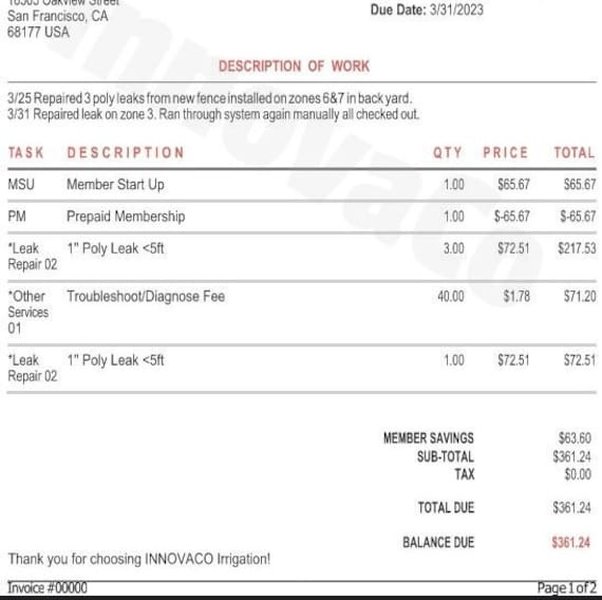
An example of an irrigation invoice template.
Leveraging Irrigation Business Software
For more established businesses or those looking to streamline their operations further, dedicated irrigation business software offers a comprehensive solution for invoicing and much more. These platforms often integrate quoting, scheduling, customer relationship management (CRM), and payment processing, in addition to invoicing.
Irrigation software automates many of the manual tasks associated with invoicing, such as calculating subtotals and taxes, tracking payments, and sending reminders. This automation not only saves time but also reduces the likelihood of errors.
Some popular features of irrigation business software related to invoicing include:
- Instant invoice generation upon job completion.
- Ability to create and send estimates and convert them to invoices.
- Integration with payment processors for online payments.
- Automated payment reminders for overdue invoices.
- Tracking of payment statuses.
- Integration with accounting software (e.g., QuickBooks).
Using software can also provide valuable insights into your business's financial health and help you manage client accounts more effectively.
Sending Invoices Electronically
Electronic invoicing is the most common and efficient method for sending invoices today. This typically involves sending the invoice as a PDF attachment via email. This method is fast, cost-effective, and provides a digital record of the sent invoice.
When sending invoices via email, ensure the subject line is clear and professional (e.g., "Invoice from [Your Business Name] - Invoice # [Invoice Number]"). The body of the email should include a brief message, reiterate the total amount due, and clearly state the payment terms and accepted payment methods. Attaching the invoice as a PDF ensures that the formatting remains consistent regardless of the recipient's device or software.
Traditional Mail
While less common for many businesses, sending invoices via traditional mail is still an option, particularly for clients who prefer paper copies or who may not have reliable internet access. This method is slower and incurs postage costs, but it can be a necessary option for certain clients.
If sending by mail, ensure the invoice is printed clearly and mailed in a professional envelope. Consider including a self-addressed stamped envelope for clients to return payment, which can encourage faster payment.
Facilitating Payment
Once an invoice is sent, making it easy for clients to pay is crucial for maintaining healthy cash flow. Offering multiple convenient payment options can significantly speed up the payment process.
Online Payment Methods
Integrating with online payment processors allows clients to pay their invoices electronically using credit cards, debit cards, or bank transfers (ACH). This is increasingly the preferred method for many clients due to its convenience and speed.
Many irrigation business software platforms offer built-in online payment processing or integrate with popular payment gateways like Stripe, PayPal, or Authorize.net. Offering online payment options can result in getting paid significantly faster.
Traditional Payment Methods
Accepting traditional payment methods like checks and cash is still important, as some clients may prefer these options. Ensure your invoice clearly states how and where to send checks if this is an accepted method.
In-Person Payments
For some services, accepting payment at the time of service completion is an option. This can be done with cash, check, or by using a mobile payment processing device.
Table: Comparison of Invoice Sending Methods
| Method | Pros | Cons | Best For |
|---|---|---|---|
| Using Templates (Manual) | Cost-effective, customizable, provides structure. | Time-consuming, potential for manual errors, limited tracking. | Small businesses, those with low invoice volume. |
| Irrigation Business Software | Automated calculations, integrated features (scheduling, CRM), efficient tracking, online payment integration. | Subscription cost, learning curve for new software. | Growing businesses, those with higher invoice volume, businesses seeking streamlined operations. |
| Electronic (Email PDF) | Fast, cost-effective, digital record, easy to send reminders. | Requires client email address, potential for emails to be missed or filtered. | Most businesses and clients. |
| Traditional Mail | Suitable for clients without email, provides a physical copy. | Slow, incurs postage costs, less efficient for tracking. | Clients who prefer paper invoices or lack email access. |
Tips for Effective Irrigation Invoicing
Beyond the basic elements and sending methods, several best practices can enhance your invoicing process and improve your cash flow.
Sending Invoices Promptly
Send invoices as soon as the work is completed. The sooner the invoice is sent, the sooner you can expect to receive payment. Delays in sending invoices can lead to delays in payment.
Clarity and Detail
Ensure your invoice is clear, easy to understand, and provides sufficient detail about the services rendered. Ambiguous invoices can lead to client questions and delays in payment.
Following Up on Overdue Invoices
Have a system in place for following up on invoices that are past their due date. This can involve sending reminder emails or making phone calls. Many irrigation business software solutions automate this process.
Maintaining Professionalism
Regardless of the method used, maintain a professional tone and appearance in all your invoicing communications. This reinforces your business's credibility.
Potential Challenges and Solutions
While the invoicing process is generally straightforward, some challenges can arise. Being prepared for these can help you navigate them effectively.
Disputed Charges
Occasionally, a client may dispute a charge on their invoice. Ensure you have clear records of the work performed and any agreements made with the client. Professional documentation and clear communication are key to resolving disputes.
Late or Non-Payment
Late or non-payment can impact your business's cash flow. Clearly stated payment terms, prompt invoicing, and consistent follow-up are essential. For persistent issues, consider involving a collections agency, although this should typically be a last resort.
Administrative Burden
Managing invoices can be time-consuming, especially for businesses with a large number of clients. Implementing irrigation business software can significantly reduce this administrative burden through automation and streamlined workflows.
Understanding Related Billing Aspects
While primarily focused on service invoices, it's worth noting other aspects related to irrigation billing that clients might encounter.
Water Bills and Irrigation Charges
Clients also receive separate water bills from their utility providers, which reflect their overall water consumption, including irrigation use. Understanding the components of a water bill, such as consumption charges, service fees, and potential irrigation-specific rates, is important for clients to manage their overall water costs.
This video discusses how a poorly managed irrigation system can lead to high water bills, highlighting the importance of efficient irrigation practices.
Some water providers may have specific billing structures or charges related to properties within irrigation districts. These fees can cover the maintenance and construction of irrigation and drainage systems.
Estimates and Quotes
Before sending an invoice, providing a detailed estimate or quote for the proposed irrigation work is a crucial step. This sets clear expectations for the client regarding the scope of work and the estimated cost. Many irrigation business software solutions also facilitate the creation and management of estimates.
FAQ: Common Questions About Irrigation Invoicing
What information should be included on an irrigation invoice?
A comprehensive irrigation invoice should include your business information, client information, invoice number and date, details of services rendered and materials used, quantities, prices, subtotal, taxes, total amount due, payment terms, and the payment due date.
What are the different ways to send an irrigation invoice?
Irrigation invoices can be sent using templates (via email or mail), through dedicated irrigation business software, or as a PDF attachment via email. Traditional mail is also an option.
How can I make it easier for clients to pay their irrigation invoices?
Offering multiple convenient payment options, such as online payment via credit card or ACH, checks, and potentially in-person payments, can significantly improve the likelihood and speed of payment.
When should I send out irrigation invoices?
It is best practice to send out irrigation invoices as soon as the services have been completed to encourage timely payment.
What should I do if a client doesn't pay their invoice?
Start by sending polite payment reminders. If payment remains outstanding, follow up with phone calls. For persistent non-payment, you may consider a formal demand letter or, as a last resort, a collections agency.
Recommended Further Reading
- What are the leading software options for irrigation business invoicing?
- What are the key elements of a professional service invoice?
- How can service businesses improve their cash flow through better invoicing?
- How are water bills calculated for properties with irrigation systems?
References
Last updated May 17, 2025