
Simplifying the Algebraic Expression
A comprehensive guide to simplifying polynomials and combining like terms
Key Takeaways
- Identify and group like terms to simplify complex algebraic expressions efficiently.
- Systematically combine coefficients to ensure accurate simplification.
- Understanding polynomial degrees aids in organizing and simplifying expressions effectively.
Introduction
Understanding the Problem
Simplifying algebraic expressions is a fundamental skill in mathematics that involves reducing complex expressions to their simplest form. This process not only makes calculations easier but also enhances comprehension of the relationships between different terms within the expression. The expression in question, 6x – 7 + 8x³ – 4x – 6x³ – 1 – 8x – 2x³, presents an opportunity to practice combining like terms and simplifying polynomials.
Importance of Simplification
Simplifying expressions is crucial for solving equations, performing integrations and differentiations in calculus, and understanding higher-level mathematical concepts. It also plays a significant role in various applications, including engineering, physics, economics, and computer science, where complex mathematical models are prevalent.
Step-by-Step Simplification
Step 1: Identifying Like Terms
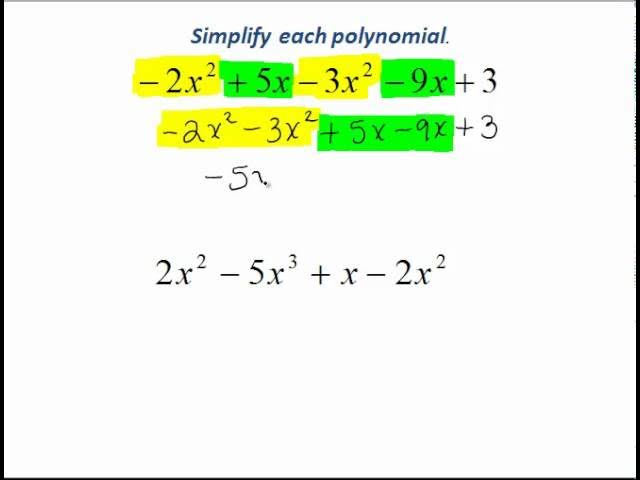
The first step in simplifying an algebraic expression is to identify like terms. Like terms are terms that contain the same variable raised to the same power. In the given expression, the like terms can be categorized based on their degree (the power of the variable):
Grouping Like Terms
| Term Category | Terms |
|---|---|
| Cubic Terms (x³) | 8x³, -6x³, -2x³ |
| Linear Terms (x) | 6x, -4x, -8x |
| Constant Terms | -7, -1 |
Step 2: Combining Like Terms
Once like terms are identified, the next step is to combine them by performing the necessary arithmetic operations on their coefficients.
Combining Cubic Terms
Focusing on the cubic terms:
\[ 8x³ - 6x³ - 2x³ = (8 - 6 - 2)x³ = 0x³ = 0 \]
The cubic terms cancel each other out, resulting in zero.
Combining Linear Terms
Next, we combine the linear terms:
\[ 6x - 4x - 8x = (6 - 4 - 8)x = -6x \]
Combining Constant Terms
Finally, we combine the constant terms:
\[ -7 - 1 = -8 \]
Step 3: Writing the Simplified Expression
After combining all the like terms, we compile the simplified components:
\[ 0 - 6x - 8 = -6x - 8 \]
Therefore, the simplified form of the original expression is -6x - 8.
Detailed Explanation
Understanding Polynomial Degrees
Polynomials are algebraic expressions consisting of variables and coefficients, structured in terms of powers of the variables. The degree of a polynomial is the highest power of the variable present in the expression. In our case, the original expression has terms of degree 3 (cubic), degree 1 (linear), and degree 0 (constants).
The Process of Combining Like Terms
Combining like terms is pivotal in simplifying expressions as it reduces complexity and makes further operations manageable. Here's a more granular look into each step:
1. Grouping Terms by Degree
Start by categorizing each term based on its degree. This categorization helps in identifying which terms can be combined. In our expression:
- Cubic Terms (x³): 8x³, -6x³, -2x³
- Linear Terms (x): 6x, -4x, -8x
- Constant Terms: -7, -1
2. Performing Arithmetic Operations
Once like terms are grouped, the next step is to combine them by adding or subtracting their coefficients. It's essential to pay attention to the signs (positive or negative) of each term during this process:
-
Cubic Terms:
\[ 8x³ - 6x³ - 2x³ = (8 - 6 - 2)x³ = 0x³ = 0 \]
The cubic terms eliminate each other, resulting in zero.
-
Linear Terms:
\[ 6x - 4x - 8x = (6 - 4 - 8)x = -6x \]
-
Constant Terms:
\[ -7 - 1 = -8 \]
3. Compiling the Simplified Expression
After performing the arithmetic operations, the simplified terms are:
\[ 0x³ - 6x - 8 = -6x - 8 \]
This final expression is much simpler and easier to work with.
Common Mistakes to Avoid
1. Misidentifying Like Terms
One common mistake is incorrectly identifying like terms. It's crucial to ensure that only terms with the same variable raised to the same power are combined. For instance, x³ and x² are not like terms and should not be combined.
2. Sign Errors
Another frequent error involves mismanaging positive and negative signs during addition or subtraction. Always pay careful attention to the signs to avoid incorrect coefficients in the simplified expression.
3. Forgetting to Combine All Like Terms
Ensure that all like terms are combined. Overlooking even one term can lead to an incorrect final expression.
4. Incorrect Arithmetic Operations
Simple arithmetic mistakes, such as incorrect addition or subtraction of coefficients, can lead to wrong results. Always double-check calculations to maintain accuracy.
Applications of Simplifying Expressions
1. Solving Equations
Simplified expressions are essential when solving algebraic equations. They make it easier to isolate variables and find solutions.
2. Calculus
In calculus, simplifying expressions is crucial for performing differentiation and integration. Simple expressions lead to more straightforward calculations and clearer insights into the behavior of functions.
3. Engineering and Physics
Engineers and physicists often deal with complex formulas. Simplifying these expressions helps in modeling physical phenomena and designing systems.
4. Computer Science
In computer algorithms and programming, simplified expressions can enhance computational efficiency and optimize performance.
Conclusion
Simplifying algebraic expressions is a fundamental mathematical skill that facilitates problem-solving across various domains. By methodically identifying and combining like terms, one can reduce complex expressions to their simplest form, enhancing both comprehension and computational efficiency. The expression 6x – 7 + 8x³ – 4x – 6x³ – 1 – 8x – 2x³ simplifies elegantly to -6x - 8, demonstrating the power of systematic simplification.
References
Last updated February 13, 2025