
Optimizing Solar Thermal Systems: The Interplay of Equilibrium Temperature and Concentration
Unlocking Efficiency and Performance in Renewable Energy Generation
Key Insights into Solar Thermal Optimization
- Equilibrium Temperature: A fundamental concept in solar thermal systems, defining the stable temperature achieved when absorbed solar energy equals emitted thermal energy. Understanding and manipulating this temperature is crucial for maximizing efficiency.
- Solar Concentration's Role: Concentrating solar power (CSP) systems utilize mirrors or lenses to focus sunlight, significantly increasing the solar flux and thus the achievable temperatures in a receiver, which is vital for high-efficiency electricity generation and industrial heat applications.
- Synergistic Optimization: The optimal performance of a solar thermal system is not merely about achieving high temperatures or high concentration ratios independently. Instead, it lies in the synergistic optimization of both equilibrium temperature and solar concentration, balancing thermodynamic efficiency with practical material and economic constraints.
Solar thermal energy, a cornerstone of renewable power, leverages the sun's abundant radiant energy to generate heat, which can then be directly utilized or converted into electricity (Repsol, n.d.; National Grid, n.d.). Unlike photovoltaic (PV) systems that directly convert sunlight into electricity, solar thermal technologies focus on harnessing the thermal component of solar radiation (EnergySage, n.d.). This chapter delves into two critical aspects governing the efficiency and applicability of solar thermal systems: equilibrium temperature and solar concentration. By understanding the intricate relationship between these two concepts, we can better design and optimize solar thermal technologies for diverse applications, from residential heating to large-scale industrial processes and electricity generation.
The Essence of Solar Thermal Energy Conversion
Solar thermal energy involves the conversion of solar radiation into thermal energy. This process relies on fundamental principles of heat transfer, including absorption, conduction, convection, and radiation (Newheat, n.d.; Evergreenenergy.pro, n.d.; Tara Energy, n.d.). At its core, a solar thermal system collects sunlight and transfers the absorbed energy to a heat transfer medium, which then circulates to deliver heat for various purposes (Hargassner, n.d.).
Types of Solar Thermal Systems
Solar thermal systems broadly fall into two categories based on their design and the temperatures they achieve:
- Non-concentrating Systems: These systems, such as flat plate and evacuated tube collectors, are typically used for low to medium-temperature applications (up to 100°C), primarily for domestic hot water and space heating (Renewable Thermal Collaborative, n.d.; Solar-energy.technology, n.d.). They directly absorb solar radiation over a broad area.
- Concentrating Solar Power (CSP) Systems: These are more advanced technologies that use mirrors or lenses to focus a large area of sunlight onto a smaller receiver, generating much higher temperatures (up to 1,000°C) (Renewable Thermal Collaborative, n.d.; SEIA, n.d.). This concentrated heat is then used to generate electricity via steam turbines or power engines, or for high-temperature industrial processes (Energy.gov, n.d.; ScienceDirect Topics, n.d. - 'Concentrating Solar-Thermal Power Basics'; Wikipedia, n.d. - 'Concentrated solar power').
The ability to achieve high temperatures in CSP systems is a significant advantage, as higher temperatures lead to more efficient conversion of thermal energy into electricity and enable more effective thermal energy storage (Wikipedia, n.d. - 'Solar thermal energy').
Equilibrium Temperature: The Thermal Balance Point
The concept of equilibrium temperature is central to understanding how solar thermal systems operate and how planets maintain their thermal balance. In simple terms, equilibrium temperature is the stable temperature an object reaches when the rate of energy absorbed from its surroundings equals the rate of energy it emits (ScienceDirect Topics, n.d. - 'Equilibrium Temperature'; UCAR Center for Science Education, n.d.). For a solar thermal receiver or even a planet, this balance is crucial for determining its operating temperature.
Calculating Equilibrium Temperature in Solar Systems
For an object receiving solar radiation, its equilibrium temperature is primarily determined by the incoming solar flux, its albedo (the fraction of incoming radiation it reflects), and its emissivity (its efficiency in radiating heat) (ScienceDirect Topics, n.d. - 'Equilibrium Temperature'; UCAR Center for Science Education, n.d.). The fundamental principle is that the absorbed solar flux must balance the emitted thermal flux. This can be expressed using the Stefan-Boltzmann law for blackbody radiation, although real-world objects deviate from ideal blackbody behavior.
The equation for the equilibrium temperature (\(T_{eq}\)) of a simplified object in space, assuming it behaves like a blackbody and is in radiative equilibrium, can be derived by equating the absorbed solar power to the emitted thermal power:
\[ \text{Absorbed Power} = \text{Emitted Power} \]The absorbed power from the sun (\(P_{abs}\)) by a spherical object with radius \(R\) and albedo \(\alpha\) at a distance \(d\) from the sun (with solar constant \(S\)) is given by:
\[ P_{abs} = \pi R^2 S (1 - \alpha) \]The emitted power (\(P_{emit}\)) by the spherical object, assuming it radiates as a blackbody with temperature \(T_{eq}\) and emissivity \(\epsilon\) (often taken as 1 for a perfect blackbody), is given by the Stefan-Boltzmann law:
\[ P_{emit} = 4 \pi R^2 \sigma T_{eq}^4 \]Where \(\sigma\) is the Stefan-Boltzmann constant (\(5.67 \times 10^{-8} \, \text{W m}^{-2} \text{K}^{-4}\)).
Setting \(P_{abs} = P_{emit}\) and assuming emissivity \(\epsilon = 1\) for simplicity:
\[ \pi R^2 S (1 - \alpha) = 4 \pi R^2 \sigma T_{eq}^4 \]Solving for \(T_{eq}\):
\[ T_{eq} = \left( \frac{S (1 - \alpha)}{4 \sigma} \right)^{1/4} \]This equation highlights that the equilibrium temperature of a planet (or a solar receiver) depends on the solar intensity, its albedo, and fundamental physical constants, but not on its size (Princeton University, n.d. - 'Equilibrium Temperatures of Planets'). However, for practical solar thermal receivers, material properties and heat losses to the environment play a significant role.
Equilibrium Temperature in CSP
In CSP systems, the goal is to achieve very high equilibrium temperatures in the receiver to maximize the efficiency of the power cycle (ScienceDirect, n.d. - 'Optimal concentration and temperatures of solar thermal power plants'). While the theoretical equilibrium temperature of a solar absorber can be calculated, practical limitations such as material constraints for receivers (typically around 900°K or 627°C) influence the achievable operating temperatures (Stanford University, n.d. - 'The Physics of Solar Concentration'). For instance, increasing the concentration ratio allows for higher temperatures in the receiver, but this must be balanced against heat losses and material integrity (ScienceDirect, n.d. - 'Optimal concentration and temperatures of solar thermal power plants').
Solar Concentration: Magnifying the Sun's Power
Solar concentration is the process of using mirrors or lenses to focus a large area of sunlight onto a much smaller area, thereby increasing the intensity of the solar radiation (ScienceDirect Topics, n.d. - 'Solar Concentration - an overview'; ScienceDirect Topics, n.d. - 'Solar Concentrators - an overview'). This increase in solar flux is crucial for achieving the high temperatures required for efficient solar thermal electricity generation and various industrial applications.
Mechanisms of Concentration
Different types of solar concentrators employ various optical designs:
- Parabolic Troughs: These systems use long, U-shaped parabolic mirrors to focus sunlight onto a receiver tube running along the focal line. A heat transfer fluid inside the tube is heated to high temperatures (U.S. Energy Information Administration, n.d. - 'Solar thermal power plants').
- Solar Power Towers: These systems use an array of large, flat, sun-tracking mirrors (heliostats) to reflect and concentrate sunlight onto a central receiver located at the top of a tower. This design can achieve very high temperatures and offers good energy storage capabilities (Wikipedia, n.d. - 'Concentrated solar power'; SolarPACES, n.d.).
- Parabolic Dishes: These are dish-shaped concentrators that focus sunlight to a single focal point, often integrated with a Stirling engine. They offer high solar-to-electric conversion efficiency (Wikipedia, n.d. - 'Concentrated solar power').
- Linear Fresnel Reflectors: Similar to parabolic troughs, but use a series of flat or slightly curved mirrors to focus sunlight onto an overhead receiver tube, often for lower to medium temperature applications (Solar-energy.technology, n.d. - 'What is a solar concentrator?').
The efficiency of a solar concentrator is often measured by its concentration ratio, which is the ratio of the aperture area (collecting area) to the receiver area. A higher concentration ratio generally leads to higher achievable temperatures and potentially higher efficiencies, but also introduces engineering challenges related to precision tracking and heat management (Stanford University, n.d. - 'The Physics of Solar Concentration').
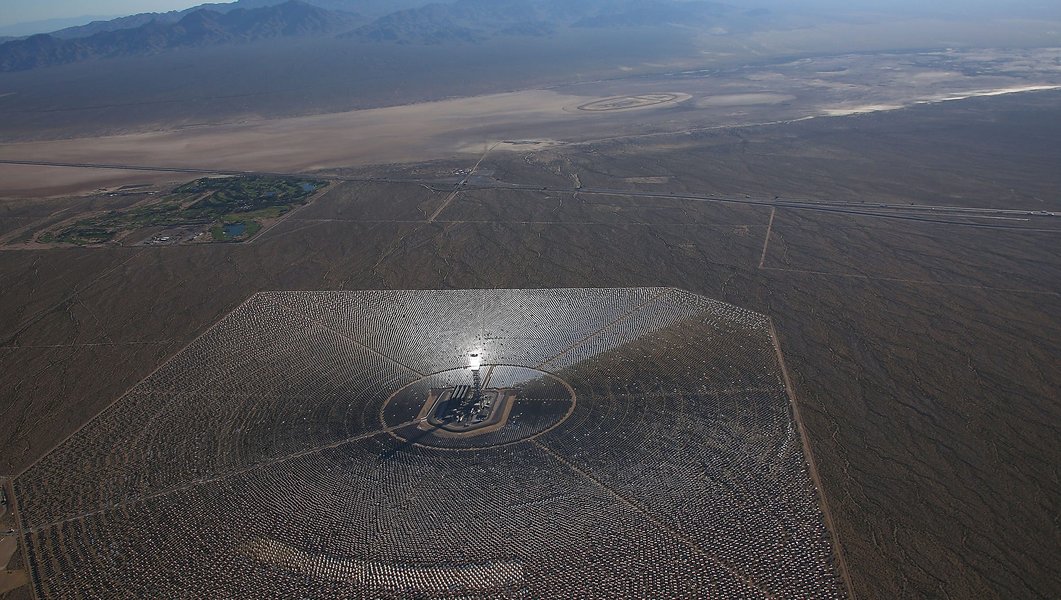
Aerial view of the Ivanpah Solar Electric Generating System, a large-scale CSP plant utilizing power tower technology.
The Advantages of High Concentration
High solar concentration enables several advantages:
- Higher Temperatures: Crucial for thermodynamic cycles like the Rankine cycle used in electricity generation, as higher temperatures lead to higher Carnot efficiency (ScienceDirect, n.d. - 'Optimal concentration and temperatures of solar thermal power plants').
- Efficient Thermal Energy Storage: Higher temperatures allow for the use of molten salt or other high-temperature storage media, enabling electricity generation during cloudy periods or after sunset (SolarPACES, n.d.; Wikipedia, n.d. - 'Solar thermal energy').
- Broader Industrial Applications: Concentrated solar heat can be used for various industrial processes requiring high temperatures, such as water desalination, enhanced oil recovery, food processing, and chemical production (Energy.gov, n.d. - 'Concentrating Solar-Thermal Power Basics'; Heliogen, n.d.).
- Reduced Receiver Size: By concentrating sunlight, the active area of the receiver can be significantly smaller, potentially reducing material costs and heat losses.
The Interplay: Equilibrium Temperature and Solar Concentration
The relationship between equilibrium temperature and solar concentration is fundamentally intertwined. Solar concentration is the primary mechanism by which solar thermal systems elevate the absorbed energy, thereby driving up the equilibrium temperature of the receiver. Without concentration, achieving the high temperatures necessary for efficient power generation or high-temperature industrial heat is impossible (Stanford University, n.d. - 'The Physics of Solar Concentration').
Optimizing for Efficiency
Designing an optimal CSP system involves a delicate balance between maximizing the concentration ratio and managing the resulting high temperatures. While higher temperatures generally lead to higher thermodynamic efficiency, they also impose greater stress on materials and can increase heat losses if not properly insulated (ScienceDirect, n.d. - 'Optimal concentration and temperatures of solar thermal power plants'). The selection of materials for receivers and heat transfer fluids is critical to withstand these extreme conditions.
For example, power tower systems, with their higher concentration ratios, can achieve much higher operating temperatures compared to parabolic trough systems. This higher temperature capability allows power towers to utilize more efficient power cycles (such as super-critical Rankine cycles) and more effectively integrate with molten salt thermal energy storage, providing greater dispatchability of electricity (Wikipedia, n.d. - 'Solar thermal energy'; ScienceDirect, n.d. - 'Optimal concentration and temperatures of solar thermal power plants').
This radar chart illustrates the perceived performance characteristics of different Concentrating Solar Power (CSP) technologies across key metrics, reflecting their strengths and weaknesses in achieving optimal equilibrium temperature and solar concentration.
Challenges and Future Directions
Despite the advancements, challenges remain. High temperatures can lead to material degradation, and the precise tracking required for high concentration systems adds to complexity and cost (ScienceDirect, n.d. - 'A review of solar concentration technology applications in deep ...'). Future research focuses on developing advanced materials that can withstand even higher temperatures, optimizing optical designs for improved efficiency, and enhancing system integration to reduce costs and improve reliability (ScienceDirect, n.d. - 'A review of solar concentration technology applications in deep ...').
Applications of Concentrated Solar Power
The high temperatures achievable through solar concentration open up a wide range of applications beyond traditional electricity generation:
- Industrial Process Heat: Many industries, such as food processing, chemical production, and mineral processing, require significant amounts of heat. CSP can provide this heat, offering a sustainable alternative to fossil fuels and helping to decarbonize industrial sectors (Energy.gov, n.d. - 'Concentrating Solar-Thermal Power Basics'; Heliogen, n.d.).
- Water Desalination: High-temperature solar thermal energy can be used in thermal desalination processes, providing a clean source of fresh water in arid regions (Energy.gov, n.d. - 'Concentrating Solar-Thermal Power').
- Enhanced Oil Recovery: Steam generated from concentrated solar energy can be injected into oil reservoirs to facilitate the extraction of heavy crude oil (Energy.gov, n.d. - 'Concentrating Solar-Thermal Power').
- Solar Fuels and Chemicals: Research is ongoing into using concentrated solar energy to drive thermochemical reactions for producing solar fuels (e.g., hydrogen) and other chemicals (e-education.psu.edu, n.d. - '7.1 Introducing Concentrating Solar Power').
The following table summarizes the characteristics and applications of different concentrating solar power technologies:
| CSP Technology | Concentration Mechanism | Typical Operating Temperature Range (°C) | Primary Applications | Key Advantages | Key Considerations |
|---|---|---|---|---|---|
| Parabolic Trough | Parabolic mirrors focus sunlight onto a receiver tube at the focal line. | 200-400 | Electricity generation (Rankine cycle), Industrial process heat. | Mature technology, good reliability, relatively lower cost than power towers. | Lower efficiency than power towers, requires large land area. |
| Solar Power Tower | Heliostats (tracking mirrors) reflect sunlight to a central receiver on a tower. | 500-1000+ | Electricity generation (Rankine or Brayton cycle), High-temperature industrial heat, Thermal energy storage. | Highest efficiency, excellent thermal storage potential, higher temperatures. | Complex tracking systems, higher initial cost, visual impact. |
| Parabolic Dish/Stirling Engine | Dish-shaped concentrator focuses sunlight to a Stirling engine at its focal point. | 750-1000 | Distributed electricity generation. | Highest solar-to-electric efficiency (31-32%), modular, scalable. | No integrated thermal storage, individual units require tracking. |
| Linear Fresnel Reflector | Series of flat or slightly curved mirrors focus sunlight onto an overhead receiver. | 100-300 (can reach higher with advanced designs) | Electricity generation, Industrial process heat, Solar cooling. | Simpler structure, lower cost, easier maintenance than troughs. | Lower concentration ratio than troughs, susceptible to optical degradation at very high temperatures. |
These diverse applications underscore the versatility of solar thermal technology, especially when coupled with effective solar concentration, in addressing a significant portion of global energy demands, particularly for heat which constitutes a large percentage of industrial energy consumption (Heliogen, n.d.).
Deep Dive: How CSP Works for Electricity Generation
The process of generating electricity using CSP systems, particularly power towers, is a fascinating display of engineering prowess. Let's explore this further with a visual aid:
This video provides an excellent animated explanation of how Concentrating Solar Thermal Power Plants work to produce electricity.
As explained in the video, CSP plants convert solar energy into electricity by following several key steps:
- Solar Concentration: A large field of mirrors, known as heliostats, precisely tracks the sun and reflects its rays onto a central receiver atop a tall tower. This immense concentration of sunlight creates extremely high temperatures at the receiver.
- Heat Transfer: Inside the receiver, a heat transfer fluid (often molten salt due to its high thermal stability and ability to store heat) absorbs the concentrated solar energy, reaching temperatures of 500-1000°C or more.
- Steam Generation: The superheated fluid then transfers its thermal energy to a conventional steam turbine cycle. Water is heated to produce high-pressure, superheated steam.
- Electricity Generation: This steam drives a turbine, which in turn spins a generator to produce electricity. This process is essentially a modified Rankine cycle, similar to that used in conventional fossil fuel power plants, but fueled by solar heat.
- Thermal Energy Storage (TES): A significant advantage of CSP, especially molten salt systems, is the ability to store thermal energy. The molten salt can be stored in large tanks, allowing the plant to continue generating electricity even when the sun is not shining, such as during cloudy periods or several hours after sunset (SolarPACES, n.d.; U.S. Energy Information Administration, n.d. - 'Solar thermal power plants'). This provides a dispatchable and reliable renewable energy source, overcoming the intermittency challenges associated with other solar technologies.
This integration of light concentration, thermal transfer fluids, steam-powered turbines, and thermal energy storage makes CSP a robust and promising technology for large-scale power generation (e-education.psu.edu, n.d. - '7.1 Introducing Concentrating Solar Power | EME 812: Utility Solar ...').
Conclusion
The effective harnessing of solar thermal energy hinges on a profound understanding and intelligent manipulation of equilibrium temperature and solar concentration. Solar concentration technologies are pivotal in elevating temperatures to levels suitable for efficient electricity generation and demanding industrial processes. The concept of equilibrium temperature provides the theoretical foundation for predicting and optimizing the thermal performance of these systems. As the world transitions towards a more sustainable energy future, continuous innovation in solar concentration techniques and heat management strategies will be essential for unlocking the full potential of solar thermal energy, making it an increasingly viable and critical component of the global energy mix. The synergy between achieving high concentration ratios and maintaining optimal equilibrium temperatures underpins the performance and economic viability of advanced solar thermal solutions, offering a path to significant carbon emission reductions.
Frequently Asked Questions
What is the main difference between solar thermal and solar photovoltaic (PV) systems?
Why is a high concentration ratio important in CSP systems?
Can solar thermal energy be stored for later use?
What are the primary applications of concentrated solar power beyond electricity generation?
How does equilibrium temperature relate to the greenhouse effect?
Recommended Further Reading
- Explore advanced materials for high-temperature solar receivers.
- Investigate the role of thermal energy storage in dispatchable Concentrating Solar Power.
- Delve into the different thermodynamic cycles used in concentrating solar power plants.
- Understand the economic viability of industrial solar process heat applications.