
Exploring Words with Similar Sounds: A Deep Dive into Phonetic Resemblance
Unpacking the Sounds of "huh-bich-u-ware-re" and Potential Matches
Understanding how words sound is a fascinating aspect of language. While there might not be an exact single word that perfectly matches the complex phonetic string "huh-bich-u-ware-re," we can break down this sequence into its constituent sounds and explore English words that share similar pronunciations or elements. This exploration delves into phonetics, the study of speech sounds, and how subtle differences can distinguish one word from another.
Key Insights into Pronunciation and Sound-Alikes
- The "huh" sound: The initial "huh" sound is remarkably prevalent across many languages, often used to express confusion or seek clarification. This sound is typically produced with a relaxed mouth and a central vowel.
- Deconstructing the sequence: The phonetic sequence "huh-bich-u-ware-re" is likely a combination of perceived sounds rather than a standard English word or phrase. Analyzing each part individually is crucial for finding potential matches.
- Homophones and similar-sounding words: English has many words that sound alike but have different spellings and meanings (homophones), as well as words that are near-homophones. Identifying these can help find words that approximate parts of the target sound.
Analyzing the Sounds: A Phonetic Breakdown
To find words that sound like "huh-bich-u-ware-re," we need to consider each part of the sequence phonetically. This involves looking at the individual sounds and how they are produced.
The Initial "Huh" Sound
The sound "huh" is a common interjection used in English and many other languages. It's often represented phonetically by the International Phonetic Alphabet (IPA) symbol /ʌ/ for the vowel sound, sometimes preceded by an /h/ sound or a glottal stop. The /ʌ/ vowel is a short vowel sound, produced with a relatively relaxed tongue and a mid-to-open jaw.
Interestingly, research suggests that a sound similar to "huh?" is a universal word, used across different languages to initiate clarification when there's a misunderstanding. This is thought to be due to "selective pressures in its conversational environment" and the ease of producing the sound with a relaxed mouth.
Here is an image illustrating the phonemic chart, which helps visualize different speech sounds:
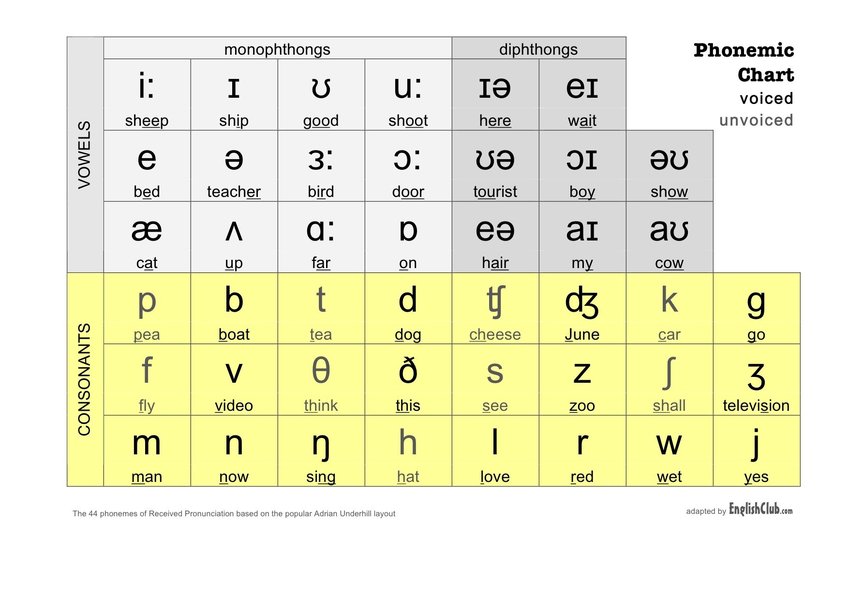
The International Phonemic Chart, showing various speech sounds.
Deconstructing "Bich-u"
The "bich-u" part of the sequence is more challenging as it doesn't immediately correspond to a common English word or sound combination. If we interpret "bich" as potentially sounding like "bitch," the vowel sound would be similar to the "i" in "sit" or "pitch," which is the /ɪ/ sound in IPA. The "ch" sound is typically represented by /tʃ/.
The addition of "-u" after "bich" is unclear in terms of standard English pronunciation. It might represent a schwa sound (/ə/), a "oo" sound (/uː/ or /ʊ/), or another vowel sound depending on the intended pronunciation. Without further context or a clearer phonetic representation, pinpointing an exact match for "bich-u" is difficult.
It's worth noting that names from other languages, like Vietnamese, might contain sounds that are less common in English. For example, the pronunciation of a Vietnamese name like "Bich" involves a vowel sound that can be challenging for English speakers.
Exploring "Ware-re"
The "ware-re" portion strongly suggests words that sound like "ware," "wear," "where," or "we're." These are well-known homophones or near-homophones in English. The sound is typically the /ɛər/ diphthong or a similar vowel-consonant combination.
-
Ware: Refers to manufactured goods or products.
-
Wear: Means to have clothing or accessories on your body, or to deteriorate with use.
-
Where: Refers to a place or position. It contains the word "here," which can be a helpful memory trick.
-
We're: A contraction of "we are."
Another similar-sounding word is "weir," which is a low dam built across a river. Less commonly, "whir" or "whirr" (an onomatopoeic word for a rapid, buzzing sound) can also sound similar in some accents, particularly to "were," which itself can sound similar to "we're" and "where" in some American speech.
Here is a table summarizing these similar-sounding words:
| Word | Meaning/Usage | IPA Pronunciation (General American) |
|---|---|---|
| Ware | Manufactured goods | /wɛər/ |
| Wear | To have on the body; deteriorate | /wɛər/ |
| Where | Place or position | /wɛər/ |
| We're | Contraction of "we are" | /wɪər/ or /wɛər/ |
| Weir | Low dam across a river | /wɪər/ or /wɛər/ |
| Were | Past tense of "be" | /wɜr/ |
| Whir / Whirr | Buzzing sound | /wɜr/ |
The final "-re" sound in the user's sequence is also ambiguous. It could be a schwa sound (/ə/), a reduced vowel, or part of a longer word ending. Without more context, it's difficult to determine its intended phonetic value.
Putting it Together: Finding Potential Matches
Given the analysis of the individual sound components, finding a single English word that precisely matches "huh-bich-u-ware-re" is highly unlikely. The sequence appears to be a phonetic approximation of sounds that might be present in a name, a foreign word, or a non-standard English utterance.
However, we can consider combinations of words or phrases that might approximate the sound. For instance, a sequence of sounds like "huh," followed by a sound similar to "bitch," and then a word like "where" or "wear" could sound somewhat similar.
For example, imagine someone expressing confusion ("huh?") followed by a frustrated exclamation ("bitch!") and then asking about a location ("where?"). While this is a hypothetical and potentially impolite combination, it illustrates how the individual sound components could be combined in a spoken context.
Another possibility is that the sequence represents a non-English name or word. Many languages have phonetic structures that differ significantly from English, and direct transliteration of sounds can result in unfamiliar-looking or sounding combinations.
Considering Context
The context in which the user heard or encountered this sound sequence is crucial. Was it part of a conversation, a song, a movie, or something else? Knowing the context could provide valuable clues about the origin and intended meaning of the sounds.
For example, if the sound was part of a movie script, like the examples provided from the JAWS script, it might be a character's name, a place name (like "South Beach"), or an exclamation. In the JAWS script, we see names like "Cassidy" and "Chrissie" and locations like "South Beach" and "Jones Beach," but none that closely match "huh-bich-u-ware-re."
If the sound relates to a name, it could be from a language where such sound combinations exist. Pronunciation guides, like those for Vietnamese names, highlight the challenges English speakers face with certain foreign sounds.
The Nature of Utterances
It's also possible that "huh-bich-u-ware-re" is not a formal word but an utterance or a series of sounds used in informal communication. Linguistic analysis of utterances, including "filler words" or "non-lexical conversation sounds" like "uh," "um," and "uh-huh," shows that not all vocalizations in speech are formal words with defined spellings and meanings.
The "uh-huh" sound, for instance, is used to indicate agreement or understanding and is distinct from "huh?" which signals a lack of understanding. These utterances are part of paralanguage, the non-verbal elements of communication.
Exploring "Huh?" as a Universal Phenomenon
The prevalence of the "huh?" sound across languages is a fascinating linguistic phenomenon. It highlights a shared human need for quick clarification in conversation. This simple sound, often dismissed as a mere grunt, plays a significant role in facilitating understanding and repairing communication breakdowns.
Researchers have found similar sounds with the same function in numerous languages from different language families, suggesting it's not a coincidence but a result of convergent evolution in language. The sound's simplicity and ease of production make it an efficient tool for signaling a need for repetition or clarification.
Here is a video that further explores the idea of "huh?" being a universal word:
Exploring the universality of the word "Huh?"
This video delves into the research behind why this sound is so common across the globe and its importance in human interaction.
Conclusion
While a direct match for the phonetic string "huh-bich-u-ware-re" in standard English is improbable, breaking down the sounds allows us to explore similar elements in existing words and linguistic phenomena. The "huh" component points to a universal interjection, while the "ware-re" part likely relates to homophones like "ware," "wear," "where," and "we're." The "bich-u" section remains the most ambiguous, possibly indicating a non-English origin or a less common sound combination in English.
Ultimately, understanding the context in which this sound sequence was encountered is key to potentially identifying its intended meaning or origin. Without that context, we can only analyze the phonetic components and draw parallels to known English sounds and words.
Frequently Asked Questions
Is "huh" a real word?
"Huh" is considered an interjection and is recognized as a word in English and many other languages, used to express confusion or to request repetition or clarification.
Why do so many languages have a sound like "huh"?
The similarity of the "huh" sound across languages is believed to be a result of its functional efficiency in conversation for initiating repair when there's a misunderstanding. It's easy to produce with a relaxed mouth and serves a universal communication need.
What are homophones?
Homophones are words that sound the same but have different spellings and meanings, such as "ware," "wear," and "where."
Can phonetic analysis help understand unfamiliar words?
Yes, phonetic analysis, which involves breaking down words into their individual speech sounds, can help in approximating the pronunciation of unfamiliar words and understanding how they relate to known sounds in a language.
References
Last updated April 25, 2025