
Tariff Wars Decoded: How US Trade Policies Reshape the Economic Landscape for China and India
A comprehensive analysis of tariff impacts, growth trajectories, and globalization effects on the world's two most populous economies
Essential Insights on US-Initiated Tariff War
- Strategic Positioning: India faces a 26-27% tariff from the US, still lower than China's 34%, creating a relative competitive advantage in certain export sectors
- Economic Resilience: Despite tariff challenges, India maintains a robust growth projection of 6.1-6.8% for 2025/26, showcasing economic durability amid trade tensions
- Trade Diversification: Both nations must accelerate market diversification strategies, with India's ongoing FTA negotiations providing potential buffers against US market dependencies
Key Learnings for India from the US Tariff War
The recent imposition of a 26-27% tariff on Indian exports to the United States represents a significant shift in trade dynamics that offers multiple strategic lessons for India's economic policymakers. These tariffs are part of a broader protectionist stance affecting global trade networks, with varying impacts across different economies.
Sector-Specific Vulnerabilities and Opportunities
The tariff implementation affects Indian industries asymmetrically, creating both challenges and strategic openings:
- Vulnerable Sectors: Textiles, jewelry, chemicals, plastics, and automotive components face immediate competitive pressure in the US market due to price increases.
- Resilient Sectors: Pharmaceuticals have largely been exempted from these tariffs, positioning India's robust pharmaceutical industry for continued growth in the US market.
- Comparative Position: India's tariff rate (26-27%) remains lower than those imposed on key competitors like China (34%), Vietnam (46%), and Bangladesh (37%), creating potential market share opportunities.
Strategic Trade Policy Responses
India's policy response options include both defensive and proactive measures:
- Bilateral Negotiations: Engaging in direct trade negotiations with the US to potentially reduce tariffs, particularly focusing on the $46 billion trade deficit cited as a key concern.
- Market Diversification: Accelerating efforts to diversify export destinations beyond the US market, particularly focusing on emerging economies and regional trade partnerships.
- Sectoral Support: Implementing targeted support for affected industries through export incentives, quality improvement initiatives, and technological upgrades to maintain competitive advantages.
- Supply Chain Integration: Positioning India as an alternative manufacturing hub for companies seeking to diversify away from China's higher tariff exposure.
Tariff Impact Analysis by Industry Segment
Different segments of the Indian economy face varying degrees of vulnerability to US tariff policies:
| Industry Sector | Tariff Impact Level | Key Challenges | Strategic Opportunities |
|---|---|---|---|
| Pharmaceuticals | Low | Regulatory compliance costs | Market share expansion due to exemptions |
| Textiles & Apparel | High | Price competitiveness reduction | Relative advantage vs China's higher tariffs |
| Gems & Jewelry | High | Luxury market sensitivity | Value addition to offset tariff impacts |
| IT Services | Moderate | Indirect impact through client industries | Digital transformation acceleration |
| Automotive Components | High | Supply chain disruptions | Electric vehicle component specialization |
Prospective Growth Trajectories: China and India
The ongoing tariff war creates divergent growth paths for China and India, influenced by their respective economic structures, demographic profiles, and policy responses to global trade disruptions.
Comparative Growth Dynamics
China and India exhibit markedly different economic profiles that influence their resilience and adaptation to trade tensions:
- China's Plateau: China's working-age population peaked in 2012, and its technological gap with advanced economies is narrowing, potentially leading to moderating growth rates as it transitions to a consumption-driven economy.
- India's Demographic Dividend: India's economic growth benefits from a growing working-age population, creating opportunities for manufacturing expansion and domestic market growth.
- Growth Projections: Despite global disruptions, India maintains a growth projection of 6.1-6.8% for 2025/26, while China's growth may face more significant headwinds due to higher tariff exposure and structural transitions.
Structural Economic Transformations
Both economies are undergoing fundamental transformations that shape their response to tariff pressures:
- China's Transition: Moving from export-led growth to a model balancing domestic consumption, high-tech manufacturing, and services, with initiatives like the Belt and Road providing alternative market access.
- India's Industrialization: Accelerating manufacturing capacity through initiatives like "Make in India," while leveraging strengths in services exports and emerging as a potential alternative in global supply chains.
- Technology and Innovation: Both countries are investing heavily in technological capabilities, with China leading in artificial intelligence and advanced manufacturing, while India demonstrates strengths in software services and pharmaceutical innovation.
Comparative Economic Indicators
This radar chart illustrates the comparative strengths of China and India across seven key economic indicators, highlighting their complementary capabilities and competitive positions in the global economy.
Impact of Globalization on China and India
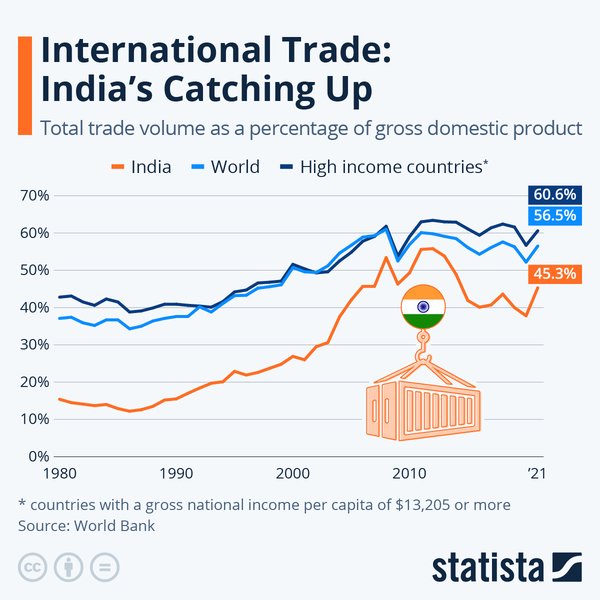
Globalization has transformed both economies over the past three decades, with their integration into global markets yielding different outcomes and challenges that shape their responses to current trade tensions.
Historical Globalization Benefits
- China's Manufacturing Ascent: China leveraged globalization to become the world's factory, experiencing rapid economic growth since 1990 and lifting hundreds of millions out of poverty.
- India's Services Revolution: India capitalized on its English-speaking workforce and educational advantages to become a global IT and business process outsourcing hub.
- Foreign Investment: Both countries attracted significant foreign direct investment, though China's manufacturing focus resulted in larger investment volumes compared to India's services-oriented approach.
Globalization Challenges and Responses
The current tariff war represents a significant shock to the globalization model that both countries have leveraged for growth:
- Supply Chain Resilience: The tariff war has accelerated the "China+1" strategy among global manufacturers, creating opportunities for India to capture relocating production.
- Self-Reliance Initiatives: Both countries have responded with policies promoting domestic manufacturing and reduced import dependence, such as China's "dual circulation" strategy and India's "Atmanirbhar Bharat" (Self-Reliant India).
- Regional Integration: As global trade tensions rise, both countries are strengthening regional economic partnerships, with China's Belt and Road Initiative and India's engagement with ASEAN and other regional forums.
Globalization Timeline and Impact
The following mindmap illustrates the key phases of globalization and their distinct impacts on China and India:
Analytical Framework for Assessing Tariff Impacts
A structured analytical approach helps evaluate the multidimensional effects of tariffs on both economies and their future growth prospects.
Economic Impact Assessment
The tariff war generates cascading effects across multiple economic dimensions:
- Trade Balance Effects: Tariffs directly impact bilateral trade balances, potentially reducing India's $46 billion trade deficit with the US while increasing supply chain costs.
- Sectoral Redistribution: Export-oriented sectors face immediate pressure, while domestic market-focused industries may benefit from import substitution effects.
- Investment Flows: Tariff uncertainty affects investment decisions, potentially redirecting manufacturing investments from China to alternative locations including India.
- Monetary Policy Implications: Tariff-induced inflation may complicate central bank policies in both countries, limiting flexibility in interest rate decisions.
Strategic Response Analysis
Both countries are employing multifaceted strategies to navigate the changing trade landscape:
- Diplomatic Engagement: Bilateral and multilateral negotiations to address trade tensions and secure favorable terms.
- Industrial Policy: Targeted interventions to support affected sectors and promote domestic manufacturing capabilities.
- Trade Diversification: Expanding trade relationships with emerging markets and regional partners to reduce US market dependence.
- Innovation Focus: Accelerating technological advancement to move up the value chain and reduce vulnerability to commodity-based competition.
Market Response Insights
Capital markets have responded to the tariff developments with sector-specific impacts, reflecting investor assessments of tariff vulnerabilities:
- Sector Rotation: Defensive sectors like FMCG and utilities tend to outperform during tariff uncertainty, while export-dependent sectors face pressure.
- Valuation Adjustments: Companies with significant US export exposure may experience valuation discounts reflecting tariff risks.
- Currency Effects: Trade tensions influence currency dynamics, with potential implications for export competitiveness and inflation management.
Case Study: US-China-India Tariff Dynamic
The unique three-way relationship between the US, China, and India creates a complex trade environment with significant strategic implications.
This video provides an in-depth analysis of the impact of US tariffs on India, examining the sectoral effects and strategic implications. The analysis highlights how different industries are positioned to navigate the changing trade landscape, with some sectors facing challenges while others may find new opportunities.
The tariff dynamics create a triangular relationship where:
- US-China Tensions: The higher tariff rate on Chinese goods (34%) creates potential market share opportunities for alternative suppliers, including India.
- China-India Competition: As both countries compete for global market share, their different tariff rates influence competitive positioning in the US market.
- India's Balancing Act: India must navigate relationships with both major economies, balancing trade opportunities with strategic autonomy considerations.
Frequently Asked Questions
References
- Three Globalization Shocks: Different Impact on China & India - Project Syndicate
- China and India in the Global Economy - Research Gate
- US Tariff Announced: India Hit With 26% Duty - India Briefing
-
US Slaps 26% Tariff on India Amid Ongoing Bilateral Trade Talks - Reuters
- China-India Economic Globalisation - Business Today
- New US-China Trade War and Its Impact on India - Wright Research
- Managing Globalization: India and China Compared - Research Gate
Recommended Topics
Last updated April 7, 2025