
Is Manipulating Time Just Science Fiction, or Does Physics Allow It?
Exploring the theoretical boundaries of traveling through the fourth dimension according to Einstein and beyond.
The concept of time travel captures the human imagination, fueling countless stories and philosophical debates. But is it merely a fantasy, or does the framework of modern physics permit journeys through time? According to our current understanding, particularly Albert Einstein's theories of relativity and ongoing research in quantum mechanics, the answer is complex and depends heavily on whether we're talking about traveling to the future or the past.
Key Insights into Time Travel Theory
- Forward time travel is theoretically sound: Based on Einstein's relativity, time dilation allows for travel into the future, a phenomenon observed and accounted for in technologies like GPS.
- Backward time travel is highly speculative: While certain solutions in general relativity (like wormholes or closed timelike curves) hint at possibilities, backward travel faces immense theoretical hurdles and paradoxes.
- Physics sets the rules: Both relativity and quantum mechanics provide frameworks for exploring time travel, suggesting that if it's possible, it must adhere to the fundamental laws of the universe, potentially resolving paradoxes automatically.
The Physics of Forward Time Travel: A Relativistic Reality
Einstein's Legacy: Time is Relative
The idea that we can travel into the future is not just theoretical; it's a direct consequence of Albert Einstein's groundbreaking theories of special and general relativity. These theories revolutionized our understanding of space and time, revealing them not as separate, absolute entities, but as a unified fabric called spacetime, which can be bent and warped by mass, energy, and velocity.
Special Relativity and Speed
Einstein's special theory of relativity (1905) postulates that the speed of light in a vacuum is constant for all observers, regardless of their motion. A key consequence is time dilation: the faster you move through space, the slower you move through time relative to a stationary observer. If you could travel in a spaceship at speeds approaching the speed of light, time would pass much more slowly for you than for people back on Earth. Upon returning, you would find that you have aged less, effectively having traveled into Earth's future. While reaching such speeds is technologically impossible currently, time dilation is a real, measurable effect. Particle accelerators observe it routinely with subatomic particles, and even astronauts on the International Space Station age slightly slower (by fractions of a second over months) than people on Earth due to their orbital velocity.
General Relativity and Gravity
Einstein's general theory of relativity (1915) added gravity to the picture, describing it as the curvature of spacetime caused by mass and energy. This theory also predicts time dilation, but due to gravity: time passes more slowly in stronger gravitational fields. Clocks closer to a massive object (like Earth) tick slightly slower than clocks further away (like those on GPS satellites). This gravitational time dilation effect, though minuscule in everyday life, is crucial for the accuracy of the Global Positioning System (GPS), which must constantly adjust for both special relativistic (velocity) and general relativistic (gravity) time differences between satellites and ground receivers. Orbiting near an extremely massive object, like a black hole, would cause significant time dilation, offering another theoretical pathway to the future.
In essence, traveling forward in time is consistent with known physics and has been experimentally verified. We are all traveling into the future at one second per second, but relativity shows this rate isn't fixed.
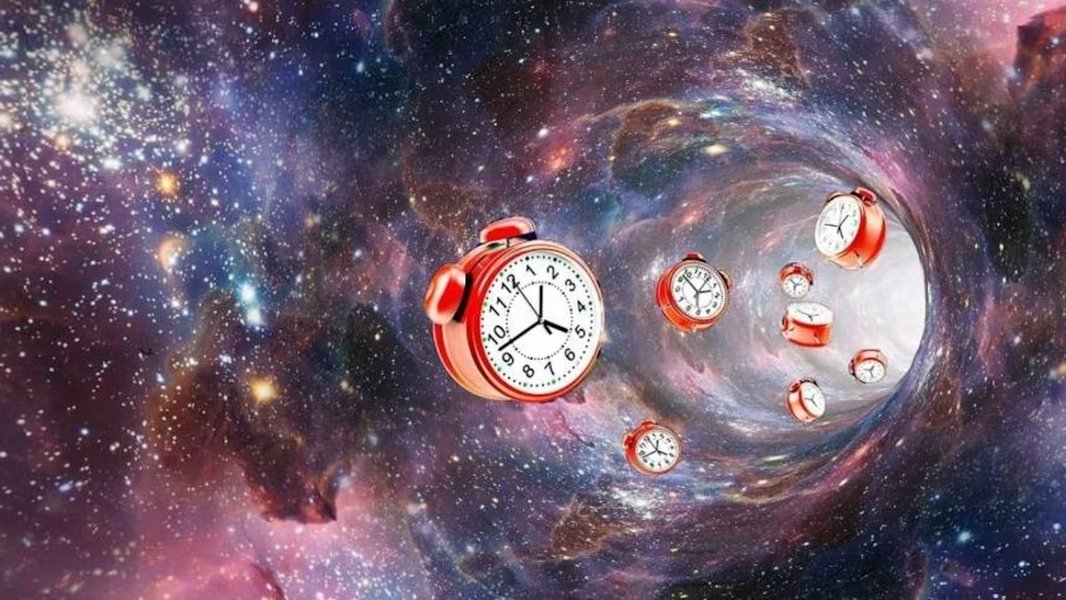
Illustration depicting the curvature of spacetime, a key concept in general relativity that underpins theoretical time travel.
Venturing into the Past: Theoretical Loopholes and Paradoxes
General Relativity's Exotic Solutions
While forward time travel rests on relatively solid ground, traveling backward into the past is far more speculative and fraught with theoretical difficulties. However, Einstein's general relativity doesn't explicitly forbid it. Certain mathematical solutions to Einstein's field equations permit the existence of exotic spacetime structures that could potentially act as time machines.
Closed Timelike Curves (CTCs)
One such possibility involves Closed Timelike Curves (CTCs). These are hypothetical paths in spacetime that loop back on themselves, allowing an object or person following such a path to return to their own past. Kurt Gödel first found solutions to Einstein's equations that contained CTCs in 1949. Since then, other scenarios involving rotating black holes (Kerr metric) or infinitely long rotating cylinders (Tipler cylinder) have been proposed that might contain CTCs. These concepts suggest that under extreme gravitational conditions, spacetime could be warped sufficiently to allow for causal loops.
Wormholes (Einstein-Rosen Bridges)
Another potential mechanism for past time travel involves wormholes, hypothetical tunnels connecting distant points in spacetime, potentially including different points in time. A traversable wormhole, if one could exist and be stabilized, might allow travel from its "exit" mouth to its "entrance" mouth at an earlier time. However, stabilizing a wormhole is thought to require vast amounts of exotic matter with negative energy density – a substance whose existence is purely theoretical and has never been observed.

A conceptual wormhole, potentially linking different points in time and space.
Other Theoretical Ideas
Theoretical physicist Ronald Mallett has proposed a concept using circulating beams of light (a ring laser) to twist spacetime, potentially creating conditions allowing for time travel based on general relativity. Additionally, cosmic strings, hypothetical 1-dimensional topological defects in spacetime, have also been discussed as potentially enabling time travel if two such strings were to interact in specific ways. However, like wormholes, these ideas rely on extreme physics and unobserved phenomena.
The Paradox Problem
Backward time travel immediately raises the specter of logical paradoxes. The most famous is the grandfather paradox: what if you traveled to the past and prevented your own grandfather from meeting your grandmother, thus preventing your own birth? If you were never born, how could you have traveled back in time in the first place?
Physicists and philosophers have proposed several potential resolutions:
- Self-Consistency Principle (Novikov): This principle suggests that the laws of physics conspire to prevent paradoxes. Any action taken by a time traveler in the past must already be part of history, ensuring that the events leading to the time travel itself still occur. Essentially, you cannot change the past in a way that creates a contradiction. Recent research, including studies published in 2025, explores mathematical models where spacetime "self-heals" or adapts to maintain consistency, making paradox-free time travel mathematically plausible within certain frameworks.
- Quantum Mechanics and Multiple Histories/Universes: Quantum theory offers other ways out. In the "many-worlds" interpretation, traveling to the past might cause the timeline to split, creating a new parallel universe where the time traveler's actions have consequences, but leaving the original timeline intact. Alternatively, quantum probabilities might inherently prevent paradoxical outcomes from occurring.
Visualizing Time Travel Feasibility
Comparative Analysis: Forward vs. Backward Time Travel
To better understand the current scientific stance, this radar chart contrasts key aspects of forward and backward time travel based on theoretical physics. The scores (out of 10) represent a qualitative assessment based on the synthesis of current knowledge, where higher scores indicate greater feasibility or stronger evidence.
As the chart illustrates, forward time travel is much more strongly supported by established physics and observation, facing mainly technological barriers for significant effect. Backward time travel, while not entirely ruled out by theory, remains highly speculative, requiring potentially non-existent forms of matter/energy and facing significant logical hurdles (paradoxes), despite ongoing theoretical attempts to resolve them.
Mapping the Concepts of Time Travel
A Mindmap Overview
This mindmap provides a simplified overview of the core concepts surrounding the theoretical possibility of time travel, branching into the two main directions (forward and backward) and highlighting the key theories, mechanisms, and challenges involved.
(To the Future)"] id1a["Basis: Einstein's Relativity"] id1a1["Special Relativity:
Time Dilation via Velocity"] id1a2["General Relativity:
Time Dilation via Gravity"] id1b["Feasibility: Possible & Observed"] id1b1["Examples: GPS, Astronauts, Particle Accelerators"] id1c["Challenges: Technological (Near Light Speed / Intense Gravity)"] id2["Backward Time Travel
(To the Past)"] id2a["Basis: General Relativity & Quantum Mechanics"] id2a1["General Relativity Solutions:
Closed Timelike Curves (CTCs)
Wormholes (Einstein-Rosen Bridges)
Rotating Black Holes / Cosmic Strings"] id2a2["Quantum Mechanics:
Paradox Resolution (Many-Worlds?)"] id2b["Feasibility: Highly Speculative"] id2b1["Requires Exotic Matter/Energy?"] id2b2["Technologically Unattainable"] id2c["Challenges: Paradoxes"] id2c1["Grandfather Paradox"] id2c2["Potential Resolutions:
Novikov Self-Consistency
Quantum Effects"]
Comparing Forward and Backward Time Travel
Key Distinctions
The following table summarizes the fundamental differences between the theoretical possibilities of traveling to the future versus traveling to the past:
| Feature | Forward Time Travel (Future) | Backward Time Travel (Past) |
|---|---|---|
| Primary Theoretical Basis | Einstein's Special & General Relativity (Time Dilation) | General Relativity (CTCs, Wormholes), Quantum Mechanics |
| Scientific Consensus | Widely accepted as theoretically possible | Highly speculative, controversial |
| Observational/Experimental Evidence | Yes (time dilation measured in particles, GPS, astronauts) | None |
| Key Mechanism | High velocity or strong gravity causing time to slow down for the traveler | Traversing hypothetical spacetime structures (CTCs, wormholes) |
| Major Obstacles | Technological (achieving near-light speed or accessing extreme gravity) | Theoretical (paradoxes), Physical (requires exotic matter/energy?), Technological (creating/navigating required structures) |
| Paradox Risk | Essentially none | Significant (e.g., Grandfather Paradox), though potential resolutions exist |
Expert Insights on Time Travel Physics
Neil deGrasse Tyson on Relativity and Time
Understanding time travel often benefits from hearing experts break down complex ideas. Astrophysicist Neil deGrasse Tyson frequently discusses topics related to relativity and cosmology. In the video below, he explains how Einstein's general theory of relativity provides a basis for understanding how time can be manipulated, particularly focusing on the established concept of time dilation allowing for journeys into the future.
Neil deGrasse Tyson discusses the science of time travel, focusing on Einstein's theories.
Tyson emphasizes that while forward time travel aligns with known physics, backward time travel remains in the realm of theoretical speculation, often requiring conditions or phenomena beyond our current observation or technological reach. This perspective aligns well with the broader scientific consensus outlined earlier.
Frequently Asked Questions about Time Travel Theory
So, is time travel definitely possible or not?
Time travel to the future is theoretically possible according to Einstein's theory of relativity and has been experimentally observed (time dilation). Time travel to the past is much more speculative. While some solutions in general relativity allow for it mathematically (like wormholes or closed timelike curves), it faces major hurdles like paradoxes and the need for exotic matter, and there's no observational evidence. So, future travel = yes (theoretically), past travel = maybe (highly speculative).
What is time dilation and how does it relate to future time travel?
Time dilation is a phenomenon predicted by Einstein's relativity where time passes slower for an observer who is moving relative to another observer (special relativity) or who is in a stronger gravitational field (general relativity). If you travel at very high speeds or spend time near a very massive object (like a black hole), time would pass slower for you than for people on Earth. When you return, less time would have passed for you, meaning you would have effectively traveled into Earth's future.
What about the grandfather paradox? Doesn't that make past time travel impossible?
The grandfather paradox (and similar paradoxes) poses a significant logical challenge to backward time travel. However, it doesn't necessarily prove it's impossible. Physicists have proposed solutions:
- Novikov Self-Consistency Principle: Physics might prevent you from creating a paradox in the first place. Any attempt to change the past would fail or turn out to be part of what already happened.
- Many-Worlds Interpretation (Quantum Mechanics): Traveling to the past might shift you to a parallel timeline or universe, where your actions don't affect your original past.
If time travel is possible, why haven't we met visitors from the future?
This is sometimes called the Fermi Paradox applied to time travel. There are several possible explanations:
- Backward time travel might simply be impossible, despite theoretical loopholes.
- It might be possible but technologically unfeasible or incredibly difficult/dangerous.
- Time travelers might exist but adhere to rules preventing interference or detection (like a temporal equivalent of the Prime Directive).
- Travel might only be possible back to the point where the time machine was first created.
- Paradox-resolution mechanisms might prevent significant interaction.
Recommended Further Exploration
- How does general relativity allow for closed timelike curves?
- What are the proposed solutions to time travel paradoxes like the grandfather paradox?
- What is exotic matter and why is it needed for traversable wormholes?
- Explain time dilation effects measured in real-world experiments.
References
Last updated May 4, 2025