
The Theoretical Possibility of Time Travel
Exploring the Frontiers of Physics and the Limits of Reality
3 Key Takeaways
- Forward Time Travel is Supported by Relativity: Time dilation, as described by Einstein’s theories, allows for the possibility of moving forward in time under specific conditions.
- Backward Time Travel Remains Highly Speculative: Concepts like wormholes and closed timelike curves present theoretical frameworks but face significant practical and paradoxical challenges.
- Enormous Technological and Energetic Barriers: Both forward and backward time travel, especially the latter, require advancements and resources far beyond current capabilities.
Introduction to Time Travel
Time travel has long been a staple of science fiction, captivating the imagination with visions of journeys to the past and future. Scientifically, the concept of time travel is anchored in the realms of theoretical physics, particularly through Einstein’s theories of relativity. This comprehensive exploration delves into the theoretical underpinnings, mechanisms, challenges, and current scientific consensus regarding the feasibility of time travel.
Forward Time Travel: The Science Behind Moving Ahead
Time Dilation and Special Relativity
Albert Einstein’s Special Theory of Relativity forms the cornerstone of our understanding of time dilation, a phenomenon that allows for forward time travel. According to this theory, as an object approaches the speed of light, time for that object slows down relative to an observer at rest. This effect has been experimentally verified using atomic clocks placed on fast-moving jets, which showed slight time differences compared to those on Earth.
For instance, astronauts aboard the International Space Station (ISS) experience time slightly slower than people on Earth due to their high orbital velocities. Although the difference is minuscule, this principle demonstrates that traveling into the future, in a relative sense, is theoretically possible. Extended periods spent traveling at near-light speeds could result in significant time dilation, allowing travelers to age much less than those remaining on Earth.
Gravitational Time Dilation and General Relativity
Einstein’s General Theory of Relativity extends the concept of time dilation to include the influence of gravity. This form of time dilation occurs in strong gravitational fields, where time passes more slowly compared to regions with weaker gravity. For example, clocks situated near a massive object like a black hole would tick more slowly than those further away.
This gravitational time dilation has practical implications. GPS satellites must account for both special and general relativistic time dilation to provide accurate positioning data. Without these adjustments, discrepancies in time measurements would render the system unreliable.
Mechanisms Facilitating Forward Time Travel
| Mechanism | Description | Feasibility |
|---|---|---|
| Time Dilation (Special Relativity) | Slight slowing of time for objects moving at high velocities. | Proven experimentally on small scales. |
| Gravitational Time Dilation (General Relativity) | Slowing of time near massive objects. | Experimentally verified; practical application limited. |
| Accelerated Frames of Reference | Time experienced differently in accelerating systems. | Theoretically sound, practical implementation challenging. |
Backward Time Travel: Theoretical Possibilities and Challenges
Closed Timelike Curves (CTCs)
One of the most discussed concepts for backward time travel involves Closed Timelike Curves (CTCs). These are continuous paths in spacetime that curve back on themselves, theoretically allowing an object to return to its own past. Solutions to Einstein’s field equations, such as those involving rotating black holes (Kerr black holes) or certain cosmological models, predict the existence of CTCs. However, creating or maintaining such structures would require conditions and materials currently beyond our technological and energetic capabilities.
Wormholes as Time Machines
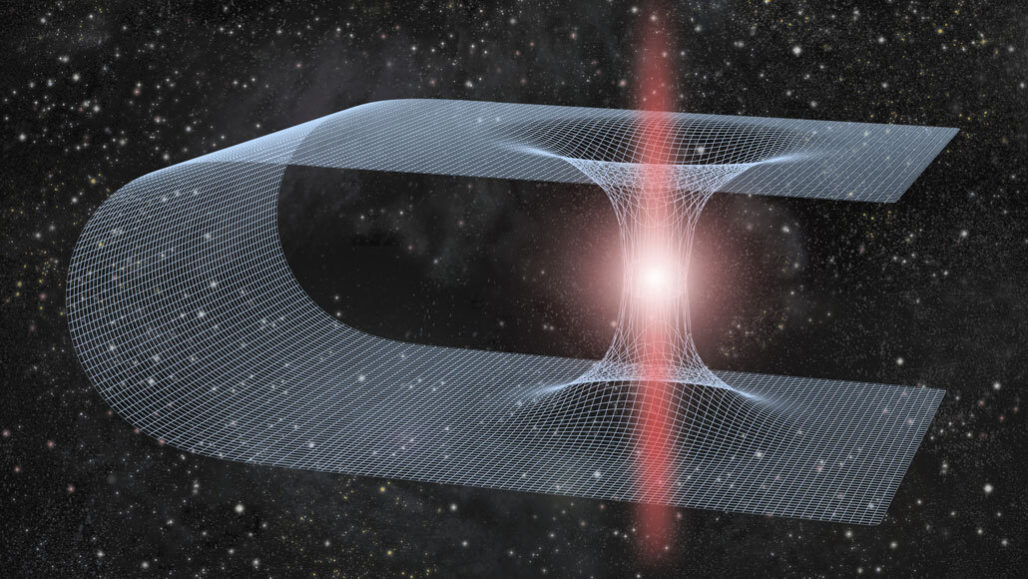
Wormholes are theoretical constructs that act as bridges connecting disparate points in spacetime. If traversable, a wormhole could potentially allow for travel between different times as well as different locations in space. Stabilizing a wormhole would necessitate the existence of exotic matter with negative energy density, which has not been observed or created in nature. Moreover, even if wormholes could be stabilized, safely navigating them without destructive gravitational forces remains a significant hurdle.
Parity and Physical Constraints
The feasibility of backward time travel is further constrained by fundamental physical principles. The Second Law of Thermodynamics posits that entropy must increase over time, posing a barrier to reversing time’s arrow. Additionally, the potential for causality violations, such as the infamous grandfather paradox, challenges the consistency of backward time travel within our current understanding of physics.
Paradoxes and Self-Consistency
Backward time travel introduces the possibility of paradoxes where cause and effect are disrupted. The grandfather paradox—where a time traveler could prevent their own existence by altering past events—illustrates such conflicts. To address these issues, some physicists propose the Novikov self-consistency principle, which suggests that any actions taken by a time traveler were always part of history, thereby avoiding paradoxes. Mathematical models supporting this principle exist but remain speculative and lack empirical verification.
Technological and Energetic Barriers
Creating the conditions necessary for backward time travel demands astronomical amounts of energy and the manipulation of exotic matter. Currently, humanity lacks both the theoretical frameworks and technological means to even begin approaching these requirements. Furthermore, maintaining stable wormholes or generating closed timelike curves would necessitate materials and energies that are beyond our existing or foreseeable capabilities.
Current Scientific Consensus and Future Prospects
The scientific community remains divided on the possibility of time travel, particularly backward time travel. While forward time travel is a well-established consequence of relativity and has been demonstrated on small scales, traveling to the past remains entrenched in theoretical speculation. Most physicists agree that significant breakthroughs in our understanding of spacetime, quantum mechanics, and exotic matter are required before time travel, especially to the past, could transition from theory to practice.
Recent advancements in fields like quantum gravity and string theory may offer new insights, but as of now, time travel remains beyond our technological and theoretical reach. Ethical and societal implications also loom large, raising questions about the consequences of altering past events and the potential for misuse of such technology.
Conclusion
In summary, time travel to the future is firmly rooted in the established principles of relativity and has been empirically validated, albeit on scales too small for practical application. Backward time travel, on the other hand, remains a highly speculative endeavor fraught with theoretical challenges and paradoxes. While the allure of traversing time captivates both scientists and the public, substantial scientific, technological, and philosophical barriers must be overcome before time travel can be considered more than a theoretical possibility.
References
Last updated January 21, 2025