
Unraveling the Threaded Performance Gap
Discover why AMD’s Bulldozer struggles with heavy threading compared to Intel’s Westmere
Key Takeaways
- Shared Resources Impact: AMD Bulldozer modules share critical execution resources between two cores, limiting independent processing capability.
- Architecture and IPC: The Bulldozer’s design yields a lower instructions-per-clock (IPC) performance than Intel’s dedicated core design in Westmere.
- Cache and Memory Latency: Higher cache latency and memory bottlenecks in Bulldozer impede heavy multithread performance compared to Westmere’s efficient cache hierarchy.
Detailed Architectural Comparison
Understanding AMD Bulldozer’s Design
AMD's Bulldozer architecture, introduced around 2011, was built on a modular design philosophy where each module consists of two x86 cores that share key internal resources. These shared resources include:
- Fetch/Decode stage
- Floating-point scheduler and its related floating-point units
- L2 cache and some execution units
This approach, while aiming for an improved performance-per-watt ratio and reduced chip area, induces a clustering effect. When both cores within a module are active, they compete for the same pool of resources. This conflict results in reduced per-thread performance, especially when the application or workload demands simultaneous use of the shared components.
Clustered Multithreading Effect
Bulldozer’s implementation of Clustered Multithreading (CMT) was designed to allow simultaneous processing of two threads in each module. However, due to the shared resources, the two cores are not as independent as they are in architectures where resources are dedicated. This means that while the module may appear to double the threading capacity, the actual execution efficiency can fall short if both threads need to access the shared pipelines, schedulers, or caches concurrently.
Dissecting Intel Westmere’s Approach
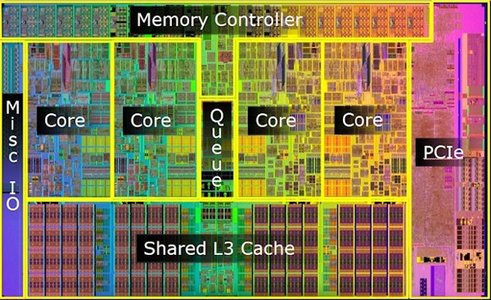
In contrast, Intel’s Westmere series employs a more traditional design with a strong emphasis on per-core performance and efficient thread management. Each core in the Westmere architecture is equipped with its own dedicated set of execution resources, including:
- Independent fetch and decode units
- Dedicated execution pipelines
- Exclusive cache hierarchy elements ensuring reduced latency
Furthermore, Intel leverages Hyper-Threading (also referred to as Symmetric Multithreading or SMT) effectively. This technology allows a single core to process two threads concurrently, dynamically allocating execution resources among the threads while maintaining higher IPC (instructions per clock) throughput.
Efficiency in Resource Allocation
Westmere’s strategy ensures that even if multiple threads are running simultaneously, each core can execute instructions without significant contention. This leads to smoother thread handling in environments where tasks are highly parallelized. The superior single-thread performance of Westmere contributes to overall better multithreaded outcomes, as the efficiency of each core remains high even when working under load.
Performance Bottlenecks and Their Impact
Shared Execution Units and Reduced IPC
One of the core reasons for Bulldozer’s struggle with heavy multithreaded applications is the compromise in instructions per clock (IPC) efficiency due to shared execution units. In a typical scenario:
When two threads attempt to execute concurrently on the same module, they experience contention for the shared floating-point units, fetch/decode logic, and other similar units. This reduces the effective IPC, leading to slower overall processing speeds compared to a scenario where each thread could operate from fully independent resources.
Cache Hierarchy Limitations
Another significant limitation of Bulldozer’s architecture lies in its cache design. The modules share a single L2 cache between cores. Additionally, the L3 cache design in Bulldozer often suffered from higher latency because it operated at reduced speeds compared to the rest of the CPU. As a result, the processor encountered delays when fetching data required by multiple threads, thus intensifying the performance degradation in multithreaded applications.
Memory Latency and Bandwidth
Memory latency directly affects the speed at which a processor can access data stored in different levels of the cache hierarchy. Bulldozer’s higher latency means that even if it could handle more threads on paper, the access delays impact overall system throughput. In environments where threads demand rapid data retrieval and processing, this becomes a pronounced bottleneck. Intel’s Westmere, by contrast, has a well-optimized cache system that provides lower latency and higher bandwidth, further driving its superior multithread performance.
Comprehensive Comparison Table
| Feature | AMD Bulldozer | Intel Westmere |
|---|---|---|
| Core Design | Modules with 2 cores sharing resources | Dedicated cores with independent resources |
| Multithreading Technique | Clustered Multithreading (shared execution) | Symmetric Multithreading/Hyper-Threading (efficient sharing) |
| Instructions Per Clock (IPC) | Lower IPC due to resource contention | Higher IPC thanks to dedicated execution channels |
| Cache Hierarchy | Shared L2 cache and slower L3 interactions | Optimized, low-latency cache structure |
| Memory Latency | Higher latency affecting throughput | Optimized for low latency and higher bandwidth |
| Overall Thread Efficiency | Effective only under low-to-moderate threading loads | Scales well under heavy multithread scenarios |
In-Depth Analysis: Key Architectural Insights
Resource Sharing Trade-offs
The design philosophy of Bulldozer was aimed at denser silicon usage and potential efficiency gains by sharing certain resources between paired cores. While this method theoretically increases the number of threads that can be handled, the trade-off becomes apparent in execution scenarios involving heavy multithreading. The shared fetch/decode stages and floating-point schedulers mean that when two threads are running concurrently, an inherent competition reduces overall effectiveness. This design, while innovative, is less suited for tasks that require high-speed, concurrent processing where minimal latency and maximum throughput are essential.
Clock Speed versus IPC
AMD often attempted to offset lower IPC by operating at higher clock speeds. However, the effectiveness of this strategy was limited by several factors:
- Thermal limitations and power consumption did not allow for sustainable high clock speeds under heavy multithread loads.
- The shared execution resources meant that even high clock speeds could not fully mitigate performance degradation when two threads ran simultaneously.
- With Westmere, the architecture allowed for both respectable clock speeds and high IPC, delivering superior performance even in complex, multithreaded environments.
Software and Operating System Considerations
Besides hardware intricacies, initial software and operating system optimizations also played a role. Early implementations of Windows, for example, were not ideally tuned to recognize Bulldozer’s unique core design. This meant that scheduling decisions at the software level sometimes failed to fully exploit the hardware’s potential, exacerbating performance issues under multithreaded workloads. Over time, software patches and improved scheduling strategies have somewhat alleviated these challenges, yet the underlying architectural constraints remain a critical factor.
Further Technical Discussions and Analysis
Impact on Real-World Applications
The differences in how AMD’s Bulldozer and Intel’s Westmere handle threading have significant implications in real-world scenarios. Applications that are highly parallelized, such as server workloads, scientific computing, and high-end content creation, benefit substantially from efficient threading. With Westmere’s approach, where each core processes threads with minimal contention, tasks complete faster and more reliably under load. On the other hand, Bulldozer’s design, while innovative, tends to struggle as the number of concurrently running threads increases, leading to bottlenecks that are especially noticeable when many threads vie for the same execution units.
Evaluating Workload Variability
The impact of these architectural differences becomes apparent when evaluating specific workloads:
- Single-threaded applications rely heavily on raw IPC performance, where Westmere outperforms due to dedicated execution paths.
- Multithreaded applications that scale efficiently only benefit if the architecture supports truly independent threading – a strong point for Westmere but a point of contention for Bulldozer’s shared resource model.
- Memory-intensive tasks suffer from the latency issues inherent in Bulldozer’s shared cache design, impacting overall application responsiveness.
References
- The Bulldozer Aftermath – AnandTech
- Analyzing Bulldozer Performance – ExtremeTech
- Bulldozer Scaling Review – Phoronix
- Bulldozer Microarchitecture – Wikipedia
-
What Might Westmere Mean for AMD? – TechReport
Recommended Next Steps
Last updated March 26, 2025