
Unlock Basic Turkish Conversation in Just 5 Days: Your 10-Minute Daily Plan for a Memorable Family Visit!
Rapidly refresh your Turkish and connect with family using this focused, vocabulary-activating strategy.
Embarking on a family visit to Turkey soon? With a foundation of over 500 passive Turkish words but rusty grammar, you're in a great position to quickly achieve a minimal conversational level. This 5-day plan, requiring only about 10 minutes of focused effort daily, is designed to activate your existing knowledge and build your confidence for essential interactions. We'll prioritize practical communication over grammatical perfection, helping you make the most of your precious family time.
Essential Insights for Your Rapid Turkish Refresh
- Focus on Functional Phrases: Prioritize learning and practicing high-frequency greetings, questions, and expressions crucial for everyday family interactions, rather than getting bogged down in complex grammar.
- Activate Your Passive Vocabulary: Your existing 500+ word knowledge is a goldmine. This plan emphasizes using those words in simple sentence structures and conversational contexts.
- Consistent, Short Bursts of Practice: Just 10 minutes of dedicated practice daily, combining listening and speaking, can significantly improve your ability to understand and respond in basic Turkish.
Your Intensive 5-Day Turkish Conversational Kickstart
This plan is meticulously structured to build your conversational skills progressively. Each day focuses on different aspects of communication, ensuring you're ready for simple yet meaningful exchanges with your Turkish family.
Day 1: Laying the Groundwork - Greetings, Introductions, and Pronunciation
Focus:
Mastering fundamental greetings, polite expressions, and self-introductions. Emphasis on clear pronunciation to build a strong first impression.
Activities (10 minutes):
- Listening & Pronunciation (5 mins): Use an audio resource (like a language app or YouTube clip) to listen to native speakers pronounce common greetings and phrases. Repeat aloud:
- "Merhaba" (Hello)
- "Selam" (Hi - more informal)
- "Günaydın" (Good morning)
- "İyi akşamlar" (Good evening)
- "Nasılsın?" (How are you? - singular/informal) / "Nasılsınız?" (How are you? - plural/formal)
- "Benim adım [Your Name]." (My name is [Your Name].)
- "Teşekkür ederim." (Thank you.)
- "Lütfen." (Please.)
- Speaking Practice (5 mins): Practice introducing yourself. Say your name and perhaps mention you're visiting family. Repeat each phrase 3-5 times, focusing on rhythm and intonation. Example: "Merhaba, benim adım [Your Name]. Ailenizi ziyarete geldim." (Hello, my name is [Your Name]. I came to visit your family.)
Why this helps:
These are the absolute essentials for initiating any conversation. Correct pronunciation from the start builds confidence and ensures you are understood.
Day 2: Building Bridges - Basic Questions, Answers, and Family Vocabulary
Focus:
Learning to ask and answer simple questions relevant to a family setting, and reviewing essential family member vocabulary.
Activities (10 minutes):
- Interactive Phrases (5 mins): Listen to and practice questions like:
- "Bu ne?" (What is this?)
- "Kim bu?" (Who is this?)
- "Nerede?" (Where?) - e.g., "Tuvalet nerede?" (Where is the bathroom?)
- "Adınız ne?" (What's your name? - formal/plural) / "Adın ne?" (What's your name? - informal)
- "İyiyim, teşekkür ederim." (I'm fine, thank you.)
- "Evet." (Yes.) / "Hayır." (No.)
- Family Vocabulary & Mini-Dialogues (5 mins): Review terms for immediate family: "anne" (mother), "baba" (father), "kardeş" (sibling - can specify "erkek kardeş" for brother, "kız kardeş" for sister), "eş" (spouse), "çocuk" (child/children). Practice simple dialogues like:
Person A: "Merhaba! Nasılsınız?"
You: "İyiyim, teşekkürler. Siz nasılsınız?" (I'm fine, thanks. How are you?)
Practice identifying family members: "Bu benim annem." (This is my mother.)
Why this helps:
This allows you to move beyond greetings into simple exchanges, understand basic inquiries, and talk about the very people you are visiting.
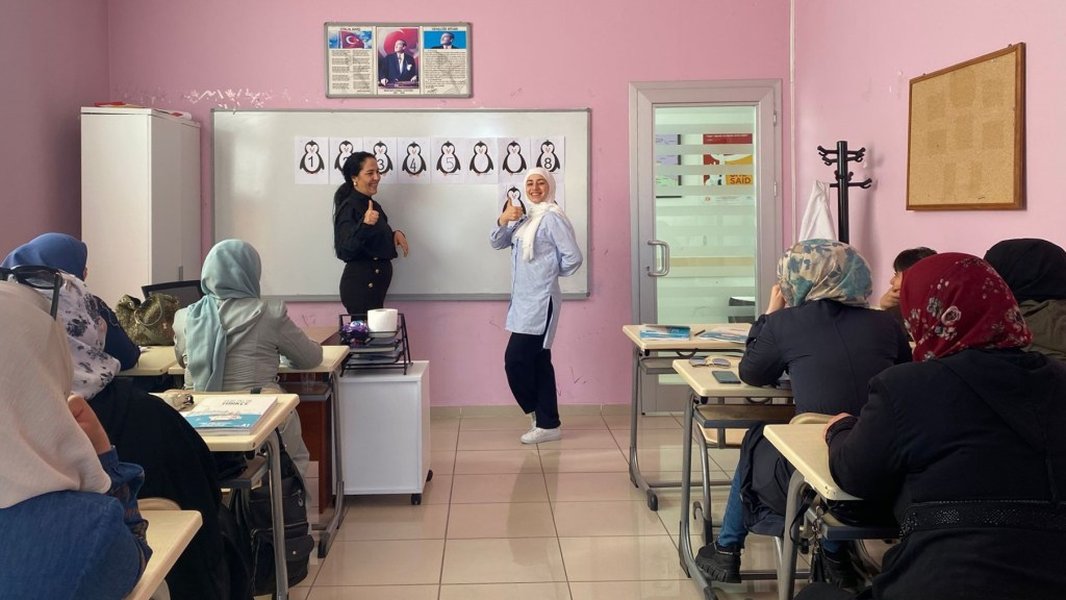
Visualizing interaction and learning can enhance motivation.
Day 3: Everyday Essentials - Expressing Needs and Preferences
Focus:
Learning phrases for common daily needs (especially around food and drink) and expressing simple likes and dislikes.
Activities (10 minutes):
- Practical Phrases (5 mins): Focus on phrases you'll likely use:
- "Su, lütfen." (Water, please.)
- "Çay istiyorum." (I want tea.)
- "Kahve ister misin?" (Do you want coffee?)
- "Açım." (I'm hungry.) / "Susamadım." (I'm thirsty.) (Note: "Susadım" is more common than "Susamadım" for "I'm thirsty". Let's use "Susadım".)
- Corrected: "Açım." (I'm hungry.) / "Susadım." (I'm thirsty.)
- "Çok güzel!" (Very beautiful/good! - for food, etc.)
- "Afiyet olsun!" (Enjoy your meal! - said before someone eats, or as a reply to "thank you for the meal")
- Likes & Dislikes (5 mins): Practice the structures:
- "[Noun] seviyorum." (I like [Noun].) e.g., "Türk kahvesi seviyorum." (I like Turkish coffee.)
- "[Noun] sevmiyorum." (I don't like [Noun].) e.g., "Baharatlı yemek sevmiyorum." (I don't like spicy food.)
- Ask: "[Noun] sever misin?" (Do you like [Noun]?)
Why this helps:
These phrases are crucial for navigating daily situations during your visit, especially around mealtimes, and for sharing personal preferences, making interactions more engaging.
Day 4: Activation Station - Using Your Vocabulary in Simple Sentences
Focus:
Actively using your 500+ word passive vocabulary to construct basic Subject-Verb-Object (SVO) sentences. Turkish is SOV, but for simplicity focusing on getting meaning across with known words is key.
Activities (10 minutes):
- Sentence Building (5 mins): Take 10-15 nouns and verbs you know well from your Duolingo studies. Try to form simple sentences. While Turkish word order is typically Subject-Object-Verb (SOV), for a beginner, even SVO can convey meaning. Focus on the present tense. Examples:
- "Ben elma yiyorum." (I apple eat - literal, but "Ben elma yiyorum" is correct for "I am eating an apple.")
- "O kitap okuyor." (He/She book reads - literal, "O kitap okuyor" is correct for "He/She is reading a book.")
- "Biz Türkiye'deyiz." (We are in Turkey.)
- Practice with Variations (5 mins): Try changing one word in your sentences. If you know "kedi" (cat) and "park" (park), try "Kedi parkta." (The cat is in the park.) The goal is to become comfortable linking words you already know.
Why this helps:
This day is crucial for transforming passive vocabulary into an active communication tool. It bridges the gap between knowing words and using them to express simple ideas.
Day 5: Dress Rehearsal - Review, Listening, and Scenario Practice
Focus:
Consolidating everything learned, improving listening comprehension for conversational flow, and practicing responses in anticipated family visit scenarios.
Activities (10 minutes):
- Comprehensive Review (3 mins): Quickly go over the key phrases and vocabulary from Days 1-4. Use flashcards if you made any, or just say them aloud.
- Listening Comprehension (4 mins): Listen to a short, simple Turkish dialogue (beginner level, perhaps from a YouTube resource). Try to pick out familiar words and get the gist of the conversation. Don't worry about understanding every word.
- Scenario Role-Play (3 mins): Mentally (or aloud) run through simple scenarios:
- Arriving and greeting family.
- Being offered food or drink and responding.
- Asking where someone is or what something is.
- Saying goodbye briefly.
Why this helps:
This final session pulls everything together, boosts confidence by reviewing familiar material, and prepares you for the rhythm of real-life conversations you're likely to encounter.
Visualizing Your Progress: Skill Focus Over 5 Days
To give you a sense of how your efforts will build, the following chart illustrates the shifting emphasis on different language skills throughout your 5-day plan. While all skills are touched upon daily, certain aspects receive more focus as you progress, aiming for a well-rounded minimal conversational ability by the end.
This chart visually represents the shifting focus and increasing complexity of your 10-minute daily Turkish practice sessions over the 5-day plan. It highlights how different skills like vocabulary activation, phrase learning, listening, speaking, and cultural relevance are emphasized each day to build a well-rounded minimal conversational ability for your family visit.
Core Conversational Components: A Mindmap
This mindmap illustrates the key components of achieving a minimal conversational level in Turkish for your family visit. It branches out from the main goal into essential building blocks like greetings and introductions, crucial interaction elements such as asking basic questions, specific vocabulary and phrases for the family context, and overarching conversation skills you'll be developing. Each node represents a focus area in your 5-day learning journey.
for Family Visit"] id1["Core Building Blocks"] id1a["Greetings & Farewells"] id1a1["Merhaba, Selam, Günaydın"] id1a2["İyi akşamlar, İyi geceler"] id1a3["Güle güle, Hoşça kal"] id1b["Introductions"] id1b1["Benim adım [Name]"] id1b2["Sizin adınız ne?"] id1b3["Tanıştığımıza memnun oldum"] id1c["Polite Expressions"] id1c1["Lütfen (Please)"] id1c2["Teşekkür ederim (Thank you)"] id1c3["Rica ederim (You're welcome)"] id1c4["Afedersiniz (Excuse me)"] id1c5["Özür dilerim (I'm sorry)"] id2["Essential Interactions"] id2a["Basic Questions"] id2a1["Nasılsın? / Nasılsınız?"] id2a2["Bu ne? (What is this?)"] id2a3["Kim bu? (Who is this?)"] id2a4["Nerede...? (Where is...?)"] id2a5["Ne zaman? (When?)"] id2b["Simple Answers & Statements"] id2b1["İyiyim (I'm fine)"] id2b2["Evet (Yes) / Hayır (No)"] id2b3["Anlamıyorum (I don't understand)"] id2b4["Biraz Türkçe biliyorum (I know a little Turkish)"] id2c["Expressing Needs & Wants"] id2c1["Su istiyorum (I want water)"] id2c2["Yardım eder misiniz? (Can you help?)"] id2c3["Tekrar eder misiniz? (Could you repeat?)"] id3["Family & Social Context"] id3a["Family Vocabulary"] id3a1["Aile (Family)"] id3a2["Anne (Mother), Baba (Father)"] id3a3["Kardeş (Sibling), Çocuk (Child)"] id3a4["Eş (Spouse), Akraba (Relative)"] id3b["Talking About Family"] id3b1["Ailen nasıl? (How is your family?)"] id3b2["Bu benim [family member]"] id3c["Food & Drink"] id3c1["Yemek (Food), İçecek (Drink)"] id3c2["Açım (I'm hungry), Susadım (I'm thirsty)"] id3c3["Çok lezzetli! (Very delicious!)"] id4["Key Conversation Skills"] id4a["Active Listening (Dinleme)"] id4b["Speaking Practice (Konuşma)"] id4c["Using Known Vocabulary (Kelime bilgisi)"] id4d["Pronunciation (Telaffuz)"] id4e["Non-Verbal Cues & Gestures"]
Summary Table: Your 5-Day Turkish Quick Guide
This table provides a quick overview of your daily focus, key activities, and the benefits of each session, making it easy to stay on track.
| Day | Focus | Key Activities & Phrases | Why It Helps |
|---|---|---|---|
| 1 | Foundations: Greetings & Pronunciation | Practice "Merhaba," "Nasılsınız?," "Benim adım..." Listen to audio, repeat aloud. Focus on clear pronunciation. | Builds initial confidence, crucial for first impressions and initiating contact. |
| 2 | Basic Q&A and Family Vocabulary | Learn "Bu ne?," "Kim bu?," "Nerede?" Review family terms (anne, baba, kardeş). Practice short intro dialogues. | Enables simple interactions, understanding of who's who in the family context. |
| 3 | Everyday Needs & Expressing Preferences | Phrases for food/drink ("Su lütfen," "Çay istiyorum"), directions ("Tuvalet nerede?"), expressing likes/dislikes ("[Noun] seviyorum/sevmiyorum"). | Manages practical daily situations, allows sharing of simple personal opinions, makes interactions more personal. |
| 4 | Activating Vocabulary & Simple Sentences | Form basic sentences with your known words (e.g., "Ben elma yiyorum," "O kitap okuyor"). Focus on conveying meaning. | Turns your passive word knowledge into active use, practice basic sentence construction for expression. |
| 5 | Consolidation & Scenario Practice | Review all key phrases. Listen to short Turkish dialogues. Role-play common family visit scenarios (greetings, mealtime talk). | Solidifies what you've learned, prepares you for real-time conversation flow, and boosts overall speaking confidence. |
Enhance Your Learning: Turkish Conversation Practice Video
To supplement your 10-minute daily sessions, immersing yourself in the sounds and rhythm of spoken Turkish can be incredibly beneficial. This video provides extended conversation practice. Even listening passively while doing other things can help attune your ear to Turkish pronunciation, intonation, and common conversational patterns, further reinforcing what you learn actively.
This particular video, "30 Minutes of Turkish Conversation Practice," is a great resource for hearing how phrases are used in context. You can pause and repeat segments that align with your daily learning goals or simply let it play to get more exposure to the language.
General Tips for Success in Your Turkish Crash Course
- Embrace Imperfection: Your goal is communication, not flawless grammar. Your family will appreciate your effort far more than grammatical precision. Don't be afraid to make mistakes!
- Focus on the Gist: When listening, try to understand the main idea rather than every single word. Key vocabulary you know will help you piece together the meaning.
- Maximize Your Existing Vocabulary: Actively try to incorporate the 500+ words you already know from Duolingo into your practice sentences and when you try to speak.
- Listen Actively and Passively: Beyond your 10-minute sessions, try listening to Turkish music, podcasts, or simple videos. Even passive exposure helps your brain get used to the sounds and rhythm of the language.
- Use Non-Verbal Cues: Gestures, facial expressions, and pointing can significantly aid communication when you're missing a word.
- Be Patient and Persistent: Language learning is a journey. These 5 days are about giving you a conversational jumpstart. Enjoy the process!
- Write Down Key Phrases: Consider keeping a small notebook or using a notes app on your phone for the most crucial phrases you learn each day. Quick reviews can be very effective.
Frequently Asked Questions (FAQ)
What if I only have 5 minutes on some days?
Any practice is better than no practice! If you're short on time, focus on the single most important activity for that day. For example, on Day 1, prioritize repeating greetings aloud. Even 5 minutes of focused effort helps maintain momentum and reinforce learning. Consistency is key, even in smaller doses.
How important is perfect pronunciation?
Aim for clear and understandable pronunciation, not perfection. Turkish has some sounds that might be new to English speakers (like vowel harmony). Listening to native speakers and trying to mimic them is beneficial. However, your family will likely understand you even if your pronunciation isn't perfect, especially given the context. Effort is highly valued!
What's the best way to use my existing 500 words?
Focus on combining them into simple phrases and sentences (as outlined in Day 4). Don't just review them as isolated words. Try to think of situations where you might use them during your family visit. For example, if you know words for food items, practice saying "I like [food item]" or "Can I have [food item]?". Contextual usage is key to activation.
Should I focus more on understanding or speaking?
For a minimal conversational level, both are important, but speaking practice often builds confidence faster for practical interactions. This plan tries to balance both with listening activities followed by speaking practice. In a family setting, being able to express your basic needs, greetings, and understanding simple responses will be very effective. Don't hesitate to ask for clarification ("Anlamadım, lütfen tekrar eder misiniz?" - I didn't understand, could you please repeat?).
Recommended Next Steps & Deeper Dives
If you wish to explore further after this initial 5-day plan, consider these related queries:
- What are some common Turkish phrases specifically used during family gatherings and meals?
- How can I improve my understanding of spoken Turkish when my grammar knowledge is limited?
- What are some fundamental Turkish sentence structures that beginners can practice for everyday conversation?
- Are there any cultural etiquette tips I should know when speaking Turkish with family members in Turkey?
References
This plan was synthesized drawing inspiration and information from various helpful resources on learning Turkish effectively. Here are some relevant ones:

Last updated May 6, 2025