
Unlocking Your Cognitive Profile: How Can You Discover Your IQ?
A comprehensive guide to understanding Intelligence Quotient, its measurement, and how you can ascertain your score.
Understanding your Intelligence Quotient (IQ) involves more than a simple number; it's about gaining insight into your cognitive abilities. While I, as an AI, cannot assess your IQ directly, I can provide you with detailed information on what IQ represents, how it's measured, and the pathways available for you to determine your score.
Highlights: Key Insights into IQ
- Professional Assessment is Key: For the most accurate and clinically valid IQ score, a standardized test administered by a qualified psychologist, such as the WAIS, is the gold standard.
- Online Tests Offer Estimates: Numerous online IQ tests can provide a general estimation of your IQ by assessing areas like logical reasoning, verbal skills, and spatial intelligence, but they are not substitutes for professional evaluation.
- IQ is a Relative Measure: IQ scores are standardized, with 100 being the average. Scores indicate how an individual's cognitive abilities compare to others in their age group, typically following a bell curve distribution.
Decoding Intelligence: What Exactly is an IQ?
The Concept of Intelligence Quotient
IQ, or Intelligence Quotient, is a total score derived from a set of standardized tests or subtests designed to assess human intelligence. It aims to measure a range of cognitive abilities and provide a score that is intended to serve as a measure of an individual's intellectual abilities and potential. Historically, IQ was calculated by dividing a person's mental age score (obtained from an intelligence test) by their chronological age and multiplying by 100. However, modern IQ testing uses a more sophisticated approach, comparing an individual's performance to the average performance of a representative sample of people of the same age.
What Do IQ Tests Measure?
IQ tests are designed to evaluate various facets of cognitive functioning. While specific tests may vary, common areas assessed include:
- Verbal Comprehension: The ability to understand and use verbal information, think in words, and express oneself verbally.
- Perceptual Reasoning (or Visual-Spatial Processing): The ability to think in visual images and manipulate them, organize and interpret visual information, and solve problems using visual reasoning.
- Working Memory: The capacity to hold and manipulate information in one's mind for short periods, essential for tasks like mental arithmetic or following multi-step instructions.
- Processing Speed: The speed and efficiency with which one can perform simple or automatic cognitive tasks, particularly when under pressure to maintain attention and concentration.
- Logical Reasoning: The ability to analyze information and solve problems on a complex, intangible level.
- Numerical Reasoning: The capacity to work with numbers and use mathematical concepts to solve problems.
It's important to understand that while IQ tests are comprehensive, they do not capture all aspects of human intelligence, such as creativity, emotional intelligence, practical skills, or artistic talent.
Pathways to Discovering Your IQ
Determining your IQ requires taking a standardized intelligence test. There are primarily two avenues for this: professional assessment and online testing.
Professional IQ Assessment: The Gold Standard
The most accurate and reliable method to determine your IQ is through a professionally administered test conducted by a licensed psychologist or a trained examiner. These tests are standardized, meaning they are administered and scored in a consistent manner, and have been validated on large, representative populations.
Key Professional Tests
- Wechsler Adult Intelligence Scale (WAIS): This is one of the most widely used IQ tests for adults (typically 16 years and older). The current version, WAIS-IV, assesses the four main components of intelligence mentioned earlier: Verbal Comprehension, Perceptual Reasoning, Working Memory, and Processing Speed.
- Stanford-Binet Intelligence Scales: Another highly regarded and comprehensive test, suitable for individuals across a wide age range, from young children to adults. It also measures various cognitive factors.
Professional testing involves a one-on-one setting, allowing the administrator to observe behavior, ensure optimal testing conditions, and provide a detailed interpretation of the results in a clinical context.
Online IQ Tests: A Convenient Estimation
Numerous websites offer free or paid online IQ tests. These can provide a convenient way to get an estimate of your IQ score.
What to Expect from Online Tests
Online IQ tests typically consist of multiple-choice questions covering areas such as:
- Logical reasoning puzzles
- Pattern recognition
- Numerical ability
- Verbal skills
- Spatial visualization
While accessible, it's crucial to approach online IQ test results with caution. Their reliability and validity can vary significantly. Some platforms claim scientific validation, but they generally cannot replicate the controlled environment and comprehensive nature of a professionally administered test. They can, however, offer a general indication of cognitive strengths and weaknesses.
Considerations for Online Platforms
If you choose to take an online IQ test, consider platforms that are transparent about their methodology. Some reputable options mentioned include IQTest.com, 123test.com, and Free-IQTest.net. The Mensa organization also offers practice tests that can give an indication of whether one might qualify for their society, which typically requires an IQ in the top 2% (usually 130 or above).
Remember, these online tests provide an estimate, not a definitive or clinical diagnosis. For a truly accurate measure, professional testing is indispensable.
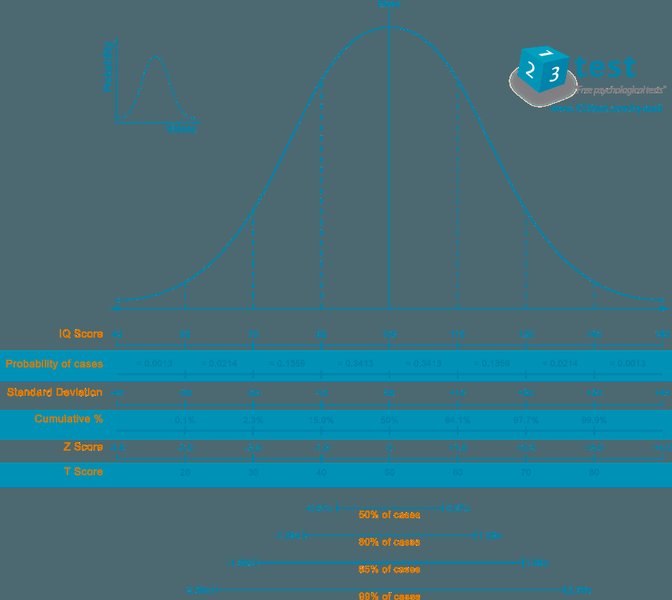
A typical IQ score distribution, showing the bell curve with the majority of individuals scoring near the average of 100.
Interpreting Your IQ Score
Once an IQ score is obtained, understanding its meaning within the standardized scale is important.
The Standardized Scale
IQ scores are standardized so that the average (mean) score for the population is 100. Most IQ tests also have a standard deviation of 15 points. This means that scores are distributed along a bell-shaped curve:
- Approximately 68% of the population scores within one standard deviation of the mean (IQ 85-115).
- About 95% of the population scores within two standard deviations (IQ 70-130).
- Roughly 99.7% of the population scores within three standard deviations (IQ 55-145).
What Different Score Ranges Indicate
While classifications can vary slightly between tests and systems, a general guide to IQ score ranges is as follows. This table provides a common classification for IQ scores:
| IQ Score Range | Classification | Approximate Percentage of Population |
|---|---|---|
| 130 and above | Very Superior / Gifted | ~2% |
| 120-129 | Superior | ~7% |
| 110-119 | High Average | ~16% |
| 90-109 | Average | ~50% |
| 80-89 | Low Average | ~16% |
| 70-79 | Borderline / Well Below Average | ~7% |
| Below 70 | Extremely Low / Intellectual Disability | ~2% |
It's vital to remember that an IQ score is just one data point. It provides a snapshot of certain cognitive abilities at a particular point in time and doesn't define a person's overall worth, potential for success, or happiness.
Visualizing Cognitive Abilities: A Conceptual Overview
IQ tests aim to provide a comprehensive assessment of various cognitive domains. The radar chart below offers a conceptual illustration of how different cognitive abilities might contribute to an overall intellectual profile. The scores are hypothetical and serve to demonstrate how individuals might exhibit varying strengths across these domains. For instance, someone might excel in verbal comprehension while having average processing speed, or vice-versa. A balanced profile would show similar scores across all areas, while specialized talents might lead to peaks in specific domains.
This chart helps visualize that "intelligence" isn't monolithic but rather a composite of various abilities. An IQ score synthesizes these into a single number, but understanding the underlying profile can be more insightful.
Important Considerations About IQ
While IQ scores can be informative, there are several important factors to keep in mind.
Stability and Fluctuation of IQ Scores
For adults, IQ scores tend to be relatively stable over time. However, they are not entirely fixed and can fluctuate. Factors that might influence scores include testing conditions (e.g., fatigue, anxiety), practice effects from repeated testing, and significant life changes or educational experiences. Children's IQ scores can show more variability as their cognitive abilities are still developing.
Limitations of IQ Testing
It's crucial to acknowledge the limitations of IQ tests:
- Narrow Scope: As mentioned, IQ tests primarily measure analytical and problem-solving skills. They don't typically assess creativity, emotional intelligence, social skills, practical knowledge ("street smarts"), or artistic/musical talents, all of which are important aspects of human capability and success. Howard Gardner's theory of multiple intelligences highlights this broader view.
- Cultural Bias: Historically, some IQ tests faced criticism for cultural bias, as questions might have favored familiarity with the dominant culture. Modern tests strive to be more culturally fair, but this remains a consideration.
- Not a Complete Picture: An IQ score should not be seen as the sole determinant of an individual's potential or worth. Motivation, perseverance, opportunity, and environmental factors also play significant roles in life outcomes.
- Test Anxiety and Performance: Performance on any test can be affected by anxiety or other temporary states, potentially leading to a score that doesn't fully reflect an individual's true abilities.
Mapping the Landscape of IQ
The mindmap below provides a visual summary of the core concepts related to Intelligence Quotient, from its definition and methods of measurement to how scores are interpreted and the important considerations to bear in mind. It serves as a quick reference to the multifaceted nature of IQ.
This mindmap illustrates the interconnectedness of different aspects surrounding IQ, helping to form a more holistic understanding than just a single number might provide.
Exploring IQ Measurement Further
To gain a deeper understanding of what IQ tests actually measure and the nuances involved, the following video offers valuable insights. It explores the history and application of IQ testing, providing context beyond just the score itself.
This video, "I Took an IQ Test to Find Out What it Actually Measures" by Veritasium, delves into the nature and implications of IQ testing.
The video discusses the development of IQ tests, what they aim to assess, and some of the debates and interpretations surrounding intelligence measurement. It's a useful resource for anyone curious about the science and psychology behind IQ.
Frequently Asked Questions (FAQ)
Can I increase my IQ score?
While core intellectual ability is considered relatively stable, scores can sometimes be improved to a degree through familiarity with test formats, cognitive training exercises (targeting working memory, processing speed, etc.), and overall mental stimulation like continued education and learning new skills. However, substantial, lasting changes in underlying general intelligence are less clear-cut. Factors like good nutrition, sleep, and managing stress can also optimize cognitive performance during testing.
What is the difference between IQ and EQ (Emotional Quotient)?
IQ (Intelligence Quotient) primarily measures cognitive abilities like reasoning, problem-solving, and learning capacity. EQ (Emotional Quotient or Emotional Intelligence) refers to the ability to perceive, understand, manage, and use emotions effectively in oneself and in relationships with others. While IQ tests focus on analytical intelligence, EQ is about social and emotional competencies. Both are considered important for overall life success, but they represent different aspects of human capability.
Are online IQ tests accurate?
The accuracy of online IQ tests varies greatly. Some are developed with more rigor and attempt to emulate standardized testing principles, while others are purely for entertainment. Generally, online tests can provide an estimate or an indication of your cognitive abilities but should not be considered as accurate or reliable as a professionally administered IQ test like the WAIS or Stanford-Binet. For official purposes or a definitive assessment, professional testing is necessary.
At what age can IQ be reliably tested?
IQ tests are available for children as young as 2 or 3 years old, such as the Wechsler Preschool and Primary Scale of Intelligence (WPPSI). However, IQ scores in very young children tend to be less stable and less predictive of adult IQ compared to scores obtained later in childhood or adolescence. By around age 6-8, IQ scores start to show more stability. Most psychologists agree that scores become quite reliable by late childhood and adolescence.
Recommended Next Steps
If you are keen to explore this topic further, consider these related queries:
- What are the most reliable professionally administered IQ tests available?
- How do different cognitive abilities contribute to an overall IQ score?
- What is the theory of multiple intelligences and how does it relate to IQ?
- Are there ways to improve cognitive functions typically measured by IQ tests?
References
Last updated May 6, 2025