
Unlocking the Secrets of a Lost Tongue: Can We Truly Speak Etruscan Today?
Journey into the world of ancient Etruria and discover the fascinating, yet challenging, quest to understand its enigmatic language.
While I can process and understand information about the Etruscan language, "speaking" Etruscan in the way one speaks a living, modern language is not currently possible for anyone, including AI. The Etruscan language, spoken in ancient Etruria (modern Tuscany, Italy) from roughly the 7th century BCE to the 1st century CE, is extinct. Our understanding of it, while growing, remains incomplete, making fluent conversation or comprehensive generation of new sentences a significant challenge.
Highlights: The Etruscan Language at a Glance
- Largely Mysterious Vocabulary: While the Etruscan alphabet (derived from Greek) is legible and pronunciation can be reconstructed, the meaning of many words and complex grammatical structures remains elusive.
- An Extinct Language: Etruscan has no living native speakers and was gradually replaced by Latin. It survives only through approximately 13,000, mostly short, inscriptions.
- Reconstruction, Not Conversation: Scholars can pronounce known Etruscan words and phrases, but this is based on academic reconstruction, not the ability to engage in spontaneous, fluent conversation.
Delving into the Etruscan Enigma
The Etruscan civilization flourished in ancient Italy before the rise of Rome, leaving behind a rich archaeological record but a linguistic puzzle that continues to intrigue scholars. Understanding why we cannot "speak" Etruscan requires a closer look at the language itself and the nature of the evidence available to us.
The Nature of the Etruscan Language
A Unique Linguistic Branch
Etruscan is generally considered a non-Indo-European language, setting it apart from Latin, Greek, and most other ancient and modern languages of Europe. It is classified as part of the Tyrsenian language family, with its closest known relatives being Raetic (spoken in the Alps) and Lemnian (attested on a stele found on the Aegean island of Lemnos). This linguistic isolation contributes to the difficulty in deciphering it, as comparisons with well-understood language families are limited.
The Written Record: Inscriptions and Their Limitations
Our knowledge of Etruscan comes almost entirely from inscriptions. Around 13,000 such texts have been discovered, primarily on:
- Tombstones and sarcophagi (epitaphs, names, lineage)
- Pottery and mirrors (dedications, ownership marks)
- Religious objects (ritual formulae)
The Etruscan alphabet was adapted from a Euboean Greek script around the 7th century BCE. This means we can largely "read" the letters and have a good idea of how words were pronounced. However, the vast majority of these inscriptions are very short and formulaic, often consisting of just names or brief dedications. Longer texts are exceptionally rare, with the most significant being the Liber Linteus Zagrabiensis (Linen Book of Zagreb), a ritual calendar written on linen bandages, which, while extensive, is still not fully understood.
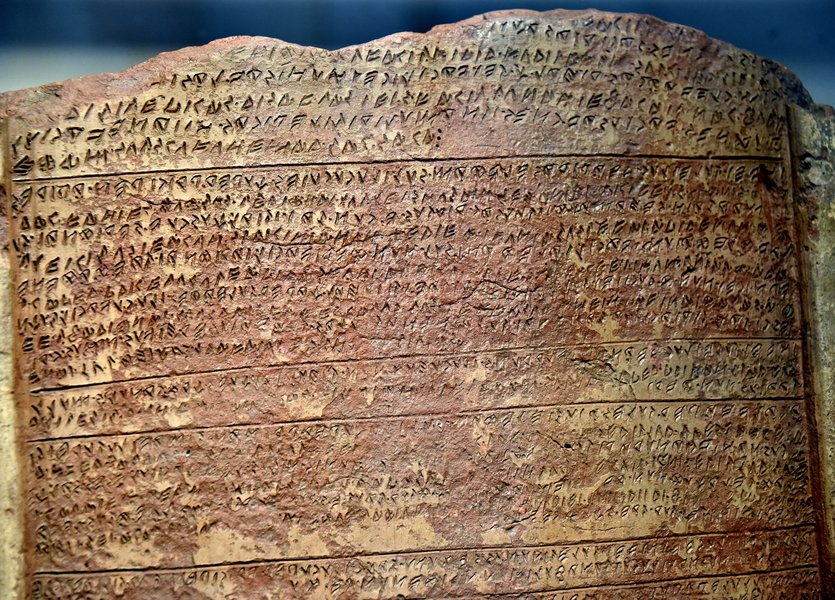
An example of an Etruscan inscription, showcasing the script derived from Greek letters.
Challenges in Full Comprehension
Despite the legibility of the script, fully understanding Etruscan presents several hurdles:
- Limited Vocabulary: Scholars have confidently identified the meaning of only about three hundred Etruscan words. Many more remain unknown or their meanings are conjectural.
- Grammatical Nuances: While some grammatical features are understood (Etruscan is an agglutinative language, forming words by adding suffixes to roots), many aspects of its syntax and morphology are still debated.
- Scarcity of Bilingual Texts: Unlike the Rosetta Stone for Egyptian hieroglyphs, there are very few extensive bilingual inscriptions (Etruscan alongside Latin or Greek) that would provide direct translations. The Pyrgi Tablets, containing texts in Etruscan and Phoenician, are a notable but limited example.
- Lack of Surviving Literature: Historical sources suggest the Etruscans had a body of religious, historical, and dramatic literature, but none of it has survived directly.
What We *Do* Know About Etruscan
Phonology and Pronunciation
Thanks to the alphabetic script and comparative linguistics, scholars have a reasonably good reconstruction of Etruscan phonology. We know it had a system of four core vowels (a, e, i, u) and distinctions between aspirated (e.g., ph, th, kh) and unaspirated stop consonants. This allows for the pronunciation of known words and inscriptions with some confidence.
Basic Grammar and Vocabulary
Key insights into Etruscan grammar include the identification of noun declensions (case endings for subject, object, possessive, etc.) and verb conjugations (tense and mood markers). Many proper nouns (names of people, gods, and places) are known. The understood vocabulary often pertains to kinship terms, religious rituals, and common objects found in funerary contexts.
Etruscan Language Understanding: A Comparative Look
To illustrate the current state of Etruscan knowledge compared to a well-understood ancient language like Latin, the following radar chart provides a visual representation. The chart assesses various aspects of linguistic understanding, rated on a hypothetical scale where 10 represents complete comprehension or viability.
As the chart illustrates, while the Etruscan alphabet is well-deciphered and pronunciation is fairly well understood, knowledge of its vocabulary, grammar, and the availability of extensive texts lags significantly behind that of Latin. Consequently, achieving conversational fluency remains beyond our current capabilities.
The Journey of the Etruscan Language: A Mindmap Overview
The following mindmap provides a structured overview of key aspects of the Etruscan language, from its origins and characteristics to the challenges scholars face in its study and its eventual decline.
(Raetic, Lemnian)"] id1b["Non-Indo-European"] id1c["Pre-Roman Italy"] id2["Writing System"] id2a["Adapted Greek Alphabet
(Euboean script)"] id2b["Right-to-left script (mostly)"] id2c["Phonetic Representation"] id3["Corpus of Texts"] id3a["~13,000 Inscriptions"] id3b["Mostly Short: Epitaphs, Dedications"] id3c["Liber Linteus Zagrabiensis
(Linen Book)"] id3d["Pyrgi Tablets
(Bilingual with Phoenician)"] id4["Linguistic Features"] id4a["Agglutinative Language"] id4b["Known Phonology (4 vowels)"] id4c["Partially Understood Grammar
(Noun cases, Verb forms)"] id4d["Limited Known Vocabulary
(~300 words)"] id5["Challenges in Decipherment"] id5a["Scarcity of Long Texts"] id5b["Few Bilingual Inscriptions"] id5c["Linguistic Isolation"] id5d["Lost Literature"] id6["Decline & Extinction"] id6a["Gradual Replacement by Latin"] id6b["Extinct by 1st Century CE (everyday use)"] id6c["Religious use persisted until ~5th Cent. CE"] id7["Modern Study"] id7a["Epigraphy & Archaeology"] id7b["Comparative Linguistics"] id7c["Ongoing Research"]
This mindmap encapsulates the multifaceted nature of Etruscan, highlighting its unique position in linguistic history and the ongoing efforts to piece together its intricacies from the surviving remnants.
Hearing the Echoes: Reconstructing Etruscan Sounds
While fluent conversation in Etruscan is not possible, linguistic research allows us to reconstruct how the language might have sounded. The video below explores these reconstructions, giving an auditory glimpse into this ancient tongue. It discusses the methodologies scholars use, based on the Etruscan alphabet, comparative analysis with related languages, and how ancient authors described Etruscan pronunciation.
Such reconstructions are invaluable for academic study and offer a tangible connection to the Etruscan people, even if the full richness of their spoken language remains largely beyond our reach. They help us appreciate the phonetic landscape of ancient Italy and the sounds that once filled Etruscan cities and sanctuaries.
Etruscan vs. Latin: A Tale of Two Ancient Tongues
The contrast between Etruscan and Latin, its eventual successor in Italy, is stark in terms of our modern understanding and ability to engage with them. The following table highlights key differences:
| Feature | Etruscan | Classical Latin |
|---|---|---|
| Language Family | Tyrsenian (likely non-Indo-European isolate) | Indo-European (Italic branch) |
| Surviving Texts | ~13,000 mostly short inscriptions; Liber Linteus | Vast corpus of literature, historical texts, letters, inscriptions |
| Vocabulary Comprehension | Limited (approx. 300 words well-understood) | Extensive |
| Grammar Comprehension | Partially understood; many complexities remain | Well-documented and comprehensively understood |
| Bilingual Aids | Very few (e.g., Pyrgi Tablets) | Many translations, comparative studies with Greek, etc. |
| "Speakability" Today | Pronunciation of known words possible; no fluency | Reconstructed pronunciation used; composition in Latin practiced; texts read aloud |
| Living Descendants | None directly | Romance languages (Italian, Spanish, French, etc.) |
This comparison underscores why, despite being able to read Etruscan script, we cannot "speak" Etruscan with the same level of engagement possible for Latin, for which a rich literary and linguistic tradition survives.
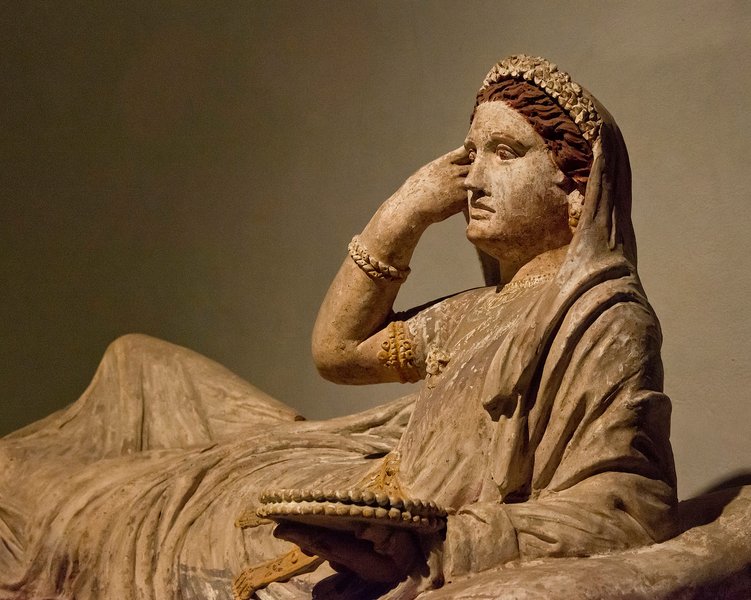
The Sarcophagus of the Spouses, a famous example of Etruscan art, reflects a vibrant culture whose language remains partly enigmatic.
Frequently Asked Questions about the Etruscan Language
Is Etruscan completely undeciphered?
No, Etruscan is not completely undeciphered. The alphabet is well understood, and scholars can read inscriptions phonetically. Many proper names, some basic vocabulary (around 300 words), and some grammatical features are known. However, the meaning of a large portion of the vocabulary and the full complexities of its grammar are still not understood, making comprehensive translation of longer texts difficult.
Are there any surviving Etruscan literary texts?
Directly, no extensive literary works like those of Greece or Rome have survived. The longest single Etruscan text is the Liber Linteus Zagrabiensis (Linen Book of Zagreb), which appears to be a ritual calendar. While historical sources mention Etruscan books (libri Etrusci) on religion, divination, and history, these have been lost. Our knowledge comes primarily from thousands of short inscriptions.
What language family does Etruscan belong to?
Etruscan is generally considered a language isolate or part of the small Tyrsenian language family, which also includes Raetic (an ancient Alpine language) and Lemnian (found on the island of Lemnos). It is not related to the Indo-European languages (like Latin or Greek) that surrounded it, which is one reason it's challenging to study.
Can we learn to read Etruscan inscriptions?
Yes, one can learn to read the Etruscan alphabet and pronounce the words in inscriptions. With study, it's possible to recognize common words, names, and formulaic phrases found in epitaphs or dedications. However, understanding the full meaning of more complex or unique inscriptions remains a task for specialist scholars due to the limited known vocabulary and grammar.
Why did Etruscan die out?
Etruscan gradually died out due to the political and cultural ascendancy of Rome. As Rome expanded its territory and influence across the Italian peninsula, Latin became the dominant language of administration, commerce, and daily life. Etruscan speakers progressively assimilated, and Latin eventually replaced Etruscan, which ceased to be a commonly spoken language by around the 1st century CE, though it lingered in some religious contexts for a few more centuries.
Recommended Further Exploration
- What are the main characteristics of the Etruscan alphabet and its origins?
- Can you explain the significance of the Liber Linteus Zagrabiensis in understanding Etruscan?
- What are some known Etruscan words and their meanings?
- How did the Etruscan language influence Latin?
References

 crewsproject.wordpress.com
Last updated May 14, 2025