
The Unseen Driver: What Force Is Accelerating Our Universe's Expansion?
Delve into dark energy, the enigmatic phenomenon shaping the cosmos and its ultimate destiny.
The universe is not just expanding; it's doing so at an ever-increasing rate. This startling discovery, made in the late 20th century, pointed to a mysterious, dominant force at play: dark energy. It's an invisible entity, yet it comprises the majority of the universe's total energy and matter content, profoundly influencing its structure and fate. Understanding dark energy is one of the most significant challenges in modern physics and cosmology.
Key Insights into Dark Energy
- Dominant Component: Dark energy is estimated to make up approximately 68% to 72% of the total mass-energy density of the universe, far outweighing ordinary matter and dark matter.
- Accelerated Expansion: It acts as a repulsive force, counteracting gravity on cosmic scales and causing the expansion of the universe to speed up, a phenomenon confirmed by observations of distant supernovae in 1998.
- Enduring Mystery: Despite its profound effects, the exact nature of dark energy remains unknown, with leading theories including the cosmological constant (vacuum energy) and dynamic fields like quintessence.
The Discovery of an Accelerating Universe
For much of the 20th century, astronomers believed the universe was expanding, a consequence of the Big Bang. The prevailing assumption was that this expansion should be slowing down due to the gravitational pull of all the matter within it. However, in 1998, two independent teams of astronomers made a revolutionary discovery that turned this notion on its head.
These teams, which included notable astronomers like Saul Perlmutter, Brian Schmidt, and Adam Riess (who later shared the Nobel Prize in Physics for this work), were studying Type Ia supernovae. These distant stellar explosions serve as "standard candles" – objects of known intrinsic brightness – allowing astronomers to measure cosmic distances accurately. Their observations revealed that these supernovae were fainter, and thus farther away, than predicted if the universe's expansion were decelerating. The only explanation was that the expansion was, in fact, accelerating.
This unexpected acceleration implied the existence of a new, unseen energy component with a repulsive gravitational effect, overwhelming the attractive gravity of matter on the largest scales. University of Chicago astrophysicist Michael Turner coined the term "dark energy" in 1998 to describe this mysterious entity.
A diagram illustrating the timeline of the universe, from the Big Bang to the present day, showing the period of accelerated expansion driven by dark energy.
The Nature and Properties of Dark Energy
Dark energy is unlike any known form of matter or energy. Its defining characteristic is its ability to exert a negative pressure, which, according to Einstein's theory of general relativity, results in a repulsive gravitational force. This "anti-gravity" effect pushes space itself apart, causing galaxies to recede from each other at ever-increasing speeds.
Key Characteristics
Constant Density
Unlike ordinary matter and dark matter, whose density decreases as the universe expands (because the same amount of matter occupies a larger volume), the energy density of dark energy appears to remain constant or very nearly constant. This means that as space expands, more dark energy seems to fill the new volume, maintaining its overall influence.
Negative Pressure
In general relativity, pressure contributes to gravity just as mass-energy does. For most forms of matter and energy, pressure is positive or negligible. However, dark energy is characterized by a significant negative pressure. A simple way to think about this is that positive pressure pushes outward (like air in a balloon), while negative pressure pulls inward, effectively creating an outward "push" on spacetime itself when considered in the context of cosmic expansion.
Homogeneous and Isotropic
Dark energy appears to be smoothly distributed throughout the universe and doesn't clump together like matter. It exerts its influence uniformly in all directions, consistent with observations of the large-scale structure of the cosmos.
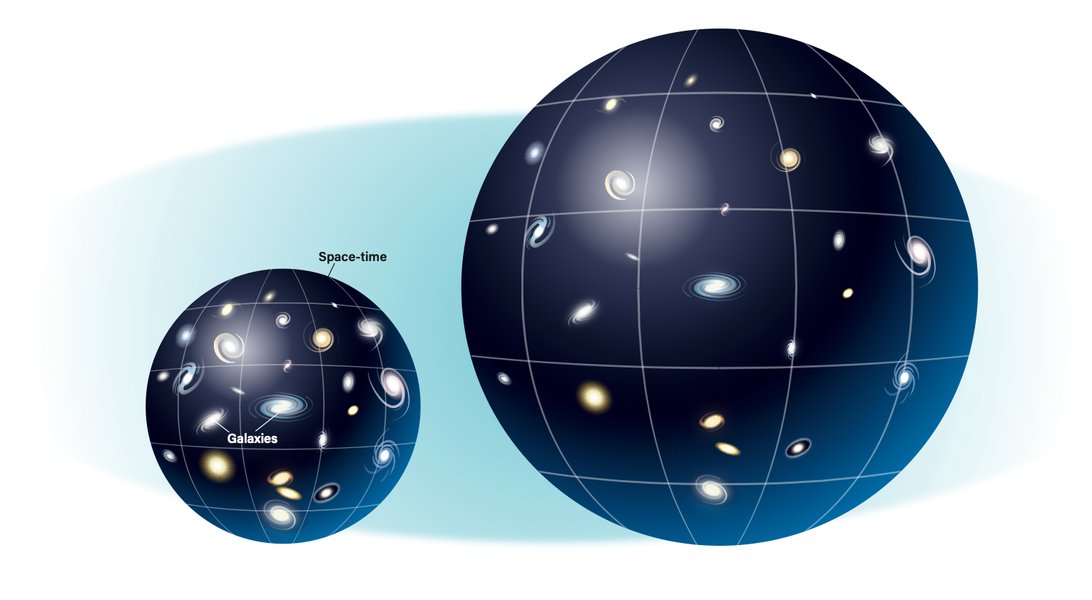
An artist's conception of spacetime expanding, driven by dark energy, illustrating how galaxies are carried further apart.
Cosmic Composition Comparison
The universe's composition is dominated by phenomena that we cannot directly see. Dark energy and dark matter together constitute the vast majority of the cosmos, with ordinary matter (the stuff that makes up stars, planets, and us) being a surprisingly small fraction. The radar chart below visualizes the estimated contributions and characteristics of these cosmic components.
This chart uses a 1-10 scale for qualitative characteristics: 'Gravitational Effect' (1=Very Repulsive, 10=Very Attractive), 'Pressure Type' (1=Very Negative, 10=Very Positive), 'Observability' (1=Unobservable, 10=Directly Observable), 'Clumping Behavior' (1=Uniform, 10=Highly Clumped), 'Scientific Understanding' (1=Mystery, 10=Well Understood). 'Percentage of Universe' is direct.
Theoretical Explanations for Dark Energy
While dark energy's existence is well-supported by observational evidence, its fundamental nature remains a profound puzzle. Several theoretical candidates have been proposed:
The Cosmological Constant (\(\Lambda\))
The leading and simplest explanation for dark energy is the cosmological constant, often denoted by the Greek letter Lambda (\(\Lambda\)). Albert Einstein originally introduced this term into his equations of general relativity in 1917 to allow for a static universe, which was the prevailing view at the time. When Edwin Hubble discovered the universe was expanding, Einstein reportedly called the cosmological constant his "biggest blunder."
However, the discovery of accelerated expansion revived the idea. In this context, \(\Lambda\) represents a constant energy density inherent in the vacuum of space itself – the "energy of empty space." Quantum field theory predicts that even a perfect vacuum is teeming with virtual particles constantly popping in and out of existence, which could contribute to this vacuum energy. The problem is that theoretical calculations of this vacuum energy are vastly larger (by many orders of magnitude) than the observed value of dark energy, a discrepancy known as the "cosmological constant problem." Despite this, a small, positive cosmological constant is consistent with all current observational data.
\[ G_{\mu\nu} + \Lambda g_{\mu\nu} = \frac{8\pi G}{c^4} T_{\mu\nu} \]Einstein's field equations with the cosmological constant term \(\Lambda\).
Quintessence and Dynamic Dark Energy
Another class of theories proposes that dark energy is not constant but dynamic, meaning its energy density can change over time and space. This type of dark energy is often referred to as "quintessence," a hypothetical scalar field that pervades the universe. Unlike the cosmological constant, quintessence could have a different equation of state (the relationship between its pressure and energy density) and could evolve as the universe ages. Detecting such evolution is a key goal of ongoing cosmological surveys.
Alternative Theories
Some scientists explore more radical ideas:
Modified Gravity
Instead of introducing a new form of energy, these theories suggest that our understanding of gravity itself, as described by general relativity, might be incomplete on cosmic scales. Perhaps gravity behaves differently over vast distances or at very low accelerations, leading to the observed cosmic acceleration without the need for dark energy.
Inhomogeneous Cosmology
These models propose that we might live in a particularly underdense region of the universe (a large cosmic void). The expansion rate within such a void could appear to be accelerating relative to denser regions, creating an illusion of dark energy. This is sometimes referred to as "timescape cosmology." However, most observations suggest the universe is largely homogeneous on the largest scales.
Other Possibilities
Researchers have also explored links between dark energy and other exotic concepts, such as extra spatial dimensions or energy associated with black holes. These ideas are generally more speculative but highlight the breadth of theoretical investigation.
Comparison of Dark Energy Theories
The following table summarizes key aspects of the leading theoretical explanations for dark energy:
| Theory | Nature of Dark Energy | Energy Density | Equation of State Parameter (w = P/ρ) | Key Implication |
|---|---|---|---|---|
| Cosmological Constant (\(\Lambda\)) | Energy of vacuum space | Constant in time and space | \(w = -1\) | Universe expands exponentially in the future. |
| Quintessence | Dynamic scalar field | Varies in time, possibly space | Typically \(-1 < w < -1/3\) (can evolve) | Expansion rate can change differently than with \(\Lambda\). |
| Modified Gravity | Not a new energy; gravity behaves differently | N/A (no new energy component) | N/A (effective w can be derived) | General Relativity needs revision on cosmic scales. |
| Inhomogeneous Cosmology | Apparent effect due to local underdensity | N/A (observational illusion) | N/A | Universe is not as homogeneous as assumed. |
Mapping Dark Energy's Influence
The mindmap below illustrates the interconnected concepts surrounding dark energy, from its fundamental definition and discovery to its theoretical explanations and far-reaching effects on the cosmos.
expansion of the universe"] id1c["~68-72% of universe's
mass-energy"] id2["Discovery"] id2a["1998 - Type Ia Supernovae"] id2b["Observations of fainter,
more distant supernovae"] id2c["Perlmutter, Schmidt, Riess"] id3["Properties"] id3a["Repulsive Force
(Anti-Gravity)"] id3b["Negative Pressure"] id3c["Constant (or near-constant)
energy density"] id3d["Homogeneous & Isotropic"] id4["Theoretical Explanations"] id4a["Cosmological Constant (Λ)"] id4aa["Vacuum Energy"] id4ab["Einstein's 'blunder' revisited"] id4b["Quintessence"] id4ba["Dynamic Scalar Field"] id4bb["Energy density evolves"] id4c["Modified Gravity"] id4ca["General Relativity incomplete?"] id4d["Inhomogeneous Cosmology"] id4da["Local void effects?"] id5["Effects on Universe"] id5a["Accelerated expansion"] id5b["Galaxies receding faster"] id5c["Slows formation of
large-scale structures"] id5d["Determines ultimate fate
(e.g., Big Freeze)"] id6["Research & Observatories"] id6a["ESA's Euclid Mission"] id6b["NASA's Nancy Grace Roman
Space Telescope"] id6c["Hubble Space Telescope"] id6d["Ground-based surveys"]
This mindmap provides a visual summary of the key facets of dark energy, highlighting its central role in modern cosmology and the ongoing efforts to understand its nature.
Impacts on the Cosmos
Dark energy's influence is profound and far-reaching, shaping not only the present state of the universe but also its ultimate destiny.
Accelerated Recession of Galaxies
The most direct consequence of dark energy is the accelerated rate at which distant galaxies are moving away from us and from each other. The fabric of space itself is being stretched at an increasing pace. This means that galaxies beyond a certain distance (the cosmic event horizon) are receding so fast that light emitted from them now will never be able to reach us. Over eons, this will lead to an increasingly isolated Milky Way galaxy as other galaxy groups disappear beyond this horizon.
Formation of Large-Scale Structures
While gravity works to pull matter together to form galaxies and galaxy clusters, dark energy's repulsive force acts in opposition. In the early universe, when matter density was higher, gravity dominated, allowing these structures to form. However, as the universe expanded and matter thinned out, dark energy's constant density meant its influence grew relatively stronger. For the past few billion years, dark energy has been the dominant component, and its repulsive effects have begun to slow down and eventually halt the formation of new superclusters of galaxies.
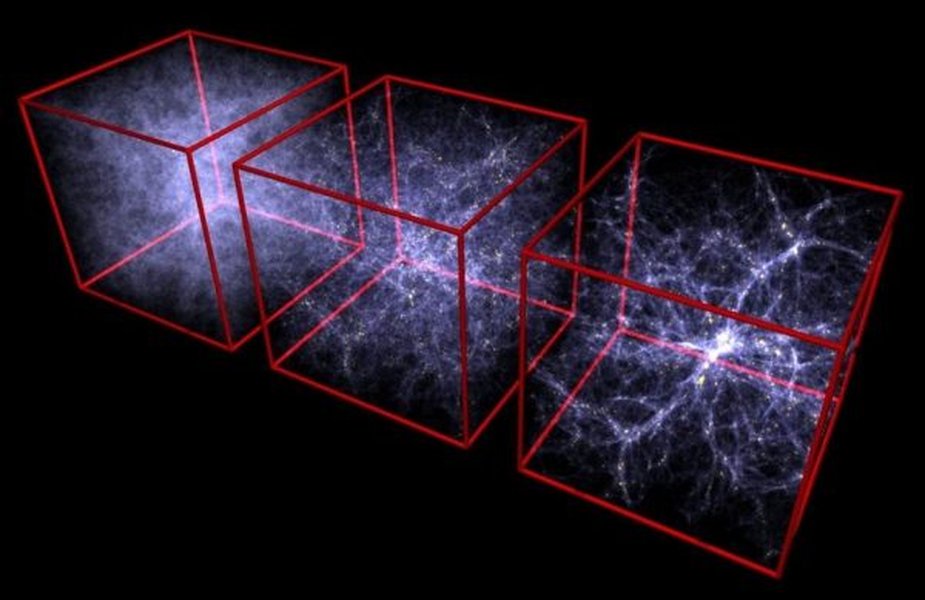
A cosmological simulation showing the filamentary large-scale structure of the universe, whose formation is influenced by the interplay between gravity, dark matter, and dark energy.
The Ultimate Fate of the Universe
The nature of dark energy is a critical factor in determining the long-term fate of the cosmos.
Big Freeze (or Heat Death)
If dark energy is a cosmological constant (or similar), the universe will continue to expand at an accelerating rate indefinitely. Galaxies will become increasingly distant and isolated. Stars will eventually exhaust their fuel, and the universe will grow colder, darker, and emptier, leading to a "Big Freeze" or "Heat Death." This is currently the most favored scenario based on existing data.
Other Possibilities
If dark energy is dynamic (like some forms of quintessence), its properties could change.
- If dark energy were to weaken or reverse its effect, the expansion could slow, stop, or even reverse, potentially leading to a "Big Crunch" where the universe collapses back on itself.
- If dark energy's repulsive force were to grow stronger over time (a scenario known as "phantom energy"), it could lead to a "Big Rip," where the expansion becomes so violent that it eventually tears apart galaxies, stars, planets, and even atoms themselves.
Exploring Dark Energy: A Deeper Dive
To further understand the concept of dark energy and its implications, the following video provides an accessible explanation from cosmological experts. It covers the discovery, the mystery surrounding its nature, and how scientists are trying to unravel its secrets.
This video from "Cosmology 101" delves into the perplexing nature of dark energy, explaining how this dominant force took control of the cosmos, causing its expansion to accelerate. It discusses the observational evidence and the profound questions it raises about the universe's composition and ultimate fate.
Ongoing Research and Future Probes
Unraveling the mystery of dark energy is a primary goal for contemporary cosmology. Several major international projects and space missions are dedicated to precisely measuring the expansion history of the universe and the growth of large-scale structures. These observations aim to constrain the properties of dark energy, particularly its equation of state parameter (\(w\)), to distinguish between the cosmological constant and more dynamic theories.
Key Observational Probes
- Type Ia Supernovae: Continuing to find and measure distant supernovae to map the expansion history with greater precision.
- Baryon Acoustic Oscillations (BAO): Studying the subtle imprint of sound waves from the early universe on the distribution of galaxies. These oscillations provide a "standard ruler" to measure cosmic distances and expansion.
- Weak Gravitational Lensing: Analyzing how the light from distant galaxies is distorted by the gravity of intervening matter (mostly dark matter). This reveals how structure has grown over time, which is sensitive to dark energy.
- Galaxy Cluster Surveys: Counting the number of galaxy clusters at different cosmic epochs. The growth rate of these massive structures is also affected by dark energy.
Flagship Missions
ESA's Euclid Mission
Launched in July 2023, the European Space Agency's Euclid telescope is designed to map the geometry of the dark universe. Over six years, it will observe billions of galaxies out to 10 billion light-years, covering more than a third of the sky. By measuring galaxy shapes (for weak lensing) and their 3D distribution (for BAO), Euclid aims to provide highly accurate data on the history of cosmic expansion and structure formation, shedding light on dark energy and dark matter.
NASA's Nancy Grace Roman Space Telescope
Set to launch by May 2027, NASA's Roman Space Telescope will have a field of view 100 times larger than Hubble's. It will conduct large surveys to study dark energy using multiple techniques, including Type Ia supernovae, BAO, and weak gravitational lensing. It will also have capabilities for exoplanet detection and general astrophysics.
Legacy and Ongoing Instruments
The Hubble Space Telescope continues to contribute valuable data, particularly for supernova cosmology. Ground-based observatories like the Dark Energy Survey (DES), the Subaru Telescope with its Hyper Suprime-Cam, and upcoming projects like the Vera C. Rubin Observatory's Legacy Survey of Space and Time (LSST) are also crucial in this quest.
The combined data from these and other experiments will hopefully lead to a breakthrough in our understanding of dark energy, potentially revolutionizing fundamental physics and our view of the cosmos.
Frequently Asked Questions (FAQ)
What's the difference between dark energy and dark matter?
Dark matter and dark energy are both "dark" because they don't interact with light (or any electromagnetic radiation) and are therefore invisible to us. However, they have opposite effects on the universe:
- Dark Matter: Exerts an attractive gravitational force, much like ordinary matter. It helps hold galaxies and galaxy clusters together. It makes up about 24-27% of the universe.
- Dark Energy: Exerts a repulsive force (negative pressure) that causes the expansion of the universe to accelerate. It makes up about 68-72% of the universe and is distributed diffusely throughout space.
So, while dark matter pulls things together, dark energy pushes them apart on cosmic scales.
How was dark energy discovered?
Dark energy was discovered in 1998 by two independent teams of astronomers who were studying Type Ia supernovae. These supernovae are excellent "standard candles," meaning they have a known intrinsic brightness. By measuring their apparent brightness, astronomers can determine their distance.
The teams found that distant supernovae were fainter (and thus farther away) than they would be if the universe's expansion was slowing down or constant. This indicated that the expansion of the universe has been accelerating for the past several billion years. This acceleration requires some form of energy with repulsive gravitational properties, which was dubbed "dark energy."
Will dark energy ever run out?
This depends on the nature of dark energy. If dark energy is the cosmological constant (the energy of empty space), then its energy density remains constant as the universe expands. In this scenario, it doesn't "run out"; in fact, as space expands, more dark energy effectively comes into being to maintain this constant density. This would lead to perpetual accelerated expansion.
If dark energy is something more dynamic, like quintessence, its energy density could change over time. It might weaken, strengthen, or even dissipate. Current observations are most consistent with dark energy being a cosmological constant, suggesting it won't run out.
Why is it called "dark" energy?
The term "dark" in "dark energy" (and "dark matter") primarily signifies its unknown nature and the fact that it does not interact with the electromagnetic spectrum – meaning it doesn't emit, absorb, or reflect light. We cannot see it directly. Its existence is inferred from its gravitational effects on the universe's expansion (for dark energy) or on visible matter (for dark matter).
So, "dark" essentially means it's invisible and mysterious, not necessarily that it's inherently ominous or related to darkness in a literal sense.
What is the cosmological constant?
The cosmological constant, denoted by the Greek letter Lambda (\(\Lambda\)), is a term Albert Einstein added to his equations of general relativity. Originally, he introduced it to allow for a static, unchanging universe, which was the accepted view at the time. When the universe was later found to be expanding, Einstein considered it his "biggest blunder."
However, with the discovery of the universe's accelerated expansion, the cosmological constant has been revived as the simplest explanation for dark energy. It represents a constant energy density that fills all of space (vacuum energy) and has negative pressure, causing cosmic acceleration. While it fits observational data well, there's a major theoretical problem: quantum physics predicts a vacuum energy vastly larger than what's observed, a discrepancy known as the cosmological constant problem.
Recommended Further Exploration
- What are the leading theories attempting to explain dark energy beyond the cosmological constant?
- How do space telescopes like Euclid and the Nancy Grace Roman Space Telescope plan to measure dark energy?
- What are the implications of dark energy for the ultimate fate of the universe, such as the Big Freeze or Big Rip scenarios?
- What is the cosmological constant problem and why is it a major challenge in physics?
References
Last updated May 7, 2025