
Unveiling Cosmic Dawn: How Did Our Universe Come Into Being?
Journey back 13.8 billion years to explore the monumental events that shaped the cosmos from a singular point to the vast expanse we observe today.
The question of how the universe formed is one of the most profound inquiries in science, touching upon the very origins of space, time, and matter. The prevailing scientific explanation, supported by a wealth of observational evidence, is the Big Bang theory. This model describes a universe that began as an incredibly hot, dense singularity and has been expanding and cooling ever since, leading to the complex structures we see around us.
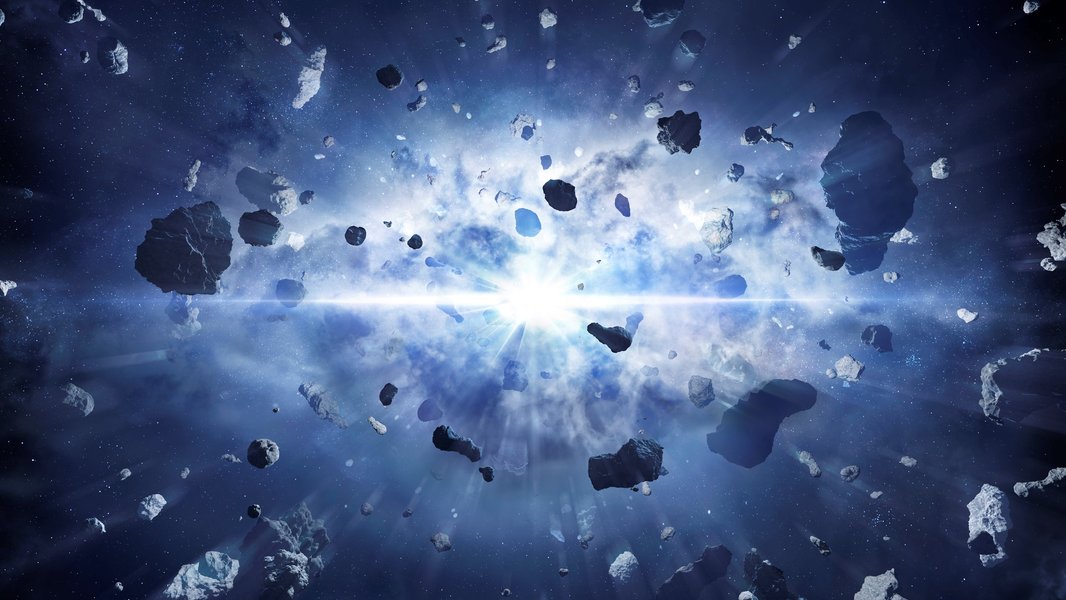
An artist's conception of the Big Bang, depicting the expansion of the universe from an initial hot, dense state.
Key Insights into Cosmic Genesis
- The Big Bang Theory: The universe originated approximately 13.8 billion years ago from an extremely hot, dense state and has been expanding ever since. This is the most widely accepted scientific model.
- Cosmic Inflation: A period of incredibly rapid, exponential expansion occurred in the first fraction of a second, smoothing out the universe and setting the stage for structure formation.
- Formation of Matter and Light: As the universe cooled, fundamental particles formed, leading to the synthesis of light elements (hydrogen and helium). Later, atoms formed, allowing light to travel freely, resulting in the Cosmic Microwave Background radiation.
The Chronology of Cosmic Creation
Understanding the universe's formation involves journeying through distinct epochs, each characterized by transformative physical processes. The Big Bang theory provides a robust framework for this journey.
The Primordial Spark: The Big Bang Singularity
The story of our universe begins at a moment of unimaginable conditions. According to the Big Bang model, all the matter and energy of the observable universe were initially concentrated in an infinitesimally small, infinitely hot, and infinitely dense region known as a primordial singularity. Current physics struggles to describe this state precisely, as it's a point where the laws of general relativity and quantum mechanics would need to be unified. The "Big Bang" itself refers not to an explosion in pre-existing space, but rather the expansion of space itself from this singular point, marking the beginning of time as we understand it.
A Moment of Exponential Growth: Cosmic Inflation
Within the tiniest fraction of a second after the Big Bang (around 10-36 to 10-32 seconds), the universe is believed to have undergone a period of extraordinarily rapid expansion called cosmic inflation. During this phase, the universe expanded exponentially, far faster than the speed of light (which is permissible as it's space itself expanding, not objects moving through space). Inflation is a crucial addition to the Big Bang model because it elegantly solves several cosmological puzzles:
- The Horizon Problem: Explains why distant regions of the universe, which seemingly haven't had time to interact, exhibit such a uniform temperature (as seen in the Cosmic Microwave Background). Inflation stretches a small, causally connected region to encompass the entire observable universe.
- The Flatness Problem: Addresses why the universe's geometry is so close to flat. Inflation effectively flattens out any initial curvature, much like inflating a wrinkled balloon makes its surface appear flatter.
- Origin of Structure: Tiny quantum fluctuations present before inflation were stretched to macroscopic scales, providing the primordial seeds for the large-scale structures (galaxies and galaxy clusters) we observe today.
The Universe Cools: Formation of Fundamental Particles and Light Elements
The Quark-Gluon Plasma and Hadron Epoch
After inflation ended, the universe was still incredibly hot and dense, filled with a soup of fundamental particles like quarks, leptons (such as electrons), and their antiparticles, along with force-carrying particles (like photons and gluons). As the universe continued to expand and cool, quarks and gluons combined to form protons and neutrons (hadrons) within the first microsecond.
Big Bang Nucleosynthesis
Between about one second and a few minutes after the Big Bang, the universe cooled sufficiently (to roughly a billion Kelvin) for protons and neutrons to fuse and form the nuclei of the lightest elements. This process, known as Big Bang Nucleosynthesis (BBN), primarily produced hydrogen (about 75% by mass) and helium-4 (about 25% by mass), along with trace amounts of deuterium (an isotope of hydrogen), helium-3, and lithium-7. The predicted abundances of these light elements match remarkably well with astronomical observations of primordial gas clouds, providing strong evidence for the Big Bang model.

A timeline depicting the early universe, from the Big Bang through inflation, the formation of light elements, and the emission of the Cosmic Microwave Background.
The First Light: Recombination and the Cosmic Microwave Background (CMB)
For the first approximately 380,000 years, the universe was a hot, opaque plasma of atomic nuclei and free electrons. Photons (light particles) were constantly scattered by these free electrons, unable to travel far. As the universe expanded and cooled further, it reached a temperature of about 3,000 Kelvin. At this point, electrons could combine with nuclei to form neutral atoms—mostly hydrogen and helium. This event is called recombination.
With electrons now bound into atoms, photons were no longer continuously scattered and could travel freely through space. The universe became transparent. This "first light" released during recombination is what we observe today as the Cosmic Microwave Background (CMB) radiation. The CMB is a faint, nearly uniform glow of microwave radiation filling the entire sky, representing the afterglow of the Big Bang. Its discovery in 1965 was a landmark confirmation of the Big Bang theory. Tiny temperature fluctuations (anisotropies) in the CMB, on the order of one part in 100,000, are the imprints of the primordial density variations magnified by inflation, which later grew into galaxies.
The Cosmic Web: Emergence of Stars, Galaxies, and Large-Scale Structures
The slight density variations observed in the CMB were crucial. Over hundreds of millions of years, gravity acted on these denser regions, pulling in more matter. The universe entered what is known as the "Dark Ages" after recombination, as there were no stars yet to illuminate it. Gradually, the denser regions began to collapse under their own gravity.
The Role of Dark Matter
The formation of these structures was significantly aided by dark matter, a mysterious, non-luminous substance that interacts gravitationally but not through electromagnetic forces. Dark matter, which constitutes about 85% of the total matter in the universe, began clumping together even before recombination, creating gravitational wells, or "halos." Ordinary matter (baryonic matter) then fell into these dark matter halos, providing the concentrated gas needed for star and galaxy formation. This "cold dark matter" model helps explain the observed large-scale structure of the universe, often described as a "cosmic web" of filaments, clusters, and voids.
The First Stars and Galaxies (The "Cosmic Dawn")
Around 200 to 500 million years after the Big Bang, the first stars ignited within the densest clumps of gas. These first-generation stars (Population III stars) are theorized to have been very massive, hot, and short-lived, composed almost entirely of hydrogen and helium. Their intense radiation ionized the surrounding neutral hydrogen, leading to the Epoch of Reionization, which gradually made the universe transparent to ultraviolet light again. These massive stars ended their lives in spectacular supernova explosions, dispersing heavier elements (synthesized in their cores) into space. These heavier elements enriched subsequent generations of stars and were essential for the formation of planets and, eventually, life.
These first stars congregated to form the first protogalaxies, which then merged and grew over billions of years to become the diverse array of galaxies we see today, including our own Milky Way.
This video from National Geographic, "Origins of the Universe 101," provides a concise overview of the Big Bang theory and the early stages of the universe's development, complementing the textual explanation.
The Accelerating Expansion: The Mystery of Dark Energy
For much of cosmic history, the mutual gravitational attraction of matter worked to slow down the expansion of the universe. However, observations of distant supernovae in the late 1990s revealed a startling discovery: the expansion of the universe is currently accelerating. This acceleration is attributed to dark energy, an even more enigmatic component than dark matter, which is thought to make up about 68-70% of the total energy density of the universe. Dark energy acts as a sort of anti-gravity, pushing space apart. Its nature remains one of the biggest unsolved mysteries in cosmology.
Visualizing Cosmic Milestones
To better grasp the complex sequence of events and the interplay of different phenomena in the universe's formation, visual aids can be very helpful. The following mindmap illustrates the key stages and concepts discussed.
(Infinite Density & Temperature)"] id2["Early Universe (First Few Seconds)"] id2a["Cosmic Inflation
(Rapid Exponential Expansion)"] id2b["Formation of Fundamental Particles
(Quarks, Leptons)"] id2c["Formation of Protons & Neutrons"] id3["First Few Minutes"] id3a["Big Bang Nucleosynthesis
(Formation of H, He, Li)"] id4["~380,000 Years After Big Bang"] id4a["Recombination
(Atoms Form: H, He)"] id4b["Universe Becomes Transparent"] id4c["Cosmic Microwave Background (CMB) Emission"] id5["~200 Million to 1 Billion Years"] id5a["Dark Ages End"] id5b["Formation of First Stars (Population III)"] id5c["Formation of First Galaxies"] id5d["Epoch of Reionization"] id6["Billions of Years to Present"] id6a["Galaxy Evolution and Mergers"] id6b["Star Formation Continues (Population I & II)"] id6c["Formation of Solar Systems & Planets"] id6d["Accelerated Expansion (Dark Energy Domination)"] id7["Key Components"] id7a["Ordinary (Baryonic) Matter"] id7b["Dark Matter"] id7c["Dark Energy"]
This mindmap provides a hierarchical overview of the universe's formation, branching from the Big Bang theory into its distinct phases and the key physical processes and components involved at each stage.
Key Epochs in Cosmic Evolution: A Timeline
The formation of the universe is a story that unfolds over billions of years, marked by distinct epochs. The table below summarizes the major events and their approximate timing according to the standard cosmological model.
| Time After Big Bang | Epoch/Event | Key Characteristics |
|---|---|---|
| 0 to ~10-43 s | Planck Epoch | Conditions unknown; quantum gravity dominates. All fundamental forces possibly unified. |
| ~10-36 s to ~10-32 s | Inflationary Epoch | Universe undergoes exponential expansion. Smoothing of irregularities, generation of density fluctuations. |
| ~10-32 s to ~1 s | Electroweak Epoch & Quark Epoch | Universe cools; fundamental particles (quarks, leptons) form. Electroweak force separates into electromagnetic and weak forces. |
| ~1 s to ~3 minutes | Hadron Epoch & Lepton Epoch | Quarks combine to form protons and neutrons. Temperature still too high for stable atomic nuclei beyond hydrogen. |
| ~3 minutes to ~20 minutes | Big Bang Nucleosynthesis | Protons and neutrons fuse to form nuclei of deuterium, helium, and trace lithium. |
| ~20 minutes to ~380,000 years | Photon Epoch (Plasma Era) | Universe filled with hot, dense plasma of nuclei and electrons. Opaque to light. |
| ~380,000 years | Recombination | Universe cools enough for electrons to combine with nuclei, forming neutral atoms. Universe becomes transparent. |
| ~380,000 years (after recombination) | Cosmic Microwave Background (CMB) Release | Photons decouple from matter and travel freely; this is the CMB we observe today. |
| ~380,000 years to ~200 million years | Dark Ages | Universe is neutral but without stars to illuminate it. Gradual gravitational collapse of matter begins. |
| ~200 million to ~1 billion years | Epoch of Reionization / First Stars & Galaxies | First stars (Population III) form, their UV radiation reionizes neutral hydrogen. First galaxies begin to assemble. |
| ~1 billion years to present | Stelliferous Era / Galaxy Evolution | Ongoing star formation, galaxy mergers, formation of planets, and evolution of large-scale structures. Dark energy begins to dominate, causing accelerated expansion. |
| ~9 billion years | Formation of Solar System | Our Sun and planets form from a cloud of gas and dust enriched by previous generations of stars. |
| ~13.8 billion years | Present Day | Universe continues to expand and cool, dominated by dark energy. |
This timeline provides a condensed overview of the major milestones in the universe's history, from its earliest moments to the present day.
Confidence in Our Cosmic Understanding
The Big Bang theory is remarkably successful, but like any scientific model, it involves aspects with varying degrees of observational support and theoretical completeness. The radar chart below offers a qualitative assessment of different components of our understanding of universe formation.
This chart visualizes different facets of cosmic formation theories, rated on a scale of 1 (low) to 10 (high) for: Observational Evidence Strength (how well supported by data), Theoretical Understanding (how well the physics is understood), and Remaining Questions/Mysteries (degree of unknowns). For example, the CMB has strong observational evidence and good theoretical understanding, while the Initial Singularity and Dark Energy have many remaining mysteries.
Frequently Asked Questions (FAQ)
What existed before the Big Bang?
This is one of the most challenging questions in cosmology. According to the Big Bang theory, time and space themselves began with the Big Bang. Therefore, the concept of "before" the Big Bang may not be meaningful in the way we typically understand it. Current physics, including general relativity, breaks down at the singularity. Some speculative theories, like string theory or loop quantum gravity, explore possibilities such as a cyclical universe or a "quantum foam" from which our universe emerged, but these are not yet experimentally verified.
Is the Big Bang theory universally accepted?
The Big Bang theory is the overwhelmingly dominant and most widely accepted cosmological model for the universe's origin and evolution among scientists. It is supported by a vast body of evidence, including the cosmic microwave background radiation, the observed abundances of light elements, the large-scale structure of the universe, and the Hubble-Lemaître law (the expansion of the universe). While there are still open questions and areas of active research (like the nature of dark matter and dark energy, or the specifics of inflation), the core tenets of the Big Bang are very well established. Alternative theories exist but generally lack the comprehensive explanatory power and observational support of the Big Bang model.
What is the evidence for cosmic inflation?
While cosmic inflation is a theoretical addition to the Big Bang, it has strong indirect support. Inflation explains:
- Flatness: Why the universe's geometry is very close to flat.
- Horizon Problem: Why the CMB is so uniform in temperature across vast, causally disconnected regions.
- Origin of Structures: The statistical properties of the temperature fluctuations in the CMB are consistent with predictions from inflationary models, suggesting these fluctuations originated as quantum fluctuations stretched during inflation.
What are dark matter and dark energy?
Dark Matter: This is a hypothetical form of matter that does not emit, absorb, or reflect light (making it "dark"), but its existence is inferred from its gravitational effects on visible matter, radiation, and the large-scale structure of the universe. For example, galaxies rotate faster than they should based on their visible matter alone, and galaxy clusters would fly apart without the extra gravity provided by dark matter. It's thought to make up about 27% of the universe's total mass-energy content.
Dark Energy: This is an even more mysterious form of energy hypothesized to permeate all of space and tends to accelerate the expansion of the universe. Observations of distant supernovae indicate this accelerated expansion. Dark energy is thought to constitute about 68% of the universe's total mass-energy content. Its nature (e.g., whether it's a cosmological constant or something else) is a major area of research.
Recommended Further Exploration
To delve deeper into the fascinating story of our universe, consider exploring these related queries:
- What is the evidence supporting the Big Bang theory and cosmic expansion?
- What are dark matter and dark energy, and what role do they play in the universe's evolution?
- How did the first stars and galaxies form after the Big Bang during the Epoch of Reionization?
- What are the major unsolved problems and future directions in modern cosmology research?
References

Last updated May 10, 2025