
How Did the Universe Begin?
Exploring the Origins of Space, Time, and Everything
Key Takeaways
- Big Bang Origin: The universe began approximately 13.8 billion years ago from an initial singularity, marking the start of space and time.
- Robust Evidence: The Big Bang Theory is corroborated by multiple lines of evidence, including cosmic microwave background radiation, the expansion of the universe, and the abundance of light elements.
- Ongoing Exploration: Alternative theories and ongoing research continue to refine our understanding of the universe's origins and address unanswered questions.
The Big Bang Theory
The Big Bang Theory stands as the most widely accepted scientific explanation for the origin of the universe. It posits that the universe began as an infinitely hot and dense point, known as a singularity, around 13.8 billion years ago. This singularity contained all the matter, energy, space, and time that make up our universe.
1. Initial Singularity
At the very beginning, the universe was compressed into a singularity—a state where density and temperature were infinitely high. In this state, the conventional laws of physics as we know them break down, and a unified description of all fundamental forces is required.
2. Rapid Expansion and Inflation
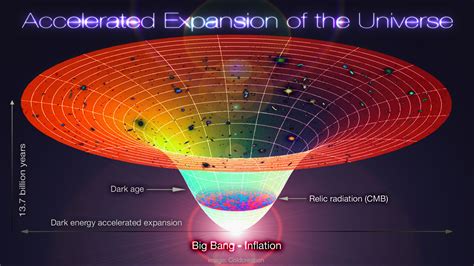
Approximately 10^-36 seconds after the initial singularity, the universe underwent a period of cosmic inflation, characterized by an exponential expansion. This rapid inflation smoothed out any initial irregularities, leading to the uniformity observed in the universe today.
3. Cooling and Formation of Basic Elements
As the universe expanded, it began to cool down. Within the first few minutes, conditions became suitable for nucleosynthesis, allowing protons and neutrons to combine and form the nuclei of simple elements like hydrogen and helium. This process set the stage for the chemical composition of the universe.
4. Cosmic Microwave Background (CMB) Radiation
Around 380,000 years after the Big Bang, the universe cooled sufficiently for electrons to combine with nuclei, forming neutral atoms in a process known as recombination. This decoupled matter and radiation, allowing photons to travel freely through space. These photons constitute the Cosmic Microwave Background (CMB) radiation, a critical piece of evidence supporting the Big Bang Theory.
5. Structure Formation
Over billions of years, gravitational forces caused matter to coalesce into stars, galaxies, and larger cosmic structures such as galaxy clusters and superclusters. This hierarchical structure formation continues to shape the universe, leading to the complex and vast cosmos we observe today.
Evidence Supporting the Big Bang Theory
1. Cosmic Microwave Background Radiation
Discovered in 1965 by Arno Penzias and Robert Wilson, the CMB is the relic radiation from the early universe, providing a snapshot of the universe approximately 380,000 years after the Big Bang. Its uniformity and spectrum closely match the predictions of the Big Bang Theory, making it one of the strongest pieces of evidence for the theory.
2. Expansion of the Universe (Hubble's Law)
Edwin Hubble's observations in the 1920s revealed that galaxies are moving away from us, with their velocities proportional to their distances. This redshift of light from distant galaxies indicates that the universe is expanding, suggesting that it was once much smaller and denser.
3. Abundance of Light Elements
The observed proportions of hydrogen, helium, and lithium isotopes in the universe align with the predictions made by Big Bang nucleosynthesis. These abundances provide a crucial test for the validity of the Big Bang model.
4. Large-Scale Structure of the Universe
The distribution of galaxies and galaxy clusters on large scales reflects the initial density fluctuations that grew under gravity. These structures match the predicted patterns from the early universe's uniformity and subsequent slight irregularities.
| Evidence | Observation | Big Bang Prediction |
|---|---|---|
| Cosmic Microwave Background | Uniform faint microwave radiation permeating the universe | CMB as remnant radiation from the early universe |
| Universe Expansion | Galaxies moving away from each other | Universe expanding from an initial singularity |
| Light Element Abundance | Specific ratios of hydrogen, helium, and lithium | Predicted by Big Bang nucleosynthesis |
| Large-Scale Structure | Clustering of galaxies and cosmic web | Formation from initial density perturbations |
Alternative Theories and Open Questions
1. Big Bounce Theory
The Big Bounce Theory suggests that the universe undergoes endless cycles of expansion and contraction. According to this model, the current expansion phase following the Big Bang will eventually reverse, leading to a "Big Crunch," which may be followed by another expansion phase.
2. Steady State Theory
Proposed as an alternative to the Big Bang Theory, the Steady State Theory posits that the universe has no beginning or end and has always existed in a constant state. It suggests that new matter is continuously created to maintain a constant density as the universe expands. However, this theory lacks support from observational evidence like the CMB.
3. Ekpyrotic Theory
The Ekpyrotic Theory originates from string theory and proposes that the universe was formed from the collision of two higher-dimensional "branes." This model aims to address some of the unresolved questions of the Big Bang Theory, such as the nature of the singularity.
4. Multiverse Hypothesis
The Multiverse Hypothesis suggests that our universe is just one of many universes within a larger multiverse. Each universe in the multiverse may have its own distinct physical laws and constants. This hypothesis attempts to explain the fine-tuning observed in our universe's fundamental constants.
Philosophical and Scientific Challenges
1. The Origin of the Singularity
One of the most profound questions is what caused the initial singularity. The Big Bang Theory describes the universe's expansion from this state but does not explain the origin of the singularity itself. Understanding this requires a theory of quantum gravity, which unifies general relativity and quantum mechanics.
2. What preceded the Big Bang?
The Big Bang Theory does not address what, if anything, existed before the initial expansion. Some theories, like the Big Bounce or the Multiverse Hypothesis, attempt to provide frameworks for understanding a pre-Big Bang state, but definitive answers remain elusive.
3. The Role of Dark Matter and Dark Energy
Approximately 95% of the universe's total mass-energy content is composed of dark matter and dark energy, which are not directly observable. Understanding their nature is crucial for a complete picture of the universe's origin and its future evolution.
Current Understanding and Future Research
Our comprehension of the universe's origins has advanced significantly, yet many questions remain unanswered. Ongoing research in cosmology, astrophysics, and particle physics continues to refine the Big Bang Theory and explore alternative models. Future investigations aim to uncover the nature of dark matter and dark energy, understand the conditions of the early universe, and possibly detect signatures of pre-Big Bang states.
Advancements in technology, such as more sensitive telescopes and particle detectors, as well as developments in theoretical physics, hold the promise of deepening our understanding of the cosmos's most fundamental questions.
Conclusion
The Big Bang Theory remains the most comprehensive and widely supported explanation for the origin of the universe. It elegantly accounts for the universe's expansion, the cosmic microwave background radiation, and the abundance of light elements. However, the theory leaves open questions about the singularity's origin and what preceded the Big Bang. Alternative theories and ongoing research continue to explore these mysteries, pushing the boundaries of our understanding of the universe's beginnings and its ultimate fate.
References
Last updated January 20, 2025