
In-Depth Exploration of Waves and Light
Discover the fundamentals, equations, and real-life applications
Key Highlights
- Understanding Wave Dynamics: Learn about the various types of waves, their parts, and basic equations.
- The Dual Nature of Light: Explore light's behavior both as a wave and as a particle, and how it influences color perception.
- Practical Applications: Solve sample problems and understand how wave properties apply to everyday phenomena.
Introduction to Waves
Waves are disturbances that propagate energy through a medium or even through a vacuum in the case of electromagnetic waves. This discussion will delve into the fundamental types of waves, their essential parts, the mathematical relationships that govern their behavior, and the intriguing aspects of light—one of the most important electromagnetic phenomena in our universe.
Types of Waves
Mechanical Waves
Mechanical waves require a medium—such as air, water, or solid materials—to propagate. Energy is transmitted from particle to particle within the medium. Mechanical waves may be further categorized into:
Longitudinal Waves
In longitudinal waves, the displacement of the medium is parallel to the direction of wave propagation. This type of wave includes sound waves, where compressions and rarefactions (regions where particles are crowded together and spread apart respectively) are evident.
Transverse Waves
In transverse waves, the particle displacement is perpendicular to the direction of wave travel. Examples include waves on a string or water waves, where the crest (highest point) and trough (lowest point) are visibly distinct.
Surface Waves
Surface waves exist at the interface between two media, such as the ocean surface where particles move in circular or elliptical paths. While they include aspects of both longitudinal and transverse waves, their propagation is more complex due to the interface dynamics.
Electromagnetic Waves
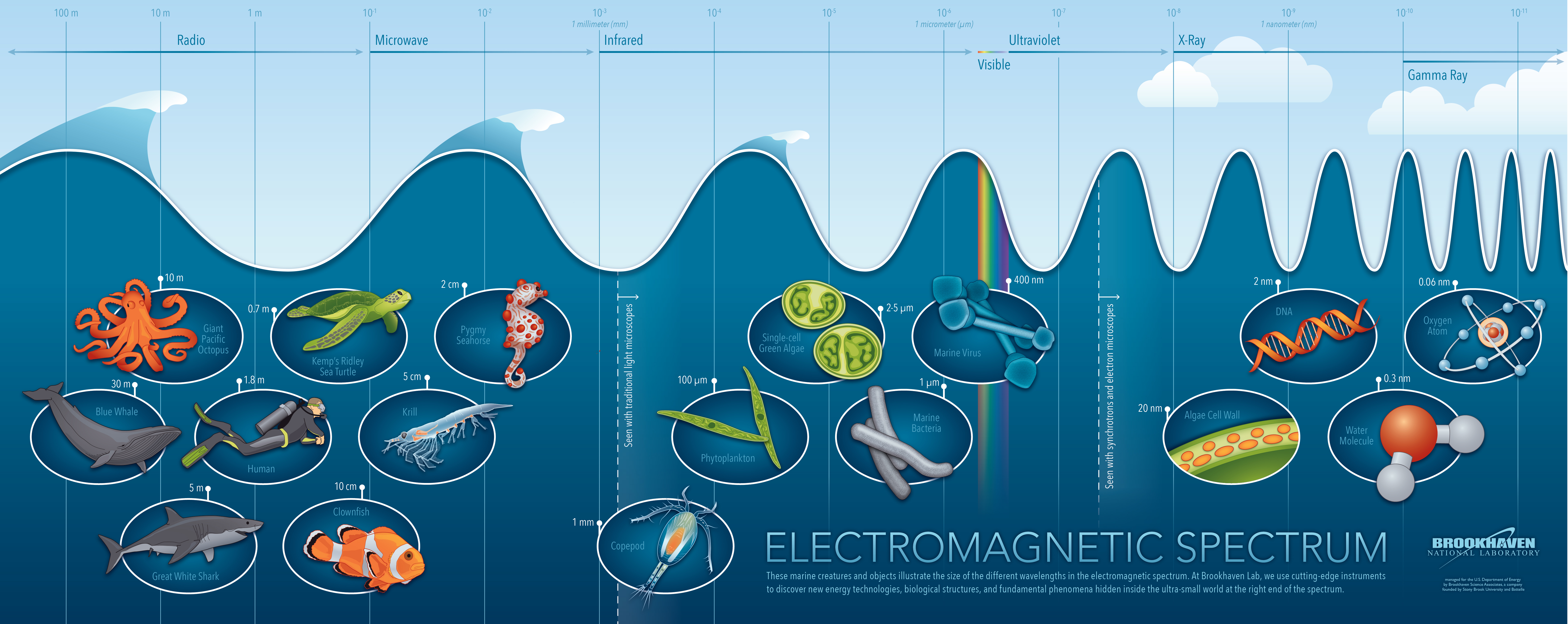
Unlike mechanical waves, electromagnetic waves do not require a medium to travel. They consist of oscillating electric and magnetic fields that are perpendicular to each other, and their propagation speed in a vacuum is the speed of light. This group includes radio waves, microwaves, infrared, visible light, ultraviolet, X-rays, and gamma rays.
Matter Waves
Matter waves describe the wave-like behavior of particles. Notably, electrons exhibit matter wave characteristics, and this duality was highlighted in quantum mechanics as part of the wave-particle duality principle.
Parts of a Wave
Every wave can be characterized by several distinct parts:
Crest
The crest is the highest point of the wave, representing the maximum upward displacement from the equilibrium position.
Trough
Conversely, the trough is the lowest point of the wave, indicating the maximum downward displacement.
Wavelength (\( \lambda \))
The wavelength is defined as the distance between two consecutive points in phase, typically measured from crest to crest or trough to trough.
Amplitude (A)
Amplitude represents the maximum displacement from the wave’s equilibrium position and is an indicator of the energy carried by the wave.
Frequency (f)
Frequency is the number of wave cycles that pass through a given point per unit time. It is measured in hertz (Hz), where 1 Hz equals one cycle per second.
Period (T)
The period is the time taken for one complete cycle of the wave. It is the reciprocal of the frequency (\(T = \frac{1}{f}\)).
Wave Speed (v)
Wave speed defines how fast the wave propagates and is directly related to both the frequency and wavelength. The relationship is given by the wave equation.
Basic Wave Equations and Sample Problems
Fundamental Wave Equation
The core relationship governing the behavior of waves is expressed by the equation:
\( v = f \times \lambda \)
Here, \( v \) represents the speed of the wave (in meters per second), \( f \) is the frequency (in hertz), and \( \lambda \) is the wavelength (in meters).
Sample Problem 1: Calculating Frequency
Consider a wave with a wavelength of 10 meters that travels at a speed of 340 m/s. To find the frequency of this wave, we rearrange the equation:
\( f = \frac{v}{\lambda} \)
Substituting the given values:
\( f = \frac{340 \, \text{m/s}}{10 \, \text{m}} = 34 \, \text{Hz} \)
Therefore, the frequency of the wave is 34 Hz.
Sample Problem 2: Calculating Wavelength
Suppose a sound wave travels at 340 m/s and has a frequency of 170 Hz. To find its wavelength, we use:
\( \lambda = \frac{v}{f} \)
Substituting:
\( \lambda = \frac{340 \, \text{m/s}}{170 \, \text{Hz}} = 2 \, \text{m} \)
Hence, the wavelength is 2 meters.
Derivation of the Wave Equation
For one-dimensional waves, the wave equation can also be expressed as a partial differential equation:
\( \frac{\partial^2 y}{\partial t^2} = v^2 \frac{\partial^2 y}{\partial x^2} \)
In this equation, \( y(x,t) \) represents the displacement at position \( x \) and time \( t \). This form is key in understanding the propagation and behavior of waves in various mediums.
The Nature of Light
Light is a fascinating phenomenon because it exhibits properties of both waves and particles—a concept known as wave-particle duality. As an electromagnetic wave, light consists of oscillating electric and magnetic fields that oscillate perpendicular to each other and to the direction of propagation.
Speed of Light
The speed of light in a vacuum, denoted by \( c \), is one of the most important constants in physics. It is exactly:
\( c = 299,792,458 \, \text{m/s} \)
This constant speed is a cornerstone of many theories in physics, including Einstein’s theory of relativity. When light travels through mediums like water or glass, it slows down depending on the medium’s refractive index.
Properties of Light
Light exhibits several distinct properties, which include:
Wave-Particle Duality
As demonstrated by experiments such as the double-slit experiment, light behaves both like a wave and like a particle (photon). This duality is central to quantum mechanics.
Rectilinear Propagation
In a homogeneous medium, light travels in straight lines. This property leads to practical applications like the formation of sharp shadows.
Reflection and Refraction
When light encounters a surface, some of it may bounce back (reflection). When it enters a different medium, its path bends due to refraction, which is governed by Snell’s Law.
Diffraction and Interference
Light waves spread out when they pass near obstacles (diffraction), and they can interact with each other to create patterns of constructive and destructive interference.
Dispersion and Polarization
Dispersion occurs when white light separates into its component colors upon passing through a prism. Polarization, on the other hand, involves the orientation of the light waves, which has numerous applications in optical technologies.
How We See Colors
The process of color perception in humans is complex and involves the interplay between light and the eye’s photoreceptors. When light strikes an object, certain wavelengths are absorbed while others are reflected back. The reflected wavelengths enter our eyes and strike the retina, which contains specialized cells called cone cells.
There are three types of cone cells, each sensitive to different ranges of wavelengths corresponding approximately to red, green, and blue. The brain processes the signals from these cones and interprets them as a spectrum of colors. This phenomenon explains why objects appear as distinct colors based on the wavelengths they reflect.
The Visible Spectrum
The visible spectrum ranges roughly from 400 nanometers (violet) to 700 nanometers (red). Each color within this range corresponds to a specific wavelength:
| Color | Wavelength Range (nm) | Description |
|---|---|---|
| Violet | 400–450 | Highest frequency, shortest wavelength |
| Blue | 450–495 | Cool, calming color with medium frequency |
| Green | 495–570 | Perceived by human eyes as dominant in nature |
| Yellow | 570–590 | Bright color, often associated with sunlight |
| Orange | 590–620 | Warm color produced by intermediate wavelengths |
| Red | 620–700 | Lowest frequency, longest wavelength among visible colors |
The interplay of these wavelengths and our brain’s interpretation allows for the rich and varied world of color we experience daily.
Further Illustrations and Practical Applications
Wave Behavior in Technology and Nature
Waves and light are not just theoretical constructs but have extensive real-life applications. For instance, understanding sound waves has led to innovations in acoustics, while the properties of light have revolutionized imaging technology, fiber-optic communications, and quantum computing.
In the realm of natural phenomena, seismic waves help us understand the inner structure of the Earth, while ocean waves are vital for understanding coastal dynamics and renewable energy sources.
Mathematical Modeling and Simulation
Mathematical equations governing wave phenomena, as discussed earlier, are used to simulate and predict the behavior of waves in various environments. These models are crucial in engineering disciplines, such as designing noise-canceling systems and improving wireless communication networks.
The wave equation in partial differential form encompasses a wide variety of phenomena and has solutions that are utilized in fields ranging from meteorology to quantum mechanics.
References
- Wave - Types of Waves, Properties of Waves & Application of Waves - BYJU'S
- Categories of Waves - The Physics Classroom
- Speed of Light - Britannica
- What is Color and How Do We See Color - Hunter Lab
- Speed of Light: Reality's Speed Limit Explained - Astronomy
Recommended Further Queries
 musicalsoundwaves.wordpress.com
 mrsimnett.files.wordpress.com

Last updated March 19, 2025